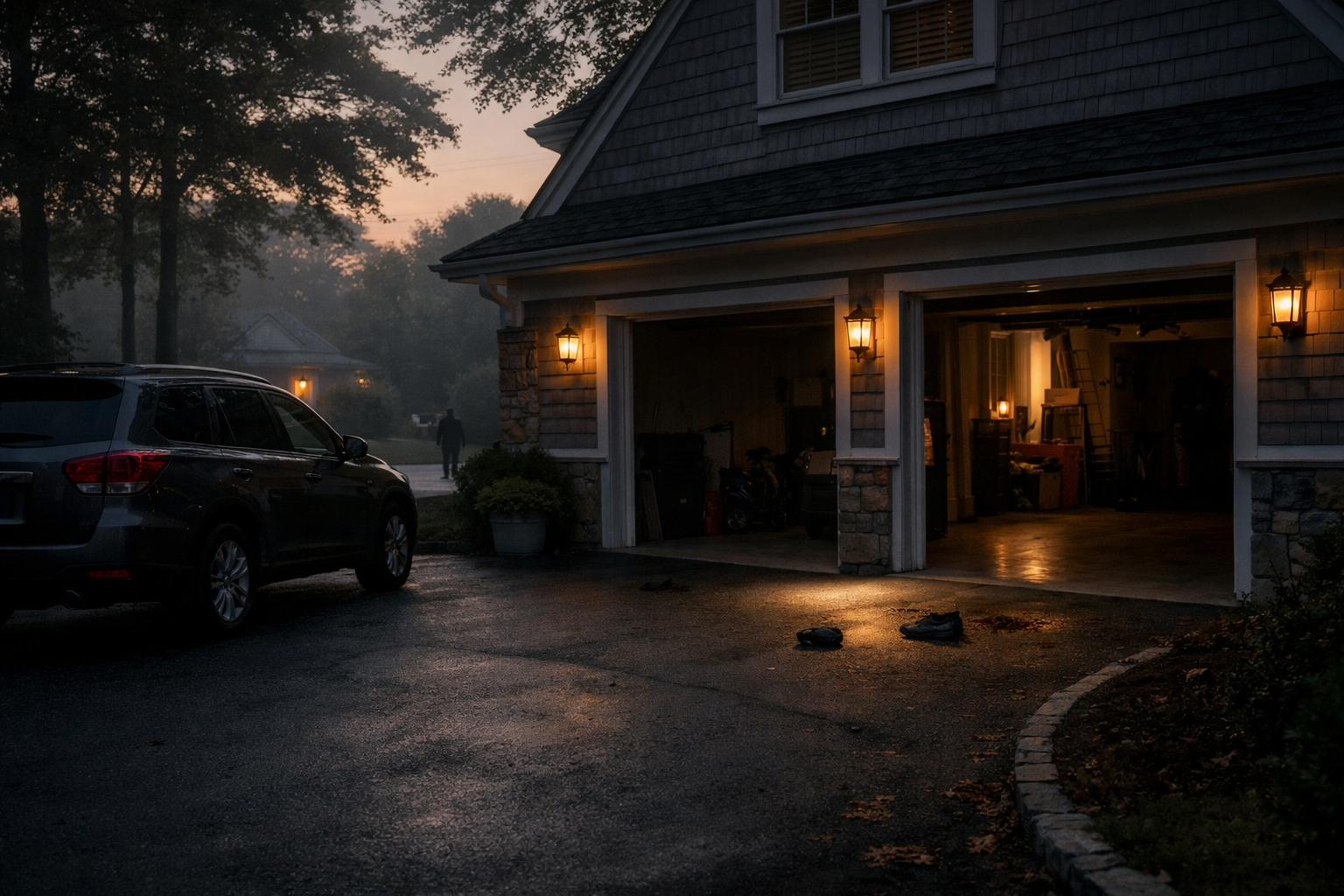
At 8:05 on a spring morning in New Canaan, Connecticut, Jennifer Dulos’s Chevrolet Suburban rolled into the driveway of a home on Welles Lane. It should have been one of the most forgettable moments in the world: a mother returning after school drop-off, a quiet street, a big house sitting still behind its trees. But by the end of that day, Jennifer was gone, her blood would be found inside the garage, and investigators would start following a trail that seemed to grow darker with every stop.
What made the case feel so unsettling from the start was how ordinary it looked at first. There was no dramatic public scene, no broken window facing the street, no witness describing a scream. There was just a missing woman, an empty vehicle, and then — as police pulled on each thread — a string of trash bags moving through Hartford like pieces of a story someone had tried to throw away.
Jennifer Dulos and the unsolved disappearance that turned a quiet morning into a national mystery
Jennifer Dulos is at the center of one of the most discussed missing person cases in recent memory because her unsolved disappearance combined a bitter divorce, surveillance footage, blood evidence, and a body that has never been found. The case still matters because it sits in that disturbing space between what investigators say clearly happened and the one final answer they still cannot give: where Jennifer is.
That tension is part of why readers keep returning to cases like Susan Powell’s disappearance, where an ordinary family routine gave way to a much darker truth hidden behind missing time and missing evidence.
By May 24, 2019, Jennifer was 50 years old and living through the kind of private collapse that rarely stays private for long. She and her estranged husband, Fotis Dulos, were in the middle of a deeply contentious divorce and custody fight over their five children. Court records and later reporting painted a picture of a marriage that had broken down into accusation, fear, control, and legal warfare. But on the surface, that Friday morning still began like a hundred other mornings before it.
Jennifer drove her children to school. Security footage later helped establish pieces of her route and timing. After the drop-off, she headed home. Her Suburban was eventually found parked at Waveny Park, a place that immediately added another layer of confusion. It looked, at first glance, like the kind of location that might suggest a voluntary disappearance, a walk, a meeting, a sudden change of plans. But the more investigators looked at the case, the less believable that idea became.
Inside Jennifer’s home, authorities found evidence of a violent attack. Prosecutors later said there was blood spatter in the garage and signs that someone had tried to clean the scene. That detail changed the emotional temperature of the case instantly. This was no longer just a question of where Jennifer went. It was a reconstruction problem: what happened in that small slice of time after she returned home, and how did the people involved think they could erase it?
The most haunting thing about Jennifer Dulos’s disappearance is the contrast at its center. The day begins with school drop-off, a suburban routine, and a quiet return home. Then the trail suddenly bends toward cleanup materials, altered license plates, suspicious vehicle movement, and trash bags stuffed with items investigators believed were tied to a violent crime. The shift is so brutal it feels almost cinematic — except it was real, and Jennifer never came back.
Timeline of Events
- Morning of May 24, 2019: Jennifer Dulos drops off her five children at school and returns toward her home in New Canaan.
- Later that day: Concern grows when she cannot be reached and does not show up for expected plans.
- Vehicle found: Her Chevrolet Suburban is located at Waveny Park.
- Search of the home: Investigators find blood evidence in the garage and signs of cleanup.
- Surveillance review: Cameras capture Fotis Dulos and Michelle Troconis in Hartford allegedly disposing of multiple trash bags.
- Evidence recovered: Authorities later say some of those discarded items contained Jennifer’s blood or were linked to efforts to destroy evidence.
- January 2020: Fotis Dulos dies by suicide after being charged in connection with Jennifer’s disappearance and presumed death.
- Aftermath: Jennifer’s body is never found, leaving the case legally powerful but emotionally unfinished.
One reason this case kept tightening around its main suspects was technology. Cameras do not feel dramatic when you pass them. Most people forget they are there. But in this case, surveillance became one of the story’s most unforgettable elements. Investigators said footage showed Fotis Dulos and Michelle Troconis in Hartford, stopping repeatedly as they moved through the city and throwing away trash bags. It was not one careless moment. It was a pattern.
And that pattern mattered because the bags were not empty gestures. According to prosecutors, some of the items recovered were tied directly to Jennifer. That is what gave the trash-run sequence its power in the public mind. It was not just suspicious behavior. It looked like a moving evidence trail — one that suggested the real story of Jennifer’s disappearance was not happening in a park or on an open road, but in the desperate hours after violence had already taken place.
The Hartford footage became the visual spine of the case the way the abandoned car image defines the disappearance of Crystal Rogers or the final-route uncertainty keeps other disappearance cases alive in readers’ minds. In Jennifer’s case, the image that sticks is not a single photograph. It is movement: stops, bags, bins, and the terrible feeling that each stop meant another piece of Jennifer’s last known reality was being hidden.
Authorities eventually alleged that Fotis Dulos killed Jennifer and then worked to cover it up. He denied responsibility. Before he could stand trial on a murder charge, he died by suicide in January 2020. That left the public with a case that felt both advanced and incomplete. Prosecutors had laid out a theory supported by forensic evidence, digital evidence, witness statements, and surveillance. Yet the central human need in a disappearance case — the recovery of the missing person — was still unmet.
That missing final step matters more than people sometimes realize. When a body is never found, the case keeps resisting emotional closure. The facts may point hard in one direction. The courts may convict accomplices on conspiracy and evidence-related charges. Families may know, in their bones, what happened. But the disappearance never fully stops being a disappearance. There is always one locked door left in the story.
What Doesn’t Add Up
- The parked SUV at Waveny Park: It looked staged to investigators, especially once blood evidence inside the home became public.
- The cleanup effort: Prosecutors said there were signs the garage scene had been cleaned, raising the question of how quickly the cover-up began.
- The trash-bag route: The repeated disposal stops in Hartford suggested planning, urgency, and fear of what specific items might reveal.
- No recovery of Jennifer’s body: Even with major evidence, the most important physical answer is still missing.
- The gap between theory and total closure: Many people believe they know what happened. The case still feels open because the final location has never been proved.
That is also why the case continues to attract attention years later. It is not just that Jennifer vanished. It is that so much of the story appears visible, almost touchable, while the last and most important piece remains out of reach. This is the opposite of a mystery built on no clues. Jennifer Dulos’s case is a mystery built on too many grim clues pointing toward an ending the public still cannot fully see.
There is another layer that keeps the story alive: the domestic setting. Some cases feel distant because they unfold in remote forests, on highways, or at sea. Jennifer’s disappearance happened against a backdrop many readers instantly recognize — school schedules, court stress, suburban neighborhoods, custody exchanges, normal errands. That familiarity makes the violence feel closer. It suggests that the rupture did not arrive out of nowhere. It arrived inside a life that looked organized from the outside and fractured underneath.
Jennifer was also not someone who appeared poised to walk away from her children, her legal fight, or her daily responsibilities. That is one reason the voluntary-disappearance idea lost force so quickly. The known facts pulled in the other direction. Investigators, prosecutors, and most observers came to see the Waveny Park vehicle not as the beginning of a mystery but as a planted misdirection — the kind of detail designed to delay the truth for just a little while.
And yet, even with that understanding, the emotional center of the case remains Jennifer herself. It is easy for major cases to turn into evidence boards and courtroom summaries. But before all of that, Jennifer Dulos was a mother whose children lost her in a single morning. The spectacle of the evidence trail can sometimes overshadow that fact. It should not.
Her disappearance also opened a larger conversation about coercion, fear, and the warning signs that can exist long before a case becomes national news. In that sense, the story belongs not only to crime coverage but to the wider pattern seen in cases where family conflict escalates behind closed doors until one day the outside world sees the damage all at once.
The most likely explanation, based on the evidence made public by investigators and later court proceedings, is that Jennifer was attacked after returning home and that her body was moved and hidden before authorities could find it. That theory explains the blood evidence, the cleanup, the vehicle staging, and the Hartford disposal route better than any innocent explanation ever has. But the reason the case still aches is simple: likely is not the same as complete.
Why This Case Still Gets Attention
- The body has never been found, which keeps the story emotionally unresolved.
- The evidence trail was unusually visible, especially the surveillance footage and discarded items.
- The case involved a high-conflict divorce, a detail that made the background story feel chillingly real.
- Fotis Dulos died before trial, denying the public a full courtroom reckoning on the murder charge.
- The contrast is unforgettable: a calm suburban morning on one side, a grim citywide disposal route on the other.
In the end, Jennifer Dulos remains part of that hardest category of missing person case: the one where the shape of the truth is visible, but the final physical answer is not. Investigators built a powerful picture. The courts addressed part of the alleged cover-up. The public can trace the morning, the blood, the vehicle, the stops, the bags. But Jennifer herself has never been brought home.
And that may be why this story keeps holding people. It does not feel like a disappearance swallowed by fog. It feels like a disappearance that left marks everywhere — in a garage, on surveillance cameras, in court filings, in the lives of five children — and still withheld the one thing everyone wanted most. Not a theory. Not another piece of footage. Just Jennifer.