By the time the little girl ran back across the street, the house had gone wrong.
Her mother was supposed to be inside. Her baby brother was upstairs. It was an ordinary suburban afternoon in Lincoln, Massachusetts — the kind where nothing dramatic is supposed to happen at all. But when four-year-old Lillian Risch stepped into the kitchen on October 24, 1961, she saw red smeared across the room and did the only thing a child could do. She turned around, ran to the neighbors, and said her mother was gone.
What her neighbors found next would turn a quiet New England home into one of the most haunting unsolved disappearance scenes in American true crime: blood on the kitchen walls, blood on the floor, a phone ripped from the wall, and no Joan Risch anywhere.
Joan Risch’s unsolved disappearance still haunts true crime for one reason above all
Joan Risch was a 31-year-old wife and mother whose unsolved disappearance from her Lincoln, Massachusetts home left behind a scene that looked, at first glance, like obvious violence. But this missing person case still matters because the evidence never settled into one clear story — and because every theory, from abduction to voluntary disappearance, seems to explain one part of the case while breaking another.
That tension is what keeps Joan Risch in the conversation today. Cases like Dorothy Jane Scott’s disappearance keep resurfacing for the same reason: the visible clues feel dramatic, but the final answer never arrives.
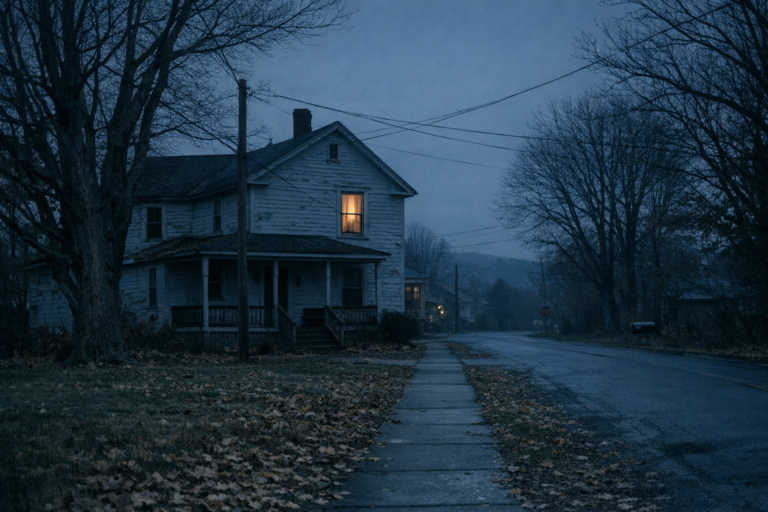
On paper, Joan Risch had the shape of a stable life. She was educated, articulate, and by most accounts deeply devoted to her two children. She had worked in publishing before marriage, then moved with her husband Martin from Connecticut to Lincoln earlier in 1961. Their new home on Old Bedford Road sat in the kind of neighborhood where people noticed milk deliveries, remembered parked cars, and let children move between houses without much worry.
That Tuesday began with nothing that should have ended in mystery. Martin left early for a business trip to New York. Joan took her daughter to the dentist, made a few errands, came home around late morning, and settled back into routine. Lunch for the children. Nap time for her two-year-old son. A playdate for Lillian. Normal pieces. Clean edges.
Then, sometime after lunch, the edges disappeared.
At about 1 p.m., a neighbor’s son came over to play with Lillian. Joan moved in and out of the yard, pruning plants and putting tools away in the garage. Nothing about her behavior struck anyone as panicked or frantic. Just before 2 p.m., she brought the children back across the street to the Barkers’ house and told them she would be back. It was such a small, forgettable moment that nobody could have guessed it would become one of the last confirmed steps in the timeline.
Around 2:15 p.m., neighbor Barbara Barker caught a glimpse of Joan again. Joan appeared to be moving quickly up the driveway, holding something red in front of her. Barker thought she might be chasing one of the kids. Later, that ordinary explanation would collapse under the weight of what was found inside the house.
By 4:15 p.m., the kitchen looked like a place where something violent had either just happened — or had been made to look like it had.
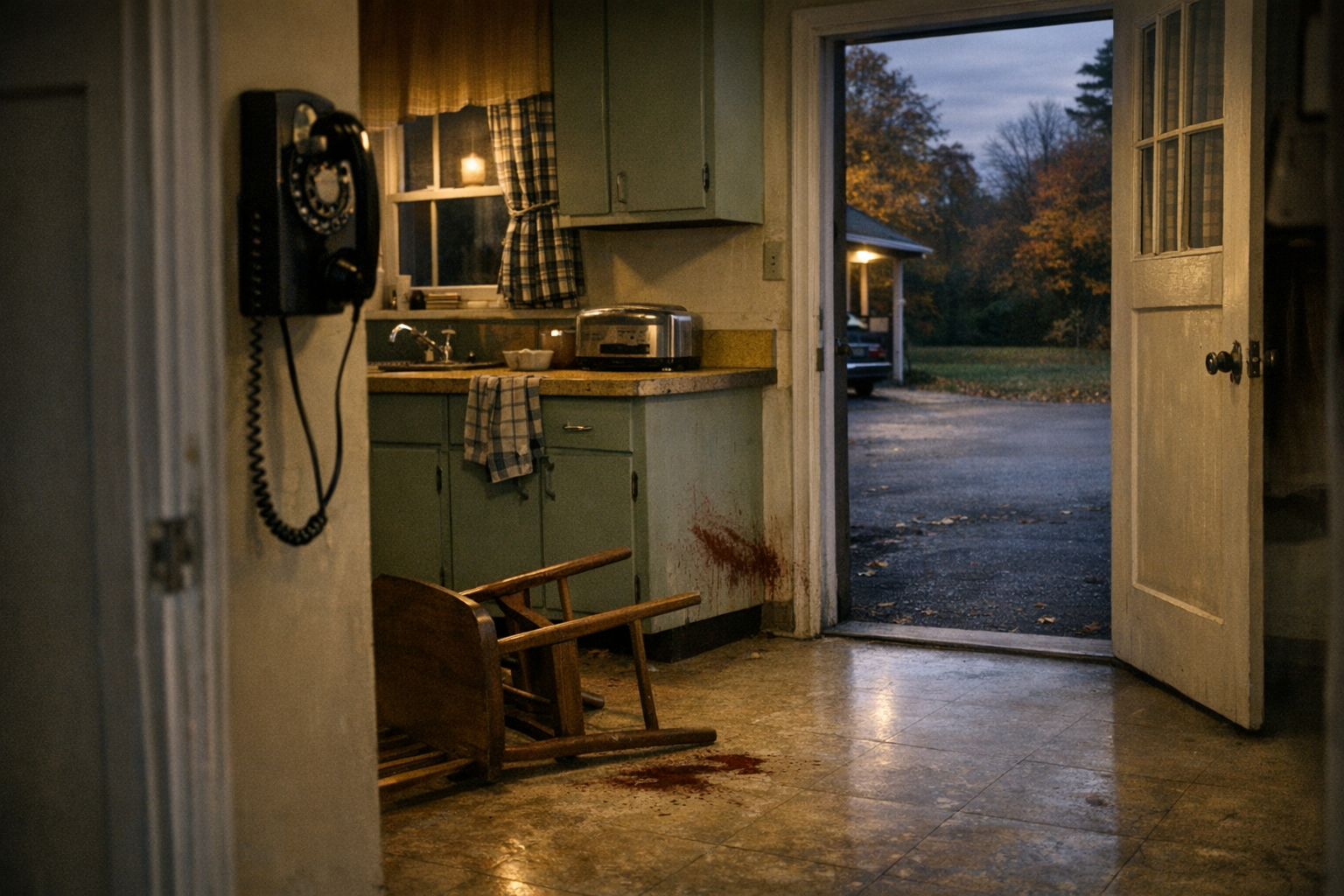
Police found blood smears on the walls and floor. The phone had been torn from its wall mount and thrown into a wastebasket that had been dragged into the middle of the room. A chair was overturned. Paper towels and children’s clothing appeared to have been used in an attempted cleanup. Blood led through the house and outside toward the driveway, where it seemed to stop. Joan’s young son was still upstairs in his crib, alive and crying. Joan herself was gone.
This is the detail that makes the case so hard to settle: the scene looked dramatic, but not necessarily straightforward. Investigators estimated there was roughly a pint of blood in and around the house — disturbing, yes, but not always fatal. And some of the stains did not look like the result of a single explosive attack. They looked more like a wounded person had moved around the room, touched walls, tried to steady herself, maybe even tried to clean something up.
That is where the case splits in two.
One version says Joan Risch was attacked in her own home. The ripped phone, the blood, the unidentified prints, and the reports of a strange car in the driveway all point that way. If that version is true, the scene is the beginning of an abduction story — one that happened fast enough to remove Joan, leave the children behind, and vanish before anyone nearby realized what was unfolding.
The other version says the scene only looked like an abduction. In that version, Joan was injured somehow, disoriented, and left on her own. Or she staged parts of the scene and walked away intentionally. It sounds far-fetched at first, until you get to the witness sightings.
Timeline of Events
- Morning, October 24, 1961: Martin Risch leaves for New York on business.
- Morning to late morning: Joan takes her daughter to the dentist, cashes a check, shops, and returns home.
- Around midday: Joan feeds the children lunch and puts her son down for a nap.
- About 1:00 p.m.: Neighbor child comes over to play with Lillian.
- Just before 2:00 p.m.: Joan takes the children across the street to the Barkers’ house and says she will be back.
- Around 2:15 p.m.: Joan is reportedly seen moving quickly near her driveway, carrying something red.
- Roughly 2:45 to 4:30 p.m.: Multiple drivers report a disoriented woman matching Joan’s description walking near Route 2A and Route 128, with blood on her legs or clothing.
- About 3:20 p.m.: An unfamiliar blue-gray sedan is reportedly seen near the Risch driveway.
- 4:15 p.m.: Lillian returns home and tells neighbors that her mother is gone and the kitchen is covered in “red paint.”
- 4:33 p.m.: Police are called.
Those roadside sightings are the reason the case refuses to become a simple home-abduction mystery. More than one person reported seeing a woman who looked like Joan walking along nearby roads later that afternoon. One witness said the woman seemed dazed. Another said blood was running down the backs of her legs. Another said she was holding something against her abdomen. No one stopped her. No one brought her to safety. And because the sightings were never conclusively confirmed, they remain suspended in that awful category of evidence that feels important but cannot be locked down.
If the woman was Joan, then she survived whatever happened in the house — at least for a while. If the woman was not Joan, then the most unsettling visual in the entire case may have led everyone in the wrong direction.
What Doesn’t Add Up
- The scene suggests violence, but not a clear ending. There was blood, but not enough to prove death inside the home.
- The phone was ripped from the wall, yet no confirmed struggle explains the entire room.
- Unidentified fingerprints and a partial palm print were found, but they never closed the case.
- The blood trail moved outward, not inward. That leaves open the possibility that Joan left the house alive.
- The witness sightings point away from a clean abduction narrative. A kidnapped victim is one explanation; a wounded or disoriented Joan walking off is another.
- Her later reading habits complicated the story. Investigators learned she had borrowed books about disappearances and unsolved crimes, which fueled staged-disappearance theories without proving them.
That final point is one of the most overused details in the Joan Risch case — and one of the easiest to mishandle. Yes, investigators discovered that she had checked out books related to disappearances, murder, and mysteries. And yes, that gave people a dramatic theory: Joan, an intelligent woman with a background in publishing, had studied these stories and built one of her own.
It’s a gripping theory. It is also dangerously neat.
Because a staged disappearance still has to answer the blood.
It has to answer why a mother would leave two small children behind in the middle of the day. It has to answer the apparent distress inside the kitchen. It has to answer why, if she planned an escape, the result looked so chaotic and uncontrolled. People do leave their lives voluntarily. That happens. But the Joan Risch case does not read like a careful exit. It reads like interruption.
And yet the abduction theory is not clean either.
If someone came for Joan, why leave such an uncertain scene? Why not remove the evidence more effectively? Why risk doing it in daylight in a neighborhood where children moved between homes and neighbors watched driveways? Why do the sightings, if genuine, seem to show a woman traveling on foot and injured rather than a victim immediately forced into a vehicle?
There is also the theory that Joan suffered some kind of medical event or accidental injury, became confused, and walked away. Some have even suggested she could have wandered into a nearby construction area around Route 128 and died there unnoticed. That idea explains the wandering woman reports better than the others do. But it still leaves the phone, the blood, the disturbed kitchen, and the unknown prints hanging there like loose wires.
The real reason this case keeps resurfacing in podcasts and cold-case discussions is not just that the scene was visual. It is that the scene seems to argue with itself.
Every major clue points in a different direction.
The blood says violence.
The roadside woman says survival.
The library books suggest planning.
The children left behind suggest rupture, not escape.
The unidentified car suggests intrusion.
And the fact that Joan Risch was never found means none of those clues ever had to answer to a body, a confession, or a final proven route.
That is what makes this case feel so modern even though it happened in 1961. It behaves like the kind of mystery people now obsess over online: a scene with strong visuals, missing certainty, and just enough evidence for rival camps to build totally different stories.
Maybe Joan Risch was attacked in her home and managed to leave the house wounded before being taken or collapsing somewhere beyond the search area.
Maybe she walked away under pressure no one around her fully understood, and the scene that shocked investigators was part injury, part panic, part attempted cleanup, and part disappearance.
Maybe the truth is worse than either theory — something messy, accidental, and human that left behind evidence too fragmented to tell the story cleanly.
But what keeps this case alive is not only the mystery of where Joan went. It is the harder question underneath it: what was that kitchen actually trying to say?
For more than six decades, nobody has been able to answer that without running into another piece of the case that pushes back.
So the Joan Risch disappearance remains exactly where the strongest unsolved cases always remain — in that narrow space between a scene that looks obvious and a truth that never arrives.