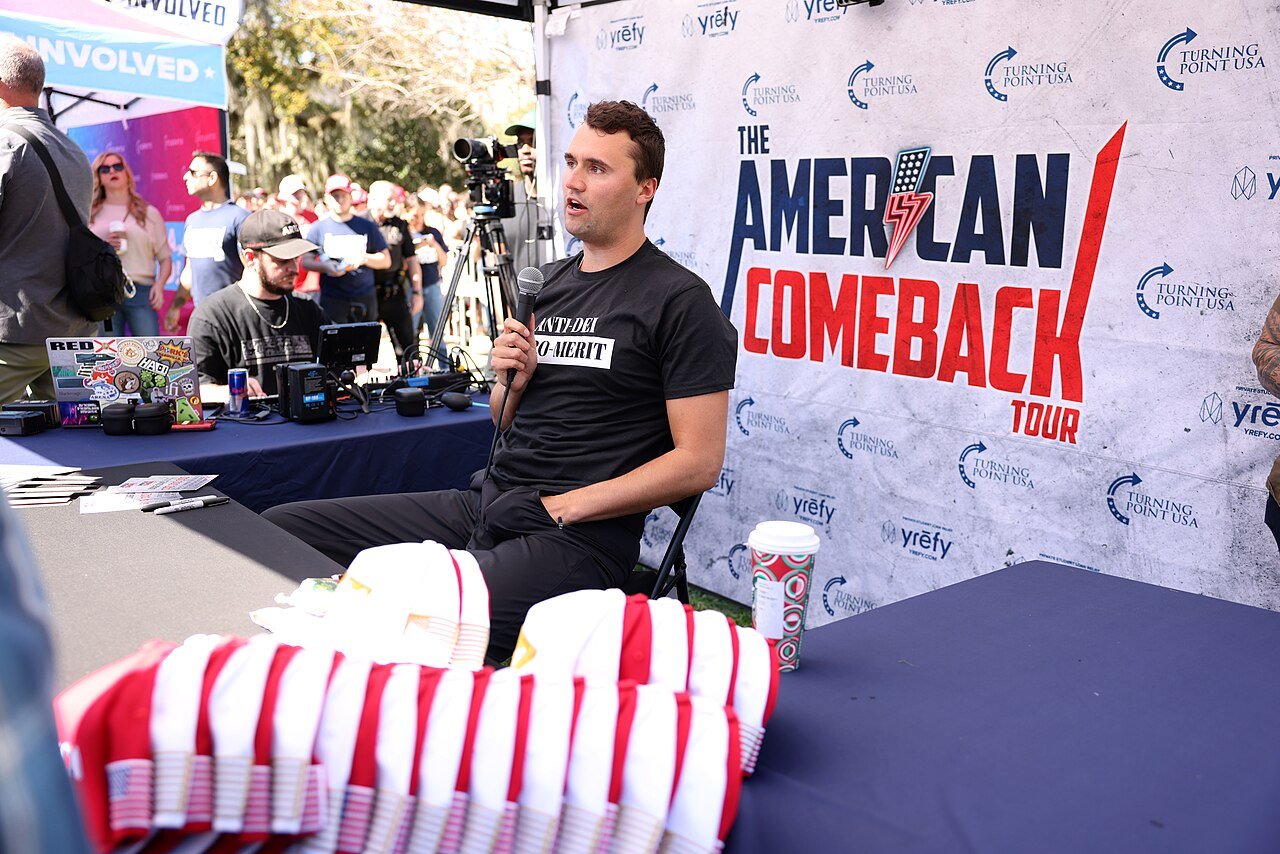
Charlie Kirk speaking in Tallahassee, Florida, in February 2025. Photo: Gage Skidmore. CC BY-SA 2.0.
Case Timeline & Updates
Awaiting first trialLatest development Oct 23, 2026 · Last checked Nov 2, 2026
The judge deferred the trial-scheduling decision until November 9 after hearing competing arguments about preparation time.
- October 23, 2026 — Judge Tony Graf heard arguments over when the case could be ready for trial and deferred his scheduling decision until November 9. (KUER: October 23 hearing)
- September 1, 2026 — Graf found probable cause for all seven counts and ordered Robinson to stand trial. The defense entered a not-guilty plea on his behalf. (KUER: September 1 ruling and plea)
- September 10, 2025 — Kirk was fatally shot at Utah Valley University. The killing is the event underlying the pending prosecution. (KUER: October 23 hearing)
Entries distinguish event dates, report dates and routine source checks. Earlier milestones remain available as the case develops. Scheduled hearings are not reported as completed events.
Charlie Kirk had come to Utah Valley University for a public event. On September 10, 2025, he was fatally shot there. A gathering organized around a speaker and an audience became the starting point of a murder prosecution that, more than a year later, still had no trial date.
The case against Tyler Robinson has moved from the immediate aftermath of the killing into a much slower contest over evidence, charges and preparation. That change of pace can make the original event disappear beneath courtroom headlines. The central question remains the same: can prosecutors prove that Robinson killed Kirk?
What the preliminary hearing revealed
At the preliminary stage, prosecutors described a shot fired from a nearby rooftop toward Kirk at the event. One dispute concerned the danger to the people around him. The prosecution argued that firing toward a crowd supported the aggravated-murder charge. The defense emphasized that there had been one shot and that Kirk was the only person hit.
Those arguments mattered because the charge could carry the death penalty. They were also a reminder that a court must examine the specific evidence and legal requirements, even when the underlying killing is already widely known.
On September 1, 2026, Judge Tony Graf found sufficient probable cause for all seven counts to proceed. Robinson’s lawyers entered a not-guilty plea on his behalf. The decision sent the case toward trial; it did not resolve the contested account.
A trial still waiting for a date
By October, attention had turned to how soon that trial could happen. At an October 23 hearing, Graf heard competing arguments about preparation time. He deferred the scheduling decision until November 9.
A scheduling dispute may look minor beside the violence that began the case. Yet it determines when witnesses can be heard, when the evidence can be challenged before a jury, and when a prosecution stops being a series of preliminary hearings and becomes a trial.
For now, Kirk’s killing has produced charges, a preliminary ruling and a denial of guilt. It has not produced a verdict. Our next update will record what the judge actually orders, then follow the evidence rulings and proceedings that bring the case closer to a decision. The timeline below separates those completed steps from dates that are still ahead.