The house should have felt safer than the street outside.
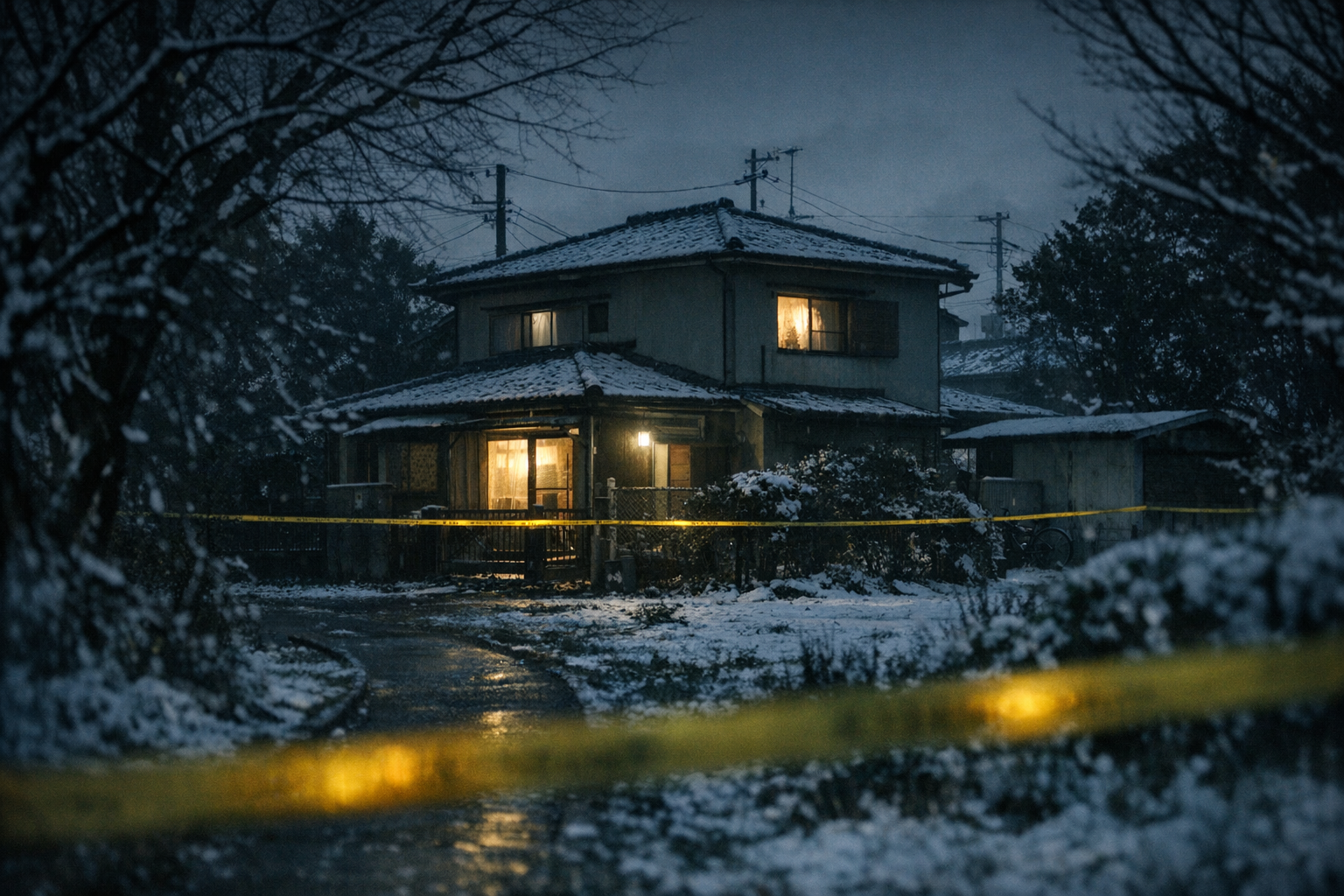
It was the last night of the year in a quiet Setagaya neighborhood, the kind of Tokyo suburb where a family could eat dinner, let a child watch television next door, and expect the dark to stay ordinary. Instead, sometime before midnight, someone came in through the rear of the Miyazawa home and turned that ordinary house into one of the most disturbing crime scenes in modern Japan.
By morning, four people were dead. And the person who killed them had done something that still feels almost impossible to process: he did not flee in panic. He stayed. He ate. He used the bathroom. He treated his own injuries. He touched the family computer. He left behind blood, clothing, a bag, fingerprints, DNA, and a trail of physical clues so dense it seemed like the case should solve itself.
It never did.
What happened to the Setagaya family?
The Setagaya family murders refer to the 2000 killing of Mikio Miyazawa, Yasuko Miyazawa, and their two children in Tokyo. It remains a missing-person-style vacuum in true crime terms only because the killer’s identity is still absent from one of the most evidence-rich unsolved murder cases on record, and that contradiction is exactly why the case still matters.
If unresolved cases built around physical evidence keep pulling you in, the True Crime archive shows how often a scene can look overwhelming on paper and still refuse to give investigators the one answer that matters.
On December 30, 2000, the Miyazawas moved through what seemed like a normal winter evening. Mikio, 44, and Yasuko, 41, were home with their children, eight-year-old Niina and six-year-old Rei. Yasuko’s mother lived next door. Niina reportedly visited her grandmother that night to watch television, then returned home around 9:30 p.m. Nothing about the routine suggested that the family was moving toward a final hour.
That detail matters because the Setagaya case has always felt like an invasion of ordinary life. This was not a lonely highway, an isolated trail, or a victim vanishing into a dangerous world. This was a family inside their own house, in a dense city, with relatives close enough to walk over the next morning.
Somewhere between late evening and shortly after midnight, an intruder appears to have entered through a second-floor bathroom window at the rear of the house, near the park behind the property. The window screen was found removed. Footprints and the layout suggested someone had climbed up from outside, using the fence and an exterior structure to reach the opening.
Investigators believe the killer went first to the room where young Rei was sleeping. Rei was strangled. That fact gives the whole case its first unbearable turn, because it suggests the attack may have begun in near silence. What happened next likely unfolded fast. Mikio appears to have confronted the intruder and fought back. He was stabbed with a sashimi knife the killer had brought into the house. Part of that blade broke during the attack, reportedly lodging in Mikio’s head. Yasuko and Niina were then attacked as well, with the intruder eventually taking a kitchen knife from the home after the original weapon was damaged.
By the time it was over, four members of the same family were dead inside a home that should have been the one place no stranger could take control so completely.
Timeline of the Setagaya family murders
- Evening of December 30, 2000: The Miyazawa family spends a routine night at home in Setagaya, Tokyo.
- Around 9:30 p.m.: Niina returns from visiting her grandmother next door.
- Around 10:38 p.m.: Mikio’s computer activity records one of the last known normal moments in the house.
- Late night, roughly 11:30 p.m. to shortly after midnight: Investigators believe the intruder enters through the second-floor bathroom window.
- During the attack: Rei is strangled, Mikio is stabbed after confronting the intruder, and Yasuko and Niina are killed afterward.
- After the murders: The killer remains inside the house for hours, eating, drinking, using the toilet, treating injuries, and leaving behind physical evidence.
- 10:40 a.m., December 31: Yasuko’s mother discovers the bodies.
- Following years: Japanese police collect thousands of pieces of evidence, including DNA, fingerprints, clothing, the murder weapon trail, and signs of the killer’s movements, yet no arrest follows.
That timeline is horrifying on its own. But what turned the Setagaya murders into a case people still cannot let go of is what happened after the killings. Most unsolved home invasion murders leave behind a brutal question mark. This one left behind an entire documentary’s worth of material.
The killer did not rush out into the night as if the risk of getting caught had suddenly become unbearable. Instead, he lingered inside the house for hours. Reports say he ate food from the family’s kitchen, drank barley tea, consumed ice cream, used the toilet without flushing, and used first-aid items to treat injuries he likely suffered during the struggle with Mikio. He also interacted with the family computer after the murders.
That is the intimate terror at the center of this case. The scene was not only violent. It was inhabited afterward. The intruder behaved less like a man escaping and more like someone who believed he still controlled the house even after filling it with death.
And because he stayed, he left behind the kind of evidence detectives dream about in every other case.
What doesn’t add up in the Setagaya case?
- There was too much evidence for the case to stay unsolved. The killer left DNA, fingerprints, clothing, personal items, biological traces, and behavioral clues inside the house.
- He appears to have been injured. That should have created a stronger path to identification, especially over time as forensic systems improved.
- The scene suggested both planning and recklessness. He brought a weapon and entered in a deliberate way, yet stayed behind long enough to expose himself repeatedly.
- Robbery never fully explains the behavior. Some money was reportedly taken, but more remained, which weakens the idea of a simple burglary gone wrong.
- The profile clues pointed everywhere and nowhere. Age estimates, ancestry clues, clothing origin, and the famous sand traces all created leads without producing a person investigators could name.
The house itself became almost a witness. It did not just contain victims. It preserved the intruder’s carelessness in extraordinary detail.
Police found fingerprints and DNA that did not belong to the family. Blood believed to be the killer’s was recovered. Clothing and accessories were left behind, including a hip bag and garments that investigators tried to trace. Fecal evidence in the bathroom reportedly helped build a dietary picture of what he had eaten before the crime. Sand found in the bag became one of the strangest details in the entire case, because later reporting tied it to highly specific locations, including parts of the Mojave Desert region and a Japanese skate park. Shoes connected to the intruder were traced to a South Korean-made Slazenger model. Scent traces, textiles, and manufacturing details all seemed to narrow the field.
Yet the case kept doing the same cruel thing: it generated information without producing identity.
One of the most discussed leads involved ancestry clues from the DNA. Investigators said the killer appeared to be male, with paternal lineage common in East Asia and maternal lineage suggesting European ancestry somewhere in the line. That detail launched years of speculation about whether the suspect was mixed-race, foreign-born, military-connected, or simply being misunderstood through an overconfident public reading of forensic science. Even now, that clue fascinates people because it sounds as if it should narrow the suspect dramatically. In practice, it never closed the gap.
There were other theories too. Maybe it was a burglary that turned catastrophic. Maybe it was personal. Maybe the killer had a grudge. Maybe the family’s location near a park and changing neighborhood dynamics mattered more than people first realized. Maybe the case looked strange because the intruder himself was unstable, injured, young, or acting on motives that do not fit clean categories.
But no theory ever solves the central contradiction: if the killer left this much behind, why is he still faceless?
Key evidence and clues left inside the house
- DNA and blood evidence: The intruder appears to have bled during the attack, giving investigators a direct biological trail.
- Fingerprints: Prints were collected, but none matched known criminal databases in a way that solved the case.
- Clothing and personal items: A bag, garments, gloves, and handkerchiefs were reportedly left behind, allowing tracing efforts by brand and point of sale.
- Computer use: Activity on the family computer after the murders suggested the killer stayed in the home long after the attack.
- Food and bathroom evidence: The intruder ate and used the toilet, leaving behind biological and behavioral details almost unheard of in an unsolved case of this scale.
- Trace material: Sand and other microscopic clues fueled years of theories about travel, lifestyle, and origin.
What makes those clues so haunting is that each one feels like it should have been the one that broke the case open. In other famous unsolved murders, one dropped item or one overlooked print becomes the missing turn decades later. Here, the scene seemed loaded with those turning points from the beginning.
That abundance changed how the public remembers the case. The Setagaya murders are not just remembered as a brutal crime. They are remembered as the case where the killer behaved as if forensic consequences did not exist. He moved through the house slowly enough to leave pieces of himself everywhere, and then still managed to disappear into history.
If that tension feels familiar, it is because cases like the Zodiac Killer investigation create the same obsessive pull: a murderer leaves material, messages, or patterns behind, and the evidence somehow enlarges the mystery instead of closing it.
The sheer scale of the investigation only deepened that effect. Japanese police assigned enormous manpower to the case over the years, gathering thousands of pieces of evidence and running vast comparison efforts. Technological updates brought renewed hope more than once. New reporting periodically revived interest, especially when fresh DNA interpretation, product tracing, or old assumptions came under review. Yet every wave of optimism ended in the same place. The house kept talking. The killer never answered.
There is also something uniquely unsettling about the emotional geometry of the crime. Four people in one home. A grandmother next door. Discovery the next morning. A city dense enough to feel watched, and yet somehow not watched enough. The distance between safety and catastrophe feels almost microscopic here. The Miyazawas did not disappear into a wilderness or get swallowed by a night road. Violence stepped over the threshold and then sat down inside their lives.
That is why the case continues to draw new readers, especially people fascinated by locked-scene murders and evidence-heavy unsolved cases. The fear is not abstract. It is domestic. The clues are not missing. They are excessive. The baffling part is not a lack of information. It is the failure of information to become certainty.
And that is what keeps the Setagaya family murders from settling into the past. Time usually erodes a case by stripping away witnesses, energy, and physical proof. This case resisted erosion in the opposite way. The evidence remained vivid enough that every few years people look at it again and feel the same shock: how can a killer be this present in the record and this absent in real life?
There is no neat ending to give you. No reveal tucked behind the final section. The prevailing explanations still split between burglary gone wrong, personal grievance, and stranger violence that turned unexpectedly prolonged. None fully absorb the strange behavior inside the house after the murders. None make the evidence feel proportionate to the lack of an arrest. None remove the image that has made this case endure for more than two decades: an intruder in a family home, surrounded by proof of his own existence, somehow still leaving the scene as a ghost.
That is why this case still haunts true crime readers in Japan and far beyond it. Not because there were no clues. Because there were too many.