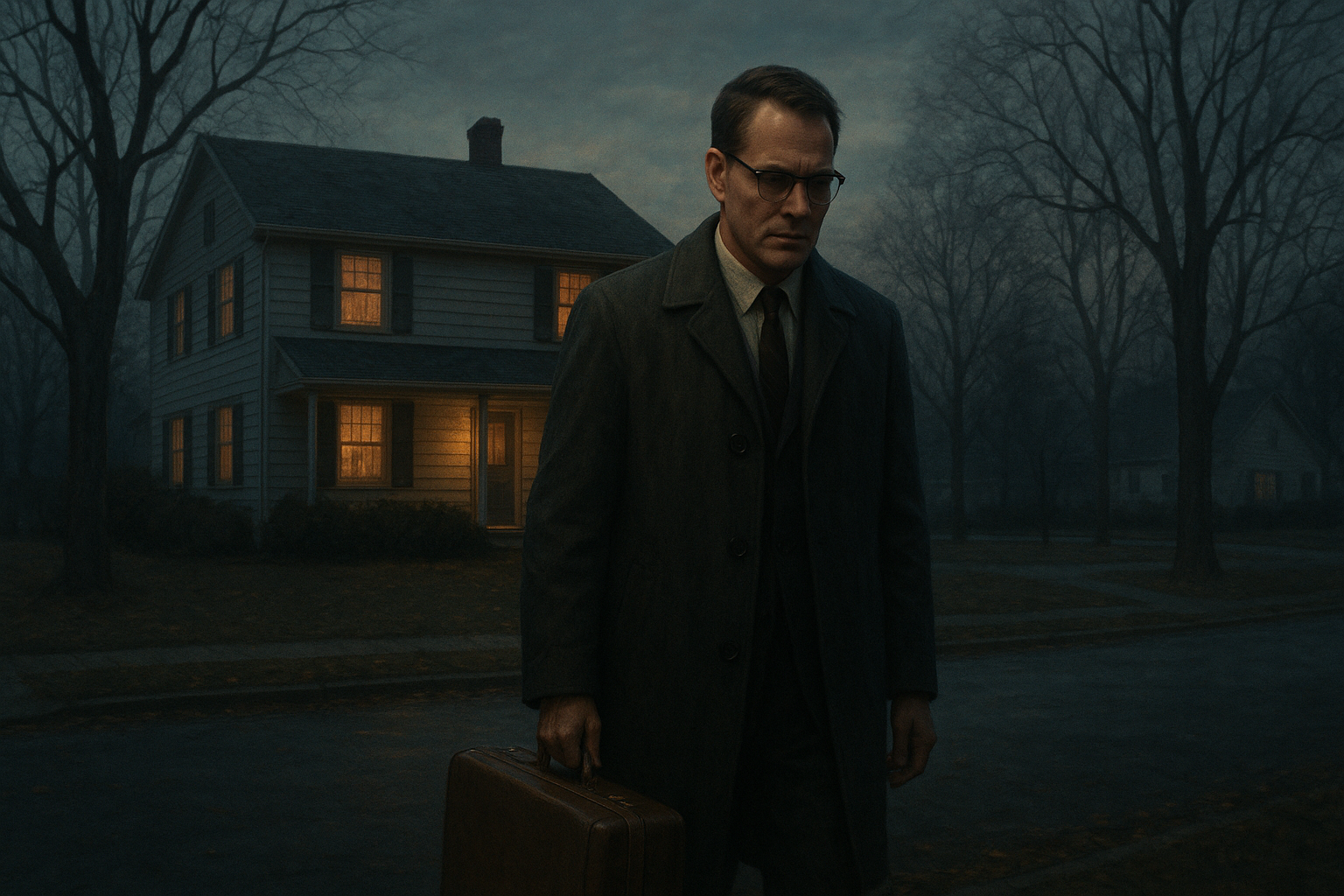
Illustrative cover artwork, not an authenticated portrait of John List or a documentary photograph of the events.
Listen to the John List Story
Audio and video update note: The recordings predate this research update and may retain earlier wording. Refer to the corrected written account and Research Sources for the updated information.
For weeks after the killings, John List’s family remained undiscovered in their Westfield, New Jersey home. The delay is part of what makes the case so disturbing.
That is what makes this case so hard to forget. John List did not explode into violence and then vanish into chaos. He moved with terrifying patience. He planned. He cleaned. He wrote letters. He lowered suspicion. And when the truth was finally discovered, he was already gone.
The John List case remains one of the most chilling family murder stories in American true crime because it combines two nightmares at once: the slaughter inside the home, and the long, ordinary-looking life the killer built afterward. Nearly eighteen years passed before the manhunt finally ended, and even now the story still feels unreal because so much of it happened in stillness rather than panic.
If this kind of case pulls you in, the broader pattern becomes even more disturbing in these family murder cases where ordinary homes became crime scenes, where the familiar setting is part of what makes the violence so difficult to process.
By 1971, List was unemployed after losing a bank position and later jobs. In his account to ABC News, he described financial trouble and his fear of failing as a provider. Those were his explanations; they do not justify the murders.
The large home, known as Breeze Knoll, remains central to the story’s imagery. Its apparent security makes the betrayal inside it harder to process.
On November 9, 1971, he turned that private collapse into something final.
According to List’s later recorded account, he killed his wife and mother first, then his three children as they returned home. His account describes cleaning and concealment between the killings. The victims were Helen, Alma, Patricia, Frederick and John Jr.
And then came the part that turns the case from horrifying to deeply eerie.
List concealed the crime by stopping deliveries and explaining absences to the children’s schools. The delay was deliberate: the bodies were not discovered until weeks later.
It is one thing to imagine violence in a burst of rage. It is another to imagine a man moving through a silent mansion, stopping to think about paperwork, appearances, and timing while his family lies dead in different rooms. That is where the coldness of this case really lives. Not just in the killings themselves, but in the deliberate stillness that followed them.
Timeline of Events
- Months before the murders: John List loses his job and hides it from his family while financial pressure grows.
- November 9, 1971: He kills Helen List, Alma List, Patricia List, Frederick List, and John List Jr. inside the family home in Westfield.
- After the murders: He writes letters, stops deliveries, stages the house for delay, and disappears.
- December 1971: Police finally enter the mansion and discover the bodies after weeks of silence and suspicion.
- 1971–1989: List lives under the name Robert Clark, relocates, works as an accountant, remarries, and blends into church communities.
- May–June 1989: America’s Most Wanted airs his case with a forensic age-progressed bust, leading to recognition and arrest in Virginia.
- 1990: He is convicted of the murders and sentenced to life in prison.
The delayed discovery is one of the most haunting parts of the case. For almost a month, the house remained sealed in silence. Notes had been sent. Deliveries had been stopped. When police entered, the murders had been hidden for weeks.
That delay mattered. It gave John List the head start he needed to become someone else.
He left the family car at an airport as a false lead. Instead, he stayed in the United States and turned himself into the kind of man people overlook. Under the name Robert Clark, he moved through ordinary spaces, found work, attended church, and eventually remarried. There was no outlaw glamour to his fugitive life. No dramatic underworld. No desperate run through motel rooms and aliases changing every few weeks. He survived by being forgettable.
And in that era, forgettable could be enough.
Before digital records instantly cross-checked identities and before faces could flood the country in minutes, a man like List had advantages. He was disciplined. He was conventional. He knew how to disappear into paperwork and routine. The same personality traits that made him seem reliable also helped him hide.
What Doesn’t Add Up
- Mercy was never the real shape of this crime. In a letter left for his pastor, List claimed he was saving his family’s souls. But the planning, concealment, and self-preservation point to control, not sacrifice.
- His own explanations were self-serving. Financial and religious claims do not make the killings an act of mercy.
- He spared himself from the fate he chose for everyone else. That contradiction is hard to ignore. If death was truly the righteous solution, why did he leave himself eighteen more years of life under another name?
- Concealment followed the killings. The effort to delay discovery adds to the crime’s horror.
Those contradictions are why the motive still feels so unsatisfying. List offered explanations, but an explanation is not an excuse, and his version cannot speak for the people he killed.
The break in the manhunt came in 1989. Television gave the old case renewed attention.
America’s Most Wanted featured an age-progressed bust made by forensic sculptor Frank Bender. The likeness helped turn an old manhunt into a recognizable face.
The FBI records that agents arrested List in a Richmond suburb on June 1, 1989, with a television-generated tip helping identify him. The long second life had ended.
Why This Case Still Gets Attention
Some true crime stories stay alive because they are unsolved. This one lingers for a different reason. It was solved, but it never became less disturbing.
The house matters. The delay matters. The confession matters. But what really holds onto people is the image of John List afterward: remarried, attending church, working ordinary jobs while hiding his responsibility for five murders. Cases like the Chris Watts case or the Scott Peterson case still pull readers in for a similar reason: the horror is tangled up with domestic normalcy, and that makes it feel much closer than people want to admit.
The jury rejected his diminished-capacity defense. In 1990, he was convicted of five murders and received five consecutive life sentences. He died in custody in 2008.
Even that legal ending does not erase the larger terror: how ordinary a fugitive life could appear, and how long the concealment lasted.
That is why the John List case still feels like a late-night documentary you cannot shake. It begins with a silent house, moves through a controlled slaughter, and ends with the realization that the killer spent years living among strangers who never knew who he really was. No supernatural twist. Just the fear that someone can destroy everything behind closed doors and then walk back into the world looking almost exactly as they did before.
FAQ
What happened to John List?
John List killed his wife, mother, and three children in their Westfield, New Jersey home on November 9, 1971, then disappeared and lived under the alias Robert Clark for nearly eighteen years before he was arrested in 1989.
Why did John List kill his family?
In his letter and later interview, List cited money and religion. These are his stated explanations, not a finding that the murders were necessary or merciful.
How was John List found?
A televised age-progressed likeness helped generate the lead that ended his fugitive life. FBI agents arrested him near Richmond on June 1, 1989.
How long did John List hide?
He remained a fugitive for almost eighteen years, one of the most unsettling stretches in the case because he spent that time building an outwardly normal life.
Is the John List case solved?
Yes. He was arrested, tried, and convicted in 1990. But the case still gets attention because the motive, the calculated staging, and the years he spent hiding in plain sight continue to unsettle people.
Research Sources
The following resources were consulted to verify and update this article.
- ABC News — 1971 Family Killer Breaks Silence
List’s recorded account, his confession letter and life under an alias. - HISTORY.com Editors — The November 9, 1971 murders
The murders, concealment, 1990 verdict and five consecutive life terms. - FBI — Richmond field-office history
The June 1, 1989 arrest and television-generated tip. - 6abc / WPVI — Frank Bender’s forensic work
The age-progressed John List bust shown on America’s Most Wanted.
Related stories
Explore this topic
Watch the John List Investigation on YouTube
Follow the search for John List in our full episode. Watch the full story on YouTube.