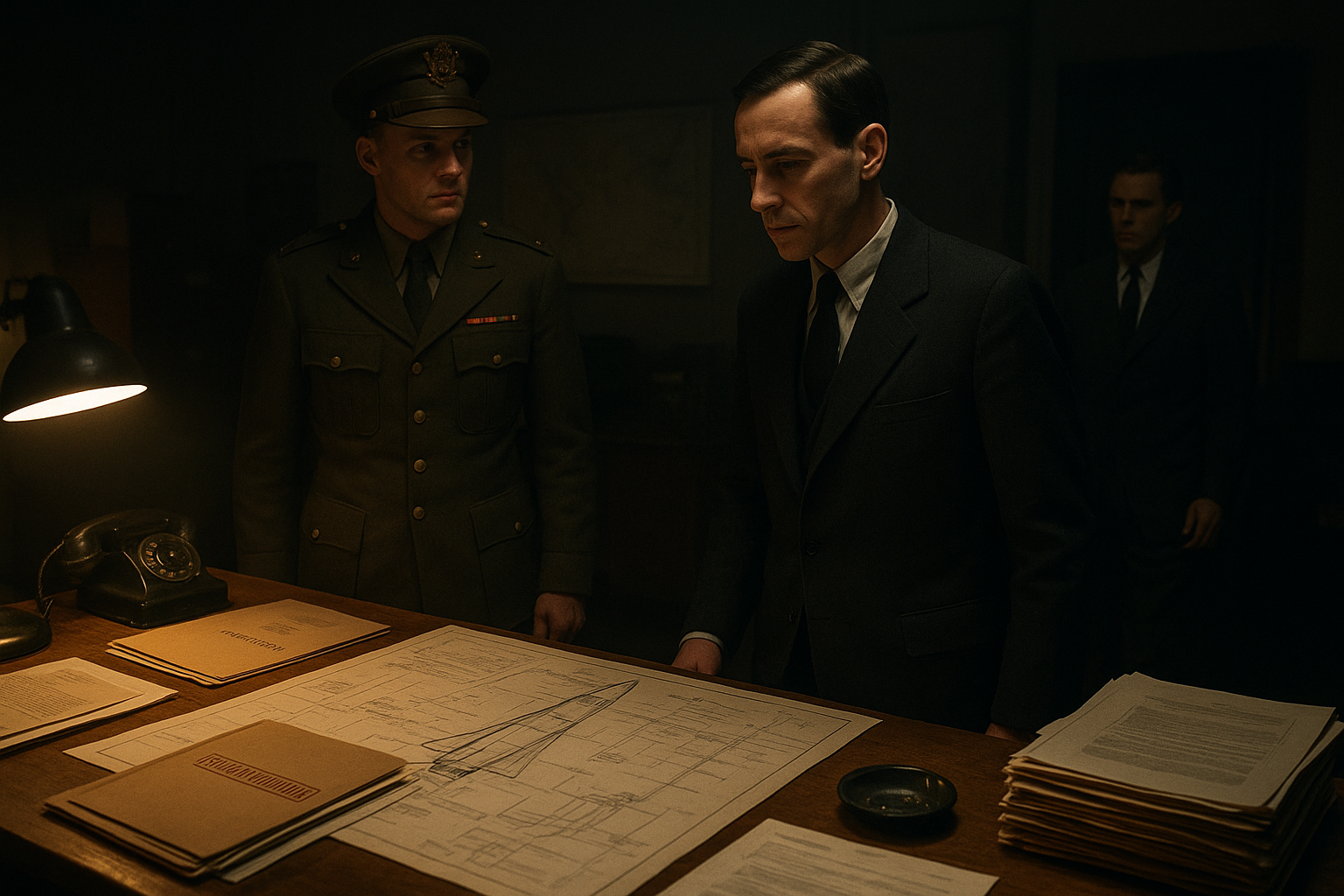
In the ruins of Nazi Germany, the war was ending in public. Behind closed doors, another race was already beginning.
Picture the scene not as a battlefield, but as a file room. Names on paper. Technical reports stacked on desks. Intelligence officers studying the men who had built rockets for Hitler and asking one question that made every moral line suddenly feel negotiable: if America did not take them, would the Soviet Union?
That question became the dark heartbeat of Operation Paperclip, the U.S. program that brought German scientists, engineers, doctors, and weapons specialists to America after World War II. It matters because this was not a rumor or an internet myth. It was a real government program, and its legacy sits uneasily between scientific triumph, Cold War fear, and the memory of victims whose suffering was pushed into the margins.
For readers drawn to documented government secrecy, this story connects directly to other official files that later fueled public distrust, including Project Blue Book and the government’s UFO investigations. But Operation Paperclip is different in one crucial way: the central scandal is not that it might have happened. It did.
The War Ended, but the Hunt for Scientists Began
By spring 1945, Germany was collapsing. Cities were shattered. Nazi leaders were fleeing, surrendering, or dying. Allied troops moved through laboratories, missile sites, factories, and underground facilities where the Third Reich had poured money and human misery into weapons research.
The Americans were not only searching for documents and machines. They were searching for people.
Some of those people had worked on advanced aircraft. Others understood chemical weapons, medicine, submarine technology, guided missiles, and rocketry. The most famous of them was Wernher von Braun, the brilliant rocket engineer tied to the V-2 program. The V-2 was a technological leap, but it was also a weapon fired at civilian targets and produced through forced labor in brutal underground conditions.
That is the tension that never leaves this story. The same knowledge that could help build the future had been developed inside a regime responsible for mass murder. The same engineers who could help America reach space had also worked for a state that built its power on terror.
Why America Wanted Them So Badly
After World War II, the United States and the Soviet Union were no longer just allies who had defeated Hitler. They were rivals staring into a new century of atomic weapons, espionage, missiles, and ideological conflict.
American officials worried that if they hesitated, Soviet teams would collect the same scientists and use them to accelerate their own military programs. That fear was not imaginary. The Soviets were actively gathering German expertise too. The difference was that America also had to explain itself as a democracy that had just helped expose Nazi crimes to the world.
So the program developed in the space between public values and private strategy.
On paper, the United States did not want committed Nazis. In practice, many of the most valuable candidates had been members of Nazi organizations, had worked under Nazi authority, or had been connected to systems that used prisoners and forced labor. Their files were not simple. Their pasts were not clean. But their skills were valuable, and value has a dangerous way of softening language.
The government could call them experts. Technicians. Assets. Specialists. Those words made the choice sound colder, cleaner, easier. They also made it easier not to linger on where some of the work had come from.
The Paperwork That Made the Past Easier to Carry
The name Operation Paperclip has become almost symbolic because it sounds so ordinary. It feels like office stationery, not compromise. Yet that plainness is part of what makes the story disturbing. Terrible decisions are not always made in dramatic rooms by villains giving speeches. Sometimes they are made with forms, signatures, security reviews, and edited biographies.
As the program moved forward, intelligence and military officials faced an obvious problem: many of these men would be hard to defend if their wartime records were fully visible. The United States had just asked its citizens to sacrifice everything to defeat Nazi Germany. It could not easily turn around and celebrate men who had served that same machine.
So records were reviewed. Some backgrounds were minimized. Some uncomfortable details were softened or pushed aside. The broader truth is clear even when specific legends about the name are retold in different ways: paperwork helped transform compromised men into useful recruits.
Timeline of Operation Paperclip
- 1945: Nazi Germany collapses. Allied forces capture documents, equipment, laboratories, and scientists as the war in Europe ends.
- Mid-1940s: U.S. intelligence identifies valuable experts. Rocketry, aviation, chemical research, medicine, and weapons development become urgent areas of interest.
- 1945–1947: Recruitment expands. German specialists are moved into U.S. custody and brought to America under military and intelligence supervision.
- Late 1940s–1950s: Cold War pressure grows. The Soviet threat makes the program easier to defend internally, even when candidates have troubling records.
- 1950s–1960s: Former German rocket experts shape U.S. missile and space programs. Wernher von Braun becomes the best-known example, eventually tied to NASA’s Saturn V program.
- Later decades: Public records and investigations expose more of the moral cost. Operation Paperclip becomes a lasting symbol of government secrecy, Cold War compromise, and the uneasy bargain beneath American scientific achievement.
Documented Facts vs Internet Myths
Operation Paperclip sits inside conspiracy culture for a strange reason: the basic story is real. That makes it different from legends built mostly on rumor. The U.S. government did bring German scientists and technical specialists to America after World War II. Some had Nazi connections. Some worked in fields tied to military research. Some later contributed to major American programs.
But because the real facts are already shocking, the story also attracts exaggeration. Online versions sometimes flatten every scientist into the same category, treat every later American breakthrough as secretly Nazi-made, or turn a documented recruitment program into a catchall explanation for every dark government project of the Cold War.
The stronger way to understand it is more unsettling, not less. Operation Paperclip does not need fantasy to be disturbing. Its power comes from the record: a victorious democracy decided that certain people were too useful to leave behind, even when their pasts should have forced harder questions.
That is also why it makes a sharp contrast with stories like the Philadelphia Experiment, where the claim itself is heavily disputed and shaped by legend. Paperclip is not remembered because people can prove every rumor attached to it. It is remembered because enough of the core truth was hidden, then later confirmed.
The NASA Shadow
For many people, the hardest part of Operation Paperclip is what came after. Wernher von Braun, tied to the German V-2 rocket program, later became one of the public faces of America’s space dream and helped shape the Saturn V work that carried Apollo astronauts toward the moon.
The achievement was real. So was the shadow behind it. The V-2 program had been linked to forced labor and deadly conditions, which means the glowing story of the space race has a darker corridor behind it: what parts of a victory become harder to celebrate when you follow the paper trail all the way back?
What Doesn’t Add Up Morally
The program’s defenders often start with the Cold War. They argue that the Soviet Union was dangerous, ruthless, and eager to capture the same expertise. If America refused to recruit these scientists, the argument goes, it might have handed its enemy a strategic advantage in rockets, weapons, and military technology.
There is truth in the fear. The postwar world was not peaceful. The next conflict felt possible before the last one had even cooled. But fear can explain a decision without fully justifying it.
- The United States had just fought Nazism, then recruited men linked to its machinery.
- Public accountability was limited because the program depended on secrecy and softened records.
- Victims of forced labor and Nazi violence were rarely centered in the story of later scientific success.
- The language of national security made ugly compromises sound like routine administration.
That last point is the one that still feels current. Once an institution learns that fear can make almost anything sound necessary, the boundary moves. Not always all at once. Sometimes just a little. A file gets cleaned up. A biography gets shortened. A public question gets delayed until the answer no longer feels urgent.
Why Operation Paperclip Still Matters
Operation Paperclip still matters because it sits at the intersection of truth and distrust. When people learn that the government really did hide uncomfortable recruitment decisions, it becomes easier for them to wonder what else was hidden. That does not mean every conspiracy theory becomes true. It means secrecy has consequences long after the original files are closed.
This is why the story belongs beside real Cold War programs like MKUltra and official investigation files like Project Blue Book. Each case is different. Each has its own evidence. But together they explain why some people look at government denials with suspicion. History gave them reasons.
There is also a human cost in how the story is remembered. The rockets are easy to film. The launch footage is beautiful. The mathematics is impressive. The survivors, prisoners, and dead laborers behind parts of the earlier weapons program are harder to place in a triumphant montage.
Operation Paperclip asks readers to hold both realities at once: the scientific gains were real, and the moral compromise was real too.
The Uneasy Legacy
The most disturbing part of Operation Paperclip is that it never ends with a clean verdict. Some see it as a brutal but necessary Cold War move. Others see proof that powerful governments will trade justice for advantage when the prize is large enough.
That is what gives the story its pull. It is the moment victory turned into calculation, enemies became assets, and a country that had helped expose evil decided some of evil’s technicians were still too useful to discard.
That may be the real legacy of Operation Paperclip: not only what it built, but what it revealed about power when fear is in the room.
FAQ
Was Operation Paperclip real?
Yes. Operation Paperclip was a real U.S. program after World War II that brought German scientists, engineers, and technical experts to America. The controversy comes from the fact that some of those recruits had worked for Nazi Germany or had troubling wartime records.
Who was brought to America through Operation Paperclip?
The program included specialists in rocketry, aviation, medicine, weapons research, and other technical fields. The most famous figure connected to it was Wernher von Braun, the German rocket engineer later associated with America’s space program.
Was NASA involved in Operation Paperclip?
NASA did not exist when the first recruitment began, but some German rocket experts brought to the United States later became important to American missile and space programs. That is why Operation Paperclip is often discussed alongside NASA’s early history and the space race.
Why does Operation Paperclip still get attention?
It still gets attention because it exposes a real moral compromise at the start of the Cold War. The story combines secrecy, Nazi science, the space race, and government decision-making in a way that still feels unsettling today.
Continue exploring:
- The real government secrets that made people doubt the official story
- The official UFO files that turned suspicion into an archive
- The disputed Navy legend that shows how secrecy becomes folklore
- The CIA mind-control program that proved some dark rumors were real
- Creepy internet mystery archives
More Conspiracies & Theories stories:
🔎 Related Investigation: