Hugh Glass Survival Story — Left for Dead and Crawled 200 Miles
8 min readJuly 29, 2025
In the wilderness of the American frontier, death usually came fast. A freezing river. A starving wolf pack. An arrow from unseen hunters. But in 1823, one man suffered a fate so violent and horrifying that the people around him believed survival was impossible. His body was shredded by a grizzly bear. His bones were broken. His companions abandoned him beside a shallow grave and walked away. Weeks later, the same man emerged from the wilderness alive. His name was Hugh Glass — and his survival story became one of the most unbelievable tales in American history.Listen to “Hugh Glass” on Spreaker.
To understand Hugh Glass, you have to understand the world he lived in.
America in the early 1800s was still largely untamed. Beyond the growing cities in the east stretched thousands of miles of wilderness that most people would never dare enter. Vast forests, endless plains, freezing rivers, towering mountains, and territory controlled by Native tribes who fiercely defended their land.
This was the era of mountain men — fur trappers and explorers who disappeared into the frontier for months or even years at a time. These men lived hard lives filled with hunger, violence, disease, and constant danger. Many never returned.
Hugh Glass was one of the toughest among them.
By 1823, Glass was already in his 40s, older than many of the trappers around him. But he had survived years in brutal wilderness conditions and built a reputation as a skilled outdoorsman. He joined an expedition organized by General William Henry Ashley, whose company was pushing deep into dangerous territory along the Missouri River in search of valuable fur.
The expedition included nearly 100 men. Some would later become legends of the American West. But at the time, they were simply trying to survive.
The dangers were everywhere.
The Arikara tribe had recently attacked trappers in the region. Food was scarce. Rivers could overturn boats without warning. A single infection could kill a man slowly over weeks. And perhaps most terrifying of all were the grizzly bears — enormous predators capable of tearing a human apart in seconds.
Most trappers feared them.
Hugh Glass did not.
The Grizzly Attack
In August of 1823, Glass ventured ahead of the group near the Grand River in present-day South Dakota. He was scouting for game when the forest around him suddenly erupted in chaos.
Hidden nearby was a mother grizzly bear with her cubs.
Glass barely had time to react.
The bear exploded from the brush with terrifying speed. Witnesses later described hearing screams echoing through the wilderness before they even reached him.
The grizzly slammed into Glass with enormous force, knocking him to the ground instantly. Then the attack became pure horror.
The bear’s claws ripped open his back and shoulders. Her jaws crushed into his leg and torso. She bit his scalp so violently that parts of it reportedly hung loose from his head. Ribs cracked beneath the animal’s weight. Flesh tore open across his body.
Still, Glass fought back.
Using his knife and the butt of his rifle, he struggled desperately beneath the massive animal. But fighting a grizzly at close range was almost hopeless. The bear outweighed him several times over and attacked with unstoppable fury.
By the time the other trappers arrived and finally killed the animal, Hugh Glass barely looked human anymore.
Blood soaked the ground around him.
His wounds were catastrophic.
Some men reportedly turned away because they could not bear to look at him.
No one believed he would survive.
Abandoned in the Wilderness
The expedition faced a terrible problem.
They were deep inside hostile territory, surrounded by danger, and moving a dying man through the wilderness would slow everyone down. But abandoning Glass immediately also felt wrong.
So General Ashley offered extra pay to two volunteers willing to stay behind until Hugh Glass passed away and then bury him properly.
The volunteers were John Fitzgerald and a young trapper named Jim Bridger.
At first, they remained beside Glass as he drifted in and out of consciousness. They expected him to die within hours.
But the days passed.
Glass continued breathing.
Meanwhile, the danger around them kept growing. Reports of hostile warriors nearby terrified Fitzgerald, who became increasingly desperate to leave.
Finally, Fitzgerald convinced Bridger that staying longer would likely get all of them killed.
So they made a choice that would haunt American frontier history forever.
They took Glass’s rifle, knife, and equipment. Then they dug a shallow grave beside him and walked away, leaving the wounded trapper alone in the wilderness to die.
At that moment, Hugh Glass was helpless.
He could barely move.
His body was broken.
He had no weapons.
No food.
No horse.
No chance.
At least that’s what everyone believed.
The Awakening
Days later, Hugh Glass opened his eyes.
He was alone.
The silence around him was terrifying. No voices. No horses. No campfire. Just wind moving through the wilderness.
Then the pain hit him.
Every breath felt like knives in his chest. His wounds were infected. His body was swollen and torn apart. He tried to stand but collapsed almost instantly.
That’s when he realized the truth.
They had abandoned him.
Most people would have given up right there.
But something inside Hugh Glass refused to die.
Maybe it was rage.
Maybe survival instinct.
Maybe pure stubbornness.
Whatever it was, it pushed him to do something almost impossible.
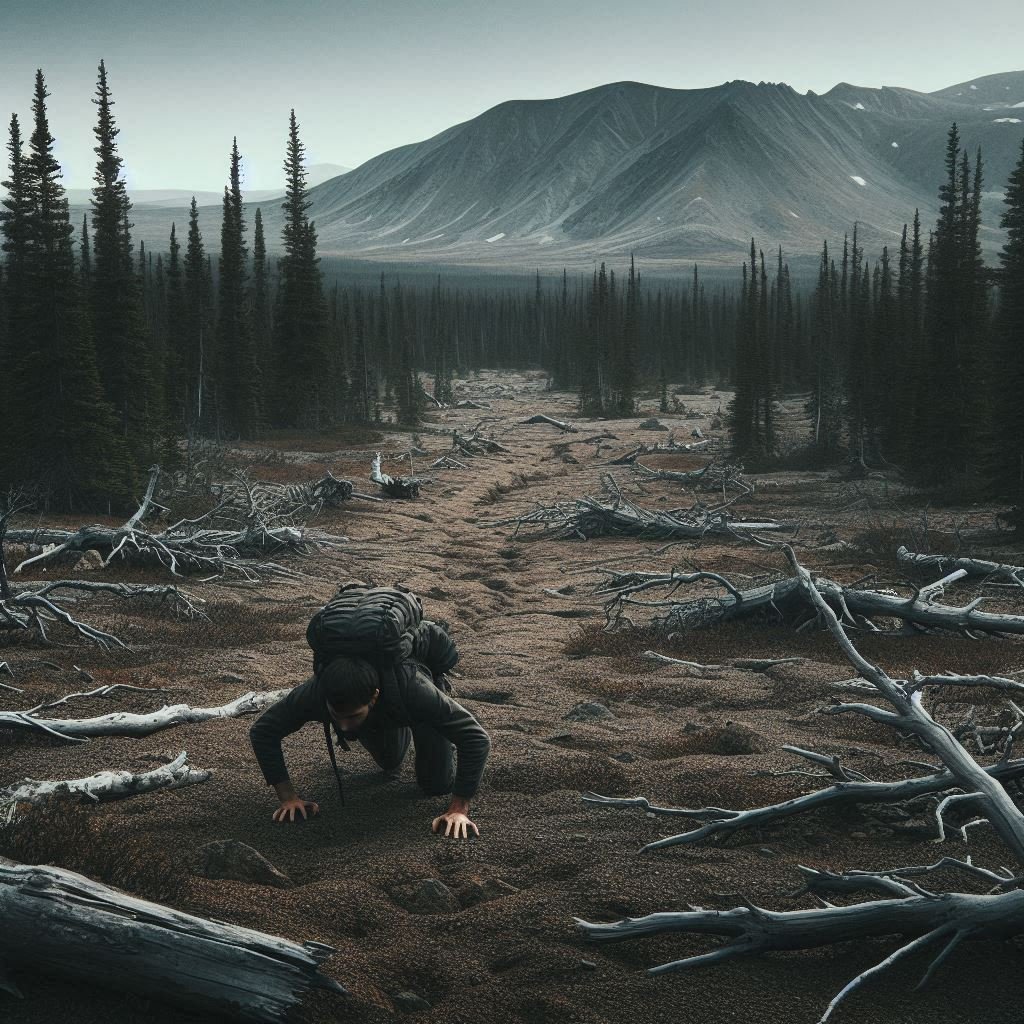
He began crawling.
The Crawl Through Hell
What followed became one of the greatest survival journeys ever recorded.
Hugh Glass was roughly 200 miles from the nearest fort.
He had broken bones, deep open wounds, and almost no supplies. Some accounts say he used the bear hide placed over him for warmth while his injuries slowly began to close. Others describe him dragging himself inch by inch through mud, rocks, and grasslands while trying not to bleed to death.
The wilderness did not care whether he lived.
Every night brought freezing temperatures. Wolves howled nearby in the darkness. Buzzards circled overhead, waiting for him to die.
Glass survived however he could.
He ate berries, roots, and insects. At one point, he discovered a rotting bison carcass and forced himself to eat pieces of decaying meat because starvation was becoming worse than disgust.
One of the most horrifying details involved his wounds.
Maggots had begun crawling inside the torn flesh on his back and legs. But instead of removing them, Glass reportedly allowed them to stay because they consumed dead tissue that could otherwise cause fatal infection.
It was primitive medicine born entirely from desperation.
And somehow… it worked.
Day after day, Glass dragged himself through wilderness that should have killed him many times over.
Rain soaked him.
The sun burned him.
Animals stalked nearby.
Yet he kept moving.
Not quickly.
Not gracefully.
But relentlessly.
The People Who Saved Him
Eventually, after weeks of suffering, Hugh Glass encountered a group of Lakota Sioux hunters.
Considering the violence that often existed between Native tribes and trappers during that period, this meeting could easily have ended in death.
Instead, the Lakota helped him.
They gave him food, treated his wounds, and helped him regain enough strength to continue traveling. Without their help, Glass almost certainly would not have survived much longer.
Slowly, the broken trapper recovered enough to travel by canoe downriver toward Fort Kiowa.
When he finally arrived, the men there could hardly believe what they were seeing.
Hugh Glass — the man everyone thought was dead — had somehow returned from the wilderness alive.
The Revenge Hunt
But Hugh Glass had not survived solely to stay alive.
He wanted revenge.
The thought of Fitzgerald and Bridger abandoning him beside a grave had burned inside his mind through every mile of suffering.
Now he intended to find them.
Glass first tracked down Jim Bridger.
But when he finally confronted the young trapper, the scene reportedly did not unfold the way many expected. Bridger was still little more than a frightened teenager who appeared genuinely ashamed of what had happened.
Glass spared him.
John Fitzgerald was different.
Glass eventually located him as well, but Fitzgerald had joined the U.S. Army. Killing a soldier would almost certainly lead to Glass being executed.
So once again, Hugh Glass made a surprising decision.
He let Fitzgerald live.
But before leaving, he reportedly warned him never to cross his path again.
After everything Glass had endured, the warning carried terrifying weight.
The Legend of Hugh Glass
Hugh Glass eventually returned to life on the frontier, continuing to work as a trapper despite the horrific injuries he had suffered.
Years later, he was killed during another violent encounter in the wilderness. But by then, his story had already become legend.
For generations, people debated which parts were exaggerated and which parts were true. Writers retold the story. Historians investigated it. Then, in 2015, the tale reached a global audience again through the movie The Revenant, starring Leonardo DiCaprio.
But even Hollywood struggled to capture how terrifying the real story truly was.
Because beneath the legend lies something deeply unsettling:
A man was torn apart by a grizzly bear… abandoned beside a grave… and still crawled hundreds of miles through one of the harshest wildernesses on Earth.
Not because he believed he would survive.
But because he refused to die.