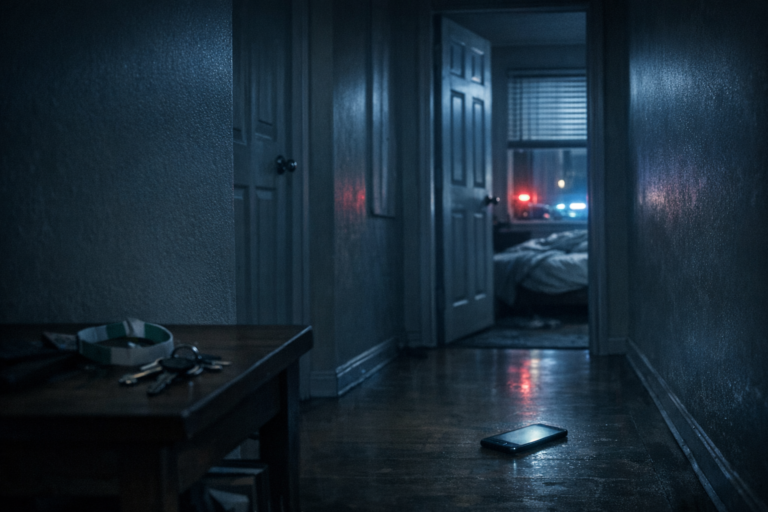

On Thanksgiving Day, a young mother walked into her own townhouse with her baby and the man she was supposed to marry. After that, the world around her kept moving as if nothing had happened. Grocery stores stayed open. Snow settled over Woodland Park. Phones kept lighting up. But behind that ordinary holiday silence, something violent had already taken place, and for days the person responsible tried to make the crime look like a disappearance.
Listen to “Kelsey Berreth Mystery” on Spreaker.
The Kelsey Berreth case became one of the most disturbing Colorado murder stories in recent memory because it began with the shape of a missing-person mystery and ended with a digital evidence trail that exposed a calculated killing. What happened to Kelsey Berreth still gets attention because the case showed how a murderer can try to fake normal life for days, and how tiny electronic clues can quietly tear that lie apart.
If this kind of evidence-led case stays with you, the Jennifer Kesse disappearance is another haunting example of how a seemingly ordinary day can collapse into a mystery built around the last visible trace.
On Thanksgiving Day in 2018, surveillance footage captured Kelsey at a Safeway grocery store with her daughter. It was one of those painfully normal moments that become unbearable only in hindsight. She was shopping for the holiday. She looked calm. Nothing in the footage warned that investigators would later study it like the opening frame of a crime scene. After that, another camera showed Kelsey, her daughter, and Patrick Frazee walking into Kelsey’s townhouse. It was the last confirmed sighting of her alive.
Then the silence began.
At first, the gap may not have looked dramatic to an outsider. Adults miss calls. Holiday weekends scramble routines. Messages go unanswered for a few hours, sometimes a day. But for the people who knew Kelsey, this silence had the wrong texture. Her mother, Cheryl Berreth, was used to regular contact. The longer that contact stopped, the more the quiet turned from inconvenience into dread. Kelsey’s car remained at the home. Her purse was still there. Her phone activity, later examined in detail, would become one of the strangest parts of the whole case.
Patrick Frazee quickly became impossible to ignore, not just because he was the last person known to be with her, but because so much about his behavior felt emotionally wrong. While Kelsey’s family fought panic and begged for answers, he stayed detached. He did not look like a man trapped in sudden fear over his fiancée’s disappearance. He looked like someone trying to stay ahead of a story. He told investigators that Kelsey had broken up with him on Thanksgiving. He suggested she might have left on her own. He said they continued communicating afterward. On paper, those claims gave him breathing room. In practice, they gave detectives something to test.
Timeline of Events
- Thanksgiving Day 2018: Kelsey Berreth is seen shopping with her daughter in Woodland Park, Colorado. Later, surveillance footage captures Kelsey, Patrick Frazee, and the baby entering Kelsey’s townhouse.
- After Thanksgiving: Family members become alarmed when Kelsey stops responding in a way that does not fit her normal pattern.
- December 2, 2018: Concern leads to a welfare check at Kelsey’s home. Her car and personal belongings are still there.
- Early investigation: Patrick Frazee claims Kelsey may have left and says they exchanged messages after Thanksgiving.
- Digital review: Investigators analyze phone records and movement data, uncovering patterns that do not support Frazee’s version of events.
- Evidence shift: The inquiry expands toward Frazee’s ranch, the cleanup story, and Krystal Lee’s role in the cover-up.
- December 21, 2018: Patrick Frazee is arrested.
- 2019 trial: Testimony, phone evidence, and the burn-pit findings are used to reconstruct what happened.
- Verdict: Frazee is convicted of first-degree murder and other charges and sentenced to life in prison without parole, plus additional years.
The case might have stayed buried under conflicting stories if not for one brutal fact: phones are often less loyal than people. Investigators started examining digital records because the human explanations were too neat, too self-protective, and too convenient. If Patrick was telling the truth, the data should have supported him. Instead, it began exposing the structure of a lie.
Kelsey’s phone appeared to remain active after she was already gone, but the activity did not feel like the movements of a woman rebuilding her life. It felt staged. The records suggested the phone had traveled, and one of the most striking turns in the case was the phone activity linked to Idaho. That mattered because it pointed toward Krystal Lee, Frazee’s longtime mistress, a woman who would become central to understanding not just the cleanup, but the psychology of the cover-up itself. The phone was not proving Kelsey’s freedom. It was helping investigators map the performance meant to fake it.
That is where the case became more than a disappearance story. Frazee’s version depended on investigators accepting a surface-level narrative: breakup, emotional distance, voluntary absence, a few messages, uncertainty. But digital evidence is unforgiving. In the same way the BTK killer case was eventually cracked by a seemingly ordinary piece of technology, the Kelsey Berreth investigation turned on records that could not be talked into forgetting.
As detectives pushed further, the picture darkened. Evidence led back toward Frazee’s ranch. Investigators began piecing together a chain of violence, transport, destruction, and cleanup. The horror of the case is not only that Kelsey was killed, but that so much effort allegedly went into erasing her while pretending she had simply stepped away from her own life. That double cruelty is what makes the story linger. She was taken, and then the truth itself was pushed into hiding.
How Investigators Broke the Case Open
- Phone movement contradicted the story: The supposed post-Thanksgiving communication did not behave like genuine contact from a living, free person.
- Timeline pressure exposed weak spots: The more detectives narrowed the hours around Thanksgiving Day, the harder it became for Frazee’s account to hold.
- Krystal Lee became impossible to ignore: Her connection to Frazee and the Idaho phone trail turned her from background figure into crucial witness.
- Physical evidence supported the digital trail: Investigators found burned material and evidence consistent with an effort to destroy a body and other incriminating items.
- Cooperation changed the case: Krystal Lee’s testimony gave prosecutors a narrative that matched the digital and physical evidence already in motion.
Krystal Lee’s cooperation was one of the most chilling turns in the case because it forced the hidden middle of the story into the open. According to her testimony, Frazee had discussed killing Kelsey before Thanksgiving and had tried more than once to involve Lee in those plans. Laid next to the phone records and physical evidence, the case no longer looked like a mystery with a few suspicious details. It looked like a murder followed by a determined cover-up.
What Didn’t Add Up
- The emotional tone was wrong: Frazee’s public and private behavior did not match the urgency most people would expect from a frantic fiancé and father in a real missing-person crisis.
- The belongings stayed behind: Kelsey’s car, purse, and other essentials being left at home worked against the idea of a voluntary disappearance.
- The phone story felt manufactured: Activity existed, but it did not feel like the lived pattern of someone choosing to leave.
- The timeline narrowed around one location: The last confirmed movements centered on Kelsey’s townhouse and the person already under suspicion.
- The cover-up required too many explanations: Once digital, physical, and witness evidence were layered together, the innocent version of events became harder to believe than the criminal one.
There is something especially disturbing about cases where the victim appears to vanish inside the architecture of family life. No dark highway. No masked stranger in a parking lot. No dramatic public abduction. Just a home, a holiday, a child in the next room, and a story that seems ordinary until you realize the ordinary details are being used as camouflage. That is part of why the Kelsey Berreth case hit people so hard. It suggested that the most dangerous moment was hidden inside one of the safest-looking settings imaginable.
Kelsey’s remains were never fully recovered, which is one reason the case still feels unfinished even after the conviction. A verdict can close the legal story, but it does not always quiet the human one.
It also became a landmark example of how modern investigations solve crimes that once might have dissolved into rumor and doubt. That is one reason this case still gets discussed alongside other evidence-heavy crimes such as Sherri Papini’s unraveling kidnapping story, where the collapse began when contradictions technology could track became too heavy to ignore.
By the end, the Kelsey Berreth case was no longer about whether she had walked away. It was about how long a lie could survive when every digital footprint was pulling in the opposite direction. The answer turned out to be: not long enough.
FAQ
What happened to Kelsey Berreth?
Kelsey Berreth was killed on Thanksgiving Day in 2018. Prosecutors said her fiancé, Patrick Frazee, murdered her in her Woodland Park townhouse and then tried to cover up the crime by moving evidence, using her phone to create misleading activity, and destroying remains and other materials.
How did investigators solve the Kelsey Berreth case?
Investigators used a combination of phone data, timeline reconstruction, witness testimony, and physical evidence. The digital trail around Kelsey’s phone and Patrick Frazee’s movements helped undermine the false story that she had simply left on her own.
Who was Patrick Frazee?
Patrick Frazee was Kelsey Berreth’s fiancé and the father of her daughter. He became the central suspect in the case and was later convicted of first-degree murder and additional charges.
Was Kelsey Berreth ever found?
Kelsey Berreth’s remains were never fully recovered. That is one of the most painful parts of the case and one reason the story still leaves such a lingering sense of incompleteness.
Why does the Kelsey Berreth case still get attention?
The case still gets attention because it combined the fear of a missing-person mystery with the precision of a digital forensic investigation. It also involved betrayal inside a family setting, a calculated cover-up, and evidence that slowly exposed the truth.
🔎 If this story stayed with you, the author suggests these real cases next:
- The disappearance story that collapsed when the evidence stopped cooperating
- The serial killer case where one simple piece of tech finally betrayed him
- The cold case that waited decades for one breakthrough to finally crack it open
- A woman vanishes in daylight, leaving behind one of the most haunting last traces on camera
Explore more Solved Cases stories here: