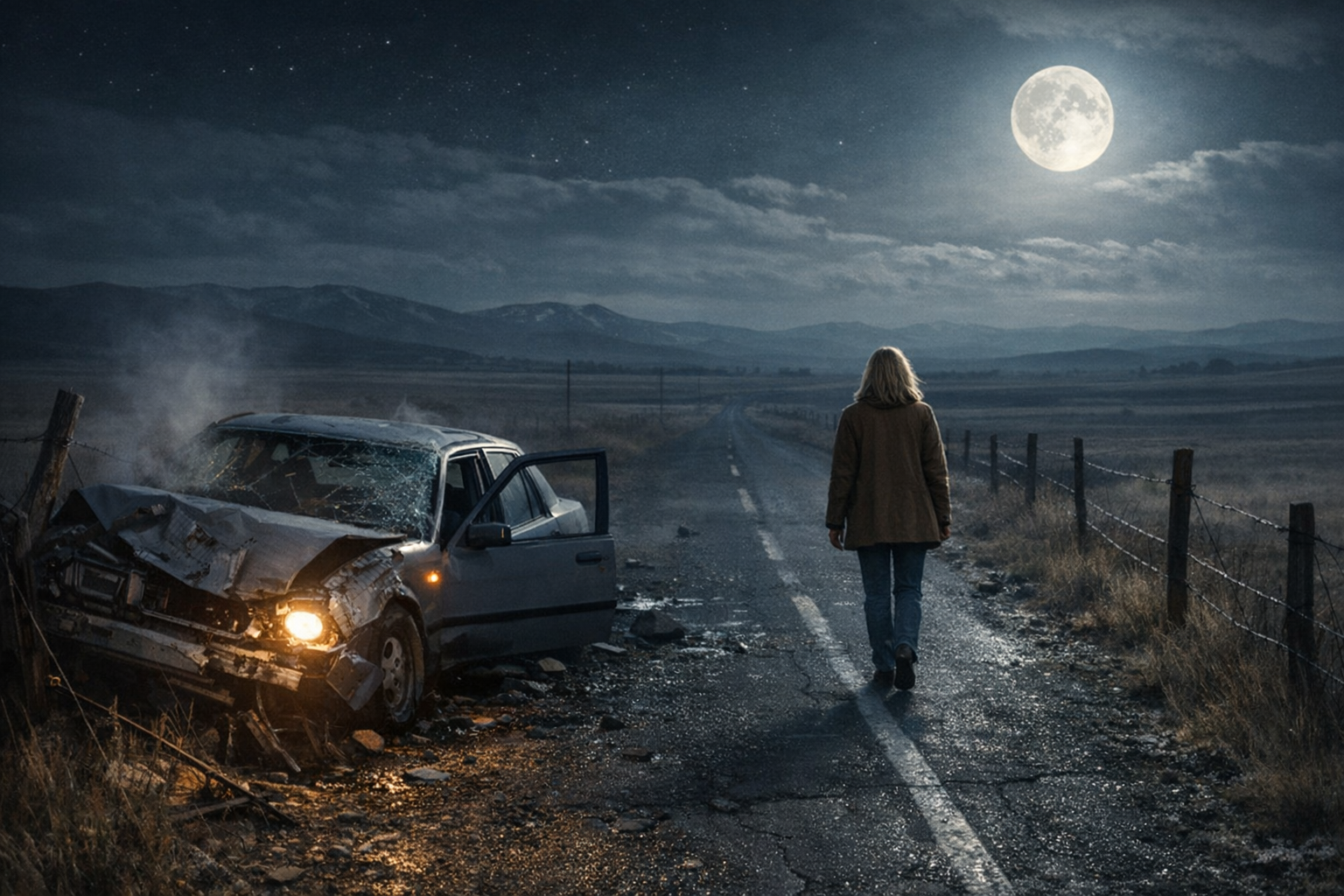
On April 20, 1989, Patricia Meehan’s car collided with another vehicle near Circle, Montana. Witnesses described Meehan leaving the crash scene beyond a roadside fence.
In interviews with Unsolved Mysteries, Carol Heitz and Peggy Bueller described a silent woman who appeared detached from the crash. The vehicle was traced to Meehan, who was never located.
Patricia Meehan’s unsolved disappearance began with a crash that should have explained everything
The Patricia Meehan unsolved disappearance remains one of Montana’s strangest missing person cases because it starts with a moment that seems impossible to misunderstand. There was a wreck, there were witnesses, and there was a woman seen alive at the scene, but after Patricia Meehan walked away from the highway outside Circle on April 20, 1989, the trail went cold in a way that still unsettles investigators and readers decades later.
That eerie combination of a damaged vehicle, a confirmed sighting, and a person who seems to dissolve into open country is exactly why readers keep returning to disappearance cases where witness sightings only made the mystery worse. Patricia Meehan’s case fits that pattern almost perfectly, but in some ways it is even more unsettling, because for a few seconds on that highway, witnesses were looking right at her.
Patricia Meehan was 37 years old and living in Bozeman, Montana, where she worked as a ranch hand and picked up odd jobs. In the days before she vanished, the people closest to her believed something was wrong. She was under stress. She had told her father she wanted to come home to Pennsylvania for a while. She had also made an appointment to see a psychologist the next morning.
That matters, because the mystery of Patricia Meehan is not just about where she vanished. It is about what state of mind she may have been in during the final 24 hours before she disappeared, and whether the crash on Highway 200 was the start of the mystery or just the first visible sign that something had already gone badly wrong.
On the evening of April 20, 1989, witnesses near Circle, Montana, reported seeing a vehicle traveling on the wrong side of the road. One motorist managed to avoid a direct collision, but the car behind her was struck head-on. The woman behind the wheel of the other vehicle was Carol Heitz. She survived. What she remembered afterward would become one of the most disturbing details in the case.
Witnesses said the woman stared without speaking and then walked away. Those observations cannot establish what she understood, why she left or whether she had a head injury.
That image is the hinge of the entire mystery. The car is found. The scene is witnessed. Patricia is seen alive after impact. And then, somehow, the case drops into a gap between those facts, a gap so wide that it has never closed.
Timeline of Events
- Before the crash: Meehan asks to return to her parents in Pennsylvania and arranges a psychologist appointment for April 21.
- April 20, 1989, evening: She is driving near Circle, Montana, far from her home in Bozeman, for reasons no one has fully explained.
- That evening: Witnesses see a vehicle traveling erratically on Highway 200 before a head-on crash.
- Moments later: Patricia climbs from the wreckage, stares silently, crosses a fence, and walks into a field.
- Following the crash: Police identify the vehicle’s owner and begin searching for Meehan.
- Following days: Searches on land and from the air over five days fail to locate her.
- Months and years after: Numerous possible sightings are reported in several states, but none leads to locating her.
Searches did not locate Meehan. The absence of a confirmed outcome leaves open questions about what happened after she walked away.
The car is not just background. It is the object around which every theory turns. Why was Patricia driving so far from Bozeman? Why was she on the wrong side of the road? Why did she leave the one place where help was certain to arrive? Every answer starts at the crash scene, and every answer breaks down there too.
Family members described Meehan as distressed before the crash. Amnesia after a possible injury became one explanation discussed publicly, but it was not a confirmed diagnosis.
It is a theory that sounds plausible at first because it helps explain the blank expression, the silence, and the strange decision to leave the crash scene on foot. But even that explanation creates new questions. A person in distress can walk away from a wreck. That part is believable. What is harder to explain is how someone can be seen, searched for, and reportedly spotted again and again, and still never be definitively found.
What Doesn’t Add Up
- Why was she near Circle at all? Patricia lived in Bozeman, roughly 370 to 400 miles away, and no clear reason for the trip has ever been established.
- Why leave the crash scene? Other people were present, but her reason for leaving remains unknown.
- Where did she go after leaving? No established route has led to finding her.
- What should be made of the sightings? There were so many reports that the case moved beyond a single rumor, yet none produced a resolution.
- Did the crash trigger the disappearance, or reveal an earlier crisis? The answer changes how the entire timeline is understood.
Later sightings were reported in several states. Her parents believed some were genuine, and Unsolved Mysteries interviewed diner workers who thought they had seen her. None led to a confirmed recovery.
If a later sighting was genuine, Meehan survived beyond the crash scene. The reports do not establish a continuing life of hitchhiking, memory loss or wandering.
But there is another side to that theory, and it is hard to ignore. Missing-person cases often attract mistaken sightings, especially when the image of the missing person spreads widely through television, newspapers, and flyers. Patricia’s case received major attention, including exposure through Unsolved Mysteries. Publicity can generate reports of lookalikes. The number itself does not prove she was alive for years. It may only prove that her story lodged itself in the public imagination.
That is part of what keeps Patricia Meehan’s disappearance so compelling today. It is not just a mystery with one missing piece. It is a mystery with too many possible pieces, too many reported glimpses, and no reliable way to fit them together.
The most chilling possibility is also the simplest: Patricia walked away from the crash injured, disoriented, and vulnerable, and succumbed to the terrain before anyone could find her. Eastern Montana can feel open enough to see everything, but open country can hide a person in depressions, grass, weather, distance, and darkness. Searches miss people. That happens more often than most people want to believe.
A woman thought to be Meehan in Washington was later shown to be someone else. That mistake illustrates why reported sightings cannot automatically establish survival.
Key Evidence and Clues
- The wrecked car: It places the crash near Circle, where witnesses described her departure.
- Witness observations: Multiple people saw her alive immediately after the crash and described her as silent, detached, and strange.
- The last observed direction: Witnesses described her leaving the highway area on foot.
- Her recent distress: Calls home, emotional strain, and a scheduled psychologist appointment suggest a serious problem may already have been unfolding.
- Reported sightings: Possible later encounters generated leads without resolving her whereabouts.
Those clues do not point cleanly in one direction. Instead, they split the case in two. In one version, Patricia died in the landscape shortly after walking away. In the other, the crash became the doorway into a second life marked by confusion, drifting, and anonymity. The reason the case has never closed is that neither theory fully defeats the other.
The strongest emotional pressure in the story is that odd, narrow slice of time right after the crash. Witnesses did not arrive too late. Investigators did not begin with nothing. Patricia Meehan was there. She was visible. She had not yet become a mystery. And then, within minutes, she was one.
There is also the question of intent. Was Patricia trying to get somewhere specific when she reached that stretch of road? Was she aimlessly driving under the weight of a mental health crisis? Did the collision itself scramble her ability to think and push her into a fugue-like state? The case continues to attract debate because each explanation accounts for some facts and fails to explain others.
Maybe that is why the story refuses to fade. Many disappearances begin with uncertainty. Patricia Meehan’s begins with apparent clarity. A crash. A witness. A direction of travel. An uncertain route. That should have been enough to shrink the unknown. Instead, every concrete detail only seems to widen it.
Why This Case Still Gets Attention
Patricia Meehan’s case continues to draw readers because it sits at the crossroads of several of the most gripping disappearance patterns:
- A recovered vehicle that offers a starting point but no resolution.
- A direct post-crash sighting that confirms she was alive after the wreck.
- A huge unexplained distance from home that suggests a hidden prelude to the disappearance.
- Numerous reported sightings that keep the story emotionally open.
- No final discovery to quiet the debate.
The continuing uncertainty is straightforward: witnesses described a woman leaving the wreck, but no later account has led investigators to Meehan.
There is also a human reason the case endures. Patricia was not swallowed by some distant legend. She was a real woman who had called home, asked for help, and seemed to be standing on the edge of some private crisis. Her family did what families do in stories like this: they flew across the country, printed flyers, followed leads, and kept hoping the next call would finally make sense of the last one. Instead, they were left with a highway, a wrecked car, and a future full of false dawns.
The crash is documented through witnesses and the vehicle. Meehan’s whereabouts afterward remain unknown.
Decades later, that is still the feeling people cannot shake. A woman climbs from a crash, crosses a fence, pauses in the dark, and walks away. The car stays behind. The witnesses stay behind. The questions stay behind. Patricia Meehan does not.
Research Sources
The following resources were consulted to verify and update this article.
- Montana Department of Justice — Montana Missing Persons Search: Meehan, Patricia
Current state clearinghouse entry listing her last contact and investigating sheriff. - Unsolved Mysteries — Patricia Meehan
Witness interviews about the collision and walk away, with attributed later sightings and amnesia speculation. - The Charley Project — Patricia Bernadette Meehan
Missing-person chronology, pre-crash concerns and the limits of later sightings.
🔎 If this story stayed with you, the author suggests these real cases next:
- Kiely Rodni: the reservoir recovery and official accidental-drowning finding
- What happened to Crystal Rogers became a Kentucky disappearance that never stopped circling back
- What happened to Johnny Gosch still divides people because the story never really stopped changing
Explore more Disappearances stories here: