Before the sun fully came up over West Des Moines, a 12-year-old boy was already out working.
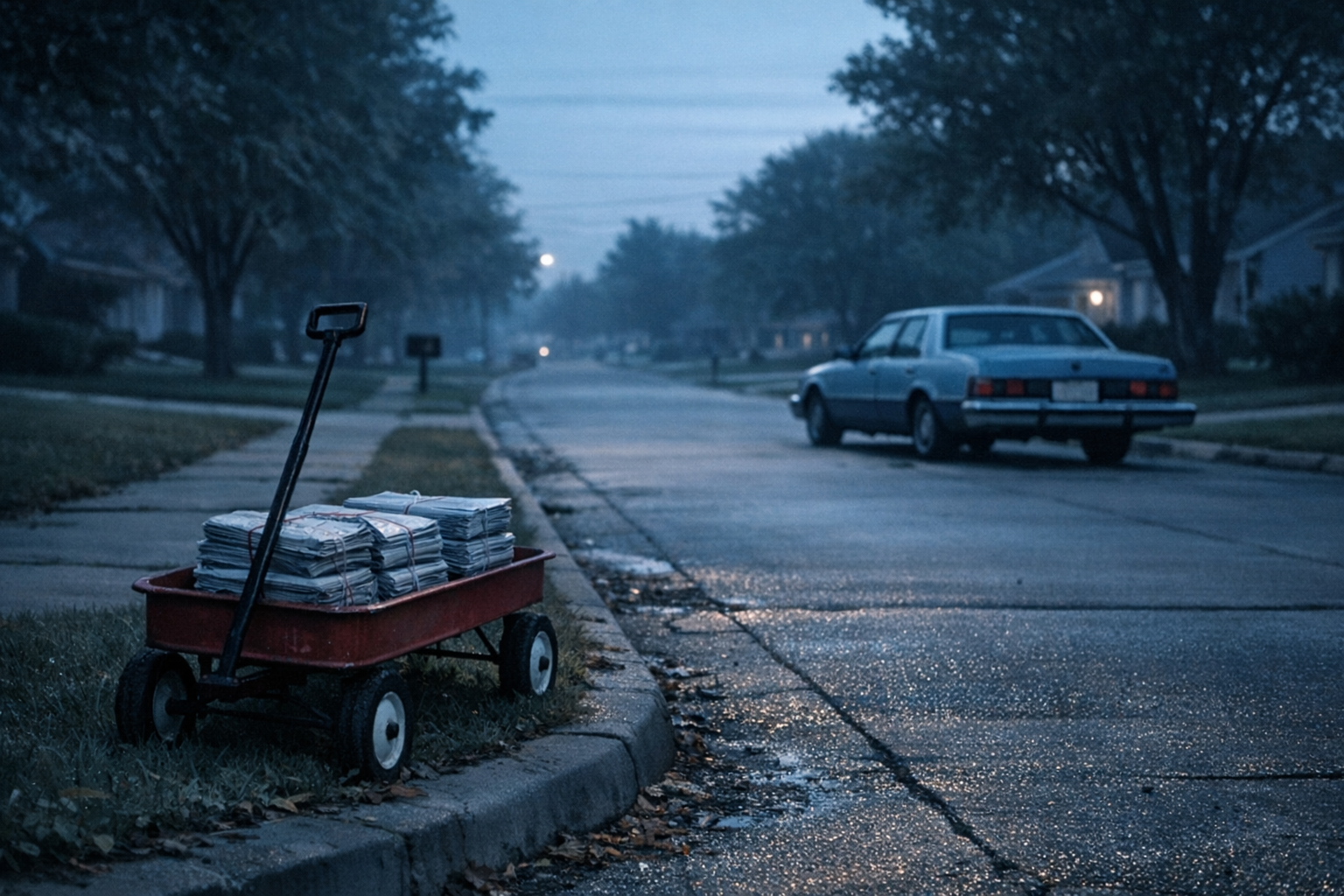
He was wearing flip-flops. Pulling a wagon. Thinking about newspapers, porches, and the ordinary route he knew well enough to walk half-awake. A stranger in a blue car slowed near him and asked for directions. Another man was seen nearby. Then, in the span of a few minutes so small it almost feels unreal, Johnny Gosch was gone.
No scream that anyone could clearly place. No confirmed final sighting after that corner. Just a wagon left behind with papers still inside, and a neighborhood that would spend the next four decades replaying one quiet Sunday morning like it should eventually give up its secret.
Johnny Gosch’s unsolved disappearance remains one of the most discussed missing child cases in American history. The case matters not only because John David Gosch vanished during an ordinary paper route in 1982, but because the basic timeline is so short, the witness accounts are so unsettling, and the later claims surrounding the case never stopped splitting public opinion.
Cases like this tend to stay alive because the last ordinary moments feel so fragile, and that’s part of why the site’s Missing Children and Teens Archive keeps circling back to the same question: how does a child disappear in public and still leave so little behind?
On September 5, 1982, Johnny left home before 6 a.m. for his Des Moines Register route in West Des Moines, Iowa. Normally, his father went with him. That morning, he did not. That detail has always sat at the center of the story, not because it explains what happened, but because it sharpens the feeling that the entire case turned on one small break in routine.
Johnny was 12 years old, but he was not a tiny child wandering alone for the first time. He knew the route. He knew the paper drop. He knew the streets. That is one reason the case still unnerves people: it did not happen in some isolated wilderness or in the middle of the night. It happened in a suburban neighborhood, near homes, near witnesses, near the kind of place people assume is safe enough for a paperboy.
At the paper drop, other carriers later said a stocky man in a blue, two-tone Ford Fairmont, or a similar car, asked Johnny for directions to 86th Street. One witness thought the exchange felt wrong. Another later described a tall man following Johnny as he moved north with his wagon. Then a neighbor reportedly heard a car door slam and saw a car speed away. Those fragments are tiny on their own. Together, they create the documentary spine of the case: a stranger in a blue car, a second man on foot, a wagon left behind, and then nothing.
Timeline of Events
- About 5:45 a.m. – Johnny Gosch leaves home in West Des Moines for his Sunday paper route.
- Shortly before 6:00 a.m. – Witnesses see him near the newspaper drop site with his wagon.
- Moments later – A man in a blue car is reported asking Johnny for directions; another witness later says a tall man appeared to follow him.
- Within minutes – Johnny disappears. His wagon, still holding newspapers, is later found about two blocks from home.
- Around 7:00 a.m. – Customers begin calling the Gosch house asking why their papers were never delivered.
- That morning and after – Searches begin, but Johnny is never found, and no arrest is made.
The power of the story is not just that Johnny vanished, but that the ordinary hour of that suburban paper route somehow became one of America’s most enduring and most contested child-disappearance cases. The mystery lives there.
And what makes that hour so unsettling is how little room it gives you to breathe. If the witnesses were right, Johnny was approached, possibly watched, and then taken in a span shorter than many people spend making coffee. The route did not stretch across town. It barely had time to begin. That compressed timeline is why the case keeps resurfacing in documentaries and podcasts: there is no long wandering trail, no clear sequence of mistakes, no known detour. The story seems to break almost immediately.
Then came the image that has never really left the case: the wagon. Not overturned in chaos. Not hidden. Just there, with newspapers still inside, like the morning had been interrupted mid-sentence. It is hard to overstate how much emotional force that detail carries. A missing car can suggest flight. A missing adult can generate a hundred theories. But a child’s wagon full of undelivered papers suggests something much colder, that whatever happened, it happened fast enough that the job itself was simply abandoned where he stood.
Police and Johnny’s family would spend years fighting over the earliest response, the assumptions made, and what was or was not pursued aggressively enough in those first hours. That tension became part of the case’s identity. Johnny Gosch did not remain only a missing boy; his disappearance became a symbol in a broader national fear about vulnerable children, stranger abduction, and whether police systems at the time were built to react fast enough when a child vanished.
🔎 Related Investigation:
If this case pulled you deeper into the mystery, continue into:
What Doesn’t Add Up
- The blue-car encounter feels purposeful. Witnesses did not describe a random passing moment that barely registered. They remembered the man asking for directions and the exchange feeling strange.
- The second-man detail makes the scene darker. If that witness was correct, the case may have involved more than one person, which would help explain how a public abduction happened so quickly.
- The wagon was left too soon. Johnny had barely started the route. That supports the idea that the interruption happened almost immediately.
- There was no clean evidence trail. Despite witnesses, a vehicle description, and a known location, the case never produced the kind of hard evidence that could anchor a prosecution.
- The later claims changed the public conversation. Once the story expanded beyond the original abduction timeline into disputed sightings, trafficking theories, and alleged later contact, the case became much harder for the public to process as a straightforward investigation.
That last point matters more than it first appears. Plenty of missing child cases remain heartbreaking but structurally simple: a child vanished, evidence is thin, and the public keeps hoping for a break. Johnny Gosch’s case did not stay structurally simple. It became layered with competing versions of reality.
There were reported sightings over the years. There were theories about organized abduction. There were claims that Johnny’s disappearance might connect to a larger pattern involving other missing boys in Iowa, especially paper carriers like Eugene Martin. And then, much later, there was the most disputed claim of all: Johnny’s mother, Noreen Gosch, said her son visited her years after the abduction as an adult, accompanied by another man, and told her he had been taken and exploited by a child trafficking ring.
That claim changed the emotional gravity of the case. For some people, it became the key to everything. For others, it marked the point where the case drifted out of evidence-based reconstruction and into territory no one could verify. Authorities never confirmed that visit. Johnny’s fate has never been officially resolved. People are not just arguing about who took Johnny. They are arguing about what kind of story this became afterward.
Why This Case Still Gets Attention
Johnny Gosch’s disappearance keeps returning because it sits at the intersection of three powerful forces:
- A highly visual abduction window – a boy, a wagon, a quiet corner, a blue car, and a route that ended almost before it started.
- A missing-child legacy – Johnny became one of the faces most associated with the milk-carton era and with reforms in how missing children cases were treated.
- An unresolved second act – the disputed later claims gave the case a disturbing afterlife that many cold cases never develop.
That combination is rare. Usually a case is either a tight mystery with little mythology, or a sprawling story where facts dissolve into folklore. Johnny Gosch exists in both worlds at once. The original disappearance is concrete enough to feel solvable. Everything that followed makes it feel almost impossible to settle.
And that is where the comparison to other disappearance cases becomes useful. In The Morning Jodi Huisentruit Vanished – And the Timeline That Still Haunts Investigators, the morning routine is also the trap: a narrow window, a familiar setting, and a public disappearance that still seems too brazen to have happened. But Johnny’s story is even more unnerving because he was a child, working before sunrise, in a role that once symbolized innocence and neighborhood trust.
There is another reason this case stays lodged in the public mind: it exposed how quickly a family can become trapped inside a permanent argument with time. If the first response had been faster, would anything have changed? If one witness had remembered a full plate number, would the trail have opened? If the route had begun five minutes later, or if Johnny’s father had gone with him as usual, would the case exist at all? Those are the kind of questions that never produce evidence, but they do keep a story alive.
Noreen Gosch turned that grief into activism, advocacy, and relentless public attention. Whatever one believes about the later claims, there is no disputing her influence on the national conversation around missing children. The case helped shape public fear, media coverage, and legal pressure for faster action when a child disappears. In that sense, Johnny’s story did not end at the corner where the wagon was found. It spread outward into policy, television, newspaper culture, and the way an entire generation of parents thought about safety.
But for all the later symbolism, the most haunting part of the case is still the smallest part. A boy left home to deliver papers. Witnesses saw a stranger. Someone may have followed him. Then a wagon full of newspapers was found alone.
That is why the case remains powerful even after decades of theories, documentaries, and arguments. Strip away everything that came later, and the original scene is still devastatingly simple. Johnny Gosch stepped into an ordinary morning, and the ordinary morning never gave him back.
And maybe that is the real reason the case still holds people. Some mysteries stay alive because they are bizarre. Others stay alive because they are famous. Johnny Gosch’s disappearance stays alive because the first few minutes are so comprehensible, and the ending is still missing. You can picture the street. You can picture the wagon. You can picture the stranger asking a child for directions. That clarity is what makes the darkness after it feel so endless.
If this story stayed with you, the author suggests these real cases next:
- The 9-year-old who also vanished into an ordinary night
- A morning disappearance where the timeline still won’t sit still
- The missing boy case that left one impossible message behind
Explore more Disappearances stories here: