By the time the first police officer stepped into the parking lot, the rain had already started washing the scene clean.
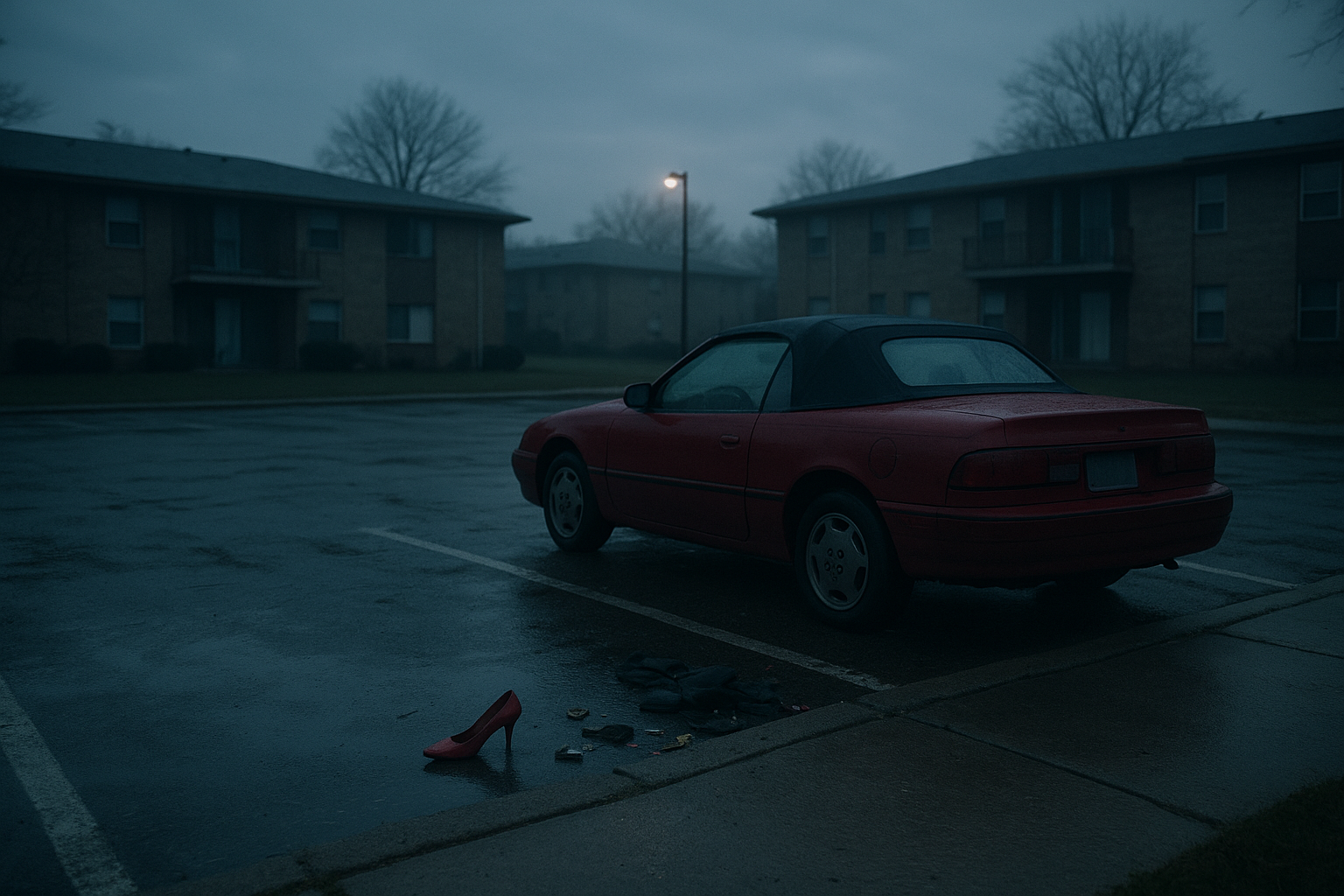
A red Mazda Miata sat where it should have been. But everything around it felt wrong. One red heel was lying in the lot. Then the other. A blow dryer. A bottle of hairspray. Earrings. A bent car key still jammed in the driver’s-side door. And across the wet pavement, there were signs that whatever had happened there had happened fast.
Just a little earlier, someone had expected Jodi Huisentruit to be alive, awake, and walking into a television studio to deliver the morning news.
Instead, it looked like the morning had swallowed her whole.
Jodi Huisentruit was a 27-year-old Iowa news anchor whose unsolved disappearance on June 27, 1995 remains one of the most haunting missing person cases in the Midwest. Her case still matters because the evidence suggests a violent abduction in a tiny window of time, yet the sequence of that final morning still leaves major questions investigators have never been able to reconcile.
Cases like Jennifer Kesse’s broad-daylight disappearance are so unsettling for the same reason: they seem to happen in ordinary places, inside ordinary routines, with almost no room for a person to simply vanish.
Jodi Sue Huisentruit had the kind of life that seemed to be moving forward fast. She grew up in Long Prairie, Minnesota, played competitive golf, studied mass communications, and worked her way into television news. By 1995, she was working at KIMT in Mason City, Iowa, anchoring the station’s morning and noon broadcasts.
Morning-show work meant brutal hours. Jodi usually got up while most of the city was still asleep. She had to be at the station well before sunrise, often arriving between 3:00 and 4:00 in the morning. That schedule mattered. In fact, it may have mattered more than anything else.
Because if someone wanted to intercept her, they did not need to guess when she might leave home. They only needed to know her routine.
The day before she disappeared, June 26, 1995, did not look like the beginning of a mystery. Jodi worked, saw people she knew, and took part in a golf event. Later, according to accounts repeated over the years, she spent time with John Vansice, an older friend from Mason City who said he was among the last people to see her alive. None of that seemed unusual enough at the time to ring a loud alarm.
But the next morning would become one of the most dissected timelines in modern disappearance cases, because nearly every known detail sits inside a narrow and maddening window.
Timeline of Events
- Before 4:00 a.m.: Jodi does not arrive at KIMT for her regular early shift.
- Around 4:00-4:10 a.m.: Producer Amy Kuns calls Jodi’s apartment. Jodi answers and says she overslept and will be there soon.
- Shortly after: Jodi should have left her apartment and walked to her car in the parking lot.
- Roughly the same time window: Neighbors later report hearing a scream or screams, and one witness reports a white van in the area.
- By 6:00 a.m.: Jodi still has not arrived at the station. Co-workers realize something is seriously wrong.
- 7:13 a.m.: Police are called to check on her.
- Minutes later: Officers find her car and scattered personal items, along with signs of a struggle.
The reason this timeline still haunts people is simple: Jodi was not a person who disappeared into a fog of unknown hours. She was heard from. She said she was leaving. Then, somewhere between her apartment door and the driver’s seat, the trail broke.
That tiny gap is where the entire case lives.
If Jodi answered the phone around 4:00 and really was rushing out the door, then her attacker either got there at nearly the exact right moment or was already waiting. That detail changes the shape of the case. It points away from randomness and toward knowledge. Not certainty, but knowledge.
Investigators found evidence that suggested a struggle in the parking lot outside her apartment at 600 North Kentucky Avenue. Her belongings were scattered. Her key was bent. Reports over the years have also mentioned drag marks on the pavement and a palm print recovered nearby. Her tote bag, which she often used to carry work materials, was never recovered.
That scene paints a frightening picture. Jodi likely made it to the car. She likely got close enough to unlock it, or tried to. And then something interrupted her with enough force to leave objects across the ground.
One of the eerie things about this case is how little noise it seems to have made in the moment. Several neighbors later said they heard screams. But screams in the dark are a strange kind of evidence. People second-guess them. They explain them away. In Jodi’s case, some believed the noise came from a nearby campground. By the time anyone understood what they might have heard, the chance to act was gone.
That is one reason the morning window matters so much. Every detail has to be weighed against those few minutes. Was the attacker parked nearby and watching? Did he approach on foot? Did Jodi recognize him and get close enough for him to strike fast? Did more than one person take part? Official theories and outside theories have split on those questions for years, but none of them erase the core fact that the abduction appears to have happened inside an extremely short sequence.
What Doesn’t Add Up
- The timing was almost too precise. If the abductor was a stranger, he arrived at exactly the moment Jodi came outside. If he was not a stranger, that suggests planning and knowledge of her routine.
- The scene looks sudden, but not silent. There were signs of a struggle and reported screams, yet no immediate intervention stopped it.
- The white van sighting remains frustratingly vague. It has long been one of the most discussed details, but not one that solved anything.
- Her missing tote bag stands out. Some items were left behind in the lot, but the bag was gone, raising the possibility that the attacker removed it intentionally.
- No body, no confession, no clear suspect. For a case with such a dramatic abduction scene, the absence of a conclusive follow-through is what makes it so unnerving.
The strongest and most unsettling angle in the Jodi Huisentruit case is not just that she vanished. It is that the morning itself appears partly visible and partly impossible to pin down. We know just enough to imagine it, but not enough to finish it.
That is why the timeline continues to pull investigators, journalists, and armchair detectives back in. It feels solvable. It feels like the answer should be sitting right there between the phone call and the parking lot. But every year that passes only makes that narrow gap feel deeper.
Over time, police and outside investigators looked at multiple people connected to Jodi’s life. One name that repeatedly surfaced in coverage was John Vansice, a friend who said he saw her the night before she disappeared. Authorities later sought GPS-related records connected to his vehicles in a search warrant years after the abduction, though he was never charged in the case. Other theories have ranged from stalking to a crime of opportunity to a planned abduction by someone who had watched her routine for some time.
And that is where the case becomes dangerous for anyone trying to understand it. There is enough mystery to invite speculation, and enough missing proof to keep speculation from becoming fact.
Still, some ideas carry more weight than others.
🔎 Related Investigation:
If this case pulled you deeper into the mystery, continue into:
🔎 Related Investigation:
If this case pulled you deeper into the mystery, continue into:
Key Evidence and Clues
- The 4:00 a.m. phone call: This is the last clearly documented contact placing Jodi alive inside her normal routine.
- The bent car key: A small but powerful sign that whatever happened was physical and abrupt.
- Scattered personal items: Shoes, grooming items, and accessories suggest she was interrupted while leaving for work, not while returning home.
- Witness reports: Screams and a white van point to possible movement in the lot, but none of it turned into a definitive break.
- The missing tote bag: Its absence hints that the attacker may have removed something rather than simply fleeing.
Each clue matters. But each clue also has a limit.
The bent key tells you there was force, but not who used it. The screams tell you fear was present, but not exactly when they were heard. The van suggests a possible vehicle, but not whose it was. The tote bag hints at control or cleanup, but not motive.
That is the trap in the Jodi Huisentruit timeline. Every clue helps the story come into focus, yet none of them pushes it fully across the line.
By the late morning of June 27, Mason City was no longer dealing with a missed work shift. It was dealing with a full-scale disappearance. Law enforcement from multiple agencies joined the effort. Search teams checked areas near the apartment complex and beyond. Interviews piled up. Tips kept coming. Years later, there would be documentaries, anniversary coverage, fresh theories, new searches, and public appeals. But the case refused to move in a straight line.
It also refused to fade.
Part of that is who Jodi was. She was local, visible, and familiar. People had watched her on television. Her voice belonged to mornings in Mason City. That made the disappearance feel both public and personal. A person the town recognized had vanished on the way to tell everyone else what had happened overnight.
But part of it is also how the case was built. Some disappearances are wide open. This one is compressed. It has edges. It has a scene. It has a last phone call. It has witness fragments. It has a probable abduction site. And still, the story breaks apart when you try to cross the final few minutes.
That is why this case continues to matter beyond Iowa. It is one of those rare missing person cases where the absence feels almost secondary to the timing. Usually the big question is where a person went. Here, the question starts one step earlier: what exactly happened in that parking lot between the phone call and sunrise?
Did someone sit and wait for Jodi because he knew her exact work pattern? Did a chance observer see an opportunity and act in seconds? Did the attacker speak to her first? Did she know immediately she was in danger, or only when she was already too close to escape?
No answer has ever closed those gaps.
And that is what keeps Jodi Huisentruit’s disappearance from becoming just another old cold case file. The final morning does not feel distant. It feels paused.
You can still picture the wet pavement. The dropped shoe. The key bent under force. The station waiting for a woman who said she would be there in a few minutes.
Then nothing.
No confirmed sighting after that. No body recovered. No one brought to trial. Only a timeline so tight it should have made the truth easier to find, and yet somehow did the opposite.
Thirty years later, that is still the detail that refuses to let go.
Jodi Huisentruit did not vanish into a wilderness or disappear over the course of days. She disappeared in the middle of an ordinary work morning, in a place where there should have been just enough light, just enough routine, and just enough evidence for the story to make sense.
But it never has.
Frequently Asked Questions
What happened to Jodi Huisentruit?
Jodi Huisentruit disappeared on the morning of June 27, 1995, after leaving her apartment in Mason City, Iowa, to drive to work at KIMT-TV. Evidence at the scene suggested she was abducted near her car.
Was Jodi Huisentruit ever found?
No. Despite decades of searches and investigations, Jodi Huisentruit has never been found, and no one has been charged in connection with her disappearance.
What evidence was found at the scene?
Police found several personal items scattered near Jodi’s red Mazda Miata, including her shoes, hairspray, earrings, and a bent car key. Investigators also noted signs of a struggle in the parking lot.
Who was the last person to speak with Jodi Huisentruit?
One of the last confirmed contacts was a phone call from KIMT producer Amy Kuns around 4:00 a.m. Jodi reportedly said she had overslept and was on her way to work.
Did investigators believe Jodi Huisentruit was abducted?
Yes. Investigators have long believed Jodi was likely abducted outside her apartment based on the physical evidence and the sudden nature of her disappearance.
Who is considered a suspect in the case?
Over the years, investigators examined multiple people connected to Jodi’s life, including acquaintances and possible stalkers. However, no suspect has ever been officially charged.
What is the white van theory?
Some witnesses reported seeing a white van near Jodi’s apartment around the time she vanished. The sighting became one of the most discussed details in the case, though it never led to a confirmed suspect.
Is the Jodi Huisentruit case still open?
Yes. Jodi Huisentruit’s disappearance remains an active cold case, and investigators continue to review tips and evidence.
🔎 Related Investigation:
- Unsolved Disappearances With Witness Sightings That Only Made the Mystery Stranger
- What Likely Happened? 7 Unsolved Disappearances Where the Evidence Points in One Direction
🔎 If this story stayed with you, the author suggests these real cases next:
- The woman who vanished in daylight and left almost nothing behind
- The college night out that turned into a timeline full of holes
- The phone call into the dark that ended all at once
Explore more Disappearances stories here: