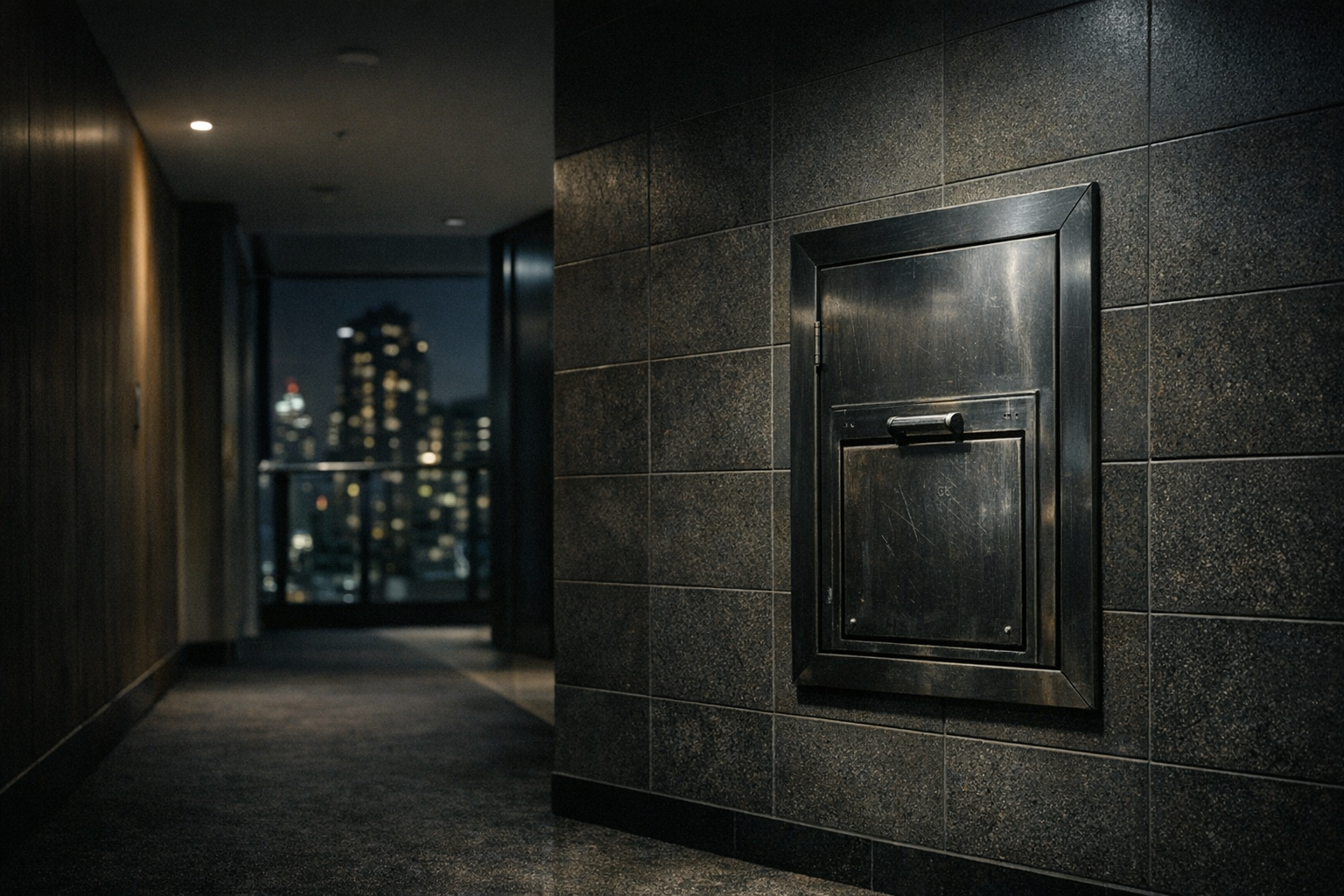
The chute door was never built for a person. It sat in a quiet hallway of a luxury Melbourne apartment tower, waist high, narrow, metal, ordinary in the way dangerous things sometimes are before they become infamous. By the time anyone realized what had happened, Phoebe Handsjuk was already at the bottom of it—twelve floors below, in the refuse room, badly injured, alone, and part of a case that would split public opinion for years.
Who was Phoebe Handsjuk, and why does this case still matter?
Phoebe Handsjuk was a 24-year-old Melbourne woman whose death inside an apartment trash chute became one of Australia’s most debated modern true-crime mysteries. While this was not an unsolved disappearance or a classic missing person case, it still matters for the same reason those cases grip people: the physical evidence, the timeline, and the official explanation have never sat comfortably together.
That tension is why the story refuses to go quiet. Readers who follow contradiction-heavy investigations often end up in stories like What Happened to Missy Bevers? The Church Surveillance Footage and Timing Questions That Still Haunt This Unsolved Murder, where the official narrative exists—but the details keep pulling people back into the room.
On December 2, 2010, nothing about the building on St Kilda Road looked like the setting for a permanent argument. The Balencea apartment complex was the sort of place people imagined as secure: elevators, key access, concierge service, polished common areas, private routines. The kind of place where, if something terrible happened, you would expect the story to come into focus quickly.
Instead, it did the opposite.
Phoebe Handsjuk had been living there with her boyfriend, Antony Hampel. By most public accounts, she was bright, social, physically active, and deeply loved by her family. She also had documented struggles in the period before her death—anxiety, depression, heavy drinking, and instability that people close to the case would later discuss in painful detail. Those facts mattered, but so did another reality: a person can be vulnerable and still deserve an investigation that feels airtight. In this case, that feeling never really arrived.
The final hours began in fragments. Phoebe sent a strange message to members of her family, a text that sounded dreamlike and unsettling enough to alarm them. There was concern almost immediately. At some point that day, CCTV captured her leaving the building briefly with a dog after a fire alarm and then returning. That would become the last confirmed sighting of her alive.
After that, the story narrowed into one apartment, one building, one chute, and one question that has never stopped echoing: how did she get in there?
The official conclusion would be that Phoebe, impaired by alcohol and medication, somehow climbed into the garbage chute herself and fell feet first. The entire case lives inside the physical improbability of that explanation. This was not just a death in an apartment building. It was a death in a space most people cannot imagine entering on purpose, in a way many people cannot imagine happening without help, force, panic, or some missing piece.
When Antony Hampel later returned to the apartment, the scene reportedly raised its own questions. Phoebe was gone, but important personal items were still there. There was broken glass. There were traces of blood. There were two wine glasses. And yet the emotional center of the case was already shifting away from the apartment interior and toward the metal hatch in the hallway, because that chute turned everything else into secondary evidence.
Down in the refuse room, the horror became even worse. Investigators concluded the fall had not killed Phoebe instantly. She suffered catastrophic injuries and appears to have survived long enough to try to move. That detail alone is enough to make the case feel unbearable. It means the mystery is not only about how she entered the chute. It is also about what happened in the final moments after impact—moments no one saw and no one can fully reconstruct.
Timeline of Events
- Earlier that day: Phoebe Handsjuk sends a troubling text message to family members, causing alarm.
- Late morning: CCTV captures her outside the building briefly after a fire alarm before she returns to the apartment.
- Afternoon into evening: No publicly confirmed sighting places her safely elsewhere.
- Later that evening: Antony Hampel returns to the apartment and reportedly finds broken glass, traces of blood, and Phoebe missing.
- About 7 p.m.: A concierge discovers Phoebe at the bottom of the building’s refuse system after a fall through the chute.
- After investigation and inquest: authorities ultimately classify the death as an accident, a conclusion that remains heavily disputed.
That timeline is short, but that is exactly why it stays powerful. Cases like this linger when there are not enough moving pieces to absorb the shock. Everything stays trapped in a tiny frame. A hallway. A hatch. A fall. A body. And then a public explanation that has to carry more weight than many people think it can support.
The chute itself became the case. Reports widely describe it as narrow, vertical, and difficult to enter. To accept the official explanation, you have to imagine Phoebe opening the hatch, lifting herself into position, getting her body through the opening, and falling feet first down the shaft. That sequence is the heart of the controversy. Not because it is theoretically impossible, but because the combination of body position, opening size, intoxication, and surrounding circumstances has never felt ordinary to the people who study the case.
That is why Melbourne still can’t put the story away. It does not behave like a normal accident in the public imagination. Most accidents, even tragic ones, begin to make emotional sense once the mechanics are clear. This one keeps resisting that clarity. Every time people think through the geometry, they get stuck at the same point: not at the bottom, but at the opening.
Phoebe’s family did not accept easy answers. They pushed for more scrutiny and helped force the kind of continued attention that many cases lose once an official ruling appears. That perseverance became part of the story too. The case was no longer just about a disputed death. It was also about whether a family was being asked to accept an explanation that sounded complete on paper but unfinished in the gut.
What Doesn’t Add Up
- The chute opening: The narrow size of the hatch is still central to the debate over whether Phoebe could realistically have entered it unaided.
- The body position theory: The official scenario depends on a very specific physical sequence that many observers have always found hard to picture.
- The apartment scene: Broken glass, blood traces, and multiple household details gave the story a messy backdrop instead of a clean accidental narrative.
- The timing gap: The public timeline never feels spacious enough to dissolve doubt; it compresses the whole mystery into a disturbingly small window.
- The emotional mismatch: An explanation can be legally sufficient and still fail to satisfy the common-sense test people apply to unusual deaths.
The more you read about the case, the more it starts to feel like two stories layered over each other. One is the official version: a tragic accident caused by impairment, confusion, and a bizarre series of movements in a private residential building. The other is the story people cannot stop retelling: a young woman found in a place that feels too mechanically wrong, after a day that already contained warning signs, inside a relationship and environment that outsiders later examined with enormous suspicion.
Those are not the same story, even when they share the same facts.
And that difference is what gave the case such durability online. This is a “what really happened?” case, not because there are endless suspects or twists, but because the physical setup itself keeps acting like a challenge to the ruling. In many disputed-death cases, the argument centers on motive. Here, it centers on mechanics. Before people even ask why, they ask how.
That makes the apartment building feel less like a backdrop and more like a machine at the center of the case. The hallway, the hatch, the shaft, the refuse room—every part of the architecture turns into evidence. Even readers who know nothing else about Phoebe Handsjuk tend to remember one thing: the chute. That is rare. Most true-crime stories are remembered by a person, a suspect, a place, or a weapon. This one is remembered by an opening in a wall.
There is also the emotional violence of the setting. Garbage chutes are impersonal, hidden, and almost industrial. They belong to maintenance, not mortality. That is part of why the case hits so hard. The location strips away normal human context. There is no roadside, no riverbank, no bedroom, no public alley, no open crime scene people can mentally walk through. There is only a sealed vertical space that instantly makes the mind recoil.
And when a case creates that kind of recoil, people rarely let go of it.
Key Evidence and Clues
- The family text message: It suggested distress or altered thinking and became an important part of the day’s emotional timeline.
- CCTV footage: The late-morning sighting established the last widely cited confirmed glimpse of Phoebe alive.
- Toxicology findings: Alcohol and medication were used to support the accidental-fall theory.
- The refuse-room evidence: Signs that Phoebe survived the fall briefly made the case even more haunting.
- The chute mechanics: The narrow opening and disputed feasibility of entry remain the single most debated physical clue.
None of those clues fully closes the gap between possibility and conviction. That is the real reason the case still ranks among the most debated Australian death investigations. It is not simply weird. It is unresolved in a more irritating way than weirdness alone can explain. People keep running the same scene in their minds and landing on different conclusions.
Some believe the accidental ruling, while bizarre, is still the most plausible explanation once intoxication and medication are considered. Others believe the official system locked onto a theory too early and then defended it instead of stress-testing it. Still others do not claim to know exactly what happened but remain convinced the public version is missing essential context.
That middle category may be the biggest of all. It includes people who are not committed to a murder theory and not committed to an accident theory either. They are simply stuck on the physical reality of the chute and the apartment scene. For them, the case remains less a solved debate than a permanent objection.
That is what makes Phoebe Handsjuk such a strong fit for the site’s suspicious-death lane. The story is not built on spectacle alone. It is built on contradiction. Every key detail seems to support a narrative while also damaging it. The toxicology supports impairment, but the chute mechanics still feel wrong. The official ruling offers closure, but the setting resists it. The apartment details add context, but not enough certainty to quiet the case.
In the end, that may be why the story still has such a grip on readers in Melbourne and far beyond it. Not because it is the bloodiest case, or the biggest, or the most famous. But because it remains one of the clearest examples of a death where the central question is almost painfully simple—and still unanswerable in a way that feels emotionally satisfying.
How did Phoebe Handsjuk end up inside that chute?
Everything else, no matter how important, keeps circling back to that.