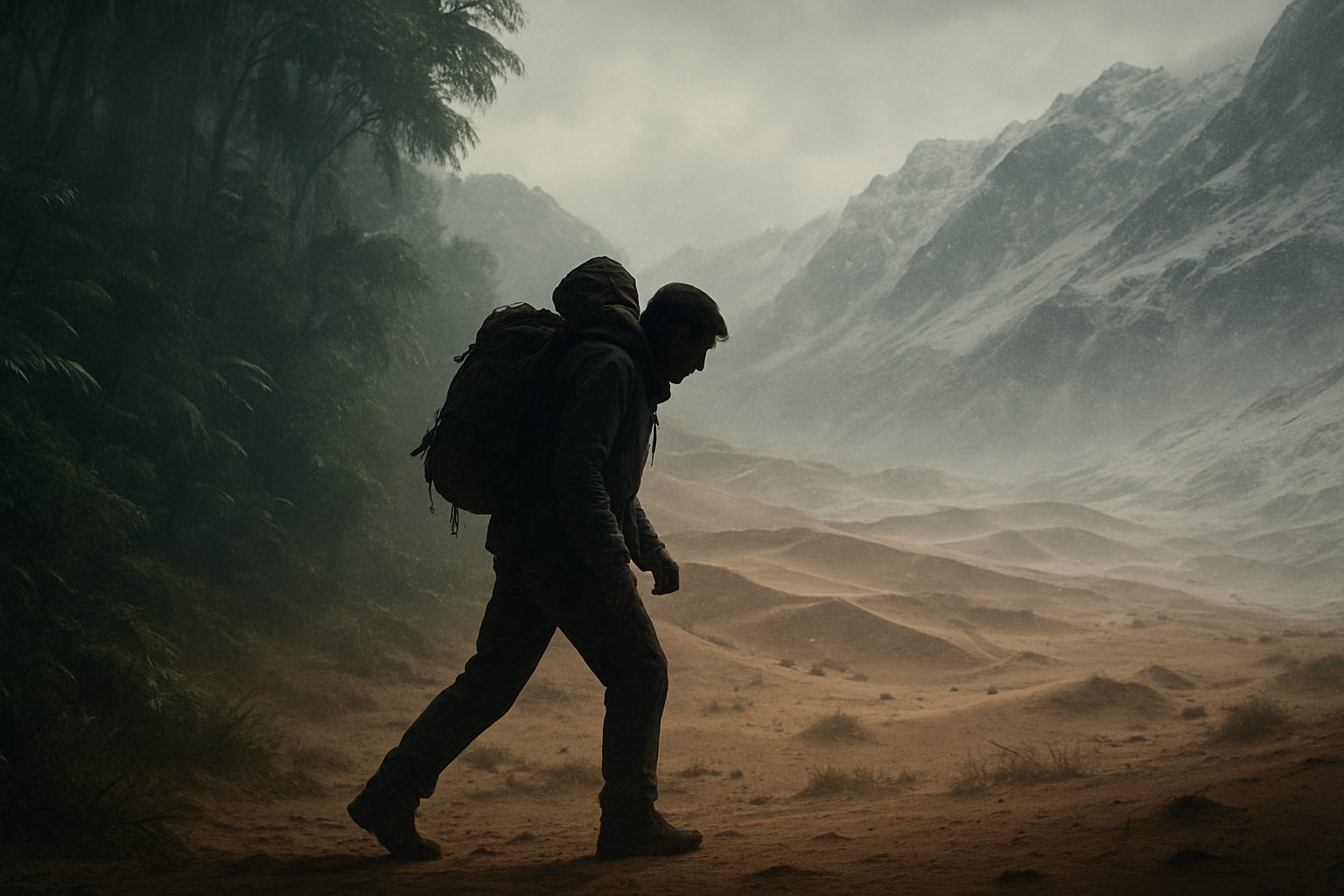
Some survival stories are really stories about weather, injury, or bad luck. Wilderness survival stories hit harder because the real villain is often isolation itself. A jungle can confuse you into circles. A desert can flatten time until thirst and hallucination become part of the same sentence. A mountain can turn one injury or one storm into a private war against cold, altitude, and the knowledge that nobody is close enough to help. What makes these stories unforgettable is not only the danger. It is the loneliness inside it.
This page covers real wilderness survival stories built around solo or near-solo ordeal: jungle disorientation, desert exposure, mountain entrapment, snowbound collapse, and long stretches where survival depended less on dramatic rescue than on whether one person could keep thinking clearly in the wrong landscape. If you came here looking for a generic list, this is not that. This is a focused survival hub about being left alone with terrain, time, and the psychological pressure that comes when nature stops feeling wide and starts feeling personal.
That focus matters because the Survival Stories cluster already has strong hubs for buried-alive rescues, ocean ordeals, and crash aftermaths. What was missing was a stronger wilderness spine: the stories where the environment does not just threaten the body, but slowly works on the mind. In that sense, the wider Survival Stories Archive already points in this direction. The cases below tighten the lens. They collect survival stories where being alone became the most dangerous condition of all.
These cases matter because wilderness survival is rarely one clean problem. It is usually a stack of problems that feed each other. The injury limits movement. The terrain steals orientation. The weather punishes delay. Hunger and thirst change judgment. Night makes everything feel farther. And once the survivor realizes nobody is coming soon, solitude itself becomes part of the threat. Not survival as spectacle, but isolation as the engine that makes every decision heavier.
Seen side by side, these stories also reveal how different landscapes force different kinds of endurance. Jungle survival becomes a war against confusion, infection, insects, and hidden water routes. Desert survival becomes a negotiation with heat, dehydration, and hallucination. Mountain survival turns every mistake into a time bomb involving exposure, altitude, or immobility. Snow and ice add a second level of cruelty by making stillness feel deceptively safe right before it becomes fatal. Together, these are not random survival stories. They are variations on one punishing theme: the moment a human being realizes the landscape has become an opponent and there is no easy way out.
Real Wilderness Survival Stories Where Being Alone Became the Real Enemy
Yossi Ghinsberg
Yossi Ghinsberg’s survival story belongs near the center of this hub because it shows how fast wilderness can become psychological warfare. Lost in the Amazon, Ghinsberg was not just hungry or exhausted. He was cut off inside a landscape that destroys orientation. Jungle survival has a special cruelty: everything is alive, everything is wet, and almost nothing looks stable long enough to trust. The deeper he moved into that green world, the less the jungle felt like scenery and the more it felt like an intelligence pressing back.
Isolation did most of the damage. The jungle did not merely threaten Yossi with injury or exposure. It steadily worked on his sense of direction, hope, and reality. Hallucination, despair, and the urge to stop moving became as dangerous as the physical terrain. The key mystery point is not whether the Amazon is dangerous. It is how long a human mind can stay organized after days alone in a landscape that seems designed to erase intention.
Read the full case here: Yossi Ghinsberg Survival Story — Lost in the Amazon for 3 Weeks and the Moment the Jungle Turned Against Him.
Mauro Prosperi
Mauro Prosperi’s Sahara ordeal belongs here because deserts punish the body openly and the mind quietly. Prosperi’s story begins with athletic endurance and quickly becomes something more primitive: a man stripped of normal bearings inside a place where heat, distance, and monotony distort judgment. Desert survival stories often sound simple from a distance — find shade, conserve water, keep moving carefully — but the Sahara makes even those ideas unstable once the landscape grows larger than the plan.
It fits the angle because isolation turns the desert into a psychological trap as much as a physical one. With Mauro Prosperi, the key mystery point is not merely how long one person can survive on almost nothing. It is how the mind behaves when the horizon offers no reassurance, no obvious route, and no clean sign that the next step is better than the last. Alone in the Sahara, time itself started working against him.
Read the full case here: Nine Days of Sand: The Runner the Sahara Tried to Erase.
Aron Ralston
Aron Ralston’s canyon survival story fits this hub because wilderness isolation does not always mean endless wandering. Sometimes it means being trapped in one terrible place with too much time to understand exactly what is happening. Ralston’s ordeal in Blue John Canyon is famous for one reason above all others: the decision that eventually let him live. But the survival story before that decision is just as important. He was alone, pinned, and forced into a narrowing countdown where every hour made rescue less likely and the reality of self-extraction more unavoidable.
Solitude removed the comforting fiction that someone would arrive in time. The canyon became a closed system: one injured man, one trap, one dwindling set of options. The key mystery point is not whether the decision was extreme. It is what prolonged isolation does to the way a person measures pain, probability, and the value of one more day alive.
Read the full case here: Aron Ralston — Rebuild It Around the Trap, the Countdown, and the Decision Nobody Wants to Imagine.
Hugh Glass
It fits the angle because isolation magnified every practical problem. Severe injury is one kind of danger; severe injury while alone in wilderness is another entirely. The key mystery point is how a person keeps choosing motion when pain, exhaustion, and distance all argue for collapse instead. Hugh Glass fits this hub not because the legend is big, but because the deeper pattern is clear: the landscape became a test of whether human will could stay intact after everything else had broken down.
Read the full case here: Hugh Glass Survival Story — Left for Dead and Crawled 200 Miles.
Beck Weathers
Beck Weathers on Everest adds the high-altitude version of the same fear. Mountain survival stories are often told through avalanche, summit ambition, or storm drama, but what makes Weathers essential to this hub is the long private collapse inside exposure. Everest is full of people and yet can still produce the same loneliness as the desert or jungle because altitude, weather, and physical deterioration separate the survivor from normal human reach. The mountain does not have to be empty to make a person feel alone. It only has to become inaccessible at the wrong moment.
Isolation on a mountain is often measured in function rather than distance. Once a climber’s body starts failing, the surrounding team can become abstract, the route can become unreal, and survival turns into a struggle to re-enter the world of movement and decision-making. The key mystery point is how someone left in storm conditions can return from the edge of exposure after the mountain has already begun treating them like part of the terrain.
Read the full case here: Beck Weathers Survival Story — Left for Dead on Everest, Then Somehow He Walked Back Into the Storm.
Juliane Koepcke
Juliane Koepcke’s survival story completes this set because it bridges crash survival and wilderness isolation perfectly. The plane breakup is unforgettable, but the deeper wilderness story starts after she wakes alone in the Peruvian rainforest. At that point, the spectacle is over and the real ordeal begins: injury, shock, jungle disorientation, and the terrifying fact that survival depends on keeping a mind organized while the environment keeps trying to overwhelm it.
Juliane’s solitude begins after an impossible fall and then becomes a quieter, more intimate struggle against the jungle itself. The key mystery point is how she turned memory, discipline, and movement into a survival system before panic could harden into fatal confusion.
Read the full case here: Juliane Koepcke Survival Story: The Fall From 10,000 Feet and the 11 Days the Jungle Tried to Finish.
What These Wilderness Ordeals Have in Common
The strongest common thread in these cases is not simply danger. It is delayed danger under isolation. None of these people were facing one clean impact followed by immediate rescue. They were facing landscapes that kept producing new problems after the original crisis. The jungle adds infection, confusion, and psychological distortion. The desert turns thirst into decision-collapse. The canyon makes time itself claustrophobic. The mountain punishes weakness with exposure, altitude, and disorientation. Historical wilderness strips away any expectation of modern help. In every case, aloneness converts an emergency into a system.
Another pattern ties them together: survival becomes mental before it becomes logistical. The body needs water, heat, movement, and shelter, but the mind has to keep building a next step even after hope starts thinning. That is why these stories stay with readers. The physical feats are dramatic, but the deeper question is always the same: what keeps a person from surrendering when nobody is close enough to witness the surrender?
These stories also work as a strong internal-link cluster because readers who respond to one kind of isolated ordeal often want another with the same emotional structure but a different terrain. Jungle readers move naturally toward desert stories. Desert readers often want mountain exposure or trap survival next. Mountain readers are primed for another case where weather and solitude eat away at ordinary judgment. That is how a real archive becomes more than a shelf of articles. It becomes a documentary pathway through variations of the same human stress test.
There is also an uncomfortable lesson underneath all of them. Wilderness does not need to be supernatural or mysterious to become terrifying. It only needs to become bigger than your plan and farther from your support than you expected. Once that happens, the silence around a person starts doing real work. It changes what pain means. It changes how long an hour feels. It changes which choices look possible. In these stories, the landscape is never just background. It is the force that turns survival into a personal negotiation with time.
Readers searching wilderness survival stories are usually not looking for one isolated anecdote. They want a pattern they can recognize. They want to understand how being lost in jungle terrain differs from being immobilized on a mountain, how dehydration in the desert scrambles decision-making differently than cold exposure on Everest, and how a trapped canyon ordeal becomes a countdown instead of a wandering journey.
Look closely enough and each environment reveals its own signature pressure. In the jungle, the survivor is overwhelmed by too much life, too much sound, too many possible wrong turns, and the constant sense that one misread riverbank or one bad footstep can multiply into days of consequence. In the desert, the opposite happens: the landscape feels stripped bare, and that emptiness becomes its own form of assault because there is so little shade, so little error tolerance, and so little feedback that the next direction is truly better. In mountain survival, the terrain becomes a vertical trap where weather, injury, and altitude can make stillness feel safer right before stillness becomes fatal. That contrast is part of what makes this cluster durable.
The stories here also expose a more human truth about survival narratives: rescue is often over-romanticized, while lonely endurance is underrated. Some survivors are eventually found. Some stagger into human contact. Some make one brutal decision that keeps the story moving. But before any of that, there is usually a long middle section where no crowd is watching and no guarantee exists. That middle is where the real identity of a wilderness survival story forms. It is where discipline matters more than drama, where patience becomes a life-saving skill, and where the survivor’s private relationship with fear becomes more important than any cinematic climax.
For the site itself, that makes wilderness content unusually valuable as a hub. These stories are naturally bingeable because each one asks the reader to test the same question under different conditions: if you were alone here, how long would your judgment hold? How long before heat, pain, cold, thirst, injury, infection, or sheer silence began changing the way you thought? That recurring question gives this archive structure. It is not just six strong pages linked together. It is one documentary idea expressed through six different landscapes.
Conclusion
What makes wilderness survival stories so hard to shake is not only that the settings are beautiful and dangerous. It is that the survivor usually reaches a point where beauty stops mattering and the landscape becomes a private adversary. The jungle confuses. The desert empties. The mountain isolates. The canyon traps. The long route home becomes a test of whether the mind can keep producing one more action after certainty has already failed.
It gives the archive a dedicated hub for real solo-ordeal wilderness cases — not generic survival, but the specific pattern where being alone becomes the most dangerous fact in the story. Yossi Ghinsberg, Mauro Prosperi, Aron Ralston, Hugh Glass, Beck Weathers, and Juliane Koepcke all show different versions of the same deeper truth: the body survives the landscape only if the mind can keep resisting what isolation is trying to do to it.
There is authority in that pattern because it turns scattered stories into a real category of experience. These are not simply famous survivors placed on one page for convenience. They are connected by the same unnerving progression: a plan fails, the environment expands, help grows abstract, and the survivor has to keep manufacturing order in a place that no longer offers any. Once you see that progression clearly, the cluster becomes stronger for both readers and search. The page stops being a roundup and starts functioning like a map of how solitude behaves under pressure.
If that pattern is what pulls you in, this is the spine you follow next. From here, the broader survival archive opens outward into crashes, buried rescues, and ocean ordeals. But wilderness is where the silence feels most personal, and that is exactly why these cases keep holding on. They are not just about living through terrain. They are about resisting the slow mental unraveling that terrain tries to cause when nobody else is there to absorb any part of it for you.
That is the lasting hook behind every story collected here. In the end, the jungle, desert, mountain, canyon, and snowfield do not need to kill quickly to become lethal. They only need to keep one person alone long enough for time, fear, and environment to start working together. The survivors above matter because, in very different ways, they all found a way to interrupt that process before the silence finished the job.
🔎 If this story stayed with you, the author suggests these deeper investigations next:
- The wider survival archive covering wilderness, buried rescues, ocean ordeals, and plane disasters
- Plane crash survival stories where the aftermath became the real ordeal
- Buried alive survival stories where tiny sounds became proof of life
Explore more Survival Stories stories here: