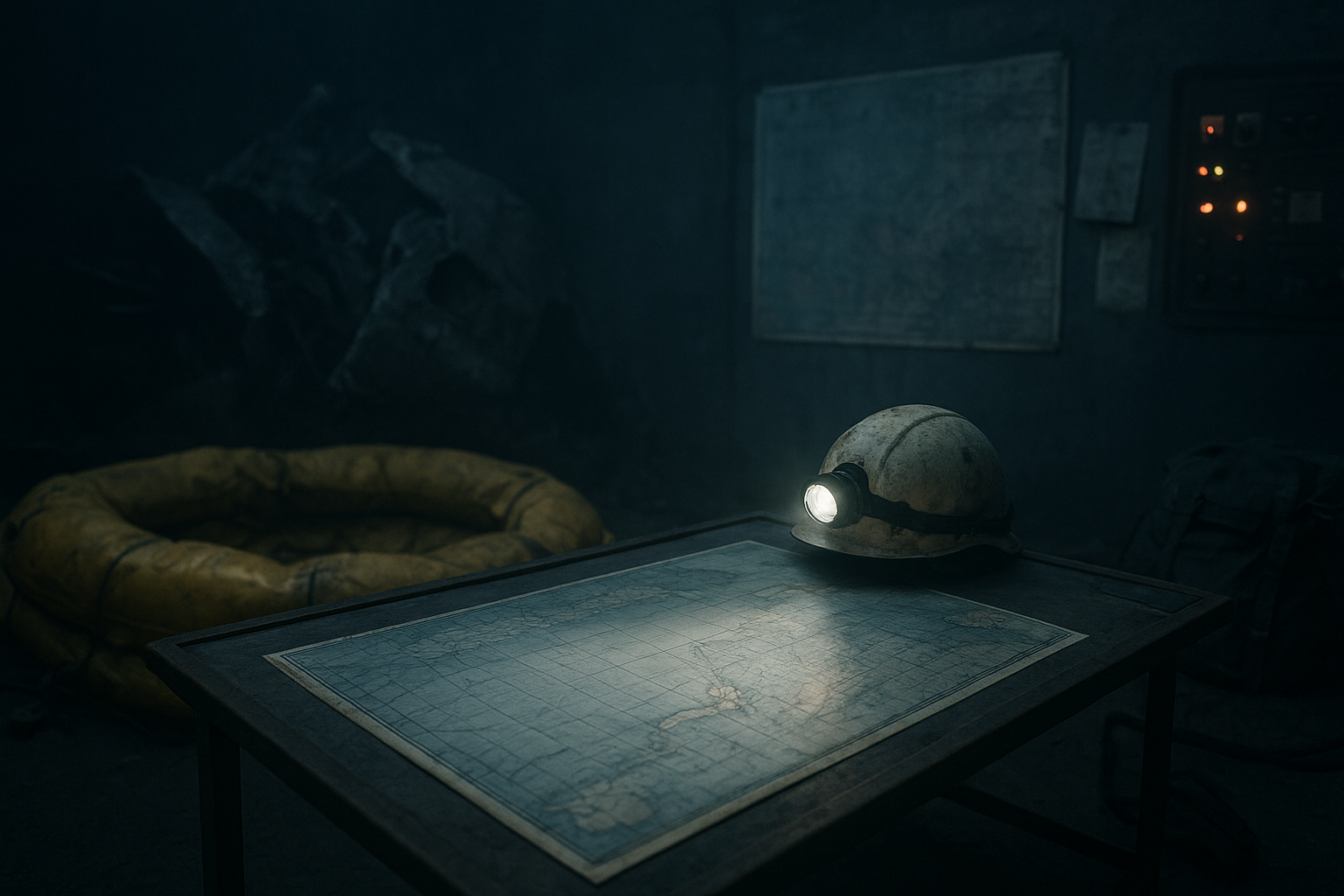
Buried alive survival stories unsettle people for a different reason than shipwreck stories or wilderness ordeals. In most survival narratives, the threat comes from exposure, distance, or time. In buried-alive stories, the threat is compression. It is darkness, weight, air, silence, and the possibility that help may be standing close enough to save you and still never know you are there. That is what makes these cases linger. They are not about being lost in open space. They are about being sealed inside the wrong one.
This page covers real survival stories where entrapment became the central horror: a child trapped in a well, survivors pinned beneath concrete, people buried in rubble, underground voids, wreckage, and sealed compartments where the smallest sound became the only bridge between the trapped and the living. Some of these rescues depended on knocking. Some depended on tapping. Some depended on someone hearing a voice, a scrape, or the faintest pattern that proved life had not gone out yet.
These cases matter because they reveal survival at its most claustrophobic. There is usually no heroic movement, no obvious escape route, and often no way for the trapped person to do much beyond endure, ration breath, fight panic, and keep making some kind of signal. That is why this cluster has such strong binge potential. Each case changes the setting — a well, a collapsed building, a submerged ship, a buried chamber, a trapped pocket of debris — but the emotional mechanism stays brutally consistent. Someone is alive in a place that should already be a tomb, and the only real question is whether the world will hear it in time.
Buried Alive Survival Stories Where Sound Became the Only Lifeline
Baby Jessica Rescue — 58 Hours Underground and the Entire World Listening
Baby Jessica Rescue remains one of the clearest examples of why buried-alive survival stories grip people so hard. A toddler trapped in a narrow Texas well created a rescue scene that felt both intimate and global: one child underground, rescuers digging beside her, and a nation fixated on the terrifying fact that survival depended on reaching a space no human body was meant to occupy for long. The story is famous, but the fear inside it has never become ordinary.
The rescue was shaped by confinement first and heroism second. Jessica McClure was not wandering, drifting, or outrunning anything. She was trapped below the surface in a shaft so unforgiving that the effort to save her became a battle against geometry, depth, and time. The key mystery point is not what happened to put her there. It is how rescue teams managed to turn an almost impossible underground position into a survivable outcome.
That is why the case still functions as more than a media memory. It set the emotional template for this entire subcluster: unbearable confinement, a rescue operation built under pressure, and the knowledge that every sound from below mattered. Read the full case here: Baby Jessica Rescue — The 58 Hours Underground That Turned One Texas Well Into a Global Vigil.
Reshma Begum Survival — Found Alive Beneath the Rubble After 17 Days
Reshma Begum Survival belongs near the center of this hub because it represents the long-duration version of buried entrapment. The collapse of Rana Plaza created a catastrophe measured in concrete, dust, crushed floors, and mass death. What made Reshma Begum’s survival feel almost impossible was not merely that she was trapped. It was that she remained alive beneath that ruin for seventeen days, long after normal expectations of rescue had begun to fail.
It fits the angle because rubble itself became both prison and accidental shelter. That is one of the paradoxes in buried-alive survival stories: the same debris that should kill a person can sometimes create the void that keeps them alive. The key mystery point is how life holds together inside that kind of compressed darkness after food, water, injury, heat, and hopelessness should already have done their work.
Cases like this also deepen the authority of the cluster because they move beyond spectacle and into endurance. Rescue here is not simply dramatic. It is almost geological. The survivor becomes part of the wreckage until one sign of life breaks the illusion that everything underneath is already still. Read the full case here: Reshma Begum Survival — Found Alive Beneath the Rubble After 17 Days.
The Knock Under the Ruins: Sylmar’s Longest Four Days
It belongs in this roundup because it narrows the theme to its purest form: a rescue driven by listening. The key mystery point is how rescuers keep faith with a faint signal in an environment designed to deceive them with shifting debris, dead air, and false hope. Stories like this are not only about who survives. They are about whether the rescuers can interpret life correctly before exhaustion or silence wins.
That is also why the case strengthens the broader cluster architecture. It connects naturally to other rubble rescues, underground survivals, and trapped-void stories where a knock becomes more meaningful than a visible clue ever could. Read the full case here: The Knock Under the Ruins: Sylmar’s Longest Four Days.
Buried Alive in the Andes: The Night Baquedano Disappeared
Buried Alive in the Andes adds a colder, more isolated version of the same fear. The landscape changes. Instead of urban collapse or industrial debris, the threat comes from a harsh mountain setting and the violence of being swallowed by terrain itself. That shift matters because it widens the buried-alive subcluster without weakening it. Entrapment does not need a city. Earth and altitude can do the same work that concrete and steel do elsewhere.
The real terror is not only disappearance. It is disappearance into a space that may hold the body alive and hidden at the same time. The key mystery point is whether survival can endure inside a sealed natural trap long enough for someone to detect it.
The story also proves why the phrase “buried alive” keeps such a grip on readers. It does not have to be literal in the old Gothic sense. It can mean snow, earth, collapse, or the sudden conversion of the environment into a lid. Read the full case here: Buried Alive in the Andes: The Night Baquedano Disappeared.
Armenia 1988: The Mother Who Refused to Let Her Baby Die
Armenia 1988: The Mother Who Refused to Let Her Baby Die belongs here because buried-alive survival stories become even more harrowing when entrapment is shared. The Armenian earthquake did not leave behind a tidy single-survivor chamber. It left devastation. Inside that devastation, one mother and her trapped child turned survival into an act of refusal measured hour by hour. The claustrophobia is physical, but the emotional force comes from the relationship inside the void.
It is built around trapped life sustained in conditions that should have closed already. The key mystery point is not just how they were found. It is how survival choices become almost unbearably intimate when the trapped space contains someone you are trying to keep alive in addition to yourself.
That makes the story one of the strongest bridges between disaster survival and buried-alive rescue. It is not only about debris. It is about love behaving like a life-support system underground. Read the full case here: Armenia 1988: The Mother Who Refused to Let Her Baby Die.
The Knock in the Dark: 60 Hours Alive Inside a Sunken Ship
The Knock in the Dark shifts the setting from rubble to waterlogged steel, but the survival mechanics remain uncannily similar. Harrison Okene was not technically underground, yet he was sealed inside a dark pocket that functioned like a submerged burial chamber. The world outside assumed the ship was lost. Inside, one man stayed alive in a shrinking air pocket and waited for rescue divers to detect what should have been impossible: a living presence in a drowned wreck.
It fits this roundup because it proves the buried-alive feeling is not limited to earth. Entrapment inside metal can produce the same psychological structure — darkness, pressure, isolation, and total dependence on being heard before the remaining livable space gives out. The key mystery point is how a person remains coherent enough to keep signaling in that kind of blackness when the sea has already transformed the ship into a grave.
It lets the cluster reach beyond earthquakes and wells into maritime entrapment without losing thematic discipline. Read the full case here: The Knock in the Dark: 60 Hours Alive Inside a Sunken Ship.
The Knocking Beneath Pearl Harbor
It fits the central question cleanly. This is not a battle story first. It is an entrapment-and-listening story. The key mystery point is how long sound can keep hope alive in an environment where rescue is technically possible but physically brutal, slow, and uncertain. When tapping becomes the only form of communication left, the story moves directly into the same emotional territory as collapsed buildings and sealed shafts.
That is why the case works so well as support inside this hub. It broadens the archive historically while keeping the rescue logic intact. Read the full case here: The Knocking Beneath Pearl Harbor.
The Sound That Saved Them
That makes the case a natural supporting node. It reinforces the page’s central claim that the smallest signal can become decisive when people are trapped in spaces rescuers cannot easily see into. The key mystery point is whether the rescuers recognize the sound in time and trust it enough to keep digging toward it.
They reveal the recurring mechanism underneath multiple events: when entrapment hides the body, sound becomes the biography of hope. Read the full case here: The Sound That Saved Them.
Why These Buried-Alive Survival Stories Still Don’t Let Go
What these cases have in common is not merely entrapment. It is the way entrapment transforms survival into a contest between silence and signal. In open-water or wilderness stories, the survivor may try to move toward help. In buried-alive stories, movement is often impossible or dangerously limited. The body is pinned, sealed, submerged, or boxed into a void. That changes everything. Survival stops looking like escape and starts looking like endurance plus communication — or at least the attempt at communication.
Another pattern links these cases: the environment that nearly kills the survivor sometimes also creates the tiny condition that keeps survival possible. A collapsed building leaves a void. A wrecked ship traps an air pocket. Debris shields part of the body. A shaft or enclosed space preserves just enough room to breathe. This is why buried-alive stories are so psychologically difficult. Death and survival occupy the same physical structure. The tomb and the shelter can be the same place.
These rescues also reveal how much depends on other people interpreting incomplete evidence correctly. Someone has to hear the knock. Someone has to believe the tap was real. Someone has to keep digging when exhaustion and probability argue the other way. In that sense, buried-alive survival is never only about the trapped person. It is also about the rescuers’ willingness to keep treating faint signals as possible life rather than residual noise.
That is what gives this subcluster real authority value. The posts do not merely share a vague theme of survival. They are connected by a precise emotional and structural mechanism: entrapment, hidden life, and detection through the smallest possible signs. Once readers enter that pattern through Baby Jessica, Reshma Begum, Sylmar, Pearl Harbor, Armenia, Baquedano, or the submerged-ship case, it becomes natural to move from one to the next because each case tests the same nerve from a different direction.
There is also a deeper reason these stories stay in people’s heads. They confront one of the oldest human fears without reducing it to superstition. Being buried alive is terrifying because it combines helplessness with proximity. Help might be close. Air might still remain. Life might still be there. And yet everything depends on whether the barrier between the trapped and the living can be crossed in time. That is more agonizing than simple disappearance. It is presence without reach.
Seen together, these cases also show how varied buried-alive survival can be. One story begins in a well. Another under earthquake rubble. Another in mountainous burial. Another in a flooded ship. Another inside wartime steel. Another in a pocket of debris where a mother fights to preserve life for someone smaller and weaker than herself. The surfaces change, but the core drama does not. The trapped person must remain alive long enough to be found, and the world above must keep listening long enough to prove the difference between death and delay.
Conclusion
The most haunting buried alive survival stories are not really stories about dramatic escapes. They are stories about suspended endings. Someone is still alive in a place that should already have sealed shut, and the outcome depends on breath, time, signal, and rescue work measured in inches rather than miles.
It gathers a precise survival pattern — wells, rubble, voids, wreckage, underground spaces, and sealed compartments where knocks, taps, and tiny sounds became evidence of life — and turns those individual pages into a coherent binge path. Each case answers the same terrible question from a slightly different angle: how do you survive when the world cannot see you?
And the answer, again and again, is never clean. Sometimes survival comes from a hidden air pocket. Sometimes from a void in the debris. Sometimes from endurance so prolonged it feels almost offensive to probability. Sometimes from the rescuers who refuse to stop believing the next sound is human. That is exactly why these stories stay with readers long after the mechanics of the rescue are over.
🔎 If this story stayed with you, the author suggests these deeper investigations next:
- Plane crash survival stories where the aftermath became the real ordeal
- Lost-at-sea survival stories built around drift, wreckage, and endurance
- The wider survival archive covering buried survivors, ocean ordeals, crashes, and wilderness escapes
Explore more Survival Stories stories here: