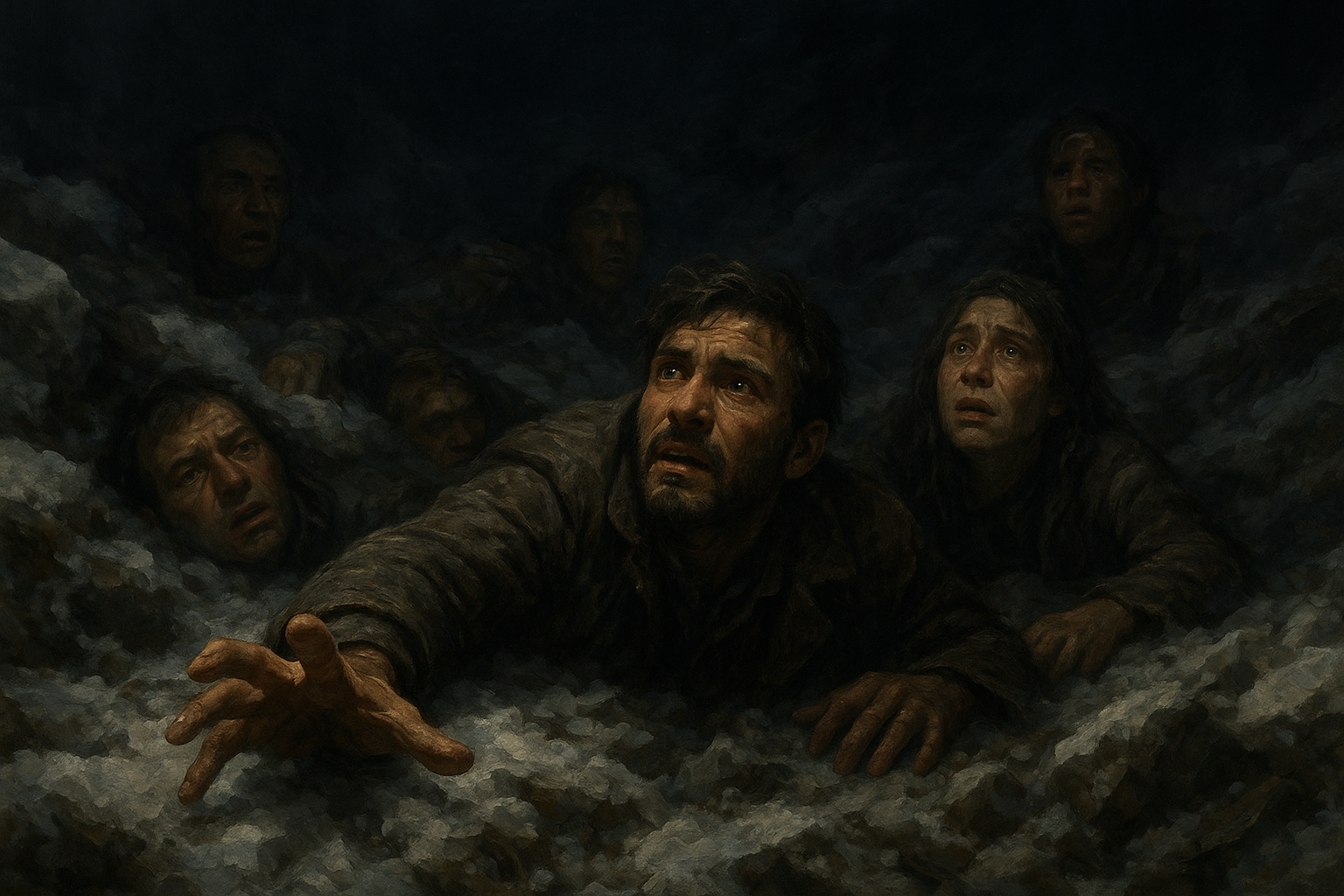
The avalanche did not arrive like a movie explosion. It arrived like a betrayal.
On the night the slope above Baquedano finally gave way, families in the Chilean Andes were doing the most ordinary things imaginable. Lamps were lit. Dinner was still warm. Children were close to the stove. Outside, the wind had been rising for hours, but mountain weather always carried a little menace, and people who lived there had learned not to panic every time the walls shook. Then, in a matter of seconds, the mountain stopped sounding like weather and started sounding like impact. Snow, ice, rock, and torn earth broke loose above the settlement and came down hard enough to erase homes before some people even understood what they were hearing.
That is what makes the Baquedano avalanche linger. It was not just a story about people trapped under snow. It was a story about how quickly an ordinary evening can become a fight for air in complete darkness.
Buried Alive in the Andes: The Night Baquedano Disappeared is one of those survival stories that still feels cinematic because nearly every survivor described the same thing after the roar ended: silence, blackness, and the sick realization that the world above them might already be gone. If you tend to get pulled into ordeal-driven rescues, the broader Survival Stories Archive shows just how often survival comes down to a tiny pocket of space and a few impossible decisions.
Most of Baquedano had settled in by sunset. People talked about the road, about the cold, about whether the storm would still be bad by morning. No one was talking as if the entire mountainside might come through the walls. Then the dogs started barking. Later, survivors remembered that detail with eerie precision, because the barking ended just before the avalanche hit, as if the valley itself had paused.
When the slab finally fractured high above the settlement, the first sound was distant enough to be mistaken for thunder. Then the break widened, the snowpack released, and the slide accelerated down the chute. By the time it reached the houses, it was no longer a soft white drift. It was a dense moving mass of snow, ice, stone, timber, and force. Entire walls blew inward. Roofs vanished. Stoves flipped. Lamps shattered. Families who had been sitting around tables were suddenly blind, pinned, and buried.
For some people, the first seconds after impact were the worst because there was still enough awareness to understand what had happened. Others woke later inside pockets so small they could not tell whether they were under a roof, under a table, or under the mountain itself. Seventeen-year-old Elena Rojas was one of the survivors later remembered for enduring the burial in that half-conscious state between panic and practicality. She woke unable to move her legs, with a beam pressing across her chest and packed snow holding the rest of her body in place. Every breath felt thin and sharp. She could not sit up, could not turn, and could barely call out, but she was alive because the collapsed furniture around her had created just enough space for air.
Nearby, brothers Luis and Mateo Fuentes were trapped shoulder to shoulder beneath what had been their kitchen ceiling. One of them had an arm partly free. The other could barely move. In disasters like this, survival often comes down to tiny repeated actions that sound almost meaningless when written down. Clear the snow from someone’s mouth. Speak every few minutes so the other person does not drift away. Strike metal when you hear voices above. Conserve breath when the cold makes panic feel urgent. Those are not dramatic gestures. They are the decisions that keep a buried person in the fight long enough for rescue to matter.
Timeline of Events
- Late afternoon: Wind intensifies and fresh snow continues to load the steep face above the settlement.
- Evening: Families move indoors as conditions worsen, but there is no clear sign that a catastrophic release is moments away.
- Just after dark: The overloaded slab fractures and the avalanche tears down toward the homes below.
- Seconds later: Houses in the slide path are crushed or buried under dense debris, snow, and shattered building materials.
- First hours of the night: Neighbors begin digging for neighbors with lanterns, axes, shovels, and bare hands.
- Before dawn: The first professional responders reach the site, but the avalanche field is already compacting into a harder, more dangerous surface.
- Next morning into the second day: Survivors are found in scattered air pockets while other victims remain buried deep under hardened snow and debris.
That first night above ground was almost as brutal as the burial below it. There were no floodlights, no immediate heavy machines, and no clean rescue corridor. The people on the edge of the slide zone began with whatever they had: lanterns, farm tools, and the willingness to dig toward any sound that might mean somebody was still alive.
By the time professional responders arrived before dawn, they were no longer racing against impact alone. They were racing against cold, compaction, and silence. A child was pulled out after surviving beneath a mattress that had preserved a small pocket of air. Elena Rojas was found after roughly ten hours under the wreckage. When rescuers finally lifted the beam from her chest, she blacked out from pain. When she woke again, she was on a stretcher under a sky so bright it hurt. That detail stays with people because it captures the violence of survival: one moment total blackness, the next unbearable light.
Luis and Mateo Fuentes lasted even longer. Their air pocket was smaller, and the rescue depended on sound. One of them reportedly began striking a pipe with a spoon to create a metallic ping at intervals. Above them, wind kept swallowing the noise. Only when rescuers ordered a full hush during another sweep did the sound come through clearly enough to follow. That kind of moment is why buried-survivor stories hit so hard. Rescue is sometimes not about strength at all. It is about hearing the right sound before the mountain decides to keep it.
If that detail is the part that gets under your skin, this story sits naturally beside Buried Alive Survival Stories, where survival begins with the smallest proof that someone below the debris is still there.
How Rescuers Pieced Together the Scene
In the days after the avalanche, the rescue effort slowly turned into reconstruction. Not just rebuilding structures, but rebuilding the final minutes.
- Weather pattern: Successive storms had loaded the slope with fresh accumulation.
- Wind drift: Strong gusts likely packed unstable snow into a slab above the settlement.
- Terrain funnel: The topography gave the avalanche a direct chute into the homes below.
- Impact field: The damage pattern showed the slide was carrying more than snow; it had become a debris wave of rock, timber, and frozen earth.
- Survival pockets: Those who lived were often shielded not by open space, but by accidental geometry: a table, a beam, a mattress, a roof angle that failed in exactly the least lethal way.
That unevenness is part of what made the disaster so hard to absorb afterward. One room became a coffin. The next became a pocket. Even after the first survivors were found, the mountain kept dictating the tempo as weather, fresh snow, and the threat of secondary slides slowed the search for the missing.
What Made Survival Possible
Survival in Baquedano did not come from one heroic act. It came from a chain of smaller things that kept people alive long enough for help to reach them.
- Air pockets: Furniture, broken beams, and collapsed roof angles created tiny breathable spaces.
- Noise discipline: Tapping, calling out, and listening in silence helped rescuers find buried survivors.
- Immediate local response: Neighbors began digging long before formal teams could fully take over.
- Endurance under pressure: Survivors who stayed calm enough to ration movement and conserve breath improved their odds.
- Persistence above ground: Rescuers kept working through cold, wind, fatigue, and the real danger of new slides.
That is part of why the story still feels heavier than a simple disaster summary. It is not only about the avalanche itself. It is about the hours after the avalanche, when the outcome depended on people refusing to accept silence too quickly. The real emotional center of the story is not the moment the mountain came down. It is the long dark stretch afterward, when buried survivors kept making tiny sounds and people above them kept digging toward those sounds.
In that sense, Baquedano belongs to a very specific branch of survival stories: the ordeal where rescue feels close enough to imagine but still far enough to die before it arrives. Readers who end up wanting another version of that pressure can move from this case into The Knock Under the Ruins or into the broader mountain-and-endurance lane with The Night K2 Went Silent and The Man Who Would Not Break.
Years later, survivors still returned to the same sensory memories: kerosene, wet wool, splintered wood, the pain of breathing cold air inside a crushed pocket, and the unnatural brightness of morning after hours underground. Most of all, they remembered the silence after the roar.
That is why this story endures. It is not just about death narrowly avoided. It is about how fragile ordinary life can be in places where nature keeps the final say. One minute there was dinner, lamplight, and conversation. The next there was impact, darkness, and a human being trying to measure survival one breath at a time.
FAQ
What happened in the Baquedano avalanche?
The Baquedano avalanche was a deadly mountain disaster in central Chile in 1965, when an overloaded slope released above a settlement and buried homes under snow, debris, and wreckage. Some residents were killed, while others survived in tiny air pockets until rescuers reached them.
How did people survive being buried under the avalanche?
Survival usually came down to chance and endurance. Collapsed beams, tables, mattresses, and roof angles created small spaces where some victims could still breathe. Those survivors then had to stay conscious, conserve energy, and make enough noise for rescuers to locate them.
Why is the Baquedano avalanche story still remembered?
It stays with people because of the contrast between the ordinary evening before the slide and the total darkness afterward. It is also remembered for the rescue effort, where neighbors and responders kept digging through hardened debris while listening for the faintest signs of life.
Was the Baquedano avalanche a typical mountain disaster?
It followed patterns common to avalanche tragedies, including heavy snow loading, unstable terrain, and sudden collapse, but the human details make it stand out. Survivors described not just the impact, but the long, cold hours trapped beneath the debris while rescue was happening somewhere above them.
🔎 If this story stayed with you, the author suggests these real cases next:
- A buried survivor story where the rescue depended on one sound under the wreckage
- A wilderness ordeal where getting lost became a slow fight against the elements
- A mountain disaster where the climb turned into a silence nobody forgot
- A full archive of survival stories built for late-night rabbit holes
Explore more Survival Stories here: