
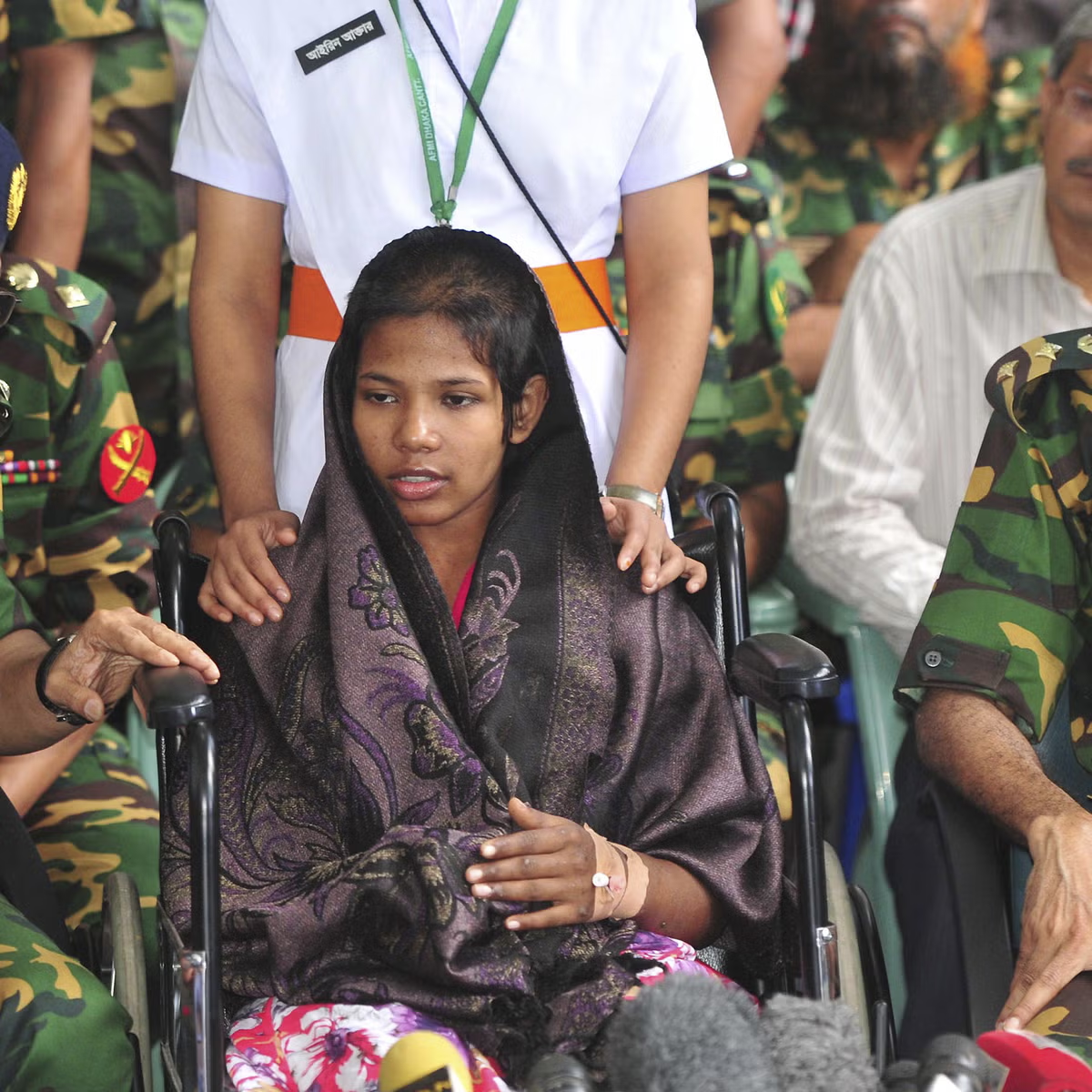
The darkness under Rana Plaza was the kind that made time feel broken. Dust hung in the air so thick it turned every breath into work. Somewhere above, concrete kept settling with slow, hateful groans. Somewhere nearby, people had screamed, then gone quiet. And in a narrow pocket inside the wreckage of a collapsed factory building, a 19-year-old garment worker named Reshma Begum realized the worst part was not the impact. It was the waiting that came after, when the world moved on overhead and she had no way to know if anyone would ever hear her again.
Reshma Begum’s survival story began inside the 2013 Rana Plaza collapse in Savar, Bangladesh, one of the deadliest industrial disasters in modern history. She survived for 17 days beneath the rubble, trapped in darkness until rescuers finally heard a voice that almost no one still believed could be there. That is why the case still lingers: not just as a miracle rescue, but as a human story buried inside a catastrophe the world should never have allowed.
Stories like this rarely stay alone for long. If the rescue-clock tension in this case pulls you in, the archive’s disaster survival stories collection shows how ordinary mornings can turn into impossible countdowns in a matter of seconds.
The Morning Everyone Knew Something Was Wrong
By the time workers returned to Rana Plaza on April 24, 2013, the building had already warned them.
Cracks had appeared the day before—large, visible cracks that ran through the structure badly enough for bank staff and shopkeepers on lower floors to panic. Some businesses shut down. Television crews came out. People pointed at the walls and said the obvious thing out loud: the building was dangerous.
But danger does not always win against pressure.
Rana Plaza was packed with garment factories, and garment workers were expected back at their stations anyway. For many of them, missing a shift was not a symbolic protest. It was lost pay. It was risk. It was a decision made under the weight of money, fear, and authority. Reshma Begum was one of thousands who came in that morning not because the building felt safe, but because life had trained them to keep going even when it didn’t.
Inside, the day began like days always do in places that run on repetition. Machines rattled. Workers settled into the shift. Then the building made a deep rolling groan survivors would never forget.
Then Rana Plaza collapsed.
When the Floors Came Down
The failure was violent and fast. Concrete columns gave way. Heavy factory machinery dropped with the floors. Dust exploded outward so hard that witnesses outside compared the scene to a bombing. One second there was work and light. The next second there was impact, blackness, and crushing weight.
When Reshma regained awareness, she was buried.
She did not wake into clarity. She woke into confusion and pressure. Dust choked the space around her. The air was stale and hot. She could not know how much of the building had come down, whether the rubble above her was stable, or whether another shift in the wreckage would finish what the collapse had started. Somewhere in the ruins, others were still crying out. Somewhere else there was a silence so complete it said more than sound ever could.
Surviving the collapse itself did not mean she was safe. It meant she had entered the second fight.
The Pocket of Air That Changed Everything
In stories like this, survival often turns on an absurdly small detail. A beam lands at an angle instead of flat. A slab catches on twisted metal instead of crushing what is underneath it. A gap remains where no gap should exist.
Reshma seems to have ended up inside one of those impossible voids: a survivable pocket beneath the wreckage. It was not comfort. It was not space in any normal sense. It was just enough room, just enough air, and just enough protection from the full force of the collapse to delay death.
That pocket gave her a chance. But a chance is not a rescue.
The heat inside the ruins would have been brutal. Dust and dehydration would have set in quickly. Later reporting said she was able to find some food in the rubble and drink water from a pipe, details that help explain how she lasted as long as she did.
That same thin line between burial and rescue appears in other buried alive survival stories, where the smallest sign of life changes everything.
Above the Rubble, Hope Started Drying Out
Outside, the rescue effort began immediately. Families rushed to the site screaming names into the dust. Soldiers, police, firefighters, volunteers, and bystanders clawed through debris by hand while heavy machinery was used cautiously to avoid crushing anyone still alive below.
In the first days, survivors were still coming out. But collapses like Rana Plaza change character over time. Rescue turns into recovery. Calls for help become fewer. The dead begin to outnumber the living in a way everyone can feel, even before they say it out loud.
By the second week, the site had become a place of exhaustion, grief, and dread. Dust coated everything. The smell of death settled over the ruins. What had once been floors and rooms were now flattened layers of concrete and machinery pressed together so tightly that each cavity looked too small to shelter a human being.
That is what makes Reshma’s survival so unsettling. She was still alive below all of that while the mood above her was turning toward finality.
Timeline of Events
- April 23, 2013: Deep cracks are reported in Rana Plaza. Some lower-floor businesses close after workers and visitors see the structural damage.
- Morning of April 24, 2013: Garment workers, including Reshma Begum, return to the building despite the visible warning signs.
- Shortly before 9:00 a.m.: Rana Plaza collapses, pancaking floors and trapping thousands inside.
- First several days: Emergency crews and volunteers pull out survivors and bodies while families gather at the site.
- As days pass: The rescue atmosphere darkens, and public expectations of finding more survivors drop sharply.
- May 10, 2013: Rescuers hear signs of life from deep inside the wreckage and locate Reshma Begum.
- 17 days after the collapse: Reshma is pulled out alive and taken for medical treatment, becoming the most famous late rescue from Rana Plaza.
What Doesn’t Add Up
The miracle of Reshma’s rescue should never distract from the uglier truth underneath it: this disaster was not a mystery in the usual sense. The warning signs were there. The danger had been seen. Workers were still inside anyway.
- The cracks were already known. This was not a hidden defect revealed only after the collapse.
- People were alarmed enough to act. Some lower-floor businesses shut their doors, which makes the return of factory workers the next day even harder to defend.
- The economic pressure was part of the trap. Refusing to enter is not simple when lost wages threaten your family.
- The rescue became miraculous because the prevention failed. More than 1,100 people died in the same collapse.
That tension is part of why her story remains so powerful. It is a survival story, yes—but it is also evidence.
Seventeen Days in the Dark
Try to imagine what survival means once the adrenaline is gone. Days pass without sunlight, without clear time, without any promise that rescue is still possible. The world shrinks to thirst, stale air, pain, and sound.
Down in the wreckage, there would have been cutting tools in the distance, voices that came and went, and long stretches of silence. That kind of isolation can destroy people even before hunger or injury does. Somehow, Reshma did not stop fighting. She stayed alive long enough to still answer when her chance finally came.
The emotional shape of that endurance is what puts this story beside cases like Juliane Koepcke’s survival story and Aron Ralston’s trap-and-countdown ordeal: not because the circumstances are identical, but because each one forces the same uneasy question—how far can a human being keep going after the moment that should have ended everything?
The Voice Rescuers Were No Longer Expecting
By May 10, the idea of finding another survivor under Rana Plaza sounded nearly impossible. That was exactly why the moment hit so hard when workers heard movement and then a voice from inside the wreckage.
Everything suddenly had to slow down again.
A late rescue in a collapse site is dangerous in a special way. The person is alive, which means every cut, every pull, every movement of debris has to be controlled. The rubble that protected them can also kill them if it shifts the wrong way during extraction. Rescuers had to work with extraordinary care because after 17 days, survival had become fragile in a different sense. She had made it that far. Now they had to bring her the last few feet.
When they finally pulled Reshma Begum out alive, the scene felt unreal. Crowds erupted. Cameras swung toward the rescue. For a brief moment, Rana Plaza stopped being only a symbol of death and became the setting for one last impossible rescue.
Why This Case Still Gets Attention
Reshma Begum’s survival story still gets attention because it holds two truths that are difficult to look at separately and almost unbearable to hold together.
- It is an astonishing rescue story. Seventeen days under the rubble should have ended in recovery, not survival.
- It sits inside a preventable catastrophe. The human miracle does not erase the structural failure, the warnings, or the labor conditions that put thousands at risk.
- It gives the disaster a face. Big death tolls can numb people. One voice answering from the dark does the opposite.
- It captures the eerie psychology of late rescues. Hope had nearly dried out. Then suddenly it was alive again.
For a different kind of delayed answer, the archive’s cold cases solved years later collection explores what happens when stories people thought were finished suddenly begin speaking again.
FAQ
Who was Reshma Begum?
Reshma Begum was a 19-year-old Bangladeshi garment worker who survived the 2013 Rana Plaza collapse and was rescued alive after spending 17 days trapped beneath the rubble.
How did Reshma Begum survive under Rana Plaza for 17 days?
Reports indicate she survived in a small air pocket beneath the wreckage and was able to access limited food and water, including water from a pipe. Even with those factors, her survival was still widely seen as extraordinary.
What was the Rana Plaza collapse?
The Rana Plaza collapse was a catastrophic building failure in Savar, Bangladesh, on April 24, 2013. The commercial building housed garment factories and other businesses, and the disaster killed more than 1,100 people.
Why is Reshma Begum’s survival story still so famous?
It remains famous because she was found alive at a stage when almost no one expected another survivor. Her rescue became a rare moment of hope inside one of the deadliest industrial disasters in modern history.
Was Rana Plaza considered unsafe before it collapsed?
Yes. Serious cracks had been reported in the building before the collapse, and that warning is a major reason the disaster is remembered not only as a tragedy, but as a preventable one.
Continue exploring:
- Real rescues that began with the faintest knocking under the ruins
- Disaster survival stories where ordinary days turned into rescue clocks
- The mother who kept fighting under a mountain of rubble
- The knocking sound that led rescuers to a survivor beneath the debris
- The desperate sounds from the wreckage that proved someone was still alive
More Survival Stories stories: