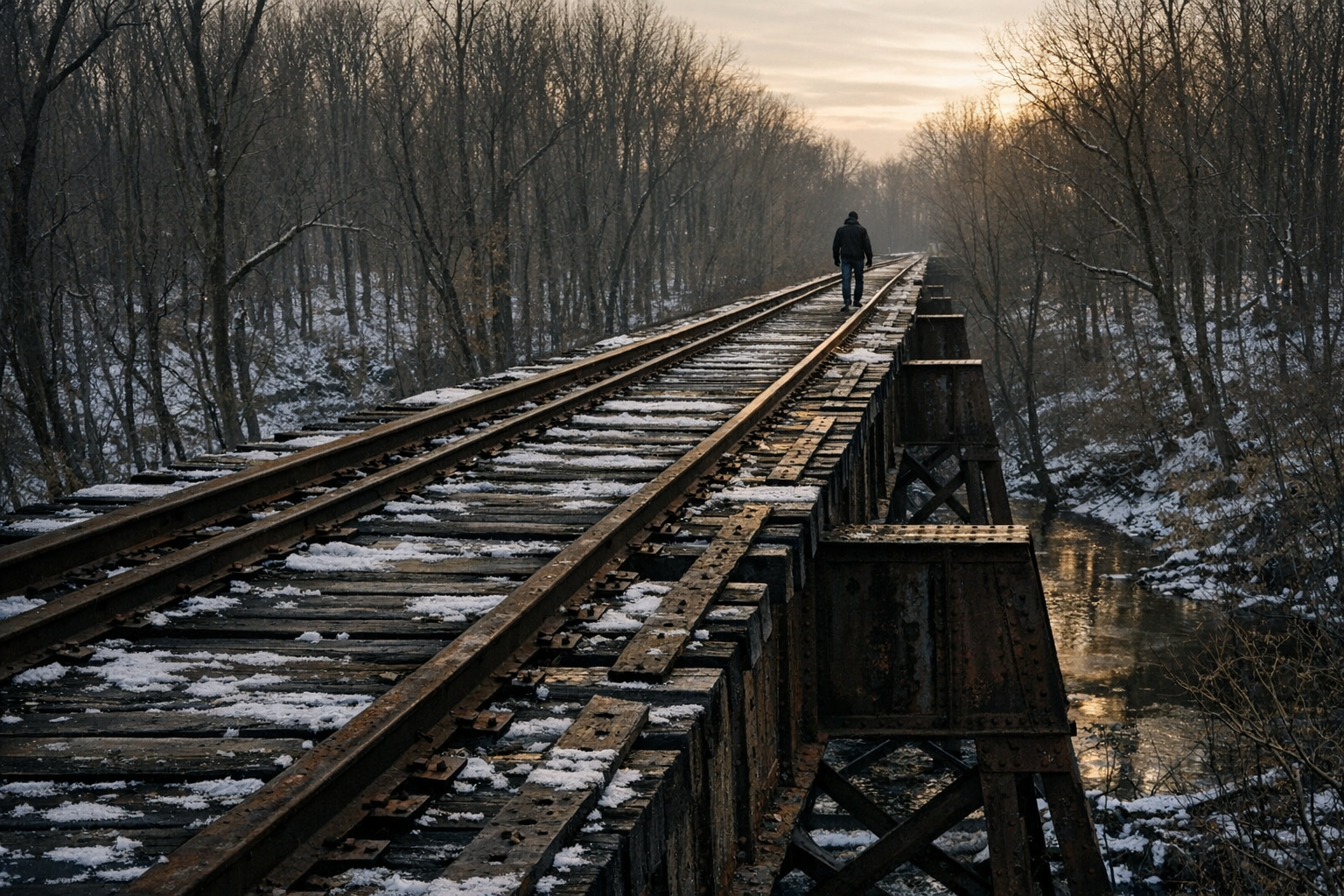
At first, it looked like nothing.
Just a shaky few seconds on a phone. A man on an old railroad bridge, hands in his pockets, walking with the kind of casual steadiness that should have meant safety. Below him, the creek cut through the woods. Around him, the afternoon looked ordinary—bare trees, winter light, the silence of a small Indiana trail in February.
But that tiny clip would become one of the most replayed pieces of evidence in modern true crime. People studied the jacket. The gait. The hat. The shape of his shoulders. They turned the audio up, cleaned it up, slowed it down, and listened again to the words that would seem to hang over Delphi for years: “Down the hill.”
And that was the nightmare of this case. The country was not looking at a ghost, or a rumor, or a suspect sketch made from memory alone. It was looking at a real person, caught in motion, moving toward two girls who never made it home.
What Happened at Delphi? Abigail Williams, Liberty German, and the Missing Person Case That Became a National Obsession
Abigail Williams and Liberty German were two Indiana teenagers whose missing person case on February 13, 2017 quickly became one of the most intensely followed murder investigations in the country. What made the Delphi case matter was not only the loss of Abby and Libby, but the unbearable fact that Liberty captured video and audio from the final stretch of that afternoon—leaving the public with a few haunting seconds that seemed like they should have been enough to identify the man on the bridge.
That tension is part of why cases involving public evidence and unanswered timelines keep pulling people back, much like this archive on murder cases caught on surveillance footage, where a few recorded moments end up carrying the full weight of a tragedy.
On that Monday afternoon, Delphi was the kind of place where people still talked about everybody knowing everybody. It was a small city in Carroll County, surrounded by farmland, creeks, and roads that could feel empty long before sunset. The Monon High Bridge Trail was already known as one of those places local teenagers liked to walk because it felt adventurous without seeming truly dangerous. The bridge itself was old, narrow, and high enough to make your stomach drop if you looked down through the gaps.
Liberty German—Libby to everyone who knew her—was 14. Abigail Williams, called Abby, was 13. They were friends, close enough to spend an off-school day together, close enough that the plan sounded harmless. They were dropped off near the trail early that afternoon. Somewhere around 2:07 p.m., Libby posted a photo of Abby walking across the bridge. In the picture, Abby is small against the rails and sky, moving forward without any sign that the ordinary day has already begun to close around them.
That image would become one of the last peaceful moments anyone could point to.
The arrangement was simple. The girls would walk, spend some time on the trails, and be picked up later. But when the pickup time came, they were not there. At first that gap felt explainable in the everyday way families always hope for. Maybe the girls were late. Maybe the phone battery had died. Maybe they had wandered farther down the trail than expected.
Then the waiting hardened into panic.
Family members began looking. Calls went out. Searchers moved through the area as daylight dropped and the temperature kept falling. What made the situation especially frightening was the layout of the trail system itself. The bridge was dramatic, but beyond it the land broke into woods, brush, creek banks, and uneven ground. Once darkness settled, that landscape stopped feeling recreational and started feeling isolating.
By the next day, the case had shifted from worry to horror. Abby and Libby were found dead near the Monon High Bridge area.
From that point on, Delphi stopped being just a local tragedy. It became one of those cases the entire country seemed to absorb all at once. But the thing that made it different—really different—was that the public was not left with only police statements and rumor. Investigators revealed that Libby had recorded video and audio on her phone. There, in grainy motion, was a man walking the bridge toward them. And there, in a short voice clip, were the words that would be repeated for years by reporters, detectives, podcasters, armchair sleuths, and ordinary people who could not shake the story.
“Guys … down the hill.”
For most murder cases, the public imagination has to build the crucial moment from descriptions. Delphi didn’t. It handed people a fragment of reality—and that fragment was worse. It made the danger feel immediate. It made the man feel both visible and unreachable. It gave the country the sense that the answer had to be sitting right there, inside a few seconds of video that millions of people watched over and over again.
That was the bridge footage paradox. The evidence made the case feel close, but not solved. Familiar, but not clear. People stared at the man’s outline so long that he became one of the most recognizable unidentified figures in America.
Timeline of Events
- February 13, 2017, early afternoon: Abby and Libby are dropped off near the Monon High Bridge Trail in Delphi, Indiana.
- About 2:07 p.m.: Libby posts a photo of Abby walking on the bridge.
- Later that afternoon: The girls fail to meet their ride and are reported missing.
- February 14, 2017: Their bodies are found near the trail area.
- 2017–2022: The case becomes a national obsession as police release the bridge image, audio, and evolving suspect sketches.
- 2022: Richard Allen is arrested after investigators revisit an earlier tip.
- 2024: Allen is convicted, shifting the case from unsolved mystery to evidence, trial, and continuing public debate.
Even after the arrest, the bridge footage remained the emotional center of the entire story. That is unusual. In many major cases, once someone is charged, the mystery moves somewhere else—to motive, forensic evidence, or courtroom strategy. In Delphi, the public kept circling back to the phone clip because it had shaped how people experienced the case from the beginning.
It is hard to overstate how much those seconds changed everything. Without them, Delphi might have remained a deeply painful regional case, known mostly to Indiana and true-crime followers. With them, it became something else: a case people felt they had personally seen, even though they had only seen the edge of it.
And that edge created years of obsession. People wanted to know how someone could be recorded so directly and still seem to slip past certainty for so long. They wanted to know whether the image should have led to a quicker identification. They wanted to know whether the man on the bridge knew he had been recorded. Most of all, they wanted to know what happened in the minutes after the camera stopped helping.
That is where the case got even more haunting.
Because the trail itself works almost like a trap in the public imagination. The Monon High Bridge was not just scenic. It was exposed. Narrow. Elevated. Once a person was committed to crossing it, movement was limited. It was the kind of setting that turns a normal approach into instant tension. A person coming toward you cannot simply be avoided the way they might be on a wide sidewalk or in an open park. The bridge gave the final known moments of Abby and Libby a stage-like quality—one that the public could picture too clearly.
Then there was the audio. People tend to remember cases through visuals, but sound is often what makes them linger. The phrase “Down the hill” sounded plain, not dramatic. That made it worse. It carried authority without emotion, which made listeners imagine a man who felt frighteningly calm. In a story already full of dread, that calmness turned the voice clip into something nearly impossible to forget.
For years, every development in the investigation unfolded under the shadow of those recordings. Police released images. Police released audio. Police changed direction publicly. Sketches shifted. Tips poured in. The community waited. The country waited. And because the evidence seemed so close to the surface, every delay felt heavier than it might have in another case.
What Doesn’t Add Up for Many People
- Why did visible evidence not produce a quicker public identification? The bridge video made people believe the answer had to be obvious, but grainy evidence can create false confidence.
- Why did the case take years to break open? One of the most discussed points is that a key earlier tip eventually drew renewed attention, raising questions about how much investigations depend on organization as much as instinct.
- Why did the suspect remain psychologically “ordinary” in the public mind? Part of the case’s power is that the man on the bridge did not look theatrical or monstrous. He looked disturbingly normal.
- Why does the footage still dominate the story even after conviction? Because the public relationship to Delphi was built through those seconds first, and courtroom developments came later.
That last point may be the most important if the goal is to understand why Delphi became so durable in the culture. This was never just a murder case people read about. It was a case people participated in emotionally. They zoomed in. They debated jackets and hats and body shape. They argued over sketches. They replayed the walk. They compared voices. In other words, they were pulled into the case not as witnesses in any formal sense, but as an audience confronted with just enough evidence to feel involved and not enough certainty to feel satisfied.
That is exactly why the case would not leave Indiana alone. It would not leave the internet alone either.
Over time, Delphi became a kind of symbol in modern true crime: the case that proved evidence can be both powerful and agonizingly incomplete in the public sphere. The bridge footage gave people a face-like outline, but not immediate resolution. The voice gave people a chilling phrase, but not the whole story. The years that followed made the public sit with that discomfort much longer than anyone expected.
When Richard Allen was arrested in 2022, the story changed shape. It was no longer purely about a man on a bridge whom nobody could name. It became about how a case so saturated with public attention could still depend on investigative review, old tips, and the long, imperfect grind of casework. It also shifted the public conversation toward courtroom evidence, the timeline, and whether the prosecution had finally connected the image on the phone to the man in custody strongly enough to close the loop.
By the time Allen was convicted in 2024, many people felt a kind of exhausted relief. But even then, Delphi did not become a cleanly finished story in the public mind. Some cases close and immediately settle into the archive. Delphi didn’t. The reason is simple: the public had spent too many years living inside the uncertainty created by those few recorded seconds. Once a case has occupied that much collective attention, resolution does not erase the atmosphere overnight.
Why This Case Still Gets Attention
- It contains unforgettable public evidence. Few cases have a suspect captured in such a haunting but limited way.
- The victims were young and the outing was ordinary. Abby and Libby were doing something that felt normal and local, which makes the danger feel too close to everyday life.
- The setting is cinematic in the worst possible way. The bridge, the creek, the winter woods, and the abrupt change from harmless afternoon to terror are hard to shake.
- It sits at the intersection of mystery and courtroom reality. Even after conviction, people still revisit how the investigation unfolded and why the case held the nation for so long.
There is another reason, too, and it is less procedural than human. Abby and Libby are remembered not just because of how they died, but because Libby’s recording created an impression of courage in the middle of fear. Investigators have long emphasized the importance of what she captured. That has shaped how many people think about the girls—not only as victims of a brutal crime, but as two friends whose final afternoon left behind the small fragment that kept the case alive in the public eye.
In that sense, the bridge video did more than identify danger. It changed the moral center of the case. Instead of the public only imagining what might have happened, they knew that one of the girls recognized enough to preserve something. That knowledge makes the story heavier, but it also explains why the case lodged so deeply in people’s minds.
And the details remain devastating in their simplicity. Two girls. An off day from school. A trail close to home. A photo on a bridge. A pickup time that passed. A family search that turned into a homicide investigation. Then years of waiting while the entire country stared at a blurry man who seemed like he should have been identifiable and yet somehow remained just outside the grasp of certainty.
That gap—between seeing and knowing—is the real engine of Delphi.
Even now, when people ask what happened at Delphi, they are usually asking two questions at once. The first is factual: what happened to Abby and Libby on February 13, 2017, and how did the case move from public mystery to arrest and conviction? The second is emotional: why did this particular case feel so impossible to put down?
The answer to the first question lives in timelines, evidence, hearings, and verdicts. The answer to the second lives on the bridge.
It lives in the way that footage turned the public into reluctant repeat viewers of a moment that clearly mattered but never fully explained itself. It lives in the way a plain command spoken in an ordinary voice became one of the most unsettling fragments in American true crime. It lives in the way an Indiana trail, which should have been forgettable to anyone outside the county, became permanently fixed in national memory.
Delphi was not just a case people followed. It was a case people felt trapped inside for years, because the evidence made them believe the truth was close enough to touch.
That is what made the story so powerful. And that is what made it so awful.
For all the investigation, all the analysis, all the arguments over sketches, tips, timelines, and trial evidence, the emotional reality of Delphi is still the same one the public met at the beginning: two friends on a bridge, a man walking toward them, and a few recorded seconds that changed how the entire country experienced a murder case.
Some stories stay alive because they are unsolved. Others stay alive because they show the public just enough of the truth to make forgetting impossible.
Delphi became both.