Brian Wells Pizza Bomber Case — The Delivery Driver Forced Into a Deadly Robbery
7 min readApril 10, 2026
Most bank robberies end with a suspect running from police.
The Brian Wells case ended with a man sitting on the pavement, handcuffed, surrounded by officers, begging for help as a bomb ticked around his neck.
It happened in broad daylight.
It was captured on camera.
And for years, investigators struggled to answer the question that sat at the center of the entire case:
Was Brian Wells a hostage, a willing participant, or something trapped between the two?
The answer led investigators into one of the strangest criminal conspiracies in FBI history—a story involving a scavenger hunt, a homemade collar bomb, a dead body hidden in a freezer, and a group of people whose motives seemed to get darker the more investigators uncovered.
The Brian Wells pizza bomber case began on August 28, 2003, when Erie, Pennsylvania pizza delivery driver Brian Wells entered a bank with a bomb locked around his neck and demanded money. After leaving the bank, he was stopped by police and claimed he had been forced to commit the robbery. Minutes later, the bomb exploded, killing him. The investigation eventually uncovered a bizarre conspiracy involving Marjorie Diehl-Armstrong, Kenneth Barnes, William Rothstein, and others. Prosecutors concluded the robbery was part of a larger plot and that Wells was never meant to escape unharmed.
The Robbery Nobody Could Understand
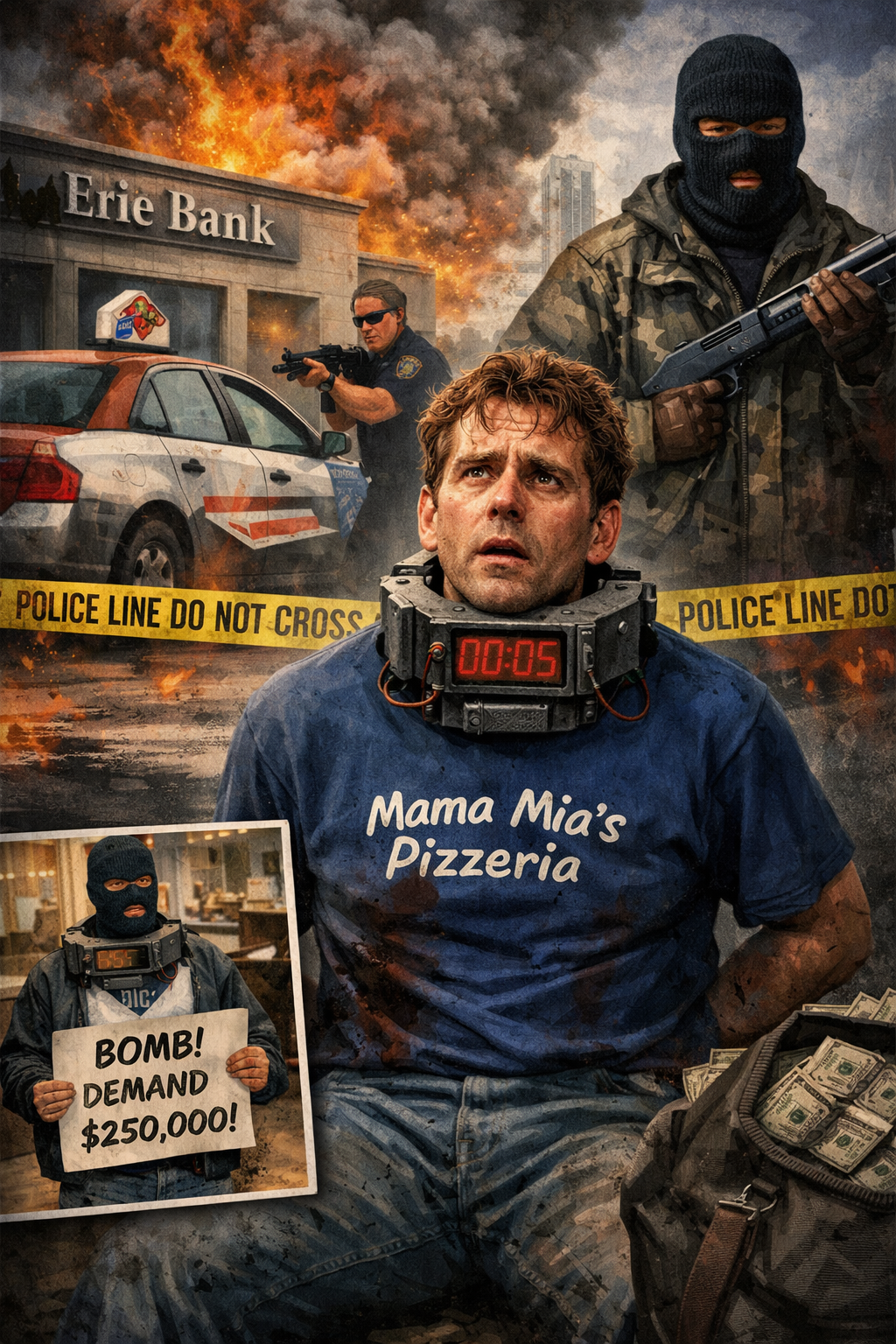
On the afternoon of August 28, 2003, employees inside a PNC Bank branch in Erie watched a man walk through the doors carrying what appeared to be a cane.
It was not a cane.
It was a homemade shotgun disguised as one.
Around his neck sat a large metal collar.
Attached to that collar was a bomb.
The man was Brian Wells, a 46-year-old pizza delivery driver.
He handed a note to a teller demanding money.
The note did not read like a normal robbery demand.
It contained instructions.
Deadlines.
Directions.
It looked less like a bank robbery and more like the opening stage of a strange game.
But there was nothing playful about the device around his neck.
Wells left the bank with far less money than the note demanded.
Minutes later, police stopped him in a nearby parking lot.
That was when the situation became terrifying.
Brian told officers the bomb was real.
And that it was going to explode.
The Parking Lot
Video footage from the scene would later become one of the most disturbing images in modern true crime.
Brian Wells sat on the pavement surrounded by officers.
He appeared frightened.
Confused.
Desperate.
He repeatedly told police he had been forced into the robbery.
According to Wells, several men had attached the bomb to his neck and ordered him to rob the bank.
He insisted he was running out of time.
Police backed away and called for assistance.
No one knew whether the bomb was real.
No one knew whether approaching him would make the situation worse.
Then the device exploded.
Brian Wells died on the pavement.
What should have been the end of the case became the beginning.
The Scavenger Hunt
Investigators discovered that Wells had been carrying a lengthy set of instructions.
The document directed him to travel across Erie collecting keys and clues.
Each step supposedly brought him closer to removing the collar bomb.
At least that was the promise.
The route was complex.
The deadlines were unrealistic.
The tasks seemed intentionally difficult.
The deeper investigators looked, the more they believed the instructions had never been designed to save Wells.
They had been designed to control him.
That realization changed the investigation.
Instead of asking who built the bomb, investigators started asking who built the entire game.
Timeline of the Pizza Bomber Case
August 28, 2003: Brian Wells enters a PNC Bank in Erie, Pennsylvania wearing a collar bomb and demands money.
Minutes later: Police stop Wells in a nearby parking lot.
Shortly afterward: The bomb detonates, killing Wells.
Following weeks: FBI investigators uncover scavenger-hunt instructions and begin tracing the conspiracy.
Investigation expands: Marjorie Diehl-Armstrong, Kenneth Barnes, and William Rothstein emerge as key figures.
2004: Authorities discover the body of James Roden in Diehl-Armstrong’s freezer.
2008: Diehl-Armstrong is charged in connection with the pizza bomber conspiracy.
2010: She is convicted and sentenced to life in prison.
Marjorie Diehl-Armstrong
Almost every road in the investigation eventually led to the same person.
Marjorie Diehl-Armstrong.
She was intelligent, manipulative, and volatile.
Friends described her as capable of charm one moment and chaos the next.
Investigators increasingly believed she sat near the center of the conspiracy.
According to prosecutors, the robbery plot was tied to financial motives and a larger scheme involving inheritance money.
The further investigators dug into Diehl-Armstrong’s life, the stranger the case became.
Then they searched her home.
Inside a freezer, they discovered the body of her boyfriend, James Roden.
That discovery transformed the investigation.
This was no longer just a bizarre bombing.
It was a case surrounded by violence, deception, and people willing to eliminate obstacles.
Did Brian Wells Know?
This remains the question that keeps the case alive.
Was Brian Wells completely innocent?
Or did he agree to participate in a robbery without realizing how dangerous the plan really was?
Investigators never reached a conclusion that satisfied everyone.
Some evidence suggested Wells may have known parts of the plan.
Other evidence suggested he had no idea how deadly it would become.
The FBI eventually concluded that Wells was not the mastermind.
If he participated at all, he was ultimately expendable.
The people behind the plot appeared willing to let him carry all of the risk.
And possibly all of the blame.
What Doesn’t Add Up?
If the conspirators wanted money, why build such a complicated plan?
If Wells was a willing partner, why place a real bomb around his neck?
If he was an unwilling hostage, why do some details suggest prior involvement?
The scavenger hunt itself remains one of the strangest elements.
The instructions looked detailed enough to appear real.
Yet impossible enough to appear hopeless.
That contradiction has fueled debate for more than twenty years.
The Most Likely Explanation
The most likely explanation is that Brian Wells became trapped inside a conspiracy far larger than he understood.
Whether he knowingly agreed to parts of the robbery or not, investigators concluded the people behind the plot had little interest in his survival.
The collar bomb was real.
The threat was real.
And the scavenger hunt appears to have been structured in a way that offered little realistic chance of escape.
In that sense, Wells became the perfect pawn.
He carried the bomb.
He entered the bank.
He faced the police.
And when the device exploded, the people who built the scheme disappeared into the background—at least for a while.
Why the Case Still Haunts People
Most true crime stories eventually settle into a simple narrative.
This one never does.
The public witnessed the ending before anyone understood the beginning.
People saw Brian Wells die.
Only later did they learn about the scavenger hunt.
The conspiracy.
The freezer.
The inheritance motive.
And the possibility that Wells himself never fully understood the role he had been assigned.
That is why the pizza bomber case remains one of the strangest crimes in American history.
Not because it feels impossible.
But because every confirmed fact somehow makes it feel even harder to believe.
FAQ
Who was Brian Wells?
Brian Wells was a pizza delivery driver from Erie, Pennsylvania who died after a bomb locked around his neck exploded following a bank robbery.
Was the bomb real?
Yes. The collar bomb detonated while Wells was in police custody.
Who planned the pizza bomber plot?
Investigators concluded that Marjorie Diehl-Armstrong and several associates played major roles in the conspiracy.
Did Brian Wells know about the robbery?
The exact extent of Wells’s knowledge remains debated. Investigators concluded he was not the mastermind and ultimately became expendable within the plot.
Why is the case so famous?
Because of its bizarre combination of a collar bomb, a public bank robbery, a scavenger hunt, and a conspiracy that seemed stranger than fiction.
If this story stayed with you, the author suggests these real cases next: