
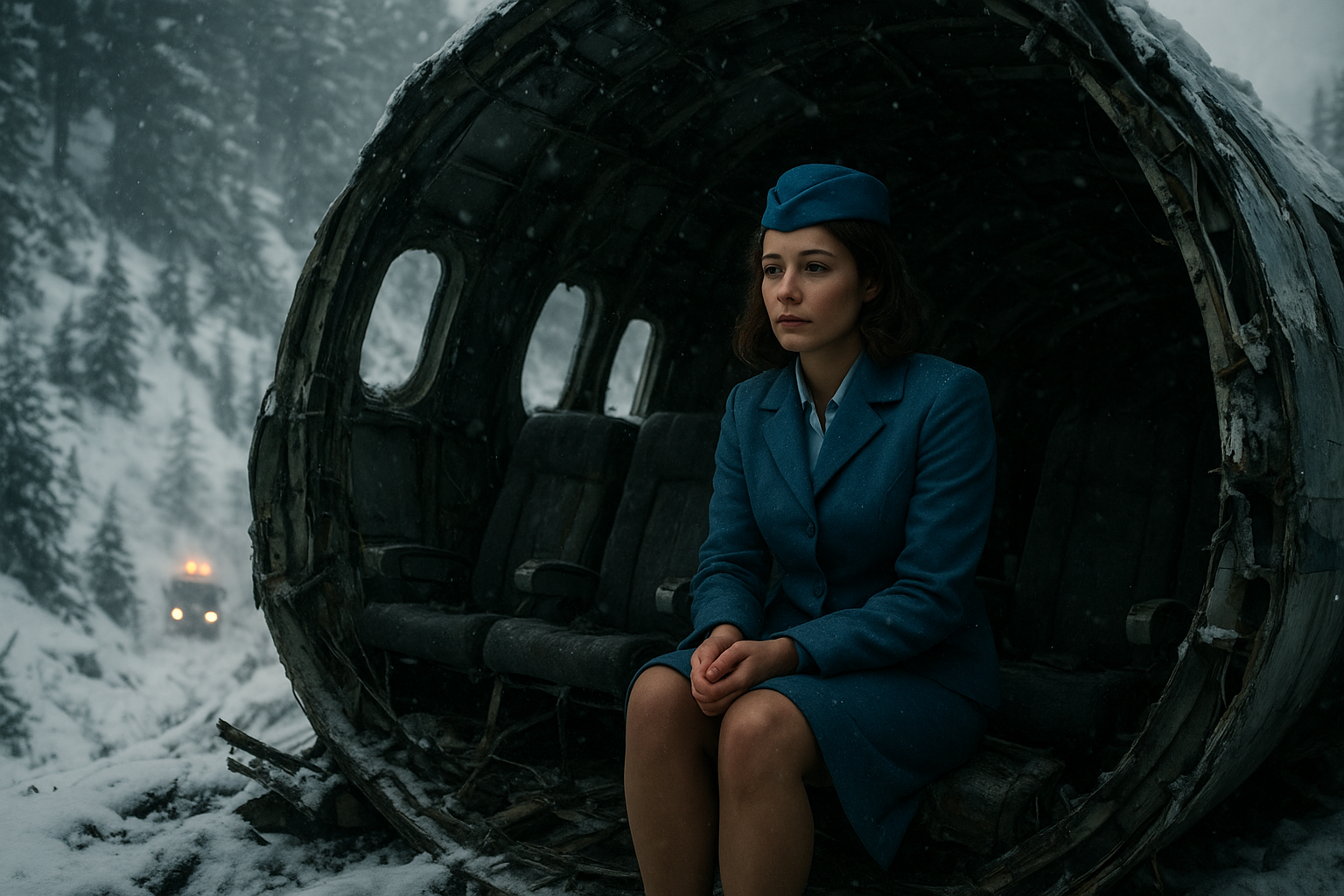
Vesna Vulović survived the destruction of JAT Flight 367, but she could not remember the fall that made her famous. In her recollection, the journey broke off in Copenhagen and resumed in a hospital, with her family beside her.
Outside that gap lay a disaster that killed everyone else aboard. On January 26, 1972, the DC-9 broke apart over Czechoslovakia. The young flight attendant was recovered alive from its wreckage near Srbská Kamenice. Twenty-seven other passengers and crew members died.
The statistic, as shocking as it is, can flatten the human reality. Guinness recognizes a fall of 10,160 metres—about 33,333 feet—without a parachute. That was the beginning of her survival, not the end of it.
A Replacement Crew in Copenhagen
Vesna was 22 and had been working as a flight attendant for only eight months. In a later interview reported by Serbian broadcaster RTS, she said a mix-up with another employee named Vesna had put her on the trip. She had never visited Copenhagen before and remembered being pleased to go.
Flight 367 linked Stockholm and Belgrade, with stops in Copenhagen and Zagreb. Vesna joined the replacement crew in Denmark. The aircraft left Copenhagen; it never reached Zagreb.
Speaking to the Associated Press in 2008, she remembered welcoming passengers before takeoff, then being in hospital with her mother. The crash and rescue remained missing. Those minutes have to be reconstructed from other evidence, not an imagined view through her eyes.
The Wreckage and the Man Who Found Her
The official investigation attributed the disaster to a bomb in the forward baggage hold. Historian Igor Kukobat’s examination of the investigation describes an explosion that damaged the flight controls, followed by a dive and the aircraft’s breakup. The disaster was not a controlled emergency landing.
Vesna remained caught in part of the aircraft as it came down. Accounts commonly describe a catering trolley holding her within the wreckage. They differ over precisely where in the fuselage she was trapped, so the familiar image of her simply falling alone through open sky is misleading.
At the crash site, Bruno Honke heard a voice in the wreckage. The local man had medical experience from the Second World War. He found Vesna alive and provided first aid before the other rescuers arrived, according to Guinness’s account. TV4’s later reporting also identifies him as the man who reached her.
The aircraft section had come down on a wooded, snow-covered slope. Investigators and later accounts have pointed to the wreckage, trees, snow and angle of impact as possible reasons she survived. These were circumstances of one extraordinary accident, not a complete demonstration of how to survive such a fall. Finding a living person in the wreckage meant rescuers had someone to treat. It did not mean she was out of danger.
Learning to Walk Again
Vesna’s injuries were devastating. Her skull, both legs and vertebrae were fractured; she also suffered serious internal injuries. NOS reported that doctors initially warned her parents she might die. She was temporarily paralysed below the waist and spent a period in a coma. Published accounts disagree about its length, but agree that recovery required months of treatment.
Survival in the hospital was a sequence of smaller changes. In her interview with Philip Baum, published in Aviation Security International in April 2002, she described being able to move her left leg after surgery. Movement in the right leg followed a month later. Eventually, she could walk.
She also described the journey home. After treatment in Prague, she was flown to Belgrade in March. She declined the offered medication to help her sleep through that flight: with no memory of the crash, she still wanted to fly. She remained in hospital in Belgrade until June, then continued recuperating at a seaside hotel in Montenegro, with her mother and a therapist.
To readers who know only the altitude, these details change the scale of the story. Her return was measured in the movement of a leg, a transfer between hospitals, and the possibility of going back to work.
Timeline of Events
- January 26, 1972: Flight 367 breaks apart over Czechoslovakia. Vesna is the sole survivor.
- 1972, during recovery: Surgery and rehabilitation gradually restore her mobility; she later returns to JAT in an office role.
- 1985: Guinness recognizes her survival record. Paul McCartney presents her award.
- 2009: Journalists challenge the reported altitude; Guinness retains the record.
- December 2016: Vesna dies in Belgrade, aged 66.
- October 2024: TV4 reports new allegations from historical intelligence files, while making clear they have not been tested in court.
What Doesn’t Add Up—and What the Record Supports
Who was responsible for the bombing?
A finding about the cause of an aircraft’s destruction is different from a conviction of the people responsible. Kukobat’s 2024 study, drawing on investigation records and diplomatic archives, explains that the inquiry located the explosion inside the aircraft and concluded that a timed device had been concealed in luggage. It also records that nobody had been brought to trial for the attack.
In October 2024, Sweden’s TV4 reported allegations against seven men contained in former Yugoslav intelligence files. Its reporters interviewed three surviving men: two denied involvement in the bombing, and the third said he did not remember it. TV4 explicitly said the allegations had never been judicially tested. That reporting adds material to the unresolved question; it is not a court verdict.
Was the fall really from 33,333 feet?
A 2009 journalistic investigation proposed a much lower altitude and an accidental military shoot-down. Guinness’s record page acknowledges that challenge, including a journalist’s concession that the evidence was circumstantial. Its later review says the flight-recorder evidence supports the accepted altitude and that insufficient evidence exists to disqualify the record.
The record retained by Guinness therefore remains 10,160 metres. Vesna’s memory cannot settle the dispute: she did not remember the fall. Nor should the dispute erase the fact that she was rescued with catastrophic injuries from an aircraft in which 27 other people died.
A Life Beyond the Record
Vesna returned to JAT, although to office work rather than cabin duties. NOS reported that she continued to travel by air. The memory loss that made her an incomplete witness to the disaster did not leave her afraid of every subsequent flight.
Her public life extended beyond the accident. In the 1990s she opposed Slobodan Milošević and later campaigned for liberal political forces, the Associated Press reported. The woman introduced through a catastrophe also made choices about the country in which she lived.
When her death was reported in December 2016, she was 66. The extraordinary record remained, but her own assessment resisted the easy description of a lucky survivor. In the Baum interview, she said she would never have been aboard if she had truly been lucky. Survival had not returned the life she had before the flight.
She lived for another 44 years. That matters more than treating the fall as a trick the human body somehow performed: there was a woman to bring home, help back onto her feet, and listen to afterward.
Frequently Asked Questions
Was Vesna Vulović the only survivor?
Yes. Twenty-eight people were aboard Flight 367; the other 27 died.
Did she fall outside the aircraft?
She came down caught in wreckage, without a parachute. Accounts differ over the exact aircraft section.
Did she walk again?
Yes. After surgery and rehabilitation, she regained mobility, although Guinness reports a lasting limp.
Did she remember the crash?
No. Her published interviews describe a gap covering the disaster and its immediate aftermath.
Is the height still recognized?
Guinness still lists 10,160 metres. It acknowledges the later challenge but has retained the record.
Sources & References
- Guinness World Records — Highest fall survived without parachute — Current record entry and acknowledgement of the 2009 altitude challenge.
- Guinness World Records — How Vesna Vulović survived the highest fall ever with no parachute — Flight route, rescue, recovery and the evidence Guinness cites for retaining the record.
- Aviation Security International — Philip Baum interviews Vesna Vulović (April 2002, PDF) — Her own account of treatment, returning home and life after the crash; some recollections differ from later summaries.
- RTS — Dan koji je mirisao na nesreću (January 2012, Serbian) — Reports her Danish television interview, including her age, short flying career and mistaken crew assignment.
- NOS — Stewardess die beroemd werd na val van 10 km overleden (December 2016, Dutch) — Injuries, rehabilitation, continued air travel and death in Belgrade.
- Associated Press, via KSL — Serbian stewardess who survived jet crash in 1972 dies at 66 — Her 2008 recollections, the death toll and later political activity.
- Igor Kukobat — Terrorism and Yugoslav Air Transport 1948–1990 (2024, PDF) — Archival research discussing Flight 367 and the investigation, especially pages 425–427.
- TV4 — Hon överlevde flygplansdådet (October 2024, Swedish) — Rescue reporting and Vesna’s resistance to describing herself as lucky.
- TV4 — Flygplansbomben dödade 27 (October 2024, Swedish) — New allegations from intelligence files, the interviewees’ responses and their untested legal status.
Related stories
Explore this topic
Watch This Story on YouTube
Prefer to watch? See the full story on our YouTube channel.