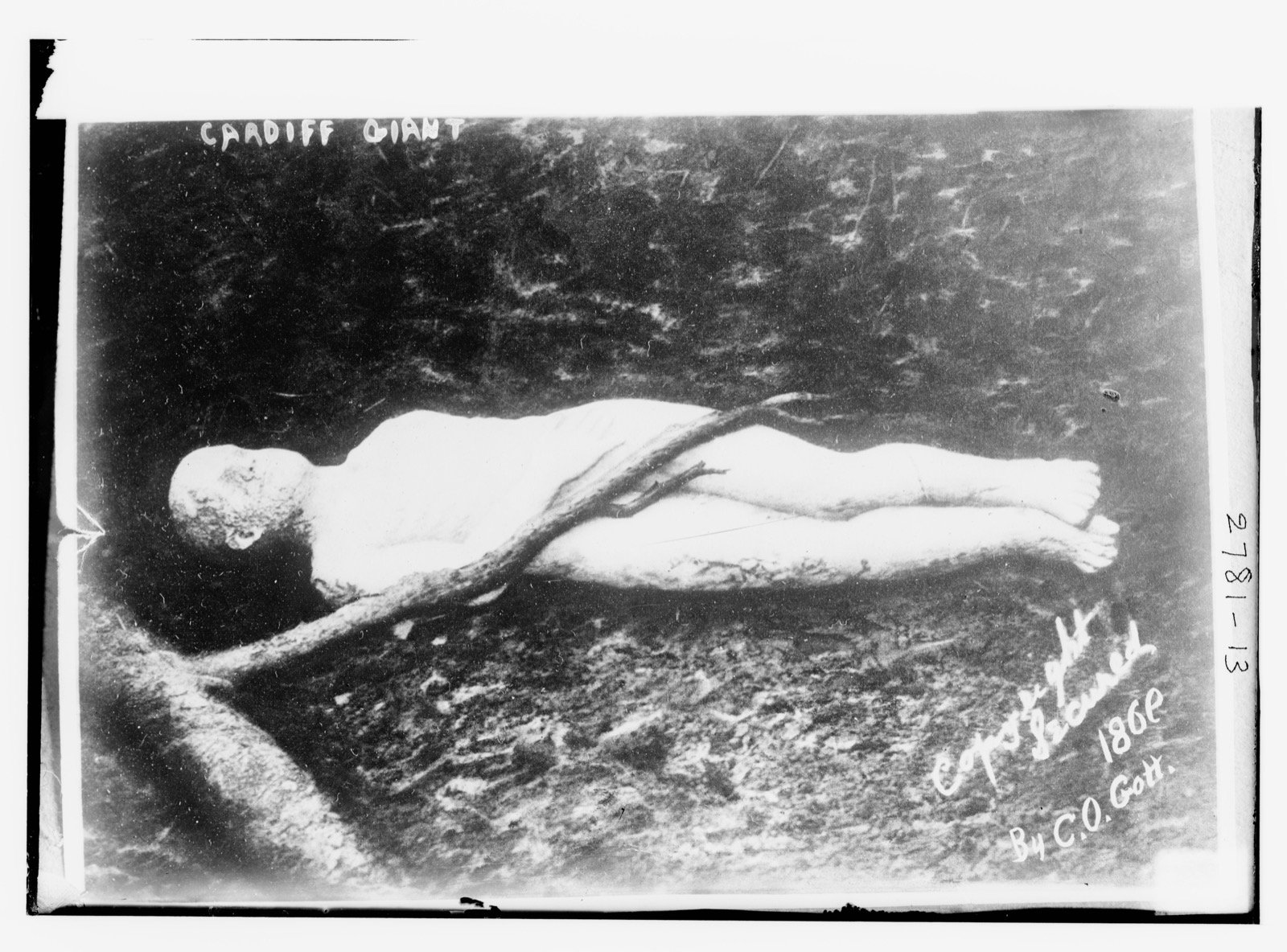
The men digging a well on William Newell’s farm uncovered a foot. Then came the rest of a stone figure roughly ten feet long, lying beneath the soil near Cardiff, New York. It was October 16, 1869, and the discovery offered an extraordinary possibility: had someone found a human giant turned to stone?
Newell had a reason to welcome the question. The figure had been buried on his land the previous year as part of a scheme devised by his relative George Hull. Soon visitors were paying to see it. Some thought they were looking at a petrified man; others proposed an ancient statue. Both explanations gave the object something its makers wanted it to have: a past.
The Cardiff Giant was a modern carving. The remarkable part of its story is how much happened after people began pointing that out.
George Hull builds his evidence
Hull was a tobacco businessman from Binghamton with a quarrel to settle. Historical accounts trace his idea to an argument with a preacher about biblical giants. Hull rejected a literal reading of the story and saw an opportunity to test how readily people would accept a giant if one could be produced. There was money in the idea, too. A convincing discovery could become a paying attraction.
That required considerably more than a rumor. In 1868, Hull obtained a large block of gypsum in Iowa and had it transported to Chicago. Stoneworkers carved a human figure from it. A nineteenth-century account by physician G. A. Stockwell describes the effort to give the fresh stone an older surface: rubbing with sand and water, marking it to resemble pores, and treating it with liquids including sulfuric acid.
Those details were essential to the deception. A newly finished sculpture would invite questions about its sculptor. A weathered body pulled from the ground would invite questions about the remote past. Hull was arranging not just an object but the circumstances in which strangers would first encounter it.
The figure went to Newell’s farm in Cardiff and was buried in 1868. Nearly a year passed before Newell hired Gideon Emmons and Henry Nichols to dig at the chosen spot. Their excavation supplied the discovery that the carving itself could not: the giant apparently emerged from ordinary farmland, with workers and neighbors there to see it.
A farm becomes an exhibition
Newell put a tent over the find and charged admission. Fifty cents bought a look at the enormous figure. The visitors could inspect its size and human features for themselves, then debate what they had seen. Their disagreement did not prevent the attraction from earning money.
Nor did the interpretation divide neatly between people who believed and people who did not. Rejecting a petrified body still left an appealing alternative: perhaps this was a sculpture made centuries earlier. John F. Boynton proposed a work associated with Jesuit missionaries. New York’s state geologist, James Hall, regarded it as an ancient statue. The giant could lose one extraordinary identity and acquire another.
Hull and Newell did not need to wait for that argument to finish. A group of Syracuse investors purchased a three-quarter interest for $30,000. The figure was moved to Syracuse, where it continued drawing crowds. What had started as a secret burial was now an exhibition with several people financially invested in its success.
Stockwell’s 1878 account describes special trains bringing visitors to Syracuse while the dispute continued. The objections had become part of the publicity. A person could travel to decide whether the giant was genuine, or simply to see the object everyone was arguing about. Either way, the journey ended at the same attraction.
The evidence that changed everything
When Yale paleontologist Othniel Charles Marsh examined the giant, he looked past the competing stories to the surface of the stone. The owners allowed him a closer inspection than ordinary visitors received. In a letter dated November 24, 1869, later printed in the Proceedings of the Massachusetts Historical Society, he called it “a most decided humbug.”
Marsh’s explanation was more damaging than the insult. Parts of the original block had been worn by water before carving began, he argued. Some of those rough surfaces remained on the head, limbs, and feet. Viewers had treated them as signs that the entire figure was ancient. Marsh distinguished the age of the stone’s surface from the age of the work cut into it.
He also identified fresh tool marks where the finishing had been careless or incomplete. In the opening of the right ear, he described marks beside or surrounded by older, water-worn surfaces. The order mattered: the cutting had come after that weathering. The figure’s appearance was being used to tell a history its details contradicted.
Gypsum presented another problem. It dissolves in water. Marsh argued that exposure in the wet ground at Cardiff would have erased the tool marks and roughened the polished areas. Instead, both remained well preserved. The object could not plausibly have spent an immense span of time where it had supposedly been found.
The physical examination narrowed the question from what the giant might represent to how recently someone had made and buried it. Accounts of its manufacture then supplied the people behind the marks. Hull admitted the deception, and stoneworkers’ accounts helped establish the route from a block of gypsum to a profitable discovery.
Barnum makes another giant
The original’s owners also faced a competitor who did not need to settle its authenticity. P. T. Barnum tried to obtain an interest in the giant and was refused. He arranged for an imitation instead, then exhibited it in New York as though his were the genuine attraction.
Now the owners of a fabricated relic had to defend it against another fabricated relic. They sought an injunction against Barnum’s exhibition and failed to stop it. The rival displays turned the distinction between original and copy into another selling point. Being the object actually dug up at Cardiff was no longer the same thing as being the object a customer chose to see.
The giant’s commercial life outlasted its claim to antiquity. The American Antiquarian Society’s description of a surviving scrapbook records years of exhibitions, a period in storage, and later letters from people seeking to lease or purchase the figure. Its history as a fraud had become an attraction of its own.
In 1947, the museum now called Fenimore Farm & Country Village acquired it. The institution identifies the giant as a hoax and displays it in its main barn in Cooperstown. Visitors can still encounter the same oversized figure that brought paying crowds to Newell’s farm. The difference is that the explanation is now part of what they have come to see.
Timeline of Events
- 1868: George Hull has a gypsum figure manufactured and secretly buried at William Newell’s farm in Cardiff, New York.
- October 16, 1869: Workers digging a well uncover the figure. It becomes a paid attraction.
- Fall 1869: Syracuse investors buy a majority interest, and the giant is moved for exhibition.
- November 24, 1869: Othniel Charles Marsh dates a letter explaining the tool marks and material evidence against the figure’s supposed antiquity.
- December 1869: Hull’s admission of the hoax is public; Barnum’s rival exhibition becomes part of the dispute.
- 1947: The museum now known as Fenimore Farm & Country Village acquires the giant.
Frequently Asked Questions
Was the Cardiff Giant a fossil?
No. It is a carved gypsum figure deliberately presented as a discovery. Its modern manufacture and staged burial are established; it is not an unresolved human fossil.
Did P. T. Barnum create the original?
No. George Hull organized the original scheme. Barnum later exhibited an imitation after failing to obtain an interest in the Cardiff attraction.
Where is the original Cardiff Giant now?
Fenimore Farm & Country Village in Cooperstown, New York, lists it as an exhibit in its main barn. The museum was formerly known as The Farmers’ Museum. Check the museum’s own visitor information for seasonal opening arrangements.
Sources & References
- Massachusetts Historical Society, December 1869 proceedings, pages 161–162 — reproduces Marsh’s November 24 letter describing his examination and the evidence against antiquity.
- G. A. Stockwell, “The Cardiff Giant, and Other Frauds,” Popular Science Monthly, June 1878 — an early retrospective account of manufacture, exhibition, and exposure, read alongside modern institutional accounts.
- Smithsonian Magazine, “The Cardiff Giant Was Just a Big Hoax” — discovery, Hull’s scheme, Barnum’s imitation, and the public admission of fraud.
- American Antiquarian Society, Cardiff Giant Scrapbook finding aid — the figure’s later exhibition and storage history and surviving correspondence about leasing or purchasing it.
- Fenimore Farm & Country Village, “Explore”: The Cardiff Giant — the owning museum’s description, acquisition year, and present display location.
Related Stories
- The Oera Linda Book — another nineteenth-century fabrication presented as evidence of a remarkable past.
- The Voynich Manuscript — a genuinely unresolved question about a surviving historical object.
- Flat Earth — the history of a belief and the evidence used to test it.
Featured image: Cardiff Giant, Bain News Service photograph, Library of Congress. Public-domain image and catalog information.