
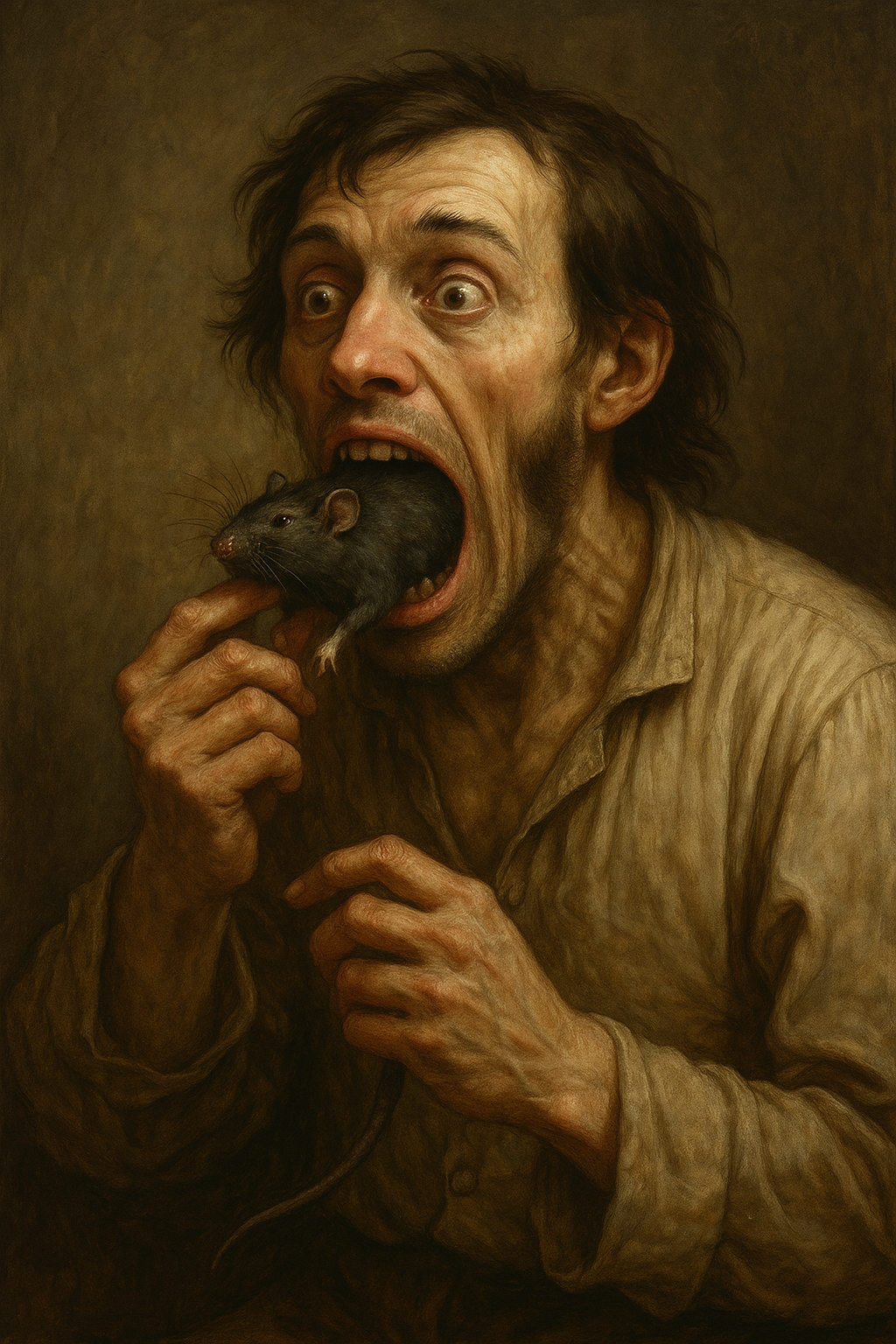
In 18th-century France, doctors claimed they encountered a man who could eat almost anything placed in front of him — entire meals, live animals, piles of garbage, and objects no human should have been able to swallow. What made the case truly terrifying was that no matter how much he consumed, he was always starving. His name was Tarrare, and centuries later, medical historians still argue about what exactly was wrong with him.
There are certain stories from history that sound so unbelievable they almost feel invented.
A man surviving a fall from the sky. A ship found drifting with no crew. A killer hiding in plain sight for decades.
And then there was Tarrare.
A man so consumed by hunger that witnesses claimed he would eat stones, corks, live animals, and entire meals meant for large groups of people — only to say moments later that he still felt empty inside.
At first glance, the story sounds exaggerated, like one of those old legends people pass around to shock each other.
But Tarrare was real.
His case was documented by French physicians in the late 1700s, including military surgeon Dr. Pierre-François Percy, who described him as one of the strangest human beings he had ever encountered.
And the deeper you look into Tarrare’s life, the more disturbing the story becomes.
Because this was not simply a man with a big appetite.
This was someone whose body appeared completely broken.
The Boy Who Was Always Hungry
Tarrare was born near Lyon, France, sometime around 1772. Historians know surprisingly little about his early life, but nearly every surviving account describes the same thing:
Even as a child, he was constantly hungry.
Not normal hunger.
Not the appetite of a growing boy.
According to historical reports, Tarrare could eat amounts of food large enough to feed several adults and still complain that he was starving. His parents were poor farmers who already struggled to survive, and feeding a child with such extreme cravings became nearly impossible.
At first, they likely believed he would grow out of it.
But instead, the hunger worsened.
Tarrare reportedly began sneaking outside at night to search for scraps. He scavenged spoiled food, stole leftovers, and dug through garbage whenever he could find it.
Eventually, his parents could no longer afford to feed him.
So they forced him out.
Imagine being so desperately hungry all the time that even trash looked appealing.
That was the beginning of Tarrare’s adult life.
Alone, filthy, and permanently starving.
The Performer Who Could Eat Anything
In the late 1700s, traveling performers attracted crowds by displaying unusual talents and bizarre human oddities. Europe was filled with roadside entertainment acts featuring sword swallowers, fire eaters, strongmen, and people advertised as “human wonders.”
Tarrare discovered he could turn his condition into money.
He joined traveling performers and became famous for public eating demonstrations that horrified audiences.
Witnesses claimed he swallowed enormous baskets of apples whole. Others reported seeing him consume corks, stones, live snakes, and live eels in front of screaming crowds.
One story even claimed he swallowed an entire cat after tearing it apart with his teeth.
Modern historians debate whether every detail is true. Some accounts were likely exaggerated over time, especially in traveling shows where shock attracted paying customers.
But multiple physicians later confirmed that Tarrare truly could consume staggering amounts of food.
And there was something else people always remembered about him.
The smell.
Doctors and witnesses repeatedly described an unbearable odor surrounding him. His body supposedly radiated heat, his skin sweated constantly, and the stench around him was said to resemble rotting meat.
People could barely stand near him.
And despite the endless eating, Tarrare remained thin.
That may have been the most unsettling part.
By most descriptions, he weighed around 100 pounds and looked sickly, weak, and skeletal.
It made no sense.
🔎 Related Power Posts and Strange Real Mysteries:
What Could Cause Hunger Like This?
Even today, doctors are not entirely certain what condition Tarrare may have suffered from.
Modern theories include severe hyperthyroidism, damage to the hypothalamus, tuberculosis-related metabolic disorders, or an extreme form of polyphagia — a condition where the brain never properly signals fullness.
Some researchers have compared parts of his symptoms to rare hormonal or neurological disorders that affect appetite regulation.
But none of the theories explain everything.
Because Tarrare’s case went far beyond overeating.
According to physicians who examined him, his stomach could visibly expand after meals until his abdomen appeared enormous and swollen. Then, after digestion, the skin would reportedly hang loosely from his body in folds.
His jaw and throat were also described as unusually wide.
Doctors claimed he could swallow large objects whole with disturbing ease.
And no treatment they tried ever slowed the hunger.
The Day Tarrare Entered the Hospital
At some point during his performing career, Tarrare collapsed from exhaustion and illness while in Paris.
He was taken to the Hôtel-Dieu Hospital, one of the oldest hospitals in France, where doctors immediately realized they were dealing with something extraordinary.
Among the physicians fascinated by him was Dr. Pierre-François Percy, a respected military surgeon serving the French army.
Percy decided to study Tarrare closely.
And that’s when the experiments began.
The doctors reportedly gave Tarrare meals designed for fifteen people.
He consumed everything.
Then asked for more.
According to Percy’s writings, Tarrare also ate raw eggs, enormous quantities of meat, and objects that should not have been digestible at all.
The physicians became obsessed with understanding him.
But eventually, Dr. Percy stopped asking a different question:
“What is wrong with this man?”
And started asking:
“Can he be useful?”
France’s Most Unusual Military Experiment
At the time, France was heavily involved in military conflict with Prussia.
Sending secret messages across enemy lines was dangerous work. Couriers could be searched or executed if captured.
Dr. Percy suddenly realized Tarrare might possess a horrifying advantage.
If he could swallow objects and later retrieve them intact, he could potentially transport classified information inside his own body.
So the doctors tested the idea.
They placed a document inside a small wooden container, sealed it carefully, and had Tarrare swallow it.
Hours later, the box successfully passed through his digestive system intact.
The experiment worked.
Soon after, Tarrare was recruited for a real mission.
He was ordered to carry a message to a captured French officer behind Prussian lines.
But there was one enormous problem.
Tarrare was not remotely believable as a normal traveler.
Caught Behind Enemy Lines
The mission failed almost immediately.
Accounts describe Tarrare acting nervous, strange, and suspicious as he crossed enemy territory. His appearance alone likely drew attention. He reportedly smelled terrible, sweated constantly, and behaved erratically from hunger.
Prussian soldiers detained him quickly.
At first, Tarrare denied carrying anything.
Then the beatings began.
After several days of torture and starvation, he finally confessed that he had swallowed a message.
The soldiers tied him near a latrine and waited.
Roughly two days later, the box appeared.
The Prussian officers opened it expecting important intelligence.
Instead, the note reportedly contained almost nothing useful.
The French military had essentially used Tarrare as a test run.
He had risked torture and execution for a meaningless message.
The Prussian commander became furious. According to some versions of the story, Tarrare narrowly escaped execution before eventually being released.
Broken, starving, and humiliated, he returned to France begging doctors to cure him.
But by then, his condition had become even darker.
The Descent Into Horror
Dr. Percy and other physicians attempted numerous treatments.
Opium.
Vinegar.
Wine.
Tobacco pills.
Soft diets.
Nothing helped.
Tarrare’s hunger became increasingly desperate and disturbing.
Hospital workers allegedly caught him drinking blood during medical procedures. Others claimed he searched through gutters and garbage piles for scraps. Some reports accused him of sneaking into morgues to consume corpses.
Then came the accusation that permanently destroyed any sympathy people still had for him.
A 14-month-old child disappeared from the hospital.
No evidence ever proved Tarrare was involved.
But suspicion immediately fell on him.
Whether fair or not, the accusation ended his treatment permanently. He was thrown out of the hospital and disappeared from public records for several years.
And that’s where the story might have ended.
Except Tarrare came back.
The Final Days of Tarrare
In 1798, several years after vanishing, Tarrare reappeared at a hospital in Versailles.
He was dying.
According to Dr. Percy, Tarrare believed his illness had been caused by swallowing a golden fork years earlier. He insisted the object remained trapped inside him.
But Percy quickly realized the problem was much worse.
Tarrare was suffering from advanced tuberculosis and severe physical deterioration. Witnesses described an overwhelming smell of decay surrounding his body during his final weeks.
Within a month, he died.
And then doctors performed the autopsy.
What they found shocked even experienced surgeons.
According to Percy’s reports, Tarrare’s digestive system was massively enlarged. His stomach reportedly filled much of his abdominal cavity. His esophagus appeared unusually stretched and wide.
Some physicians claimed they could practically see into the stomach directly through his throat.
The body appeared ruined by years of extreme consumption.
And the golden fork?
It was never found.
Which Parts of Tarrare’s Story Are Verified?
This is where the story becomes complicated.
Most surviving details about Tarrare come from historical medical writings, especially those of Dr. Percy and surgeon Alexis de Béclard.
That means historians must separate documented observations from sensational retellings.
Certain parts of the story are well-supported:
- Tarrare was real
- French physicians documented his extreme appetite
- Military doctors experimented with using him as a courier
- An autopsy was reportedly performed after his death
Other claims are harder to verify completely:
- Eating live animals
- Consuming corpses
- The missing child accusation
- Some of the more graphic performance stories
In the 1700s, medical reporting was far less rigorous than modern science. Doctors often mixed direct observation with rumor, secondhand testimony, and dramatic storytelling.
Still, even after accounting for exaggeration, Tarrare’s condition appears to have been genuinely extraordinary.
Because multiple independent physicians documented the same horrifying pattern:
A man who could eat enormous amounts of food without ever feeling satisfied.
What Still Doesn’t Add Up
Even centuries later, Tarrare’s case leaves behind difficult questions.
How did he remain thin while consuming such massive quantities?
Why was his body reportedly so hot?
What caused the extreme odor?
Could one medical disorder really explain all of his symptoms?
And how much of the legend grew larger simply because people were witnessing something they couldn’t medically explain?
That uncertainty is one reason Tarrare’s story survived for over 200 years.
Because unlike many historical curiosities, this case was examined by actual doctors who still failed to understand what they were seeing.
The Most Likely Explanation
The most realistic explanation is that Tarrare suffered from multiple severe medical conditions at once — likely involving metabolism, appetite regulation, and chronic disease.
Tuberculosis alone can dramatically affect body weight and metabolism. Hyperthyroidism can increase hunger and body heat. Neurological disorders involving the hypothalamus can interfere with fullness signals.
Combined together, those conditions might explain at least part of his behavior.
But no modern diagnosis completely solves the mystery.
And maybe that is why people still remember him.
Not because he was a monster.
Not because he was a sideshow attraction.
But because Tarrare represented something deeply unsettling:
A human body that no longer obeyed normal rules.
Closing Thoughts
History remembers kings, generals, inventors, and conquerors.
But occasionally, history also remembers people for reasons far stranger.
Tarrare became famous because his condition shocked everyone who saw him. Crowds paid money to watch him eat things no human should consume. Doctors studied him like a medical puzzle. Soldiers used him as an experiment.
Yet underneath the horror and fascination was a man who appeared to spend his entire life suffering.
Constantly hungry.
Constantly rejected.
Constantly treated as something less than human.
And centuries later, despite all modern medical advances, the full truth behind Tarrare still remains just out of reach.
🔎 If you found Tarrare’s story disturbing and fascinating, the author suggests these unbelievable real cases next:This story is part of our growing collection of bizarre real events, strange medical mysteries, and unbelievable true stories that continue to confuse historians and experts today. 👉 Explore more here: Bizarre & Unbelievable Stories
- The Man Who Ate an Airplane — The Real Story That Sounds Impossible
- The Toxic Lady Case — The Woman Who Made Doctors Collapse
- The Dancing Plague of 1518 — When an Entire Town Couldn’t Stop Dancing
- Strange True Events Nobody Would Believe — Real Stories So Bizarre They Sound Fictional
Watch This Story on YouTube
Prefer to watch? See the full story on our YouTube channel.