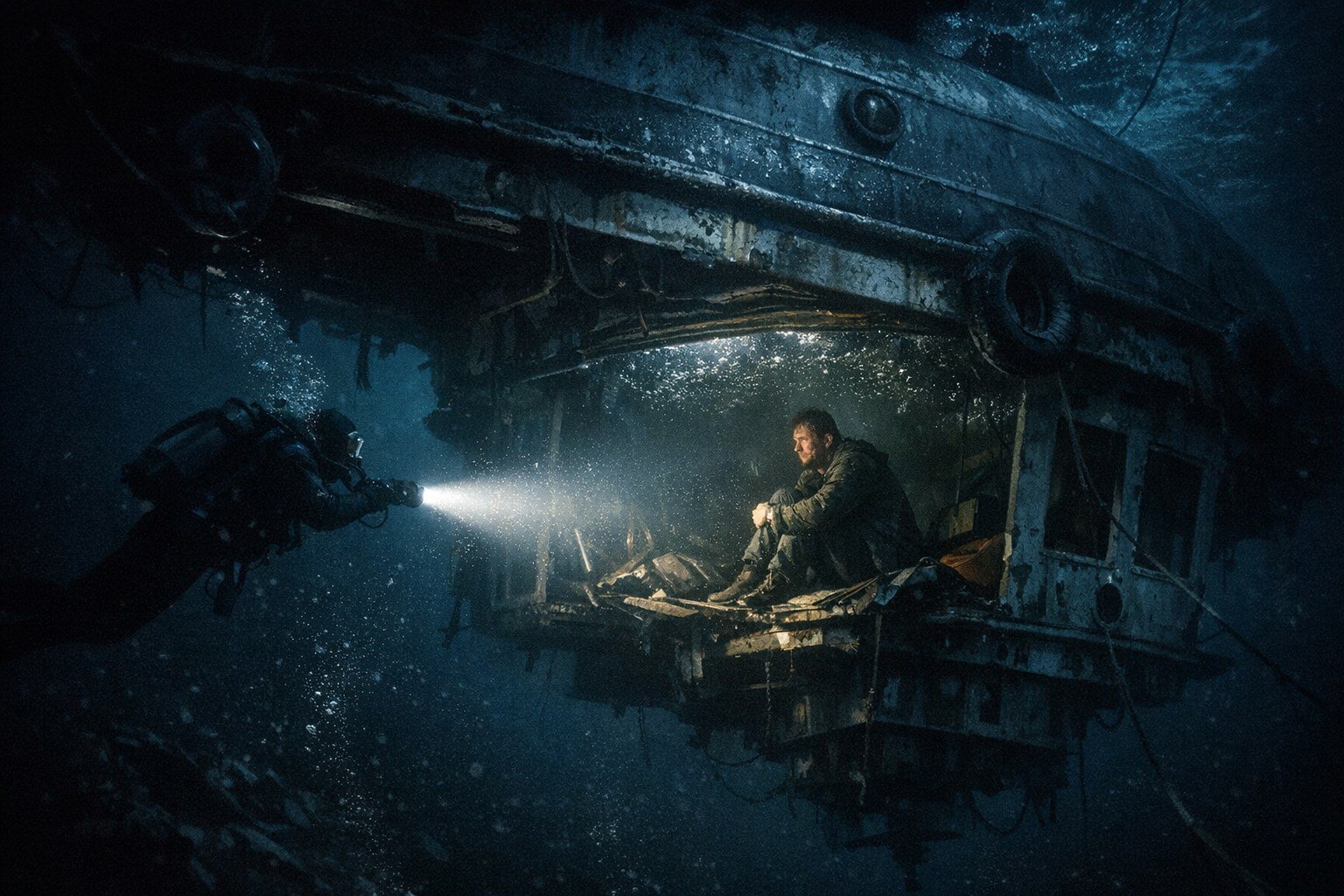
For nearly two and a half days, Harrison Okene stood inside a pocket of air trapped in the belly of an upside-down ship, with black Atlantic water pressing in around him and the weight of the ocean hanging over his head like a ceiling he could never push away.
There was no daylight. No sense of time. No proof that anyone above the wreck still believed a living man could be down there.
Only cold water, steel walls, thinning air, and the sound of his own breathing getting louder every hour.
The Harrison Okene underwater survival story still feels impossible because it unfolded in the worst place most people can imagine: inside a sunken tugboat one hundred feet below the surface off the coast of Nigeria. It matters not just because one man survived, but because he survived long enough for a recovery dive to become one of the most shocking rescues ever caught on camera.
If this kind of ordeal pulls you in, the broader archive of lost at sea survival stories shows how quickly ordinary work on open water can turn into a fight against silence, weather, and time.
On May 26, 2013, the tugboat Jascon-4 was operating near a Chevron platform off the Nigerian coast. It was a working vessel, not a cruise ship or some cinematic expedition boat. It existed for practical labor: towing, offshore support, the kind of hard routine that depends on schedules, steel, and men who know how to work in places that can kill you without warning.
Harrison Okene was the cook. He was twenty-nine years old, part of the crew, part of the machinery of daily life aboard the vessel. He was not there to be famous. He was there to feed the men, do his job, and make it through another shift in the offshore rhythm of engines, metal corridors, and dark water.
Then weather turned.
Around 5:00 a.m., Harrison got up to use the bathroom. That small decision became the hinge between life and death. While he was away from his bunk, a powerful wave struck the tug. Jascon-4 rolled, capsized, and then sank upside down.
Inside the vessel, orientation vanished instantly. Floors became walls. Walls became ceilings. Objects became weapons. Water invaded every compartment it could reach. In a disaster like that, there is no time to calmly form a plan. There is impact, noise, darkness, panic, and the body doing whatever it can to keep moving.
Harrison was thrown into chaos. He swallowed seawater. He slammed into metal. He felt his way through the overturned interior as the tug went down. Somewhere in those first moments, the situation became horrifyingly clear: the ship was not just damaged. It was on the seafloor. Upside down. And he was still inside.
Timeline of Events
- Before dawn, May 26, 2013: Jascon-4 is working offshore near Nigeria with twelve men aboard.
- Around 5:00 a.m.: Harrison Okene gets up to use the bathroom.
- Moments later: A wave hits, the tug capsizes, and the vessel sinks upside down.
- Immediately after sinking: Harrison feels through flooded compartments and finds a trapped air pocket.
- For roughly 60 hours: He remains alive in darkness, cold water, and worsening air conditions.
- Rescue operation phase: Divers enter the wreck expecting a body recovery, not a live rescue.
- Discovery moment: A diver sees Harrison’s hand move in the darkness.
- Extraction: Harrison is given breathing support and carefully removed to avoid decompression injury.
The air pocket he found was not safety. It was only a delay.
That difference matters, because survival stories often get flattened into neat myths. This was not a hidden room where someone could sit and wait comfortably. It was a cramped compartment with cold water up against his body and a shrinking supply of breathable air. The ocean was above him. The dead were somewhere else inside the wreck. And he had no idea whether rescuers would arrive in time, or at all.
He later said he prayed constantly. In total darkness, that kind of ritual becomes structure. It gives panic something to push against.
He also tried to preserve heat and energy. He found a floating mattress and used it to keep more of his body out of the freezing water. That detail is easy to miss, but it is one of the reasons this case still gets discussed. Extreme survival rarely comes down to a single heroic act. It comes down to dozens of tiny choices made under pressure: stay still, breathe slower, float higher, don’t waste strength, don’t surrender to the first wave of terror.
Inside a sealed air pocket, oxygen decreases while carbon dioxide rises. Harrison could not watch the air running out. He could only feel breathing becoming heavier and hear sounds through the hull that he could not interpret.
What Doesn’t Leave You After a Survival Story Like This
- The randomness: Harrison survived partly because he happened to be in a position that gave him a chance to move.
- The isolation: He had no confirmation that rescue was coming, which may be as psychologically brutal as the cold itself.
- The air pocket problem: Survival was not just about staying dry enough. It was about enduring a slowly poisoned atmosphere.
- The grief inside the miracle: Eleven other men on board did not make it out.
Above the wreck, rescue teams were working. But by the time divers entered the vessel, expectations had shifted. This was widely treated as a recovery mission. The reasonable assumption was that nobody could still be alive after that long in a sunken boat.
That assumption is what makes the rescue footage so unforgettable.
A South African diver moved through the submerged interior with lights cutting through dirty black water. Imagine that setting from his side for a second. You are entering an upside-down steel tomb, expecting bodies. Visibility is poor. Every tight passage can snag gear. Every edge can slice skin or hose. The work is already grim before anything unexpected happens.
Then a hand appears.
At first, the diver reportedly thought he was looking at a corpse. Then the hand moved back toward him.
That moment has become the center of the Harrison Okene survival story for good reason. It is one of those rare real scenes that feels almost too perfectly cinematic to be true: the lamp beam, the darkness, the human shape where no life should exist, the split second where one man realizes the impossible has just reached out and touched him.
But finding Harrison was only the beginning. Rescue was still dangerous. Because he had been trapped at depth for so long, bringing him too quickly to the surface could have caused decompression sickness. So divers could not simply haul him up in a burst of relief. They had to manage the escape carefully, fit him with breathing equipment, guide him through submerged sections of the wreck, and then move him into decompression treatment.
He made it out alive.
He was taken for decompression treatment and medical care, and the world reacted the way people always do when reality suddenly becomes stranger than fiction: disbelief first, then fascination. The footage spread because it seemed to reveal something people want to believe and are also frightened to believe—that the line between death and survival can sometimes be nothing more than a hand in the dark and a rescuer arriving before the air runs out.
There is another reason the story lasts. It does not offer a simple victory. Harrison survived, but eleven crew members did not. Survival did not erase loss. It only stood beside it.
That is part of what gives the case its weight. Harrison did not conquer the sea. He endured long enough to be found.
And maybe that is why readers keep returning not just to this case, but to stories like buried alive survival rescues and the wider survival stories archive. They all circle the same terrifying question: what does a person do when the world closes over them and there is no obvious way back?
Harrison’s answer was brutally simple. He prayed. He rationed his energy. He kept breathing. He stayed alive long enough for somebody else to arrive.
Years later, that remains the part that lingers. Not the headline. Not the viral clip. The image of a man standing chest-deep in black water, surrounded by steel, listening to sounds he cannot interpret, with no certainty at all that morning still exists anywhere beyond the hull.
Then, at the edge of endurance, a light appears.
Then a diver reaches out.
Then the dead place answers back with a living hand.
Why This Case Still Gets Attention
Most survival stories involve movement: swimming, climbing, running, signaling, escaping. Harrison Okene’s case is different because so much of it was about endurance inside confinement. That makes the story feel claustrophobic even in summary. It also left behind rare rescue footage that turned an already extraordinary event into something people could witness for themselves.
It also sits at the intersection of tragedy and miracle. Readers are not only drawn to the fact that Harrison survived. They are drawn to the emotional imbalance of the whole event: one man found alive, eleven men lost, and a rescue that arrived just late enough to seem impossible and just early enough to matter.
FAQ
What happened to Harrison Okene?
Harrison Okene was the cook aboard the tugboat Jascon-4 when it capsized and sank off the coast of Nigeria in May 2013. He survived for roughly sixty hours in an air pocket inside the overturned wreck before divers found him during what had largely become a body recovery operation.
How long was Harrison Okene trapped underwater?
He was trapped inside the sunken ship for about sixty hours. He was not fully submerged the entire time, but he remained inside a partially flooded air pocket around one hundred feet below the surface.
How did Harrison Okene survive in the sunken ship?
He survived by finding a trapped air pocket, conserving energy, keeping part of his body out of the cold water with a floating mattress, and enduring until divers reached the wreck. The confined air pocket gave him a chance, but it was still an extremely dangerous environment with worsening air quality and severe psychological stress.
Is the Harrison Okene case one of the most famous survival stories at sea?
Yes. It is one of the most widely known maritime survival stories because of how long he remained alive inside the wreck and because the diver’s discovery of him was captured on video, making the rescue feel immediate, real, and deeply unsettling.
Why does the Harrison Okene survival story still feel so disturbing?
Because it combines several primal fears at once: drowning, darkness, isolation, confinement, and running out of air. It also happened in a real working environment, which makes the disaster feel frighteningly plausible rather than distant or fictional.
🔎 If this story stayed with you, the author suggests these real cases next:
- Ocean ordeals where survival should have ended far sooner
- Real rescues that began with faint sounds from places thought to be tombs
- The broader archive of people who refused to die when everything said they should
Explore more Survival Stories here: