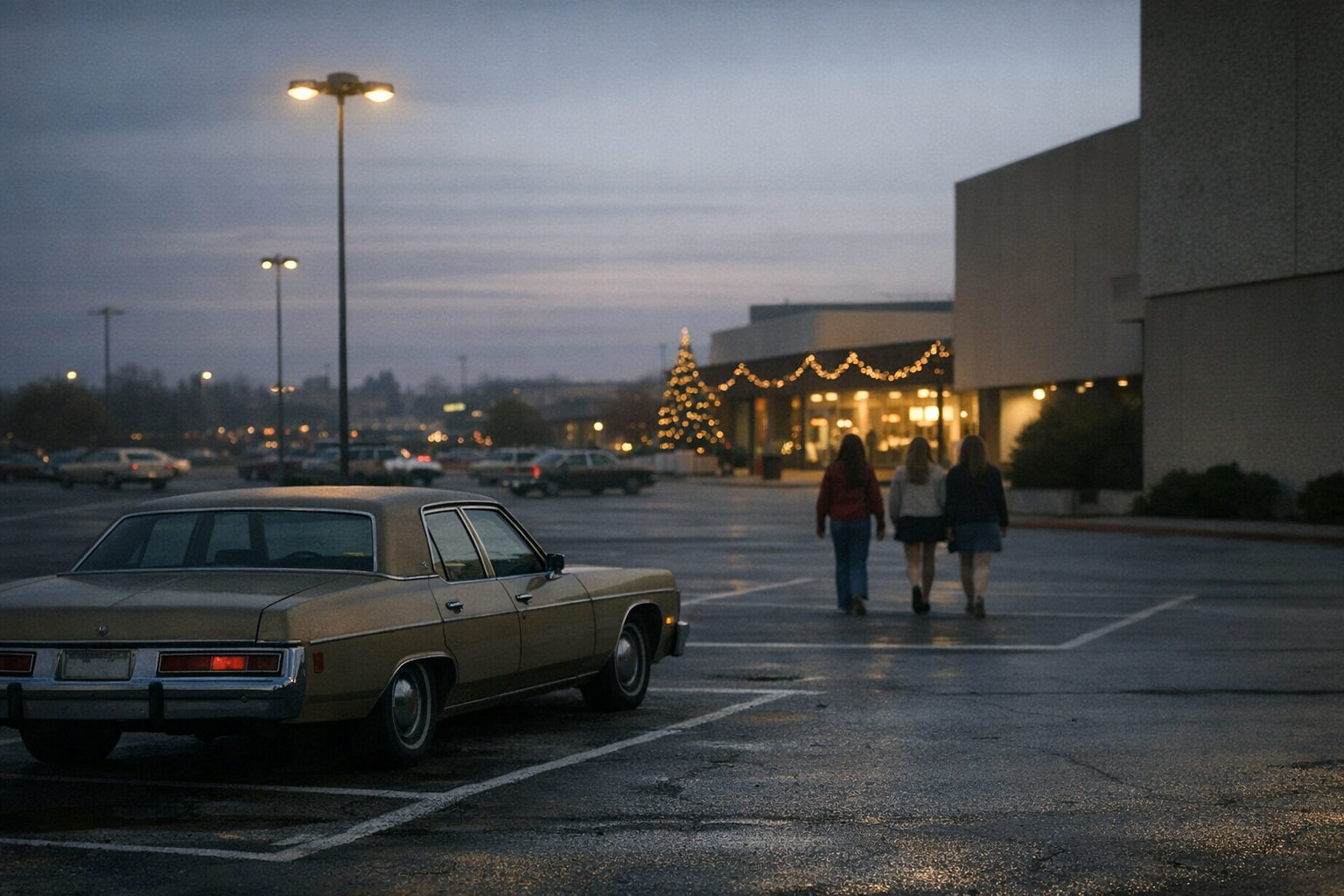
The parking lot should have been louder than that.
It was December 23, 1974, two days before Christmas, and Seminary South Shopping Center in Fort Worth should have been running on the usual holiday rhythm—car doors slamming, shopping bags brushing against winter coats, children tugging at sleeves, exhausted parents trying to finish one last errand before dark. Instead, by early evening, one car sat still in the Sears upper lot as if time had simply stopped around it.
Inside were the ordinary leftovers of an ordinary day: wrapped gifts, a few small purchases, the kind of evidence that says someone was planning to come right back. But Mary Rachel Trlica, Lisa Renee Wilson, and Julie Ann Moseley never came back. They had driven to the mall for a quick Christmas shopping trip. Then, somewhere between the bright storefronts and the walk back to the car, three futures vanished at once.
What happened to the Fort Worth Missing Trio?
The Fort Worth Missing Trio is one of the most haunting missing person cases in Texas history. On December 23, 1974, Rachel Trlica, Renee Wilson, and Julie Moseley disappeared after visiting a Fort Worth shopping mall, and the case still matters because it combines missing children, contradictory witness accounts, and a timeline that somehow ends in a crowded public place with no clear answer.
Cases like this are part of what keeps readers circling back through the site’s Missing Children and Teens Archive, because once a child or teenager disappears during something this routine, every small detail starts to feel dangerous in hindsight.
Rachel was 17 and married, old enough to drive, old enough to look like the steady one in a group. Renee was 14, excited about a Christmas party later that day and a new promise ring from her boyfriend. Julie was only 9, the youngest by far, tagging along because she did not want to stay home alone. There was nothing dramatic about the plan. That was the whole point. They were supposed to shop, come home, and go on with Christmas.
They left around midday. Before heading to Seminary South, they stopped at an Army-Navy surplus store so Renee could pick up jeans she had on layaway. After that, they drove Rachel’s Oldsmobile to the mall and parked near Sears on the upper level. Witnesses later said they saw the girls inside the shopping center through the afternoon, moving through the last-minute holiday rush like thousands of other shoppers.
And that is what makes this case so stubborn. Nothing about the beginning feels like the start of a disappearance story. It feels like the beginning of a memory almost anyone could have from the 1970s: a mall at Christmas, teenagers browsing, a younger child following along, the assumption that the world would still be there in the same shape an hour later.
The day that should have ended normally
Julie’s mother had only agreed to let her go after some pleading. Julie was supposed to be home by 6 p.m. Renee had her own reason not to stay out long—she wanted to be back even earlier so she could get ready for a party. Those details matter because they crush the old runaway theory before it even gets off the ground. People do not usually choose the exact afternoon before a holiday gathering, with gifts half-bought and plans waiting at home, to disappear forever. A 9-year-old especially does not make that choice.
Still, when the girls did not come back, their families first had to do what families always do in the opening hours of a crisis: turn worry into errands. Call around. Check with friends. Drive the route. Search the lot. Hope for something embarrassing and harmless. Hope the girls lost track of time. Hope the car broke down. Hope for anything ordinary.
Instead, around 6 p.m., Rachel’s Oldsmobile was found parked at Seminary South. The gifts were still there. The car did not look wrecked or abandoned in panic. It just looked left behind.
That image has haunted the case for decades: not an empty road, not a wilderness trail, not some isolated place where evidence disappears with the weather. A busy mall parking lot. Christmas traffic. Other shoppers nearby. And then nothing.
Timeline of Events
- Late morning to noon, December 23, 1974: Rachel Trlica, Renee Wilson, and Julie Moseley leave to shop in Fort Worth.
- First stop: They visit an Army-Navy surplus store so Renee can pick up jeans from layaway.
- Afternoon: They arrive at Seminary South Shopping Center. Witnesses later report seeing them inside the mall.
- By early evening: The girls fail to return home as expected.
- Around 6 p.m.: Family members find Rachel’s car parked in the Sears upper lot with gifts still inside.
- December 24, 1974: A letter allegedly written by Rachel arrives, claiming the girls went to Houston for about a week.
- Following years: Witness tips, searches, and theories multiply, but no confirmed trace of the trio is found.
If the story ended with that car, it would already be one of the strangest disappearances in Texas history. But the next day, the case took a turn that made everything murkier instead of clearer.
A letter arrived, supposedly written by Rachel. It claimed the girls had gone away to Houston and would be back in about a week. It also told the family where the car had been left: in the Sears upper lot.
At first glance, that should have changed the whole case. If the note was real, then maybe the girls had left voluntarily. Maybe there was a secret plan. Maybe the panic had been a misunderstanding.
But almost immediately, the letter started to feel wrong.
It was addressed to “Thomas A. Trlica,” not “Tommy,” the name Rachel normally used for her husband. The envelope was written in pencil, while the letter itself was in ink. The paper did not fit neatly inside the envelope. Even the spelling of Rachel’s own name looked odd, as if the writer may have started to form the wrong letter and corrected it. Handwriting examinations over the years never settled the issue. The results stayed frustratingly inconclusive.
So the one physical piece of evidence in the case became less of an answer than another locked door. If Rachel wrote it, why? If she did not, who did? And if someone forced her to write it, when and where did that happen?
What doesn’t add up
- The runaway idea never fit the day. Renee had a party that night. Julie was 9 years old and expected home for Christmas.
- The car was left in plain sight. If someone wanted distance from the case, leaving the vehicle in a crowded mall lot was a strange choice.
- The letter feels staged. The wording, the formal name, and the handwriting problems all keep suspicion alive.
- There was no obvious struggle. In a crowded holiday setting, three girls disappeared without a scene anyone could clearly prove.
- Witness stories clash. Reports about a pickup truck, a van, and possible companions widen the mystery instead of narrowing it.
This is where the Fort Worth Missing Trio case shifts from sad to deeply unsettling. Three girls disappear together, yet the case never develops the solid shape people expect. No single witness account locks into place. No suspect stands clearly above the rest. No object discovered later forces the story into one clean explanation.
There were, however, hints. Always hints.
One account claimed the girls were seen being hustled into a yellow pickup truck near the mall. Another witness years later described a man forcing a girl into a van and brushing off concern by calling it a family dispute. Another lead suggested the girls may have been seen with someone they knew. That possibility matters. In a public place, surprise abduction is difficult. Voluntary approach is easier. A familiar face could lower the noise, the resistance, the chance of a scream that makes everyone turn their head.
The contrast between holiday normalcy and the permanent blank space that followed. Nothing in the scene looks like a dramatic takedown. The stronger possibility—the one that makes the case feel colder—is that whatever happened may have begun with a conversation that looked harmless from a distance.
“Come here a second.”
“I’ll give you a ride.”
“Your family sent me.”
That is all it takes sometimes. Not force at first. Just an opening. Just enough trust to get someone away from the bright part of the parking lot.
The families never believed the girls ran off. They kept pushing while law enforcement, especially early on, treated the case with the kind of softness missing-person investigations once often suffered from. The runaway assumption cost time. And in cases like this, time is oxygen. Every hour that passes lets memories blur, crowds thin, and evidence disappear into normal life.
Searches followed. So did rumors. Tip after tip surfaced over the years—possible sightings, recovered remains that turned out to be unrelated, witness statements too uncertain to carry the case, and private investigations that generated momentum but not resolution. One private investigator pursued the story hard, only for his own files to reportedly be destroyed after his death. That detail almost sounds too cruel for fiction, but the case is full of those kinds of turns.
Key evidence and clues
- Rachel’s Oldsmobile in the Sears lot: The strongest fixed point in the timeline and proof the girls made it back to the parking area, or close enough to leave the car there.
- Christmas gifts left inside: Supports the idea that the outing was interrupted, not completed.
- The letter mailed the next day: Potentially the most important clue, but also the most disputed.
- Witness reports of another person or vehicle: Suggest the girls may have encountered someone familiar or persuasive.
- Lack of confirmed forensic evidence: Early investigative assumptions limited what could be preserved or tested later.
The emotional weight of this case also comes from the ages involved. Group disappearances are rare enough. But a group this uneven—a married 17-year-old, a 14-year-old with holiday plans, and a 9-year-old child—creates its own eerie logic. It is hard to imagine all three acting independently in the same reckless direction. That makes a single outside force, or someone with influence over the situation, feel far more likely.
And then there is the timing. Holiday disappearances never sit right with people because they interrupt a date that is supposed to come back every year carrying warmth. Every December, the same lights go up, the same songs start playing, the same shopping crowds fill parking lots. For most families, those details are background noise. For the families of Rachel, Renee, and Julie, they became permanent triggers. The season itself turned into evidence.
That is why this case still pulls attention decades later. It is not just unsolved. It feels unfinished in a very specific way. People can imagine the last ordinary version of those girls too clearly—walking through stores, comparing gifts, thinking about later that night. Then the film strip burns away.
In that sense, the Fort Worth Missing Trio belongs in the same conversation as cases like Asha Degree’s disappearance, where routine expectations collapse so suddenly that the timeline itself becomes the main source of dread. Once the ordinary breaks, every harmless detail starts glowing with menace.
Why this case still gets attention
- It happened in public. People expect malls, especially before Christmas, to be safer than lonely roads or abandoned fields.
- Three victims vanished together. That alone makes the case rare and unforgettable.
- The letter keeps the mystery alive. It offers a possible explanation while making the case feel even more staged.
- The family impact is impossible to ignore. Each year the same date returns, but the story never reaches an ending.
- The case still speaks to modern fears. Missing children, public-space vulnerability, and investigative blind spots remain intensely relevant.
So what is the most likely explanation?
The careful answer is that no one knows. The honest answer is that voluntary disappearance by all three girls has always looked weak. The stronger theory is that they encountered someone—possibly someone known to at least one of them—and left the mall area under pressure, persuasion, or deception. After that, whatever happened happened quickly enough, and far enough from reliable witnesses, that the case lost its chance to form a clean trail.
The letter may have been written under coercion. Or it may have been forged by someone trying to buy time and point police in the wrong direction. Either way, it feels less like a confession of freedom than a piece of staging.
And that is the hardest part of the Fort Worth Missing Trio mystery: not just that three girls vanished, but that the disappearance seems to have slipped through one of the busiest, brightest, most ordinary places imaginable. There was no forest to swallow them. No storm to erase their tracks. Just a holiday shopping center full of people who all went home.
Rachel. Renee. Julie. Three names that should have stayed attached to Christmas presents, family photos, and the next decade of their lives. Instead, they became part of a permanent unanswered space in Texas history.
Maybe that is why the case endures. Because it leaves behind an image nobody can comfortably explain away: a locked car in a mall lot, gifts still inside, and a night that looked too normal to be the edge of a cliff.
That blank space is what readers keep returning to. Not because the story is sensational, but because it feels fatally familiar. Three girls went out for a simple holiday errand. By nightfall, they had become a mystery.