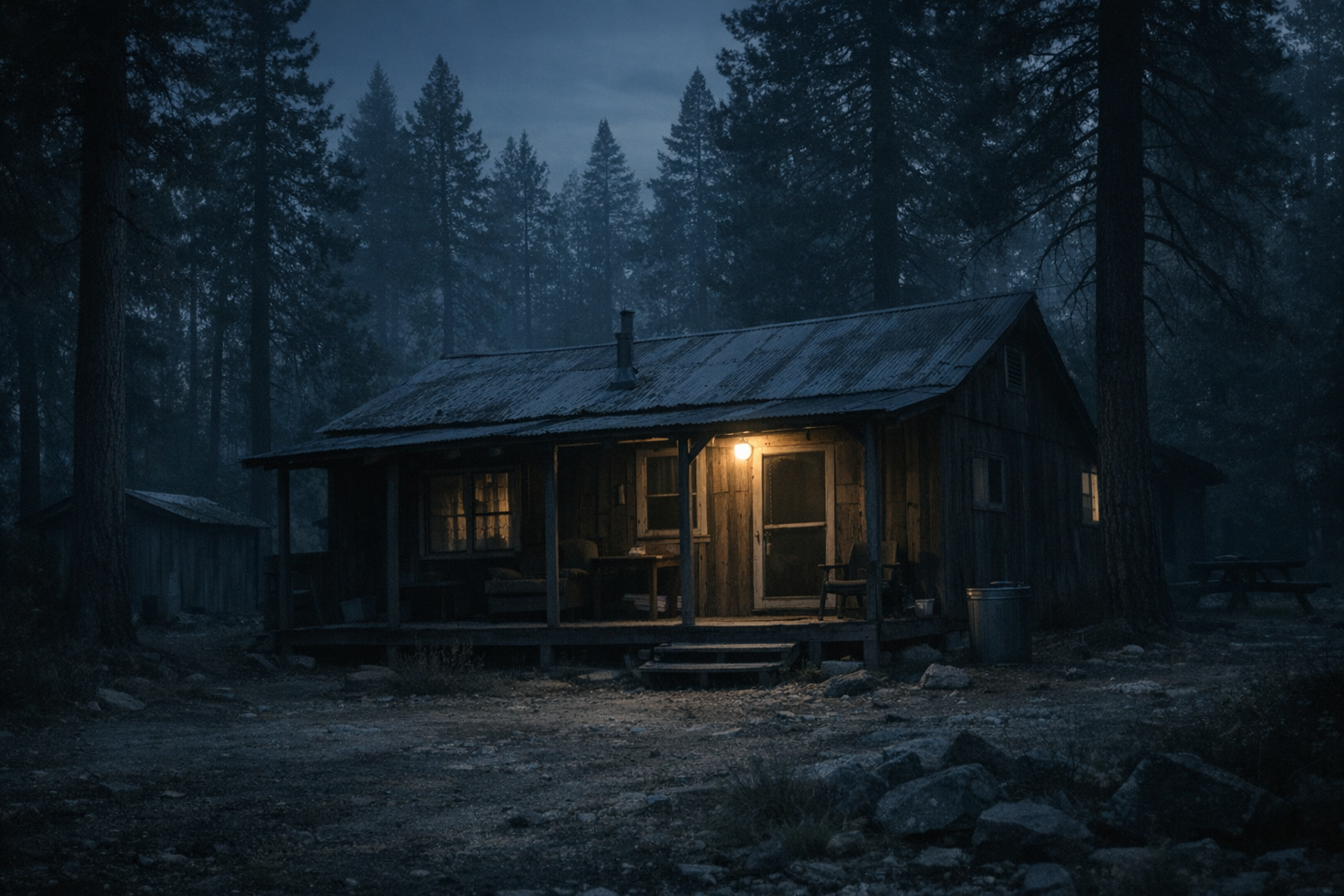
The cabin looked ordinary from the outside — one more small structure tucked into the trees of a fading resort town in the Sierra Nevada. But on the morning of April 12, 1981, the quiet around Cabin 28 felt wrong before anyone even understood why. Inside, the living room had become a frozen crime scene so violent, so intimate, and so confusing that more than four decades later, people still read about it and feel the same chill: not just because of what happened there, but because the house itself seemed to hold the mystery in place.
What happened at Keddie Cabin 28?
The Keddie Cabin 28 murders remain one of California’s most haunting unsolved murder cases, centered on the deaths of Sue Sharp, her son John, his friend Dana Wingate, and the disappearance of Tina Sharp. It still matters because the physical scene inside the cabin — who was found there, who was missing, and what evidence appeared to point in several directions at once — created a true crime puzzle that has never fully settled.
That feeling of a case trapped inside its own walls is part of why stories like the Amy Mihaljevic case keep holding readers: once a place becomes the last known setting of a crime, every doorway, object, and silence starts to feel important.
Before the murders, the Sharp family had been trying to start over. Sue Sharp had moved to Northern California with her children after separating from her husband, and Cabin 28 in Keddie offered something that must have felt badly needed at the time: room, quiet, and a chance to rebuild. Keddie itself was small, wooded, and easy to imagine as safe. It was the kind of place where children moved between cabins, where neighbors knew each other, and where danger did not seem like it belonged.
On Saturday, April 11, 1981, the day moved with the casual rhythm of an ordinary weekend. Sue was home. Her children came and went. John Sharp, 15, spent part of the day with his 17-year-old friend Dana Wingate. Sheila Sharp, 14, planned to sleep next door with the Seabolt family in Cabin 27. Tina Sharp, 12, drifted between cabins that evening, watching TV for a while before returning home. In a separate bedroom inside Cabin 28, Sue’s younger sons Rick and Greg were there too, along with their friend Justin Smartt.
Nothing about that setup looks unusual at first. That is part of what gives the case its staying power. The house was full enough that it should not have become a perfect stage for mystery. People were nearby. Children were sleeping in the next room. Another cabin sat only steps away. Yet sometime during the night, the ordinary shape of that home collapsed.
When Sheila returned the next morning, she found the living room turned into something almost impossible to process. Sue Sharp, John Sharp, and Dana Wingate were dead. The attack had been brutally personal. The victims had suffered blunt-force trauma and knife wounds. They had been bound. Blood was found throughout the room. The scene looked chaotic, but not random. It looked like violence had unfolded in stages.
And then there was the detail that made the whole house feel even stranger: Tina Sharp was gone.
That absence changed the emotional center of the case immediately. This was no longer only a triple homicide. It was also a house with a missing child inside its story, and that meant every detail in Cabin 28 became loaded with a second kind of tension. Investigators were not just asking who had killed three people. They were also asking what had happened between the violence in the living room and the disappearance of Tina.
Timeline of Events
- April 11, 1981, daytime: Sue Sharp and her children go about a normal Saturday in and around Quincy and Keddie.
- Evening: Sheila leaves to spend the night next door in Cabin 27. Tina later returns to Cabin 28 after spending time with neighbors.
- Night of April 11 to early April 12: Sue, John, Dana, Tina, and the younger boys are inside or connected to Cabin 28 during the hours when the attack is believed to have occurred.
- Around 1:15 a.m.: Nearby residents later report hearing sounds that may have been muffled cries or a disturbance.
- Morning of April 12: Sheila returns and discovers Sue, John, and Dana dead in the living room. Tina is missing.
- 1984: Tina Sharp’s remains are found miles away in Butte County, turning the case into a confirmed quadruple homicide.
- 2013 onward: Renewed attention brings old evidence, old suspects, and possible overlooked leads back into public view.
The layout of Cabin 28 has always mattered. Readers keep coming back to this case because the house itself seems to refuse simple explanations. Three younger boys in a nearby bedroom were unharmed. A neighboring family heard no clear alarm strong enough to trigger immediate action. Some reports suggested the phone was off the hook. Investigators found a scene that looked savage, noisy, and close-quarters — yet somehow the night still swallowed the full sequence.
Keddie is not just a case about suspects. It is a case about a room.
The living room in Cabin 28 became a kind of physical riddle. Sue Sharp was found near the sofa, badly wounded and bound. John and Dana were nearby, also bound and fatally attacked. Weapons connected to the violence were reportedly left at the scene. The arrangement of bodies and evidence suggested a confrontation that escalated, but the exact order never became clean. Did the attack begin with Sue? Did John and Dana walk into it? Was Tina taken during the chaos, or after it? The room had clues, but not clarity.
That is one reason the case stayed alive far beyond the usual news cycle. People do not just remember the names. They remember the image of a cabin where the physical evidence seemed loud, but the final answer stayed silent.
What Doesn’t Add Up
- The house was not isolated enough for this to feel invisible. Cabin 28 was in a lived-in area, with neighbors close by.
- Three younger boys survived in the home. Their presence raises constant questions about timing, movement, and motive.
- Tina Sharp was missing from the original scene. Her absence made the crime immediately more complicated than a single burst of violence.
- Some witness accounts and later statements conflicted. That kept investigators and the public from settling on one clean version of events.
- The case carried suspicion early, but no final resolution. Strong suspicion without charges is one of the main reasons the story still feels unfinished.
Over time, attention focused on people close to the cabin and on the idea that the murders may not have been random at all. The names Martin Smartt and John “Bo” Boubede have surfaced repeatedly in discussions of the case, especially because of later claims, letters, statements, and the strange gravity that seemed to collect around the neighbor circle. But even when the case appears to lean toward a likely direction, it never quite lands. That is the trap Keddie sets for anyone who studies it. The deeper you go, the more it seems like the answer is almost visible — just not solid enough to hold.
The suspected weak points in the early investigation only deepened that feeling. Reports of contamination, missed follow-up, disputed handling of evidence, and overlooked leads made the case feel less like a locked mystery and more like a mystery that may have slipped through human hands. In other words, the haunted quality of Cabin 28 does not come only from the crime itself. It comes from the idea that the truth may once have been closer than it is now.
Then came the discovery that widened the story again. In 1984, Tina Sharp’s remains were found far from Keddie. That discovery confirmed what many already feared, but it did not bring closure. Instead, it made Cabin 28 feel even more like the first chapter of a larger story that investigators had never fully reconstructed.
And that is why the case remains perennially searched. The Keddie murders sit in a powerful true crime lane: a family setting, a highly visual scene, possible known suspects, a missing child, and an investigation that still seems to invite the question of what was missed. Readers who spend time with cases like the True Crime Archive are often pulled back to Keddie because it has everything that keeps a case alive in public memory — horror, layout, contradiction, and the feeling that the walls themselves should have told investigators more.
Key Evidence and Clues
- The living room arrangement: The victims were found in positions suggesting the attack was prolonged or moved through phases, not one sudden strike.
- Bindings and multiple weapons: The violence appeared controlled at moments and frenzied at others, which has fueled debate about how many attackers were involved.
- Tina’s disappearance: Her absence from the cabin and later recovery elsewhere expanded the case beyond the house while making the cabin even more central.
- Later statements and reported confessions: Allegations tied to key suspects have kept suspicion alive even without a prosecution.
- Evidence questions years later: Renewed investigation brought new scrutiny to old materials, including whether some of the most important clues were mishandled or underused.
But for all the names, evidence lists, and later theories, the part of the story that refuses to fade is still the house itself. Cabin 28 feels like one of those rare crime scenes that became bigger than its address. It has the same eerie power as certain abandoned motels, empty trails, or parked cars in other famous cases. The building turned into evidence, symbol, and nightmare all at once.
Imagine the final normal moments in that cabin: the television on, children drifting between rooms, someone thinking about the next morning, someone else thinking about nothing important at all. That is what makes the story hit so hard. Violence did not interrupt a dramatic night. It interrupted an ordinary one. And when true crime readers talk about the Keddie Cabin 28 murders, what they are really circling is that split second when a home stopped being a home and became a puzzle no one could put back together.
In the years since, Cabin 28 was demolished. The structure is gone. But in one sense, it never disappeared. The room still exists in photographs, in witness memory, in case files, and in the imagination of anyone who has ever looked at the timeline and thought the same thing investigators must have thought from the beginning: this should have been solvable.
Maybe that is the reason the case never fully lets go. Not because it is the bloodiest, or the oldest, or the most famous, but because it feels so close to explanation. There are cases that are mysterious because they leave almost nothing behind. Keddie is the opposite. It left too much behind — a room full of damage, a missing child, a chain of suspicion, and just enough possible answers to keep certainty out of reach.
That is the real legacy of Keddie Cabin 28. A house in the Sierra became a frozen crime scene, and the closer people looked at it, the less the story behaved like something finished. More than forty years later, the case still reads like a door left half open in the dark.