A birthday sleepover became a death investigation on the morning of November 4, 2018.
On November 4, 2018, Tamla Horsford was found dead in the backyard of a home in Forsyth County, Georgia, after an overnight birthday gathering.
Then daylight came, and Tamla Horsford was found dead in that yard.
What happened to Tamla Horsford?
Tamla Horsford was a 40-year-old mother whose death after an adult sleepover in Cumming, Georgia became a deeply debated suspicious-death story inside the broader true-crime world. Her case still matters because the official explanation—a fall from the backyard deck—never fully quieted the questions about witness statements, investigative choices, and what the scene itself was really saying.
That tension places her story beside other house-centered cases where the setting itself never stops feeling important, including these family murder cases where ordinary homes became crime scenes.
On the night of November 3, 2018, Tamla attended a birthday sleepover at a home on Woodlet Court in Cumming. She was the only Black woman among the attendees. Her death drew questions about race and trust in the investigation, alongside the dispute over the physical evidence.
Witness accounts placed Tamla on the back deck during the night. The next morning, she was found below it. Recollections of the party and the final hours became part of the investigation, but they do not provide a witnessed account of her fall.
By the next morning, Tamla was in the backyard below the deck. The official conclusion was that she had fallen during the night. Authorities pointed to alcohol consumption, toxicology findings, and injuries they said were consistent with a fall. From the state’s point of view, the central shape of the story was simple: a tragic accident after a night of drinking.
But this case never lived as a simple story for very long.
The debate is not built around a long wilderness search, a vanished car, or years of no evidence. It is built around a contained setting. A backyard. A deck. A friend group. A dead woman. And a series of explanations that many people felt never settled into one clean, believable picture.
Timeline of Events
- Evening, November 3, 2018: Tamla Horsford arrives at an adult birthday sleepover in Cumming, Georgia.
- During the party: Witnesses described drinking and time spent on the deck.
- Overnight hours: Different attendees go to sleep at different times, leaving an uncertain final window for exactly when Tamla was last clearly seen.
- Morning, November 4: Tamla is found dead in the backyard below the deck.
- February 2019: The sheriff’s office closes its investigation after an accidental-death finding.
- June 2020–July 2021: The GBI reopens the investigation. In July 2021, officials announce that the district attorney’s review does not support criminal charges.
- Long after the file closes: Public debate continues around the witness accounts, the handling of the scene, and whether the investigation earned trust.
That final overnight window is where the case starts tightening. Tamla was not found miles away. She was not in another town, not on an empty highway, not in a place that demanded a huge imaginative leap. She was right there, in the yard of the same home where everyone had spent the night. That should have made the story easier to pin down. Instead, it made every inconsistency feel louder.
Horsford’s family disputed the accidental-death conclusion. Their attorney argued that the investigation left important questions unresolved. Concerns deepened when an internal affairs investigation found that investigator Mike Christian had shared sensitive case information with women with whom he had relationships. The sheriff’s office said his misconduct did not invalidate the work of other investigators.
That is why Tamla Horsford’s death still gets discussed as more than a closed file. It became one of those modern true-crime cases where the official ruling and the public narrative split apart and kept moving in different directions. One side said the evidence pointed to an accident. The other said the investigation never fully earned the right to sound that certain.
What doesn’t add up for many people?
- The final moments were not witnessed. The physical evidence informed the official ruling; the gathering’s attendees did not provide a direct account of the fall.
- The debate is really about confidence. Many people do not argue that a fall was impossible; they argue that the investigation sounded too settled too quickly.
- The handling of information damaged trust. Findings about an investigator’s sharing of confidential material became a documented concern, separate from the medical conclusion.
- The social context never went away. Questions about race, trust, and whether Tamla’s death would have been handled differently in another setting kept the case from fading into a routine accident file.
The social context is impossible to ignore. Forsyth County already carried a reputation that made people suspicious of neat official answers in a case like this. Tamla’s family and many outside observers believed that history mattered. To them, the case was not only about forensic interpretation. It was about whose death gets treated as a crisis and whose death gets folded into administrative certainty before the public can even trust the process.
That does not mean every rumor should be treated as fact. It does mean the case sits in an uncomfortable middle ground that true crime returns to again and again: a file where officials say the physical evidence supports one answer, while a large part of the audience keeps staring at the social and narrative details around the case and feeling the story resist closure.
Readers interested in how evidence and public interpretation diverge may also explore the Missy Bevers case. The legal status of the cases differs: Horsford’s death was ruled accidental, while Bevers’s death is an unsolved homicide.
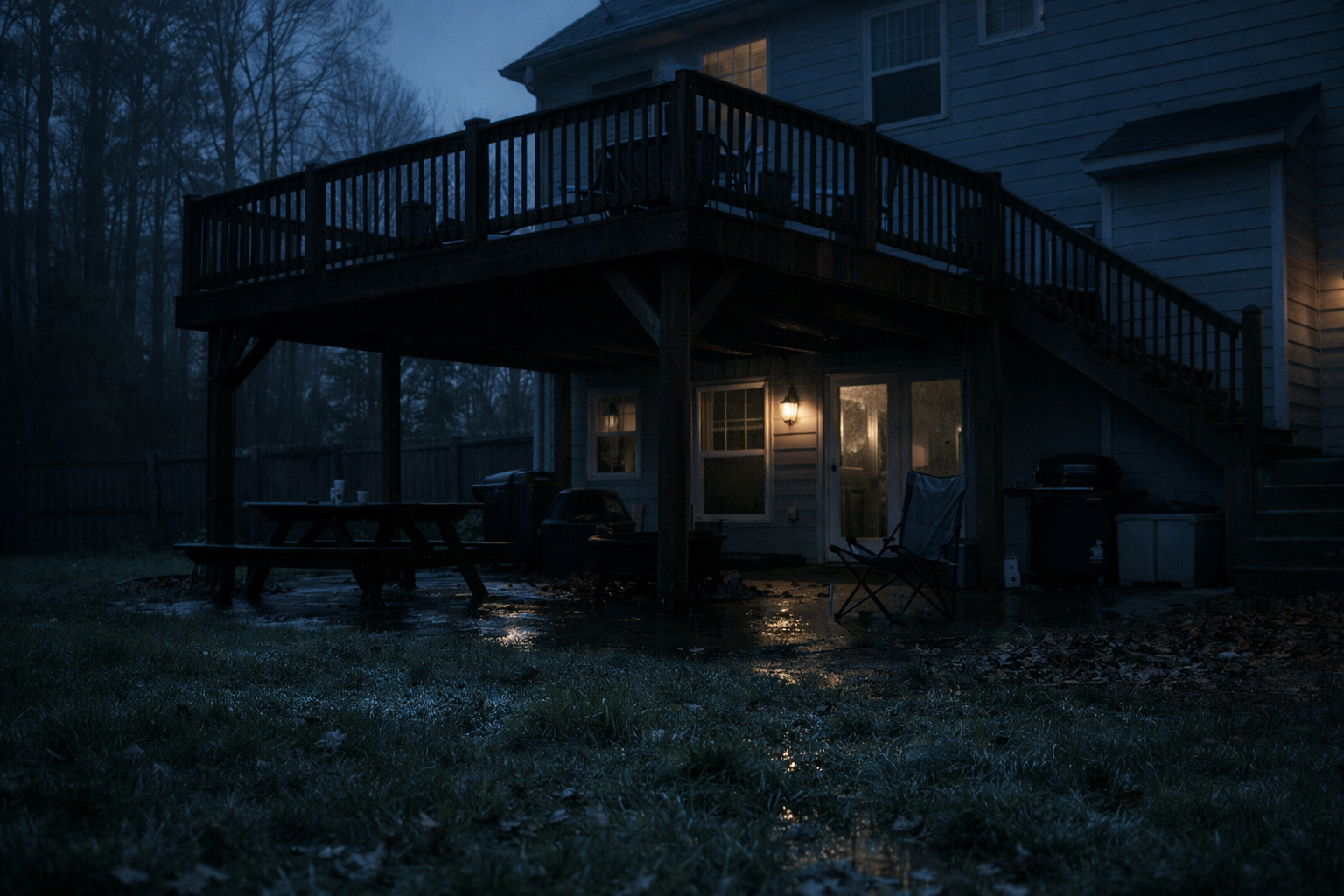
The setting is easy to picture: an elevated deck, a backyard and a morning discovery. But the official explanation was an accidental fall, and the family’s objections should be understood separately from that medical finding.
The official accidental-death ruling remains essential to the account. In July 2021, the GBI said that the district attorney’s review found no basis to pursue criminal charges. Horsford’s family continued to challenge the investigation. Their objections are not a finding that a crime occurred, just as the decision against charges does not reconstruct every unwitnessed moment.
Why this case still gets attention
- It feels closed on paper but open in conversation.
- The entire mystery happened in one relatable suburban setting.
- The family’s objections and the documented handling of confidential information remain part of the debate.
- The racial and social context made the investigation itself part of the story.
That is the real reason Tamla Horsford’s death still divides people. Not because it lacks an official answer, but because the official answer never dissolved the unease. The house remains the central character. The deck remains the image. And the case remains trapped in that late-night shift from harmless sleepover to permanent suspicion.
If you strip the story down to its bones, it becomes brutally simple. A woman went to spend the night with friends. By morning, she was dead in the yard. The state says it knows how that happened. A lot of people still do not believe the emotional math of the case ever balanced.
The disagreement concerns both the ruling and trust in the investigation. No criminal charges resulted from the GBI’s review; that outcome and the family’s continuing objections both belong in the account.
And maybe that is the detail that keeps this case alive. In so many mysteries, the darkness is out in the woods, or down the road, or in some unknown last location. Here, the darkness stayed in the backyard of a house full of people. It stayed close. It stayed domestic. It stayed ordinary. Which means the story still lands with the kind of force readers never really shake.
Research Sources
The following resources were consulted to verify and update this article.
- Forsyth County Sheriff’s Office — Incident and crime scene reports, case 2018-110177
Original reports record the November 4 discovery, property layout and observations made by responding investigators. - FOX 5 Atlanta — GBI: No criminal charges in Forsyth County woman’s death
Reports the July 2021 decision against criminal charges, the accidental-death finding and the family’s objections. - WSB-TV — GBI wants to speak with women who claim to have seen evidence tied to death of young mom
Documents allegations about a former investigator’s sharing of confidential material, internal affairs findings and the sheriff’s response.