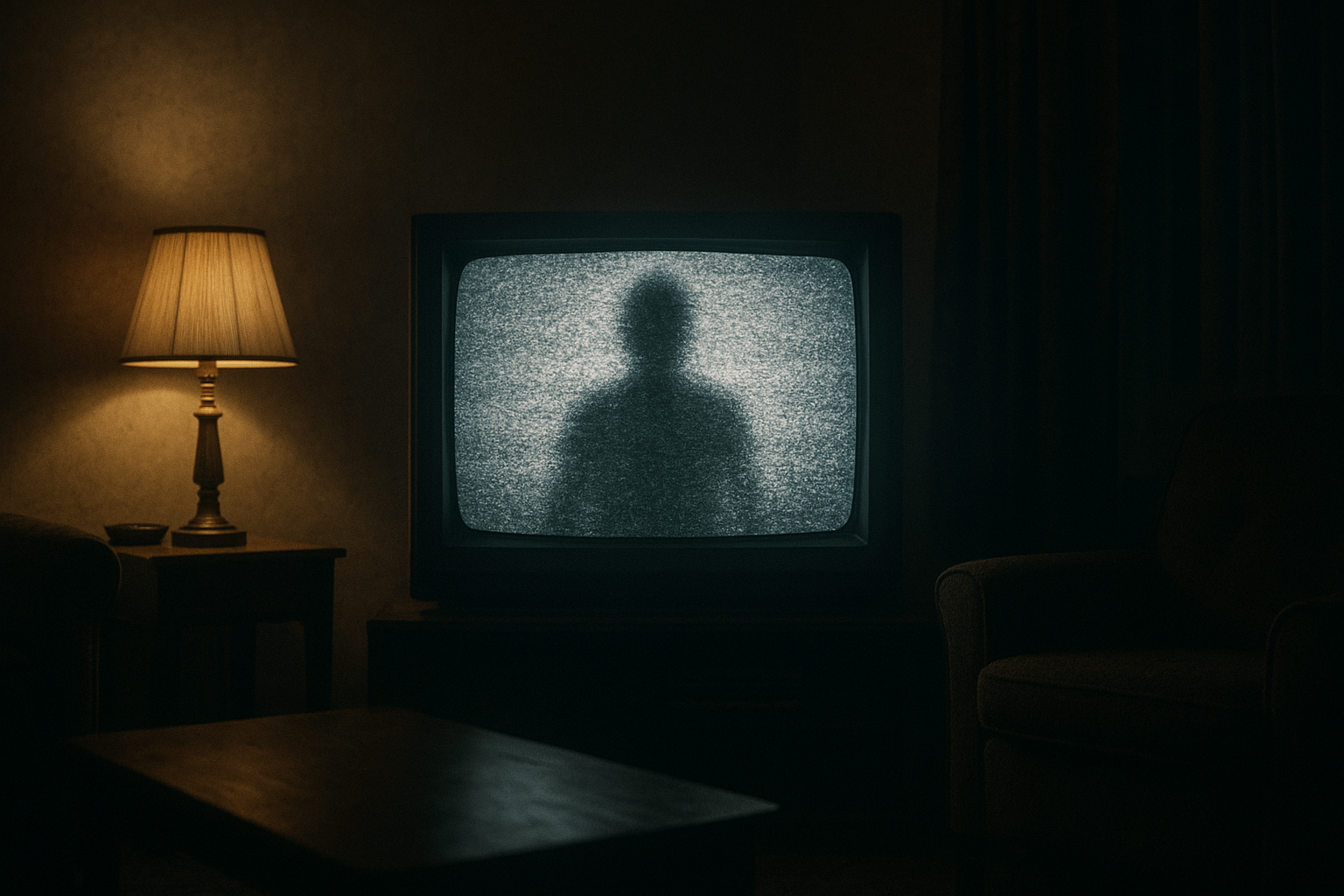
Just past midnight, with the room washed in that weak blue light only an old television could make, the picture is supposed to have broken apart.
Not faded. Not glitched for a second and snapped back. Broken apart.
In the version people still tell, the normal program disappears and the screen turns hostile – static, distortion, a face that may not be a face, audio that sounds less like speech than interference forcing its way into the room. It is brief, ugly, and impossible to shake. And by the time anyone tries to pin down exactly what happened, the Wyoming Incident has already slipped into that dangerous zone between a documented broadcast interruption and an internet legend too vivid to die.
The Wyoming Incident broadcast hack is one of the web’s longest-lasting creepy-media mysteries, a story about a supposed television signal intrusion in Wyoming that may have been real, partly real, or entirely born from digital folklore. What keeps the case alive is not just the imagery people describe, but the way the story sits beside real broadcast hijackings and dares you to decide where fact ends and myth begins.
If this kind of signal-born unease gets under your skin, it sits naturally beside Creepy Broadcast and Video Mysteries – The Signals, Channels, and Uploads That Terrified the Internet, where the same fear keeps showing up in different forms.
The interruption always comes first
The reason the Wyoming Incident survives is simple: people do not remember it as a topic. They remember it as a moment.
Something normal is on television. Then it is not.
That is the whole trap. Before anyone starts debating dates, stations, upload origins, or whether the footage was faked later, the story works on a deeper level. It revives an old analog fear – the fear that a machine you trust can suddenly stop being neutral and start behaving like a doorway.
In older decades, television carried an authority streaming never really had. A signal arrived from somewhere you could not see. It passed through towers, wires, frequencies, weather, and equipment most viewers did not understand. When that image came into your home, it felt official almost by default. So if the picture suddenly warped into something wrong, people did not immediately think “edited clip.” They thought: what just got in here?
That psychological setup matters more than any single retelling. The Wyoming Incident is scary because the alleged interruption does not feel like a ghost story told around a fire. It feels like a failure in infrastructure. Something using a trusted system to do something it was never supposed to do.
Versions differ on the exact visuals, but they orbit the same elements: heavy distortion, menacing sound, warped human imagery, and messages or flashes that seem designed to unsettle rather than communicate. Some retellings make the incident sound like a simple pirate-signal intrusion. Others push it toward forbidden-media territory, with claims that viewers experienced headaches, nausea, anxiety, or even psychological aftereffects.
And that is exactly where the mystery deepens. The closer the story gets to the internet, the less stable it becomes.
How the story spread after the screen went dark
There is a reason the Wyoming Incident became sticky online while thousands of other weird claims vanished. It arrived with just enough plausibility to survive skepticism.
Real broadcast intrusions exist. That fact alone gives the story oxygen. People do not have to imagine the basic mechanism from scratch, because history already proved that television signals could be hijacked. Cases like The Night TV Was Hijacked: The Bizarre Max Headroom Invasion. made it impossible to dismiss signal piracy as pure fantasy. Once the public understands that a stranger really can force themselves into a broadcast, a second story with stranger details becomes much easier to believe.
From there, the Wyoming Incident started behaving less like an event and more like folklore under digital pressure. Clips circulated. Re-creations appeared. Narrations layered on top of each other. Some people encountered the legend through ominous YouTube uploads. Others found it through forums, creepypasta-style discussions, or “explained” videos that often repeated each other without tracing back to a reliable source. With every retelling, the shape of the incident shifted a little more.
That kind of drift does not weaken an internet legend. Usually, it strengthens it.
Once details stop matching, believers can say the original material was buried, altered, or suppressed. Skeptics can say the whole thing was invented from the start. Both sides keep feeding the story, because the argument itself becomes part of the experience.
Timeline of the Wyoming Incident legend
- Late 1980s setting in most retellings: The alleged interruption is usually placed in the analog TV era, often described as a local Wyoming broadcast suddenly breaking into distortion and eerie audio.
- Early online circulation: The story begins spreading through internet communities interested in creepy media, lost footage, and strange signal events.
- Upload and repost phase: Edited clips, reenactments, and low-context videos help turn the incident into something many people feel they have “seen,” even when source chains are weak.
- Comparison era: Viewers begin linking the mystery to real hijack cases, especially the Max Headroom intrusion, which makes the Wyoming legend sound technically possible.
- Myth hardening: Over time, the debate shifts from “what happened?” to “was any part of this original?” and that uncertainty becomes the main reason the story survives.
Documented facts vs. legend accretion
This is where the Wyoming Incident becomes more interesting than a simple yes-or-no mystery.
There are two different stories tangled together. One is the documented history of real signal intrusions and analog-era broadcast vulnerability. The other is the increasingly stylized legend now called the Wyoming Incident.
What leans toward documented reality:
- Broadcast hijacking is not imaginary. It has happened.
- Analog systems were more vulnerable, and public fear around corrupted signals was completely real.
- The broader internet culture that amplified mysterious media was perfectly capable of turning a fringe story into a durable legend.
What leans toward myth or later embellishment:
- The most disturbing descriptions tend to grow more extreme the further they are from a verifiable source.
- Claims about physical or psychological harm are often repeated dramatically but traced poorly.
- Footage associated with the incident is difficult to authenticate cleanly and is often encountered out of context.
- The identity of the station, the date, and the exact origin chain rarely stay consistent across retellings.
That mismatch matters. If all the details lined up cleanly, the case might simply become a solved media-history footnote. If none of it sounded technically possible, it would collapse as obvious fiction. Instead it stays lodged in the middle – credible enough to hook you, unstable enough to keep you there.
That same unstable feeling is part of why internet mysteries built around fragments and source confusion – cases like Cicada 3301 Explained: The Internet Puzzle That Still Feels Bigger Than a Game and Mortis.com: The Internet’s Darkest Mystery That Shouldn’t Exist – keep drawing people back. The point is not just the answer. It is the pressure created by not being able to hold the whole thing still.
Why the footage feels real even when the source does not
A lot of digital legends fail because they overplay the supernatural too early. The Wyoming Incident does something smarter. It stays close to mechanical fear.
Static is real. Signal distortion is real. Audio warble is real. The sensation of a picture turning ugly in ways you do not understand is real. Even if later uploads were staged, edited, or repackaged, they imitate a believable failure mode. They do not ask you to accept a demon on the screen. They ask you to accept a broken broadcast becoming briefly unbearable.
That distinction is powerful.
It means the story reaches people through memory as much as imagination. Anyone old enough to remember late-night cable snow, bent tracking, dead channels, or weird local interruptions already carries the right emotional language for the legend. The Wyoming Incident exploits that perfectly. It does not need to prove itself with hard evidence right away. It only needs to trigger a memory of how vulnerable old media used to feel.
And then the internet does the rest.
Once a clip is labeled as lost, hidden, censored, or impossible to verify, it becomes more magnetic. Missing context becomes atmosphere. Poor quality becomes authenticity theater. Contradictions become clues instead of problems. What should weaken the story becomes part of the experience of consuming it.
That is why the mystery has outlived cleaner explanations. The legend behaves like interference. Every attempt to sharpen it produces another layer of distortion.
Why this mystery still gets attention
The Wyoming Incident still circulates because it sits at the crossroads of several durable fears: corrupted media, unreliable memory, analog nostalgia, and the idea that a public system can suddenly become intimate and threatening.
It also scratches a very specific internet itch. People love mysteries where the search itself feels contaminated – where every repost may move you closer to the source or farther away from it. The Wyoming Incident is almost perfect in that respect. It is not just creepy because of what people claim was on the screen. It is creepy because nobody seems able to return with a clean chain of custody and say, with confidence, this is the original and this is what happened.
That uncertainty keeps it alive in archives, compilations, and late-night rabbit holes, including the larger Internet Mysteries Archive – Codes, Broadcast Intrusions, Vanishing Identities, and Rabbit Holes That Never Reached the Bottom. It belongs there because it captures something bigger than one alleged event. It captures the moment technology stops feeling like a tool and starts feeling like an accomplice to dread.
Maybe that is the real reason the story refuses to die. Not because the evidence gets stronger, but because the emotional mechanism never stops working. You picture the room. You picture the television. You picture normal programming dissolving into something ugly and deliberate. And before your rational mind catches up, the oldest part of your brain has already decided that a signal came through the dark and brought the wrong thing with it.
FAQ
Was the Wyoming Incident a real broadcast hack?
That is the central debate. Real broadcast hijackings absolutely happened in television history, which makes the Wyoming Incident sound possible. But the specific incident most people mean by that name is hard to verify cleanly, and many of the details appear to have been shaped by later retellings.
Is the Wyoming Incident footage authentic?
Some footage associated with the legend circulates online, but authentication is the problem. The source chain is weak, the versions vary, and it is difficult to separate original material from edits, reenactments, and uploads made after the legend was already spreading.
Why does the Wyoming Incident still get attention?
Because it merges two things people find hard to resist: the documented reality of signal intrusion and the emotional power of cursed-media folklore. It feels close enough to history to believe, but unstable enough to keep arguing about.
How is it connected to other internet mysteries?
It lives in the same space as mysteries built from fragments, distorted evidence, and obsessive online retellings. That is why readers who fall into this case often end up moving next to broadcast-hijack stories, code puzzles, and stranger corners of digital folklore.
Continue exploring:
- The live TV takeover that proved broadcast nightmares could happen for real
- More signal and screen mysteries that feel wrong the longer you watch
- The code trail that turned the internet into a giant unanswered puzzle
- The forbidden website mystery that felt darker than the web should allow
- The cryptic Reddit posts that made people wonder who was really sending them
More Internet Mysteries stories: