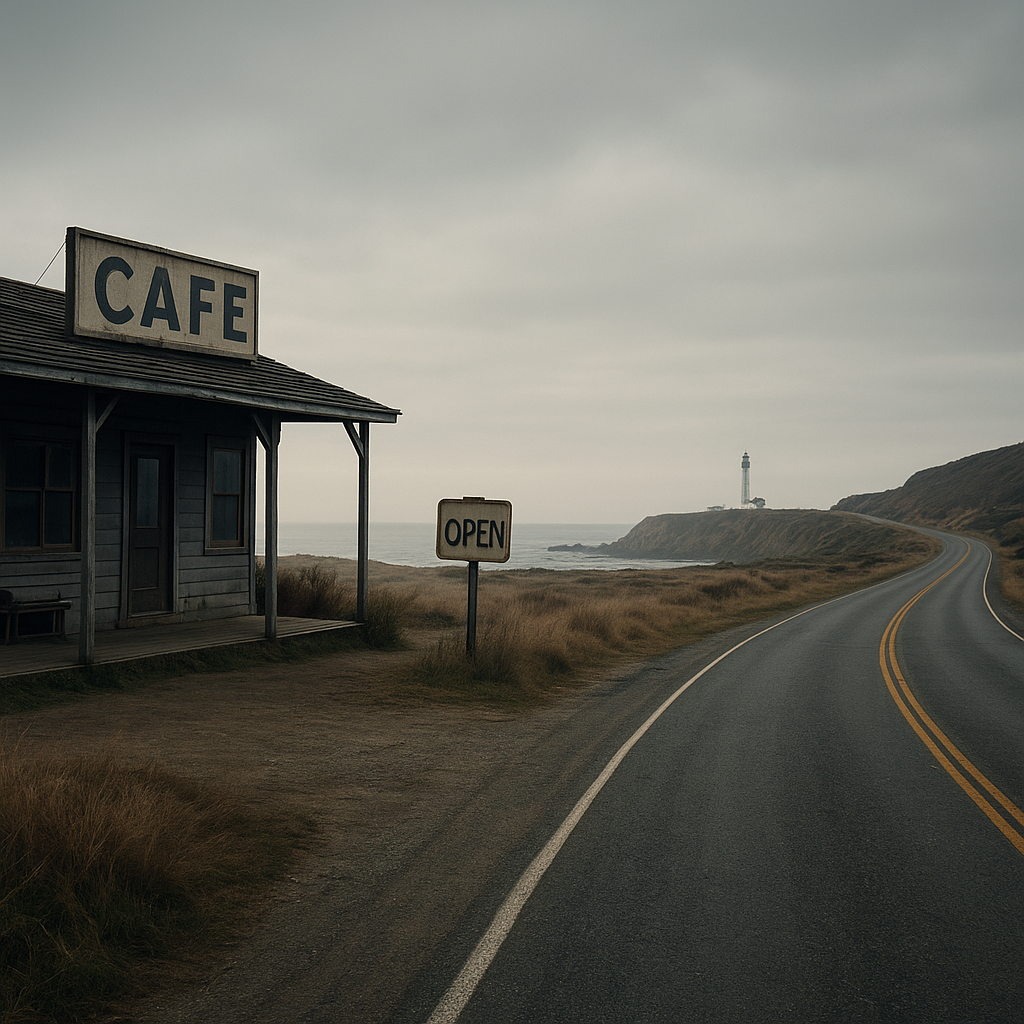
Asha Kreimer disappeared from a café near Point Arena on September 21, 2015. The uncertainty begins with the limits of the reported last sighting.
Accounts from her companions describe her leaving the table near the restroom area. Her friend said she did not see Asha inside the restroom.
Those accounts do not establish which direction she took after leaving the café.
Asha Kreimer’s unsolved disappearance remains one of the strangest missing person cases in Northern California because it combines a public setting, a visible crisis, and a timeline that seems like it should have produced answers. More than a decade later, this missing person case still matters because she disappeared in daylight, around other people, and the trail still dissolved almost immediately.
Readers can also explore Jennifer Kesse’s disappearance, while keeping the evidence of each case distinct.
The Morning Everything Slipped
Asha Kreimer was 26 years old. She had dual American and Australian citizenship and had reportedly been living in Mendocino County with her boyfriend. By the time she disappeared on September 21, 2015, the people closest to her were already frightened by how quickly her behavior had changed.
Case reports describe prolonged sleeplessness and an apparent mental-health crisis before her disappearance. Her mother told Redheaded Blackbelt that Asha was taken to a Fort Bragg hospital and later released to her boyfriend. Those reports provide context, rather than a diagnosis established here.
The hospital contact is part of the reported chronology. The material cited here does not establish a finding of professional negligence or prove what would have prevented her disappearance.
After the hospital visit, she travelled with her boyfriend and a visiting friend. They stopped at Rollerville Cafe near Point Arena.
Instead, it became the last confirmed place Asha Kreimer was seen.
The reported restroom sequence comes from the people accompanying her. It is not a continuous observation of her movements.
But when the friend returned, the story broke open. She said she never saw Asha in the bathroom at all.
The point at which she left their view remains uncertain.
Timeline of Asha Kreimer’s Disappearance
- Days before September 21, 2015: Asha reportedly goes multiple days without sleep and begins showing signs of a severe mental health crisis.
- September 20: She is taken to a hospital in Fort Bragg for evaluation, but is later released instead of being kept for treatment.
- After release: She remains with her boyfriend and a visiting friend, with reports suggesting continued confusion and instability.
- Morning of September 21: The group stops at the Rollerville Cafe near Point Arena.
- Mid-morning: Asha appears distressed, reportedly does not eat, then gets up and follows her friend toward the restroom.
- Moments later: Her friend says she never saw Asha in the restroom. Asha is no longer at the table and cannot be found nearby.
- Later reports: A jacket was found near the lighthouse trail, but her friend disputed that Asha had a jacket at the café.
The reported timeline leaves her subsequent movements unresolved.
What Does Not Add Up in the Point Arena Timeline
- The setting was public. Asha did not vanish from deep wilderness or a dark roadside at midnight. She disappeared from a cafe stop in the daytime, near people who knew she was in distress.
- The restroom account: A reported intention to use a restroom does not establish where she actually went.
- Missing belongings: The reported absence of everyday items cannot establish her intentions.
- The disputed jacket: Its reported discovery does not establish Asha’s route or fate.
- Possible sightings never became proof. Like many missing person cases, the story includes later reported sightings, but not the kind of verified evidence that can lock a timeline into place.
That is what keeps this case alive. There are enough fragments to imagine several outcomes, but not enough evidence to fully defend any one of them.
The Road, the Lighthouse, and the Fear of Exposure
Point Arena is beautiful in the way some coastlines are beautiful when they also feel merciless. The air is open. The roads can feel exposed. The ocean nearby is not just scenery. It is a force. A reported jacket discovery near the lighthouse trail does not establish that Asha reached that location.
Maybe it does not.
An object can only anchor a route if its association with the missing person is established. A reported discovery cannot supply an intention or a final location on its own.
The area presents possible hazards, but no recovered evidence establishes which, if any, she encountered.
This is where the case becomes larger than a single unexplained disappearance. It becomes a story about how thin the line is between being seen and being protected. Asha was not invisible. She was in public. She was with people. Her distress was visible enough that others had already been trying to manage it. And still, when the decisive moment came, visibility turned out not to be the same thing as safety.
Key Evidence and Clues
- Confirmed last setting: the Rollerville Cafe near Point Arena, where Asha was with her boyfriend and a friend.
- Critical condition of disappearance: she was reportedly barefoot and without the basic belongings needed to travel independently.
- Mental health context: multiple reports describe a severe crisis, prolonged sleeplessness, confusion, and behavior that worried the people around her.
- Disputed object report: A jacket was reported near the lighthouse trail; its connection to Asha is uncertain.
- Unverified later reports: Possible sightings have not resolved the case.
Each clue matters. None of them is enough. That tension is familiar in unresolved disappearances. It is why cases like Mekayla Bali’s disappearance remain so absorbing: the timeline seems visible at first, but the moment that should bring clarity only opens into more uncertainty.
🔎 Related Investigation:
If this case pulled you deeper into the mystery, continue into:
Possibilities and the Limits of the Evidence
There are a few broad theories in Asha Kreimer’s case, but each comes with serious limits.
Accidental harm is a possibility. The available material does not establish that Asha entered the sea, fell from a cliff or died of exposure.
Intent is unknown. A reported mental-health crisis and a disputed jacket cannot establish an intention to die.
An encounter with another person is also unproven. No evidence cited here identifies an assailant or establishes an abduction.
Later reports are not confirmed survival. Her mother described a possible sighting in Gualala, but it did not establish Asha’s whereabouts.
The public evidence does not justify choosing one of these outcomes as the most likely. California’s Department of Justice continues to list Asha as missing.
Why This Case Still Gets Attention
Asha Kreimer’s case remains unresolved. The reports of distress do not establish what intervention would have changed the outcome.
The accounts describe contact with other people before she disappeared. They do not establish a failure of care or a proven chain of events afterward.
That is why the story keeps resurfacing in discussions of unresolved disappearances. Not because it offers flashy mystery, but because it forces a brutal question: how can someone be so visible, so clearly vulnerable, and still disappear so completely?
There is no neat ending here. No body recovered. No confirmed sighting that closes the map. No final piece of evidence that snaps the timeline into place. Just a barefoot woman in a roadside cafe, a friend walking toward a restroom, an uncertain interval, a disputed jacket report, and no established ending.
Maybe the answer lies somewhere between those moments, in a path briefly taken and never reconstructed correctly. Or maybe it lies farther away, in some later encounter or overlooked witness memory that never got connected to the morning it belonged to.
But until that missing piece appears, the disappearance of Asha Kreimer remains one of those cases that feels impossible for a simple reason: it happened in plain sight, and plain sight was not enough.
🔎 Related Investigation:
🔎 Related Investigation:
Research Sources
The following resources were consulted to verify and update this article.
- California Department of Justice — Asha Kreimer
Official missing-person record and last-seen date. - The Charley Project — Asha Kreimer
Summarizes the café account and disputed jacket report. - Redheaded Blackbelt — Australian Mother Searches for Daughter Missing on the North Coast
Reports her mother’s account of the hospital visit and search.
If this story stayed with you, the author suggests these real cases next:
- Jennifer Kesse’s disappearance and the recorded person of interest
- Mekayla Bali’s timeline and unresolved movements
- The final-night mystery where every answered question seemed to create a new one
Explore more Disappearances stories here: