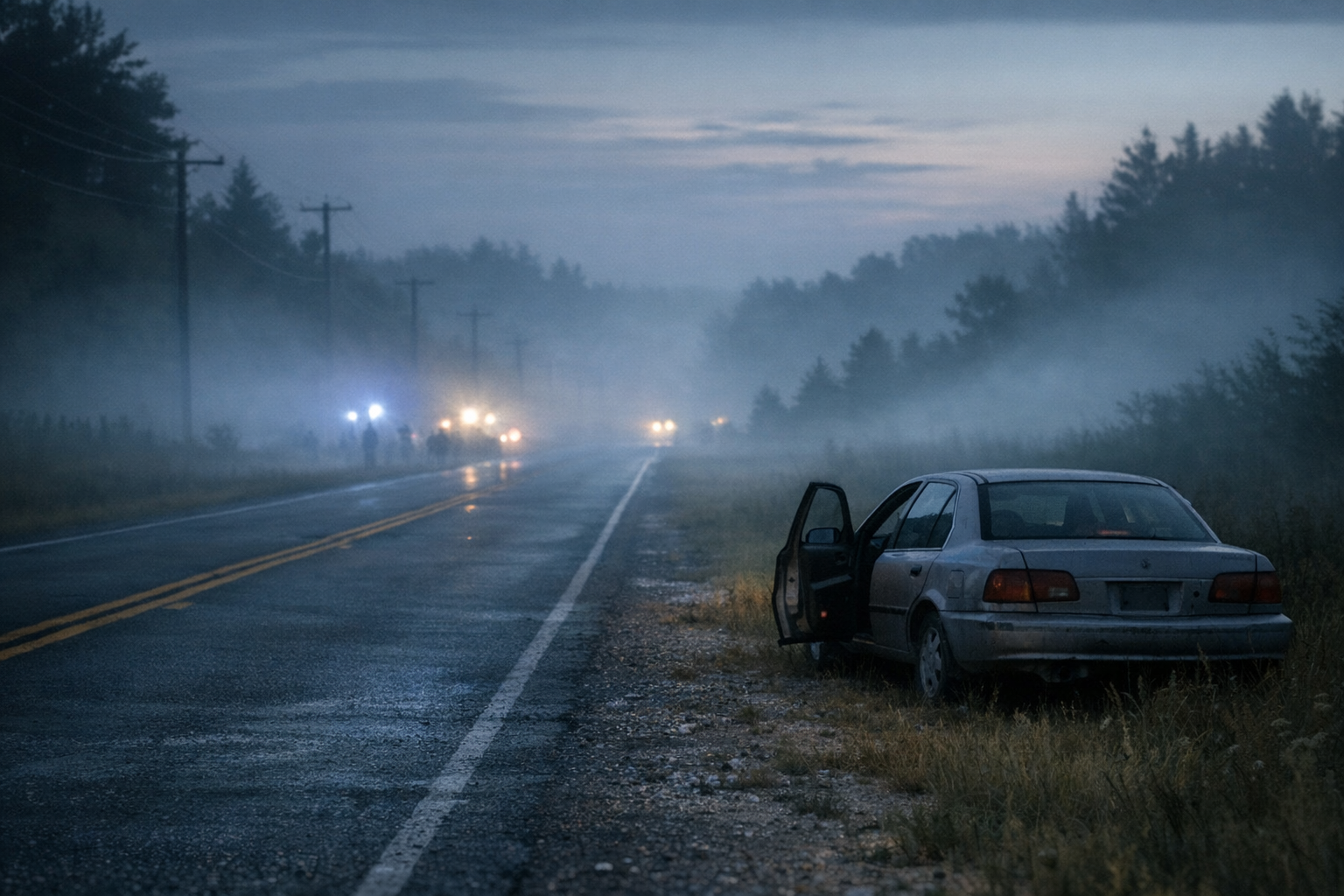
There is something uniquely disturbing about a disappearance once the vehicle is found. A recovered car should make the mystery smaller. It should mark the final known route, fix the search area, and give investigators a solid physical clue to work from. Instead, in some of the most haunting missing-person cases, the vehicle becomes the coldest part of the story: a machine sitting exactly where it can be examined, photographed, and mapped, while the human being connected to it has already disappeared into uncertainty.
This page covers real disappearance cases where the vehicle was recovered but the person was not, or where the physical travel-and-scene evidence created the same unresolved contradiction. Some involve a crash site. Some involve a roadside stop. Some leave behind a vehicle in a place that should have narrowed the truth far more than it did. What unites them is the same investigative failure point: transportation evidence exists, the scene feels concrete, and the next step in the story still does not make sense.
These cases matter because they expose one of the most frustrating patterns in disappearance investigations. A missing person with no physical trace leaves investigators with almost nothing. A found vehicle is supposed to change that. It can contain forensic evidence, define movement, anchor timelines, and tell searchers where to begin. When even that level of evidence fails to produce clarity, the case tends to endure for years. The clue is real. The answer is not.
People do not always search for “strange disappearances.” They search for the exact contradiction that is bothering them: a missing person, a recovered car, a suspicious crash, a route that should have been traceable, evidence that looks concrete but still leads nowhere.
Cases Where the Vehicle Was Recovered but the Person Was Not
Maura Murray
Maura Murray’s 2004 disappearance remains one of the defining vehicle-centered mysteries in the entire true disappearance genre because the case seems to start with a contained scene. Her Saturn was found after a crash on a New Hampshire road. Witnesses saw the aftermath. Police arrived within a narrow window. In theory, that should have created one of the cleaner investigative starting points in a missing-person case. Instead, the crash scene became the beginning of a long argument about what happened in the minutes after the car stopped moving.
This case fits the vehicle-recovered angle perfectly because the car should have made the mystery smaller. It fixed the location, narrowed the timeline, and gave searchers a real place to begin. Yet the vehicle never delivered the certainty people expect from a physical clue that concrete. It became a stage set for competing theories: did Maura leave on foot, accept a ride, hide nearby, or disappear through some route the scene failed to reveal?
The key mystery point is that the Saturn anchored the case without solving it. The whole story keeps returning to the same contradiction: the car was there, the road was there, the witness window was there — and still the person at the center of the scene seemed to vanish beyond the reach of all of it.
Readers who arrive through one vehicle-recovered disappearance are usually trying to compare structure as much as outcome. They want to know whether the car fixed the scene, whether the route narrowed the search, and whether the evidence left behind truly behaved like evidence should.
There is a documentary reason these cases linger, too. A found vehicle creates the sense that the investigation has a center of gravity. It gives journalists, readers, and investigators something concrete to return to: a shoulder on a road, a desert turnout, a remote embankment, a wrecked car, a truck left in the dark. That physical anchor should reduce the unknown. When it fails to do that, the failure itself becomes part of the mystery.
For the full case breakdown, see What Happened to Maura Murray? Inside the Unsolved 2004 Disappearance.
Brandon Lawson
Brandon Lawson disappeared in Texas after a late-night sequence involving an argument, a troubling roadside stop, and the kind of emergency call that only made more people disagree about what happened. His truck was found along Highway 277, which should have fixed the story to a real map and a real scene. But instead of stabilizing the case, the truck became the center of a mystery that seemed to widen every time someone tried to explain it.
It shows how a found truck can create the illusion of clarity while leaving the human story almost completely unstable. The roadside location, the call, the search area, and the final known activity all suggest that the truth should be reconstructable. Yet the truck never became the clean investigative anchor it seemed meant to be.
The key mystery point is that the truck remained visible while Brandon’s movements dissolved into uncertainty. The case has always felt like investigators were standing in the right scene with the wrong ending.
Readers who arrive through one vehicle-recovered disappearance are usually trying to compare structure as much as outcome. They want to know whether the car fixed the scene, whether the route narrowed the search, and whether the evidence left behind truly behaved like evidence should.
There is a documentary reason these cases linger, too. A found vehicle creates the sense that the investigation has a center of gravity. It gives journalists, readers, and investigators something concrete to return to: a shoulder on a road, a desert turnout, a remote embankment, a wrecked car, a truck left in the dark. That physical anchor should reduce the unknown. When it fails to do that, the failure itself becomes part of the mystery.
For the full case breakdown, see Brandon Lawson Disappearance — The 911 Call That Still Makes No Sense.
🔎 Related Investigation:
Bryce Laspisa
Bryce Laspisa’s case is so haunting because the drive before his disappearance already felt wrong. Family members knew he was acting strangely. His route through California was filled with delays and pauses that did not add up. Then his car was found wrecked near Castaic Lake with the rear window kicked out, creating the kind of violent-looking physical scene that should have forced the mystery into focus.
The vehicle did not simply confirm that he had been there. It seemed to imply action, panic, escape, or impact. A recovered car with visible damage usually pulls a disappearance toward a narrower story. Here it did the opposite. The scene suggested movement without explaining the direction, motive, or outcome of that movement.
The key mystery point is that Bryce’s car feels like a dramatic final chapter, but it is really the opening page of the unanswered part. The vehicle tells observers that something happened. It still cannot tell them what.
Readers who arrive through one vehicle-recovered disappearance are usually trying to compare structure as much as outcome. They want to know whether the car fixed the scene, whether the route narrowed the search, and whether the evidence left behind truly behaved like evidence should.
There is a documentary reason these cases linger, too. A found vehicle creates the sense that the investigation has a center of gravity. It gives journalists, readers, and investigators something concrete to return to: a shoulder on a road, a desert turnout, a remote embankment, a wrecked car, a truck left in the dark. That physical anchor should reduce the unknown. When it fails to do that, the failure itself becomes part of the mystery.
For the full case breakdown, see Bryce Laspisa Disappearance — The Strange Drive Before He Vanished.
Daniel Robinson
Daniel Robinson vanished in Arizona in 2021, and the case quickly centered on the Jeep found in the desert. In a landscape that already makes search logistics brutal, the vehicle should have been one of the strongest physical clues available. It offered a real location, a real object, and a scene investigators could examine directly. But instead of resolving the case, the Jeep became part of a long-running dispute about timeline, condition, and what the physical evidence actually suggested.
This case fits because it captures the vehicle-as-silent-witness idea almost literally. The Jeep is the most tangible object left behind in the story, yet even that object has not produced consensus. Was the scene consistent with accident, foul play, confusion, or a sequence no one has fully reconstructed yet? That unresolved interpretive fight is exactly what gives the angle so much authority-building power.
The key mystery point is that the Jeep should have narrowed the truth, but instead it multiplied the questions. The strongest clue in the case became the reason the case still feels unsettled.
Readers who arrive through one vehicle-recovered disappearance are usually trying to compare structure as much as outcome. They want to know whether the car fixed the scene, whether the route narrowed the search, and whether the evidence left behind truly behaved like evidence should.
There is a documentary reason these cases linger, too. A found vehicle creates the sense that the investigation has a center of gravity. It gives journalists, readers, and investigators something concrete to return to: a shoulder on a road, a desert turnout, a remote embankment, a wrecked car, a truck left in the dark. That physical anchor should reduce the unknown. When it fails to do that, the failure itself becomes part of the mystery.
For the full case breakdown, see Daniel Robinson Disappearance — The Jeep Found in the Arizona Desert.
Leah Roberts
Leah Roberts left on a road trip that seemed to carry equal parts grief, restlessness, and intention. Later, her Jeep was discovered wrecked down an embankment in Washington state — the kind of scene that should have separated simple accident from something more complex. Instead, the vehicle discovery left behind a mood of uncertainty that has followed the case ever since.
Leah’s disappearance belongs here because it shows how a recovered vehicle can feel both definitive and useless at the same time. The Jeep proves a route, confirms a location, and gives investigators a hard point in the landscape. But it does not close the emotional or evidentiary gap between travel and disappearance.
The key mystery point is whether the Jeep scene reflects misadventure, staging, outside involvement, or some combination of events that still cannot be cleanly separated. The vehicle remained in the landscape. Leah did not remain in the story long enough to explain it.
Readers who arrive through one vehicle-recovered disappearance are usually trying to compare structure as much as outcome. They want to know whether the car fixed the scene, whether the route narrowed the search, and whether the evidence left behind truly behaved like evidence should.
There is a documentary reason these cases linger, too. A found vehicle creates the sense that the investigation has a center of gravity. It gives journalists, readers, and investigators something concrete to return to: a shoulder on a road, a desert turnout, a remote embankment, a wrecked car, a truck left in the dark. That physical anchor should reduce the unknown. When it fails to do that, the failure itself becomes part of the mystery.
For the full case breakdown, see The Leah Roberts Road Trip Mystery That Still Doesn’t Make Sense.
Tiffany Valiante
Tiffany Valiante’s case sits at the edge of this vehicle-centered pattern because the larger mystery is driven by route, movement, and physical-evidence logic rather than a simple abandoned-car scene. It belongs in the cluster because readers drawn to vehicle-recovered disappearances are often really looking for cases where the known path from point A to the official explanation never feels mechanically complete. Tiffany’s case still triggers that exact response.
It fits the central question by contrast. Not every disappearance in this group needs to begin with a car on a shoulder. Some belong because they expose the same investigative frustration: there is enough physical reality in the scene to expect a cleaner answer, yet the sequence connecting that reality to the final conclusion keeps breaking apart under scrutiny.
The key mystery point is that the movement story never settles. The evidence gives the case a hard framework, but not a final explanation everyone accepts. That same gap is what links it to the stronger vehicle-found cases in this hub.
Readers who arrive through one vehicle-recovered disappearance are usually trying to compare structure as much as outcome. They want to know whether the car fixed the scene, whether the route narrowed the search, and whether the evidence left behind truly behaved like evidence should.
There is a documentary reason these cases linger, too. A found vehicle creates the sense that the investigation has a center of gravity. It gives journalists, readers, and investigators something concrete to return to: a shoulder on a road, a desert turnout, a remote embankment, a wrecked car, a truck left in the dark. That physical anchor should reduce the unknown. When it fails to do that, the failure itself becomes part of the mystery.
For the full case breakdown, see What Happened to Tiffany Valiante? The Evidence Trail That Still Doesn’t Add Up.
Why These Disappearances Still Don’t Make Sense
The shared pattern in these cases is not simply that a car, truck, or Jeep appears somewhere in the story. It is that the recovered vehicle promises resolution without delivering it. In one case, the car fixes the crash site but not the path beyond it. In another, the roadside stop becomes the center of debate instead of the end of debate. In another, the condition of the vehicle raises as many questions as it answers. That is what makes these disappearances so durable in public memory: the evidence looks like it should be enough, and yet it never becomes enough.
They also reveal why vehicle-centered hubs work so well as authority pages. This is not random listicle logic. A found vehicle is not vague. It is a concrete investigative object. It gives the cluster a clear thematic spine and turns each linked case into another variation on the same chilling question: if the vehicle was recovered, why wasn’t the truth recovered with it?
The stronger the cluster becomes, the more useful these comparison pages are. Older disappearance posts often carry a compelling case but not a clear route to the next story. It also reinforces topic depth for the site itself: crash-site disappearances, road-trip vanishings, evidence-centered mysteries, and final-movement cases all begin to look like connected chapters rather than isolated pages.
That question does not lead to a single answer. Some cases may point toward exposure, confusion, or misadventure. Others suggest human involvement, an incomplete scene, or a chain of events that investigators never fully reconstructed. But across all of them, the same emotional pressure remains. The machine stayed. The person did not. And that gap is exactly why these stories keep pulling readers back.
Conclusion
A found vehicle should reduce chaos. It should make the search more precise and the theory space smaller. In the cases above, it does the opposite. It gives each disappearance a hard physical center while proving that a hard physical center is not the same thing as an answer.
The vehicle remains. The person remains missing. And in between those two facts is the part of the story that still won’t stop haunting people.
🔎 If this story stayed with you, the author suggests these deeper investigations next:
- Disappearances where the final hours became the whole mystery
- Cases where the timeline itself still refuses to settle
- Disappearances where witness sightings only made the story stranger
- The Final Timelines That Still Don’t Close: 9 Disappearances Reconstructed Minute by Minute
Explore more Disappearances stories here: