The last day of junior year was supposed to feel light.
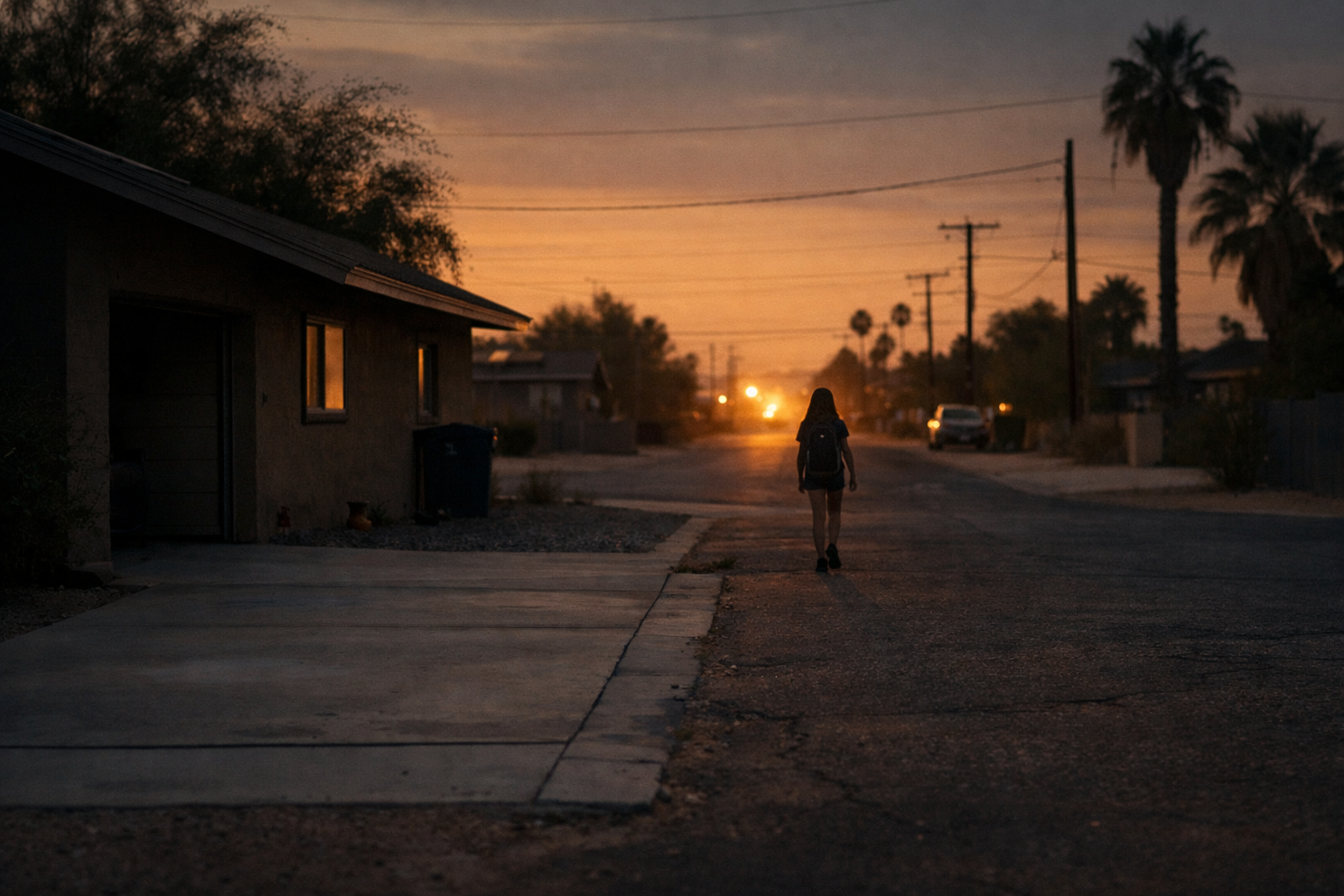
By noon, the school-year tension was already breaking apart into summer plans, rides home, part-time jobs, and whatever came next. In Phoenix, the heat had the hard, flat feel it gets before evening. Students spilled out of Paradise Valley High with that restless energy that belongs only to teenagers standing on the edge of freedom.
Somewhere in that ordinary rush was 17-year-old Alissa Turney.
And then, almost unbelievably, she was gone.
No struggle in a parking lot. No witness describing a dramatic scene. No final confirmed sighting that neatly explains what happened next. Just a teenage girl who should have been moving into the easy rhythm of summer, and a story that almost immediately bent inward — back toward the house she lived in, the person who said he was the last to see her, and the version of events that never stopped feeling wrong.
What happened to Alissa Turney?
Alissa Turney was a 17-year-old Phoenix teenager whose unsolved disappearance on May 17, 2001, became one of Arizona’s most disturbing missing person case stories. The case still matters because what began as a supposedly ordinary runaway report slowly turned into a deeper investigation shaped by family-control allegations, missing evidence, and years of public pressure for answers.
That unsettling contrast — normal life on the surface, something darker underneath — is part of why Alissa’s case still lands so hard. If cases like Jennifer Dulos’s disappearance stay with people because an ordinary day suddenly turns into a long trail of dread, Alissa Turney’s story does the same thing in a more intimate way: it keeps pulling the reader back to the home she never truly escaped.
According to the account repeated for years, Alissa went to school that morning like usual. It was the last day of her junior year. At some point around lunchtime, her stepfather and adoptive father, Michael Turney, said he picked her up early. That detail became the hinge of the entire case. If his version was true, then the last known stretch of Alissa’s day happened in private. No crowd. No hallway cameras. No clean timeline built from independent witnesses.
He later said they argued. He said she stormed off. He said she ran away.
That story might have sounded possible in the first raw hours after she disappeared. Seventeen-year-olds do leave. Teenagers do fight with parents. Houses do go quiet after slammed doors. But Alissa had plans that night. She was supposed to go to a party. She left behind personal belongings, including things most runaways do not casually abandon if they mean to start over. And the longer people sat with the story, the less it felt like a girl stepping into a new life and the more it felt like a script that had been prepared in advance.
One of the most haunting parts of this case is how normal the beginning sounds. There is no dramatic opening scene in a forest, no crashed car on a desert road, no broken phone found in a ditch. Instead, the fear comes from the everyday shape of it. A school pickup. A ride home. A private argument no one else can fully verify. Then silence.
And in disappearance cases, silence is rarely just silence. It has texture. It has weight. It tends to gather around the person with the most control over the story.
As years passed, investigators and family members began painting a far more disturbing picture of life inside the Turney home. This was not just a household where a teenager pushed against strict rules. Allegations described surveillance, humiliation, obsessive monitoring, and a kind of control so constant that even ordinary teen behavior could become a reason for punishment. There were claims that Michael monitored calls, watched recordings, showed up at Alissa’s workplace, and managed her life in ways that made independence feel almost impossible.
That matters because is the unbearable normality of the day Alissa vanished — and how that normality collapses once you understand the family dynamics around her. On the surface, the story begins with a girl leaving school. Beneath that, it begins much earlier, in a house where privacy may have barely existed.
Timeline of Events
- Morning, May 17, 2001: Alissa attends Paradise Valley High School on the last day of her junior year.
- Midday: Michael Turney later says he picked her up early from school.
- Afternoon: He says they argued and that Alissa left after the dispute.
- Later that day: A note is found that is presented as evidence that Alissa ran away to California.
- That night: Alissa does not show up for plans she reportedly had with friends.
- Following week: Michael says he received a phone call from California that he believed was from Alissa.
- Years later: The runaway theory weakens as investigators reexamine the case and focus more intensely on the home environment.
- 2008 onward: The investigation reopens, the Turney home is searched, and authorities uncover weapons, explosive devices, and material that deepens concern about Michael’s behavior.
- 2020: Michael Turney is charged with second-degree murder in connection with Alissa’s disappearance.
- 2023: The charge is dismissed, leaving the case unresolved and Alissa still officially missing.
That timeline is simple on paper. Too simple, really. And that is exactly why the case keeps clawing at people. In a genuine runaway story, the timeline usually begins expanding as soon as the missing person starts making choices somewhere else. Calls. Friends. Movement. Money. New sightings with some reliability. In Alissa’s case, the timeline does the opposite. After that ride home, it shrinks down to almost nothing.
Then came the note.
Notes in disappearance cases can feel powerful because they seem to settle the central question: did the person leave on purpose? But they can also become too convenient, especially when they appear in a house where control is already part of the story. For many people who followed the case, the note never felt like resolution. It felt like a wall placed at the edge of the narrative, a quick answer standing where the truth should have been.
Even more unsettling was the way the runaway theory initially slowed the urgency of the investigation. Once police start from the idea that a teen left voluntarily, the first hours and days can slip away. Tips lose heat. Search momentum fades. People assume the missing person will reappear. In Alissa Turney’s case, that early framing may have changed everything.
Years later, her half-sister Sarah Turney would become one of the main reasons the case stayed in public view. She pushed for answers, pulled attention back to the facts, and helped turn Alissa’s name from an old local disappearance into a case people across the country recognized. That surge of attention was not random true-crime noise. It came from the same thing that keeps this story alive: the feeling that the original explanation never matched the reality around it.
What doesn’t add up in the Alissa Turney case?
- The last ride home creates a closed-off timeline. The most crucial part of Alissa’s final day depends largely on one person’s account.
- The runaway narrative clashes with her plans. She reportedly had normal teenage plans that night, which cuts against the idea of a clean, intentional disappearance.
- Important belongings were left behind. That is often one of the first details that makes a runaway theory feel unstable.
- The note solved too much, too quickly. Rather than opening the case, it seemed to shut it down.
- The home environment was deeply troubling. Allegations of surveillance and coercive control made the family context impossible to ignore.
- Later evidence changed how earlier events looked. Once investigators learned more about Michael Turney’s behavior, even ordinary details from May 17 felt darker.
- No body and no clear trail ever supported the original story. If Alissa truly left to start over, the public record never produced a convincing second chapter.
The deeper investigators went, the more the case shifted from a disappearance mystery into something more intimate and claustrophobic. Not a question of where a teenager may have gone next, but whether she ever had the freedom to choose the next place at all.
That is where the emotional center of the story really sits. Alissa’s case is not haunting because it is flashy. It is haunting because so much of it seems to happen in a sealed environment. A private home. Private recordings. Private pressure. Private fear. Even the case’s public life reflects that same structure: for years, people on the outside could only see glimpses through what others said happened behind closed doors.
Investigators eventually uncovered details that made Michael Turney impossible to dismiss as just an eccentric or overprotective parent. Reports described hidden cameras, taped conversations, obsessive monitoring, and a household atmosphere shaped by distrust and domination. There were also disturbing allegations that Alissa had confided to others about abuse. Some of those claims later became difficult to use in court because of evidentiary rules, but they still shaped how the case was understood by the public and by people close to it.
That gap — between what many people believe happened and what can be proved in court — is one reason the legal story remains so frustrating. In 2020, Michael Turney was charged with second-degree murder. To many people who had followed the case, it looked like a long-delayed turning point. At last, the system seemed ready to say out loud what so many had suspected for years.
But courtrooms do not run on suspicion, even heavy suspicion. They run on evidence that survives challenge. In 2023, the charge against Michael Turney was dismissed. That did not close the emotional argument around the case. If anything, it sharpened it. Because a dismissal is not the same as an answer. It only means the state could not carry the charge to a conviction on what it had.
So the case remains in that terrible space families know too well: publicly known, heavily debated, morally charged, and still unresolved.
And because it is unresolved, every early detail keeps mattering. The school day. The lunch pickup. The note. The missed party. The alleged California call days later. Each piece has been examined again and again, not because it becomes clearer over time, but because it still refuses to sit in a shape that feels honest.
Why this case still gets attention
Alissa Turney’s disappearance continues to draw attention for more than one reason:
- It feels frighteningly domestic. This was not a stranger-danger story unfolding in some isolated wilderness. It was a teenager last tied to the place that should have been safest.
- The family-justice angle never went away. Sarah Turney’s advocacy kept the case active in a way many cold cases never achieve.
- The legal fallout added another layer. An arrest followed by a dismissed murder charge left the public with even more unresolved tension.
- The case mirrors broader conversations about coercive control. People now read the home-life details differently than they might have in 2001.
- The core question remains open. The case seems to point in one direction but still has no ending.
That last point matters most. Some disappearance cases endure because they are bizarre. Alissa Turney’s case endures because it feels comprehensible right up until the moment it doesn’t. Readers can imagine the school day. They can imagine the argument. They can imagine a teenager wanting out of a tense home. But they cannot make the story past that point hold together.
And that may be the most chilling thing about it.
If you strip away the headlines, the documentaries, the court filings, the podcasts, and the years of public debate, what remains is a terrible little scene no one can finish properly: a teenager gets into a car on the last day of school and is never reliably seen again.
Everything after that is a battle over who gets to define the silence.
Was she a runaway? A victim of family violence? A girl whose life had narrowed so much that her disappearance was misread from the beginning? Investigators, relatives, journalists, and the public have all pulled at those questions for years. But the case keeps circling back to the same unbearable reality: whatever happened to Alissa Turney likely happened in the shadow of someone who knew her, watched her, and had unusual power over the story told afterward.
That is why this case still points backward. Not backward in a nostalgic or documentary sense. Backward like a finger aimed at the original scene. Backward toward the house. Backward toward the last ride. Backward toward a version of events that never earned the calm it was first given.
Alissa should have had a summer after that day. She should have gone to that party, worked her shift, fought with friends, changed her mind about boys, graduated high school, and grown older in all the ordinary ways people barely notice while they are happening.
Instead, her life became a question.
And until that question is answered, the Alissa Turney disappearance will remain one of those cases that feels less like a mystery drifting into the past and more like a locked room that was never properly opened.