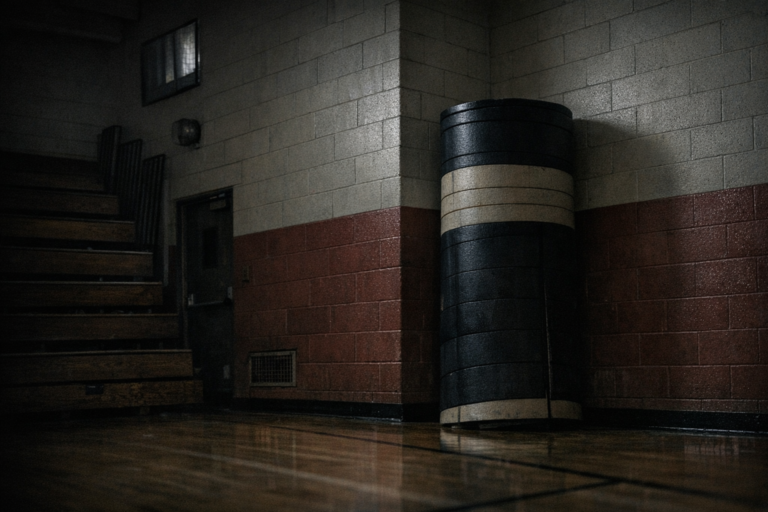
At first, it sounded like a piece of iron hitting the floor.
Inside Meux and Company Brewery on Tottenham Court Road, one of the giant metal hoops wrapped around a towering vat had snapped loose with a violent clang. The workers noticed it. Someone reported it. And then, because London in 1814 ran on routine, risk, and hard luck, the day kept moving. Porter still fermented inside the wood. Men still worked below it. And just beyond the brewery walls, families in St. Giles were cooking supper, washing dishes, or trying to survive another evening in one of the poorest corners of the city.
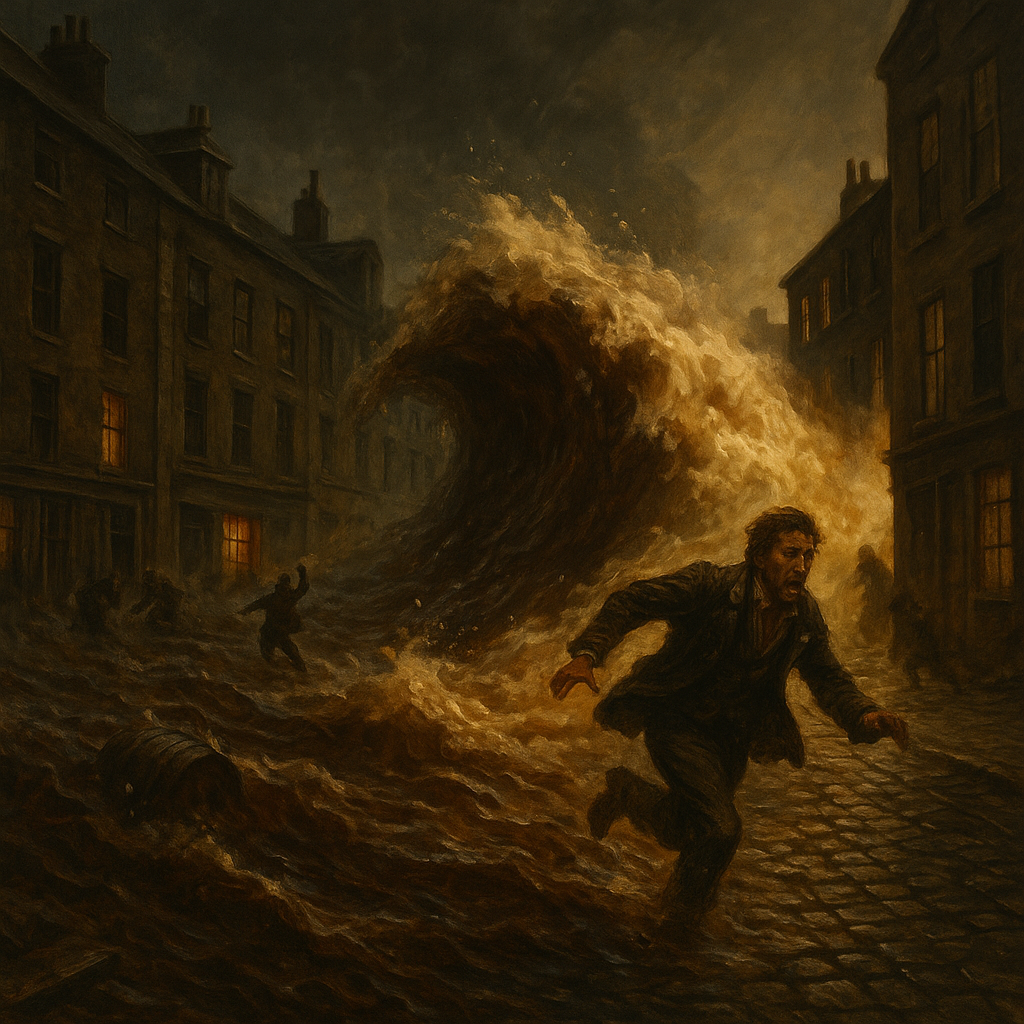
No one outside that building had any reason to imagine that within hours a wall of dark beer would come roaring into their homes like a man-made tidal wave.
The Great London Beer Flood was a real industrial disaster that struck the St. Giles district on October 17, 1814, when a massive vat of porter burst and triggered a chain reaction inside the brewery. The story still matters because it sounds almost absurd until you follow the details and realize how quickly an unbelievable accident turned into a deadly catastrophe.
Stories like this sit in the same unsettling corner of history as The Toxic Lady case: at first they seem too strange to be true, and then the facts make them harder to shake.
The Brewery Over the Slum
Early nineteenth-century London was crowded, smoky, loud, and unforgiving. In St. Giles, poverty pressed people together in cramped houses, cellar rooms, and narrow courts where bad air and bad water were ordinary parts of life. Beer, especially porter, was not just a pleasure. For many people, it was safer than the water they had access to, and breweries served a city that drank on a massive scale.
Meux and Company was one of the biggest. Its vats were enormous wooden structures bound by heavy iron hoops, built to hold huge quantities of dark porter while it matured. The largest among them rose over the workers like a wooden tower, swollen with liquid, pressure, and the confidence of an industry that had learned to live beside danger.
That confidence mattered. Reports from the time suggest that broken iron hoops were not unheard of. The equipment was huge. The brewery kept operating. And the people making decisions that evening did not treat the fallen hoop as the beginning of a disaster sequence. They treated it like an annoyance.
Timeline of the Beer Flood
- Around 4:30 p.m.: A worker notices that one of the iron hoops on a giant vat has slipped or broken loose.
- Late afternoon: The issue is reported, but it is not treated as an emergency serious enough to clear the area.
- Around 5:30 p.m. to 6:00 p.m.: The overstrained vat gives way, releasing a massive volume of porter and rupturing nearby containers.
- Moments later: The brewery wall collapses, and a wave of beer and debris tears into St. Giles.
- That evening: Homes and cellar dwellings are smashed or flooded; eight people are ultimately reported dead.
- Afterward: An inquest rules the event an “act of God,” leaving the brewery free from direct criminal blame.
When the Wall Broke
Then came the rupture.
One giant vat failed under the pressure, and the force did not stay contained. It slammed through the brewery with enough violence to burst other vats as well, unleashing a chain reaction that turned stored porter into a battering ram. Historians usually estimate that well over a million liters of beer were suddenly released. The numbers vary depending on the source, but the scale does not: it was enough liquid to destroy walls, flatten weak structures, and surge into the streets with terrifying speed.
Witnesses described it as an explosion. That matters, because this was not a slow leak or a dramatic spill spreading across the floor. It was closer to a sudden mechanical detonation followed by a flood. The brewery wall gave way. Beer, wood, brick, and iron were all thrown outward. And the neighborhood outside had almost no chance to react.
St. Giles was especially vulnerable because many of its poorest residents lived below street level in cellar rooms. In a disaster driven by moving liquid, those spaces became traps. Beer rushed into them fast, carrying rubble and splintered material. A disaster that sounds ridiculous in a single sentence became brutally ordinary once it hit people where they lived: dark water, collapsing masonry, screams from inside damaged homes, and no time to get clear.
Among the dead were women and children, along with mourners gathered for the wake of a two-year-old boy. That detail is one of the reasons the story lingers. It strips away the novelty. This was not a prank of history or an urban legend built around one weird image. It was a neighborhood tragedy that crashed straight into people already living on the edge.
What Doesn’t Add Up at First Glance
- The premise sounds comic, but the mechanics were industrial. A beer flood sounds like a joke until you remember the liquid was stored under pressure in enormous wooden vats inside a dense city.
- The danger was visible before the disaster. A broken hoop was noticed and reported, which makes the catastrophe feel less random and more like a warning that went unanswered.
- The death toll came from the neighborhood’s poverty as much as the flood itself. Cellar housing, weak structures, and overcrowding turned a freak accident into a fatal event.
- The legal outcome feels cold even by historical standards. Once the inquest labeled the flood an act of God, the moral weight stayed with the victims while the practical burden largely did not.
The People in the Path
It is easy to picture the brewery because it is spectacular. Huge vats. Iron hoops. A burst so violent it sounds cinematic. But the emotional center of the story is outside, in the homes that had no protection from what was coming.
Imagine hearing a blast from the street, then a crash, then the sound of liquid moving where liquid should not be moving at all. Not rain. Not river water. Something heavier, darker, and fast enough to hit with force. In the narrow courts of St. Giles, there was barely any room to retreat. Beer smashed through walls and windows. Furniture shifted. Masonry fell. People trying to climb clear would have been fighting not just the flood, but wreckage.
Even without the later legends, the real scene was grim enough. Rescue efforts unfolded in darkness and confusion. Families searched for relatives in collapsed rooms. The brewery district smelled of porter, dust, and broken timber, and by morning the weirdness of the event had already started to compete with the human cost.
That tension has followed the story ever since. People remember the phrase beer flood. They do not always remember the names or circumstances of the dead. The disaster became memorable for its strangeness, but forgettable in the way many poor neighborhoods become forgettable once the headlines move on.
Why the Disaster Happened — and Why It Was Forgotten
The Great London Beer Flood happened because industrial-scale brewing had outgrown the margin for error built into older methods. Massive wooden vats bound by iron hoops could hold staggering volumes, but they also created an obvious structural risk: pressure, age, and material fatigue all mattered, and failure could be catastrophic. Once one vat burst, the brewery’s design allowed the damage to multiply.
It also happened in exactly the wrong place. A violent release of liquid next to a wealthy district would still have been shocking, but St. Giles was packed with fragile housing and people who had the fewest options for escape or recovery. The neighborhood absorbed the force of a private industrial failure.
As for why the story faded, the answer is almost as revealing as the flood itself. It was not a war. It was not an assassination. It did not reshape national politics. It landed in that strange category of history occupied by events so bizarre they are retold as curiosities rather than mourned as disasters. That is part of what links it, in mood, to stories like the Dancing Plague of 1518 or the eerie abandonment at the heart of the Mary Celeste mystery. They survive because they sound impossible. But that same quality can flatten the human stakes and turn suffering into trivia.
The inquest helped with that flattening. By ruling the flood an act of God, officials effectively pushed the event away from questions of negligence and onto the safer ground of fate. Legally, that eased pressure on the brewery. Narratively, it gave later generations a neat ending. But it was not a neat ending for the people whose homes had been destroyed.
The Aftermath That Smelled Like Porter
In the immediate aftermath, the area was wrecked. Survivors were left with damaged homes and almost no safety net. The brewery itself suffered major losses too, but unlike the surrounding residents, it had a path back. That imbalance gives the story its lingering bite: industry towering over poverty, danger normalized until it burst, and the people at the bottom left to absorb the consequences.
Today a plaque marks the event, and the phrase still pops up whenever people trade historical stories that sound made up. But if you slow down and sit with the sequence, the Great London Beer Flood stops feeling like a novelty. It becomes what it really was: a sudden industrial collapse that killed vulnerable people in their homes and then drifted into memory as a darkly entertaining anecdote.
FAQ
What was the Great London Beer Flood?
The Great London Beer Flood was a real 1814 disaster in which a giant vat of porter burst at Meux and Company Brewery in London, triggering a chain reaction that sent a destructive wave of beer into the St. Giles neighborhood.
How many people died in the London Beer Flood?
Eight people are generally reported to have died in the disaster. Most of the victims lived in the nearby working-class housing that was hit when the brewery wall gave way and the flood rushed into homes and cellar rooms.
What caused the Great London Beer Flood?
The disaster appears to have begun when one of the iron hoops around a huge wooden vat failed. The pressure inside the container, combined with the size of the stored porter and the layout of the brewery, helped turn one failure into a chain reaction.
Was the brewery found responsible?
An inquest ruled the event an “act of God,” which meant the brewery was not held legally responsible in the way many people would expect today. That verdict remains one of the most unsettling parts of the story.
Why does the Great London Beer Flood still get attention?
It still gets attention because the premise sounds impossible: a city block hit by a wave of beer. But once people look closer, they find a much darker real story about industrial danger, poverty, and how easily a deadly event can be remembered as a curiosity.
🔎 If this story stayed with you, the author suggests these real cases next:
- The outlaw whose body kept turning up where no one expected it
- The emergency room case that collapsed into panic and unanswered questions
- The week an entire town seemed unable to stop dancing
- The ghost ship found drifting with its crew gone
Explore more Bizarre & Unbelievable stories here:
View all Bizarre & Unbelievable stories →
Or step into more vanished-world puzzles here: