
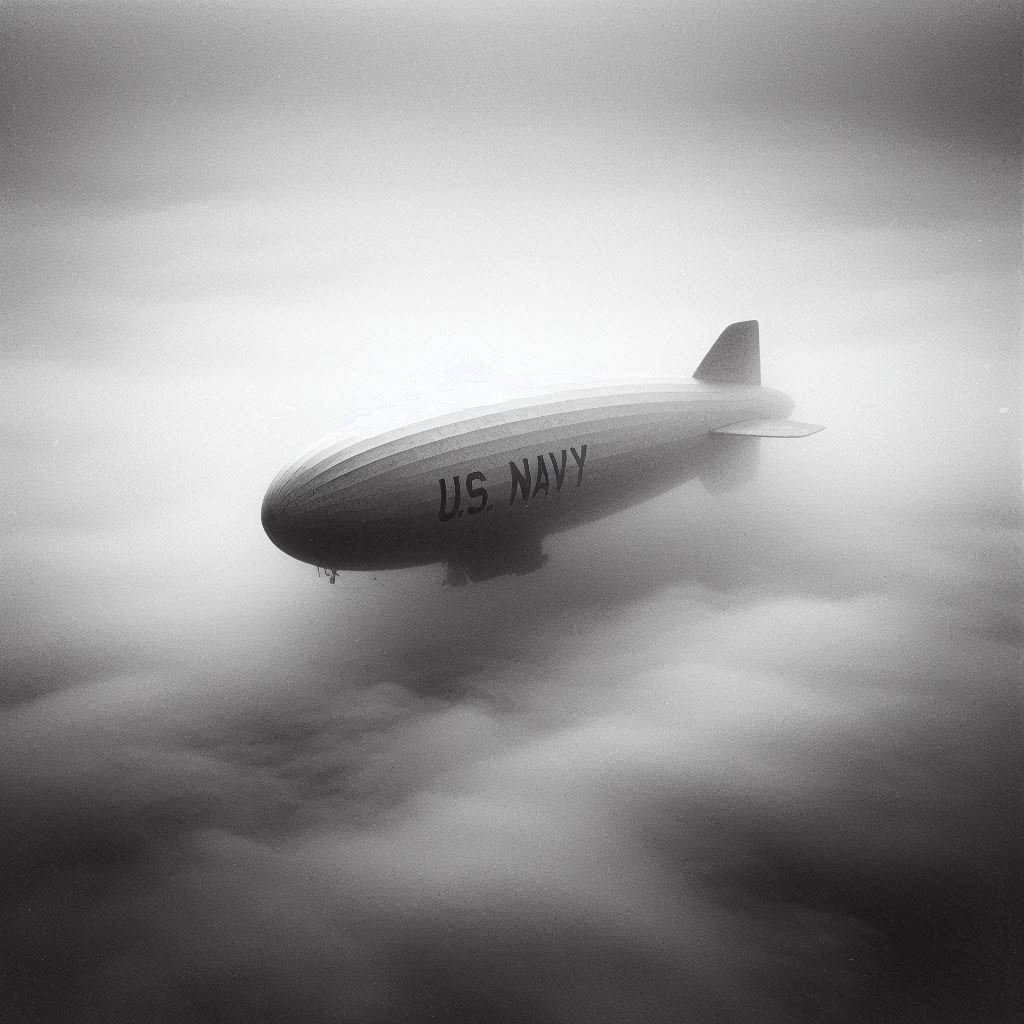
Just after dawn on August 16, 1942, a Navy blimp lifted off into the California haze to hunt for submarines. Five hours later, that same airship drifted back over the coast with its engines still running, its gear still onboard, and nobody at the controls.
Listen to “Two Airmen Vanish Without a Trace” on Spreaker.
The Ghost Blimp of WWII is the story of the U.S. Navy airship L-8, which returned from an anti-submarine patrol over the Pacific without the two men who had taken it out. More than 80 years later, the disappearance of Lieutenant Ernest DeWitt Cody and Ensign Charles Adams still feels like one of the strangest unsolved wartime mysteries on the American coast.
What makes it so unnerving is how complete the machine looked. Like the silence left behind in the disappearance of Flight MH370, the most haunting part is not what was destroyed, but what was simply missing.
In 1942, the Pacific coast was already tense. Japanese submarines had appeared off the West Coast, ships had been attacked, and every report from the water felt heavier than it used to. That was why blimps like L-8 mattered. They were slow, but they could stay over the ocean for hours, watching for oil slicks, periscopes, or anything else that did not belong.
L-8 had flown many routine trips before August 16. That morning, it lifted off at 6:03 a.m. for a coastal patrol route near the Farallon Islands. Onboard were pilot Lieutenant Ernest DeWitt Cody, 27, and Ensign Charles Adams, 35, flying his first mission as a commissioned officer. The blimp had been inspected, supplied, and armed. Nothing about the launch looked unusual.
Timeline of the L-8 Patrol
- 6:03 a.m. — L-8 departs on anti-submarine patrol from the San Francisco area.
- About 7:38 a.m. — The crew radios in after spotting an oil slick roughly four miles off the Farallon Islands.
- Shortly after — Witnesses on vessels below see the blimp descend low over the slick, as if the crew is investigating it closely.
- 8:50 a.m. — Controllers lose contact with L-8.
- After 9:00 a.m. — The blimp appears to have dumped ballast and turned back east toward San Francisco.
- 11:15 a.m. — L-8 reappears near Ocean Beach and Fort Funston, drifting low and no longer under visible control.
- Minutes later — It touches down briefly near shore, rises again, drifts inland, and finally comes down in Daly City.
- When rescuers reach the gondola — Cody and Adams are gone.
That oil slick report is the moment the whole story changes. Up to then, this was a routine patrol. After that, it feels like something accelerated inside the gondola. If Cody and Adams believed they had found evidence of a submarine, the mission stopped being passive observation. Every move would have become more deliberate, more urgent, and more dangerous.
Witnesses later said the blimp dropped unusually low over the water. That detail has always mattered. It suggests the crew wanted a better look, or believed they might need to mark or respond to what they were seeing. Then the radio contact ended, and the case turned into a blank space.
By late morning, people on the coast saw L-8 come back into view. It drifted low near Ocean Beach and Fort Funston, close enough that something felt wrong right away. Not fiery, not dramatic, just wrong. A military blimp should not move like that over a populated shoreline unless someone was controlling it carefully. This one seemed to be wandering home on momentum alone.
It briefly touched down near the shore. Two fishermen reportedly tried to grab its lines. When they looked into the gondola, there was nobody there.
That should have been the end of it. Instead, the blimp lifted again, scraped a hillside, damaged a propeller, lost one of its depth charges, and floated inland over neighborhoods. Crowds followed it as it crossed above streets and houses before finally coming down in Daly City.
And when authorities reached it, the scene was more unsettling than a crash would have been. The landing had been gentle enough that if the crew had still been there, they likely could have stepped out. But Cody and Adams were gone, and the cabin did not offer a clean explanation for why.
Parachutes were still onboard. A rubber life raft was still there. There was no clear sign of a violent struggle, no obvious gunfire damage, and no simple evidence that the men had prepared to abandon the blimp intentionally. The doors were open, but that only deepened the mystery instead of solving it.
What Doesn’t Add Up
- The survival gear was left behind. If the crew intentionally bailed out over water, why leave the raft and parachutes?
- The blimp remained flyable. L-8 returned intact enough to cross back over land and come down without catastrophic destruction.
- The timeline is tight. Whatever happened took place inside a narrow window on a single morning.
- No bodies were recovered. Search efforts by air, sea, and land found nothing that clearly explained the disappearance.
- The oil slick may be the key. The last decisive action by the crew appears tied to something they believed they saw on the water.
The leading explanation has always been some version of an accident. One man may have fallen while the blimp was descending low over the slick, and the other may have been lost trying to help. It is the most practical theory because it explains why the blimp later drifted away with no crew onboard. It also fits the wartime urgency of the moment: a normal patrol suddenly turns into a tense low-altitude inspection, and one mistake becomes unrecoverable.
But even that theory never closes the case cleanly. These were trained Navy officers, not sightseers leaning over a rail for a better view. If one man went overboard, would the other really follow without grabbing flotation gear? And if both men went into the Pacific, how did the search turn up nothing at all?
Another possibility is that some small emergency forced them into dangerous movement inside or near the open hatch. If the blimp dipped low enough, if a line, device, or observation maneuver went wrong, the situation could have unraveled fast. That would explain the open doors without requiring sabotage or desertion. The problem is the same one that shadows every theory in this case: the physical evidence is too thin to push any answer over the finish line.
The Main Theories and the Evidence Against Them
1. Accident during the oil slick investigation.
This is the most widely accepted explanation. It fits the timing and the blimp’s later ghost-like return. But it still does not explain why no trace of either man was found.
2. Emergency descent gone wrong.
If L-8 dropped dangerously low while checking the slick, one or both men may have been thrown or lost during a sudden maneuver. That helps explain the open doors, but not the total lack of aftermath.
3. Enemy action or foul play.
The wartime setting naturally pushed people toward this idea, but there is no strong evidence that L-8 was attacked or intercepted.
4. Deliberate abandonment.
This theory has never carried much weight. There is little in the men’s records to support desertion, and leaving usable survival gear behind makes it even harder to believe.
5. Unknown event.
Sometimes the most honest answer is that the missing piece may have gone into the water with the crew. As with stories like vanishing ships at sea, the final clue may have been ordinary, brief, and permanently lost.
That uncertainty is what keeps the Ghost Blimp from fading into a minor footnote. It has the pressure of a wartime story, the visual shock of an aircraft returning on its own, and the emotional emptiness of a disappearance with no last message. The machine came back. The men did not. That reversal is hard to shake.
It also places the case in the same family as other transit mysteries that seem impossible in hindsight. Readers who get pulled into Amelia Earhart’s disappearance or the unexplained vanishing of Rebecca Coriam usually recognize the same pattern here: a route is known, the machine or vessel is partly understood, and yet the human story drops out of sight at the worst possible moment.
🔎 Related Investigation:
If this case pulled you deeper into the mystery, continue into:
Why This Case Still Gets Attention
- It happened in daylight. This was not a midnight storm story swallowed by darkness.
- The aircraft came back. Most disappearance cases deny even that much closure.
- No single theory fully works. Accident feels plausible, but not satisfying.
- The wartime setting deepens the tension. Submarine fear gives every detail extra weight.
- The image is unforgettable. An empty blimp drifting over San Francisco feels almost unreal, which is exactly why people remember it.
Officially, Cody and Adams were declared missing and presumed dead. Searches of the coastline and surrounding waters found no trace of them. The Navy eventually repaired L-8 and returned it to service. The blimp survived the mystery. The explanation never did.
That is why the story still works on people all these decades later. It does not end with wreckage or revelation. It ends with an empty gondola, an open door, and a morning patrol that should have been forgettable but instead became one of the strangest documentary-style mysteries of World War II.
FAQ
What happened to the Ghost Blimp of WWII?
The “Ghost Blimp” was the Navy airship L-8, which launched on August 16, 1942, for an anti-submarine patrol off California and later drifted back to shore without its two-man crew. The blimp was recovered, but Lieutenant Ernest Cody and Ensign Charles Adams were never found.
Who disappeared from the L-8 blimp?
The two missing crewmen were Lieutenant Ernest DeWitt Cody, the pilot, and Ensign Charles Adams, the co-pilot. Both vanished sometime after reporting an oil slick off the Farallon Islands.
Was the L-8 blimp shot down or attacked?
There is no solid evidence that L-8 was attacked by enemy forces. Because the case happened during World War II, wartime foul play was considered, but investigators found no clear signs of combat damage that would explain the disappearance.
What is the most likely explanation for the Ghost Blimp mystery?
The most commonly suggested explanation is an accident during or after the crew’s low-altitude investigation of the reported oil slick. Even so, the lack of bodies, the untouched survival gear, and the blimp’s intact return keep that answer from feeling fully complete.
Why does the Ghost Blimp case still fascinate people?
It still fascinates people because the aircraft came back but the crew did not. That creates a uniquely unsettling mystery in which the machine survived the patrol while the two men inside vanished without leaving a final explanation.
🔎 If this story stayed with you, the author suggests these real cases next:
- The flight that vanished into the ocean and left only silence behind
- Ships that seemed to disappear in plain sight between sea and horizon
- The last route Amelia Earhart flew into one of history’s biggest aviation mysteries
- The cruise ship disappearance that still feels impossible to close
Explore more Unsolved Mysteries stories here: