The last eight men had escaped the sunken submarine. They were inside the rescue chamber, rising toward the surface, when its cable jammed.
Below them lay USS Squalus, with 26 men dead in her flooded compartments. Above them was the rescue ship Falcon. Between the two, eight survivors and two chamber operators faced another emergency. The machinery that had already brought 25 people to safety could no longer complete the ascent.
It was the evening of May 24, 1939, off the New Hampshire coast. Lieutenant Oliver F. Naquin, the submarine’s commanding officer, was among those on this final trip. His decision to wait for rescue had kept his men out of a dangerous underwater escape. Now he was inside the rescue apparatus itself, with the surface still beyond reach.
A routine dive becomes a sinking
Squalus was new. Built at the Portsmouth Navy Yard in Kittery, Maine, she had entered service in March 1939. On May 23 she was conducting a test dive near the Isles of Shoals. Along with her naval personnel, she carried civilians whose work belonged to the submarine’s trials. One was Harold C. Preble, a Navy naval architect assigned to the preliminary runs and dives.
A submarine’s diesel engines needed outside air while operating on the surface. The main induction valve was supposed to close that route before the boat went underwater. On this dive, water entered through it instead. Four compartments aft of the control room flooded.
The distinction between the forward and after sections became the difference between survival and death. Watertight doors isolated the forward compartments. Thirty-three people remained alive there. Twenty-six men in the flooded portion died.
Naquin tried to bring the submarine back up. The flooding was too extensive. Squalus settled on the seabed in about 240 feet of water, leaving the survivors inside a boat that could no longer take them home.
There was escape equipment aboard. The Momsen lung was a breathing device intended to help submariners ascend from a disabled boat. But possessing one did not make an ascent safe. The depth and cold made that option particularly dangerous. Naquin chose to remain in the submarine and wait for help from above, a decision described in the Navy’s historical account of the rescue.
That choice depended on people who could not yet see the submarine. They would have to recognize that something had gone wrong, locate her, and bring equipment capable of reaching the men inside.
A line to the surface
Other ships began searching. At first, according to the Navy’s account, they were looking in the wrong place. Then a signal from Squalus was spotted by her sister submarine, USS Sculpin, in the early afternoon.
The sunken boat had released a marker buoy with a telephone connection. For a short time, the men below could speak to the men above. Then the connecting line snapped.
Finding the buoy had established that the missing submarine was there. Losing its connection complicated the next task: putting a rescue ship over the boat and getting rescuers down to her. The tug Penacook dragged a grapnel through the area during the afternoon and evening, eventually hooking an object believed to be Squalus.
Meanwhile, the rescue effort was converging on the coast. Lieutenant Commander Charles B. “Swede” Momsen and divers were coming from Washington. Falcon, a submarine rescue ship, was bringing more divers and a McCann rescue chamber.
The chamber offered something individual escape equipment could not: a way to carry trapped people to the surface inside a vessel. It was a specially designed diving bell, built to connect with a submarine’s escape hatch. Rather than each survivor attempting the long ascent through open water, groups could leave through the hatch and travel upward together.
On the morning of May 24, Falcon moored over the contact found by Penacook. Divers went down and confirmed that the object beneath them was the missing submarine. The search had become a rescue operation at a known hatch.
Three trips up—and a fourth that stopped
During the afternoon and early evening, the chamber completed three round trips. Twenty-five survivors reached the surface. Each successful return reduced the number still waiting inside Squalus, but it also required the rescue equipment to make another descent and another ascent.
The Navy’s photographs preserve what that success looked like after the men left the chamber. In one, survivors wrapped in blankets arrive at the Portsmouth Navy Yard aboard the Coast Guard cutter Harriet Lane. Their return to shore happened while work continued over the submarine.
Eight survivors remained for the final trip, including Naquin. The chamber’s operators were John Mihalowski and James H. McDonald. Shortly before 8 p.m., the eight joined them, making ten people inside. The chamber started upward.
At roughly 160 feet below the surface, its guiding cable jammed. The chamber had to go back down to the submarine.
The emergency lasted about four hours. Divers worked to resolve the trouble while the ten occupants remained below. The Navy’s account describes successive problems and careful handling before the chamber finally surfaced shortly after midnight on May 25.
All 33 people known to have survived the sinking were now out.
The rescuers still went back. On May 25, further descents established that no additional survivors remained aboard. The successful rescue did not change the loss in the after compartments. There had been 59 people aboard the submarine; 26 would not return alive.
What the rescue proved—and what the inquiry found
The operation demonstrated that a rescue chamber could recover people from a sunken submarine. Its success depended on more than the bell: the forward compartments had remained intact, the submarine had been found, and divers and surface crews had reached her. Naquin’s decision to wait had given that effort time to work.
The inquiry into the sinking addressed a different question: why the water had entered. The Navy court attributed the disaster to mechanical failure in the induction-valve operating gear. In reviewing the findings, the Secretary of the Navy also identified the failure to close four internal hull stop valves and inadequate emphasis on training and supervision. He approved no further proceedings against the officers or crew.
Recovering the submarine took much longer than recovering the living. On July 13, a lifting attempt went out of control: Squalus broke the surface bow first, then sank again. Damaged gear had to be repaired and the lifting arrangement rebuilt. Later lifts moved her toward shallower water, with another uncontrolled rise and sinking delaying the work.
On September 13, 1939, Squalus finally returned to the Portsmouth Navy Yard. She was repaired, renamed Sailfish, and recommissioned in May 1940. The same hull would serve through World War II.
For the men rescued in May, survival also left smaller losses that rarely enter a ship’s history. A 1940 congressional report records a proposed reimbursement of up to $79.17 for Preble’s personal effects, including clothing and items used in his work, lost aboard Squalus.
That modest claim sits beside the larger record of the rescue. The naval architect had gone aboard to do a job. His belongings stayed behind. He came back.
Timeline of Events
- March 1939: USS Squalus enters service.
- May 23: Flooding during a test dive sinks the submarine off New Hampshire. Twenty-six men die; 33 people survive in the forward compartments.
- May 23, afternoon and evening: Sculpin finds a distress signal and marker buoy. After the buoy connection breaks, Penacook locates an underwater contact.
- May 24: Divers confirm the submarine’s position. Three rescue-chamber trips bring 25 survivors to the surface; the final trip encounters cable trouble.
- Shortly after midnight, May 25: The last eight survivors and two chamber operators reach the surface. This timing follows the Navy historical account’s local daylight-time chronology.
- May 25: Further underwater checks establish that no more survivors remain aboard.
- September 13, 1939: The salvaged submarine returns to the Portsmouth Navy Yard.
- May 1940: The repaired boat returns to service as USS Sailfish.
Frequently Asked Questions
How many people survived the USS Squalus sinking?
Thirty-three survived and were rescued. The 59 people aboard included naval personnel and civilian trial workers; 26 died in the flooded after compartments.
Why did Squalus sink?
Water entered through the main engine induction valve during a test dive. The court found mechanical failure in its operating gear. The Secretary’s review also identified four internal hull stop valves that had not been closed and shortcomings in training and supervision.
Why didn’t the survivors use the Momsen lung?
Naquin judged an individual ascent too dangerous in the depth and cold. He chose to wait for outside rescue rather than send his men into the water.
How many trips did the rescue chamber make?
Four trips recovered the 33 survivors: 25 in the first three and eight in the fourth. Further descents checked for anyone still alive; they did not rescue additional passengers.
Was the submarine lost permanently?
No. It was salvaged in September 1939, repaired, renamed Sailfish, and recommissioned in May 1940. It subsequently served in World War II.
Sources & References
- Naval Historical Center: USS Squalus—Rescue of Survivors, May 23–25, 1939, preserved by HyperWar. Rescue chronology, Naquin’s decision, the final chamber emergency, and contemporary photographs.
- Navy court of inquiry findings and Secretary of the Navy review, preserved by NavSource. Findings concerning the sinking and responsibility.
- Naval Historical Center: USS Squalus—Salvage, May–September 1939, preserved by HyperWar. Failed lifts and the submarine’s return to port.
- Naval Historical Center: USS Sailfish, formerly Squalus, preserved by HyperWar. Construction, restoration, renaming, and subsequent service.
- U.S. Senate Report 1837: Harold C. Preble, June 12, 1940. Contemporary Navy account of the flooding and Preble’s official duties and property claim.
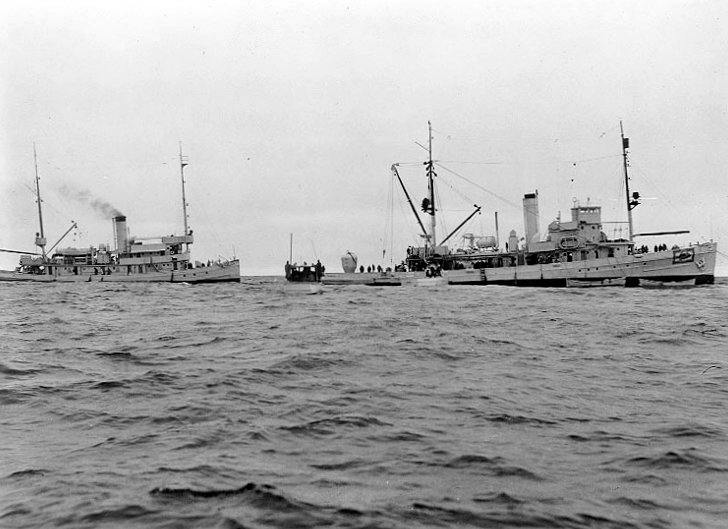
Featured photograph: USS Wandank and USS Falcon during rescue operations, circa May 24, 1939. U.S. Navy / Naval Historical Center, NH 57508. Public domain.
Related Stories
- The Knock in the Dark: 60 Hours Alive Inside a Sunken Ship — Harrison Okene’s survival in a submerged vessel.
- The Knocking Beneath Pearl Harbor: USS West Virginia’s Trapped Sailors — another naval sinking, with a very different outcome.
- USS Indianapolis: Four Days in the Water — the ordeal following the cruiser’s loss.