
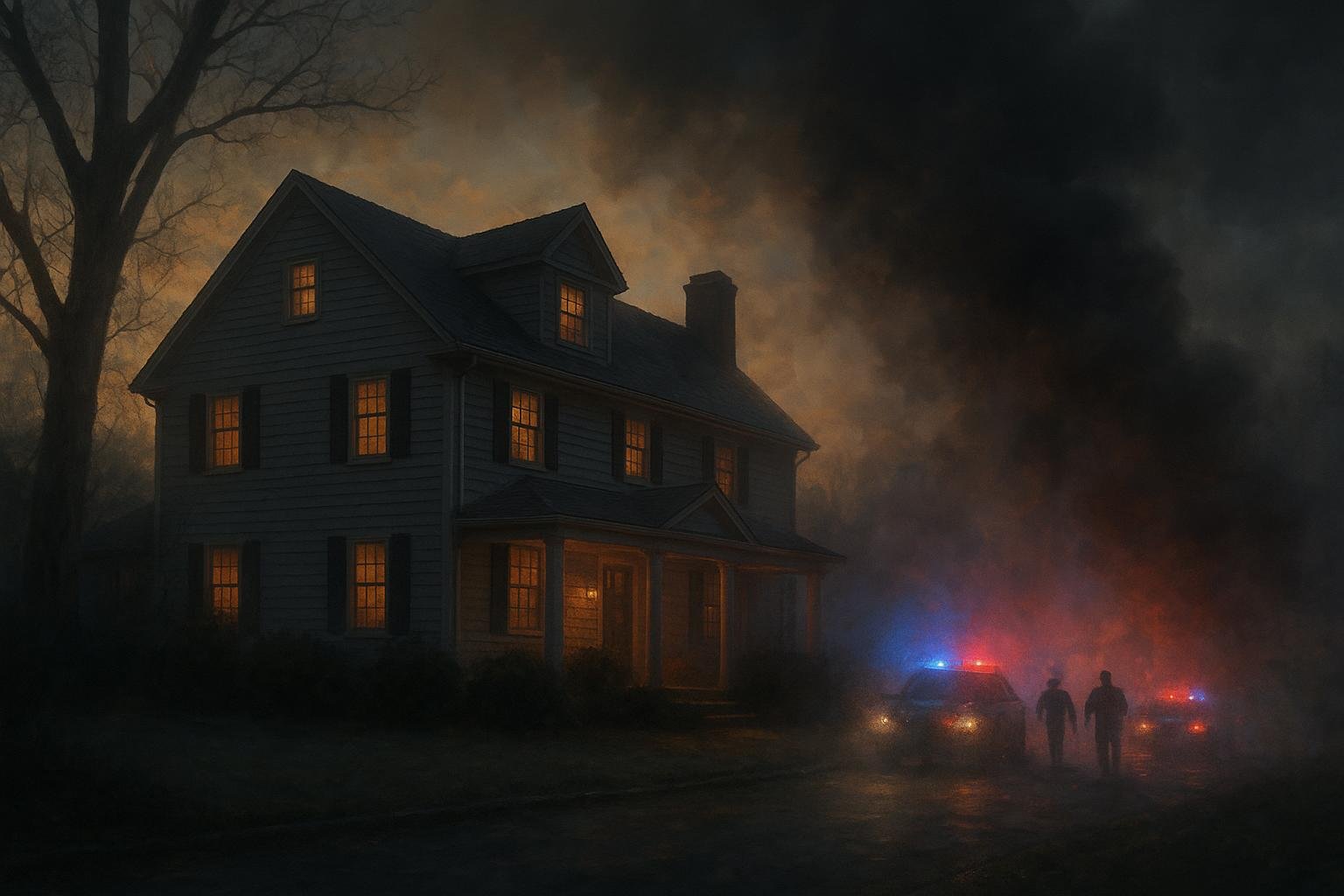
Jennifer Hawke-Petit walked into the bank that morning knowing her family was still trapped inside their home.
She was not there for a normal withdrawal.
She was not there because she wanted money.
She was there because two men had invaded her house, attacked her husband, tied up her daughters, and forced her to get cash while Komisarjevsky remained at the house and Hayes accompanied her.
Inside the bank, Jennifer did something incredibly brave.
She quietly told employees her family was being held hostage.
The bank called 911.
Police began responding.
Dr. William Petit survived. Jennifer, Hayley and Michaela did not.
This is the story of the Cheshire home invasion murders — one of the most devastating crimes in Connecticut history, and a case that still raises painful questions about evil, timing, police response, and how fast an ordinary morning can become a nightmare.
The Cheshire home invasion murders happened on July 23, 2007, in Cheshire, Connecticut. Steven Hayes and Joshua Komisarjevsky broke into the Petit family home, attacked Dr. William Petit, held Jennifer Hawke-Petit and her daughters hostage, forced Jennifer to withdraw money from a bank, then set the house on fire. Jennifer, Hayley, and Michaela died. Dr. Petit survived. Hayes and Komisarjevsky were convicted and originally sentenced to death, but their sentences were later changed to life in prison without parole after Connecticut’s death penalty was ruled unconstitutional.
A Quiet House in Cheshire
Cheshire, Connecticut was the kind of town people often described as safe.
It had quiet roads, clean lawns, family homes, and the kind of ordinary peace that makes people lower their guard.
At Sorghum Mill Drive lived the Petit family.
Dr. William Petit was a respected endocrinologist.
His wife, Jennifer Hawke-Petit, had worked as a nurse.
Hayley was 17 and preparing to enter Dartmouth’s Class of 2011.
Michaela was 11.
The crime took place in their home.
The Break-In
In the early morning hours of July 23, 2007, two men entered the Petit home.
Their names were Steven Hayes and Joshua Komisarjevsky.
They discussed ways to obtain money before approaching the house.
Dr. Petit was asleep downstairs.
He was attacked with a baseball bat and tied up. The beating was severe enough to leave him gravely injured.
Then the men went upstairs.
Jennifer, Hayley, and Michaela were forced awake and restrained.
What began as a home invasion quickly became a hostage situation.
The men wanted money.
They searched the house.
They learned there was access to a bank account.
Then they made the decision that would create the most haunting part of the case.
When the bank opened, Jennifer would be taken there to withdraw cash.
Her family would remain inside the house.
The Bank Warning
Hayes accompanied Jennifer to the bank.
Jennifer was taken to a local Bank of America branch and forced to withdraw $15,000.
The teller and branch manager learned that her family was being held hostage.
Then she quietly told bank employees the truth.
Her family was being held hostage.
The bank called 911.
Hayes waited outside the bank before taking her home.
The Race Against Time
Police began responding to the bank’s emergency call.
The later court record examines the response and disputed police communications.
Outside the Petit home, police began setting up around the area.
The Fire
Jennifer was strangled before the fire. William escaped before it began. Hayley and Michaela died in the fire; both remained restrained. The offenders fled in the family’s vehicle and were captured after crashing into police vehicles.
Timeline of the Cheshire Home Invasion Murders
July 22, 2007: Komisarjevsky follows Jennifer and Michaela home after seeing them shopping for dinner.
Early morning, July 23, 2007: Steven Hayes and Joshua Komisarjevsky enter the Petit family home in Cheshire, Connecticut.
Inside the home: Dr. William Petit is attacked and tied up. Jennifer, Hayley, and Michaela are restrained upstairs.
Morning: Jennifer is forced to go to a Bank of America branch to withdraw $15,000.
At the bank: Jennifer quietly tells employees her family is being held hostage. The bank calls 911.
Police response: Officers begin responding and position around the home.
Later that morning: The house is set on fire.
Escape: William gets out before the fire; the offenders flee and are captured.
Afterward: Jennifer, Hayley, and Michaela are found dead inside the home.
2010–2012: Hayes is convicted in 2010 and Komisarjevsky in 2011. Their death sentences follow in 2010 and January 2012, respectively.
2015–2016: Constitutional rulings lead to resentencing in 2016.
Why the Case Shocked Connecticut
This case became more than a murder case because of where and how it happened.
It happened in a quiet town.
It happened to a family people could easily recognize as their own neighbors.
It happened after a warning reached the outside world.
That warning became central to questions about the police response.
Jennifer got the message out.
The bank called for help.
Police knew something was happening.
And still, the home burned.
For years, people asked whether faster action could have saved Jennifer, Hayley, and Michaela.
That question does not have a simple answer.
But it has never gone away.
The Police Response Debate
The police response became one of the most debated parts of the case.
The Supreme Court rejected the police-disclosure claims. The appeal did not determine whether different tactics could have saved the victims.
The Trials and Sentences
The criminal case moved forward with overwhelming evidence.
Hayes and Komisarjevsky were arrested quickly.
Surveillance footage, forensic evidence, witness accounts, and trial testimony built the case against them.
Both men were convicted.
Steven Hayes was sentenced to death in 2010.
Komisarjevsky was formally sentenced to death in January 2012.
In July 2016 Komisarjevsky was resentenced to six consecutive life terms without release, followed by 140 years.
Hayes was resentenced to six consecutive life terms without parole in June 2016. Connecticut had abolished capital punishment prospectively in 2012; subsequent constitutional rulings barred the remaining death sentences.
But none of it could bring back Jennifer, Hayley, or Michaela.
What Doesn’t Add Up?
The hardest part of the case is the timing.
Jennifer reached the bank.
She warned people.
The 911 call was made.
Police responded.
And still, the outcome was catastrophic.
That is the part people keep returning to.
Not because there is a mystery about who committed the crime.
There is not.
The men responsible were caught and convicted.
The unresolved part is different.
It is the question of whether one different decision could have changed the ending.
Could police have gone in sooner?
Could the suspects have been stopped as soon as they returned from the bank?
Could the fire have been prevented?
Could Jennifer’s warning have saved them?
Those questions are painful because they live in the space between fact and possibility.
And possibility is where grief often hurts the most.
The Most Likely Explanation
The most likely explanation is that this was a home invasion that escalated into a hostage crisis and then into a deliberate attempt to destroy evidence and escape.
It unfolded over hours.
The victims were controlled.
Money was demanded.
Jennifer was forced to go to the bank.
The home was set on fire.
The killers fled.
What remains debated is not who did it.
It is whether the response could have unfolded differently once Jennifer’s warning reached the bank.
That question remains one of the reasons this case still feels so raw.
The Victims Should Be Remembered First
Cases like this can easily become centered on the killers.
Their names get repeated.
Their trials get covered.
Their appeals get discussed.
But the most important names are not theirs.
Jennifer Hawke-Petit was a mother who tried to save her family while under direct threat.
Hayley Petit was 17, on the edge of adulthood, with a future still ahead of her.
Michaela Petit was 11, still a child.
They were not just victims in a famous case.
They were a wife, a mother, daughters, students, friends, and loved ones.
That matters.
Because true crime should never turn real people into background details.
FAQ
What happened in the Cheshire home invasion murders?
On July 23, 2007, Steven Hayes and Joshua Komisarjevsky broke into the Petit family home in Cheshire, Connecticut. Dr. William Petit was attacked and survived. Jennifer was killed before the fire; her daughters died in it.
Who survived the Cheshire home invasion?
Dr. William Petit survived despite being severely beaten and restrained. His wife and two daughters died.
Why did Jennifer Hawke-Petit go to the bank?
She was forced to withdraw $15,000 while her family was being held hostage. While at the bank, she quietly warned employees that her family was in danger.
Were the killers caught?
Yes. Steven Hayes and Joshua Komisarjevsky were captured shortly after the house fire and later convicted.
Were Hayes and Komisarjevsky sentenced to death?
Yes. Both were originally sentenced to death. Their sentences were later changed to life in prison without parole after Connecticut’s death penalty was ruled unconstitutional.
Why is the police response controversial?
Because Jennifer warned the bank, the bank called 911, and police responded before the fire. Questions about a faster response persist. The record cannot establish every alternative outcome.
Closing Thoughts
The Cheshire home invasion murders remain haunting because they happened in a place that felt safe.
A normal house.
A normal town.
A normal summer morning.
Then everything broke.
Jennifer Hawke-Petit did what people hope they would have the courage to do.
She warned someone.
She tried to save her family.
And still, the ending came too fast.
That is why the case stays with people.
Not just because of the horror.
But because of the helplessness.
Because Jennifer reached the bank and asked for help.
Because one family’s home became the center of a question Connecticut would ask for years:
Could this have ended differently?
No answer can undo what happened.
No trial, sentence, law, or review can restore the lives taken that morning.
But remembering Jennifer, Hayley, and Michaela clearly matters.
Because this was not just a crime scene.
It was a home.
🔎 Related Investigation:
If this true crime case stayed with you, continue with these next:Explore more true crime stories here: View all true crime stories →
- The Elizabeth Smart kidnapping and the survival story that shocked America
- The Jaycee Dugard kidnapping and the 18-year captivity case that stunned the country
- The Junko Furuta case and the crime that still horrifies Japan
Video update note: This retained video predates the research update and may contain earlier wording. The article and Research Sources provide the updated account.
Research Sources
The following resources were consulted to verify and update this article.
- New Haven Register — Formal sentencing, January 2012
Dates the formal imposition of the death sentence. - Connecticut Supreme Court, via Justia — State v. Komisarjevsky (2021)
The criminal evidence, sequence and appellate ruling. - New Haven Register — Hayes resentenced to six life terms (2016)
Reports the June 2016 resentencing without parole. - The Dartmouth — Hayley Petit remembrance archive
A July 2007 remembrance identifies her planned Dartmouth enrollment. - U.S. Supreme Court docket; petitioner’s filing — Komisarjevsky certiorari petition (2021)
Records the sentence and later resentencing chronology.
Watch This Story on YouTube
Prefer to watch? See the full story on our YouTube channel.


So Hayes is now a chick with a male appendage, how convenient! Those two pieces of excrement will certainly get theirs in hell when Satan gets his hands on them. 👿💩…shame on Connecticut, another useless blue state!!