It always starts the same way: someone repeats one old line about Apollo instruments, and suddenly the moon stops looking like a rock. It starts looking like a shell. A mask. A giant pale object hanging over Earth with something hidden behind the familiar face.
The Hollow Moon Theory is the idea that Earth’s moon is not entirely natural at all, but an artificial or partially hollow object whose strange behavior has been misunderstood, buried, or explained away. The theory still gets attention because it feeds on a perfect mix of real lunar science, famous out-of-context quotes, and the unsettling feeling that the one object humans know best may also be the one we project onto most easily.
That is part of why theories like the Montauk Project conspiracy survive so well too. Once a story combines a real place, a little secrecy, and just enough unanswered texture, people stop asking whether it sounds reasonable and start asking whether it sounds possible.
The Moment the Moon Turns Uncanny
Most conspiracy theories depend on distance. The farther away the subject is, the easier it becomes to imagine hidden rooms, suppressed files, and impossible machinery. The moon may be the ultimate version of that. It is always present, always visible, always emotionally close, and still completely out of reach for almost everyone alive.
That contradiction gives the Hollow Moon Theory its atmosphere.
By day, the moon seems harmless enough when it fades into a pale ghost above the clouds. But at night it becomes something else. It hangs over empty roads, open water, frozen fields, sleeping neighborhoods, and old stories. It controls tides. It appears in myths from nearly every culture. It feels ancient without ever feeling dead. So when someone says the moon might not be what it seems, the claim lands harder than an ordinary science rumor. It is not just a weird idea about an object in space. It is a weird idea about the oldest thing watching us back.
The core belief is simple enough to repeat in one sentence: the moon may be partly hollow, artificially structured, or even intentionally placed in orbit long ago.
From there, the theory branches fast. Some believers argue the moon is a vast shell with a lighter interior. Some say it is an ancient alien construction. Others imagine a monitoring station, an ark, or a silent machine left above Earth for reasons humanity no longer understands. In the wildest versions, the craters are not just impact scars but damage to an armored surface, and the dark maria are not lava plains but old repairs or deliberate camouflage.
Once that frame locks in, the moon stops feeling like geology and starts feeling like evidence.
How the Theory Formed and Spread
The Hollow Moon Theory did not begin with social media. Its modern shape came together during the space age, when the moon stopped being an unreachable symbol and became a place astronauts could land on, measure, and strike.
The Apollo missions changed everything. For scientists, they created the first serious era of direct lunar study. For conspiracy-minded readers, they created an even more valuable thing: technical language dramatic enough to be repurposed into mystery.
The most famous example is the phrase that the moon “rang like a bell.” During the Apollo era, seismometers recorded vibrations caused by moonquakes and by deliberate impacts from discarded spacecraft hardware. Some of those oscillations lasted longer than many people expected. In sober scientific terms, that pointed toward a dry, rigid body with different seismic behavior than Earth. In conspiracy retellings, it became the line that launched a thousand late-night theories.
Because bells ring.
Shells ring.
Empty things ring.
That leap is the emotional engine of the whole theory.
The idea picked up another layer in 1970 when Soviet writers Mikhail Vasin and Alexander Shcherbakov published a speculative argument asking whether the moon could be artificial. Their proposal was far outside mainstream science, but it sounded official enough to become immortal in conspiracy culture. Suddenly the theory had Cold War texture, foreign scientific authority, and a premise bold enough to feel dangerous.
That is usually all a durable theory needs: one real event, one memorable quote, one semi-official text, and a public already hungry for a hidden version of reality.
Why Believers Keep Pointing to the Same Clues
The strongest conspiracy arguments around the moon are rarely built on one decisive piece of evidence. They are built on a cluster of details that sound stranger in sequence than they do alone.
Key Evidence and Clues Believers Point To
- The “rang like a bell” quote: This is the theory’s most famous line, repeated as if it were an accidental confession that the moon is hollow.
- The moon’s low density compared with Earth: Believers treat this as a hint that the interior is not what a normal rocky body should be.
- The moon’s tidal locking: The fact that one side always faces Earth is scientifically explainable, but emotionally eerie enough to keep resurfacing in theories.
- The eclipse coincidence: The moon appears almost exactly the right size in Earth’s sky to cover the sun during a total solar eclipse, which some people see as too perfect to be random.
- The Soviet artificial-moon speculation: Vasin and Shcherbakov’s proposal gave the theory a written foundation people still quote decades later.
- Blurry images and pattern-seeking: Every crater shadow, ridge line, and odd photo artifact invites fresh claims of towers, openings, grids, or buried structures.
Individually, none of those points proves anything extraordinary. Together, though, they create a pattern believers find hard to shake. That is especially true for readers already drawn to stories where official explanations feel thinner than the mood surrounding them. It is the same instinct that keeps people moving from lunar theories into pages like Operation Paperclip, where documented secrecy makes the public more willing to entertain darker versions of history.
Where the Theory Breaks Down
This is the part Hollow Moon believers usually resist, but it is also the part that keeps the theory from collapsing into pure fantasy. The scientific objections are not minor. They are the center of the case.
First, “rang like a bell” was never mainstream proof of a hollow interior. It was a vivid way of describing how seismic energy behaved on a dry, fractured world without oceans, weather, or Earth-like internal damping. Long-lasting vibrations do not automatically mean emptiness. They can also mean very different structural conditions.
Second, lower density is not a smoking gun. Planets, moons, and asteroids vary in composition. The moon’s density is already part of mainstream formation models, especially the giant-impact theory, which argues that the moon formed from debris after a colossal collision involving the early Earth.
Third, tidal locking is not rare magic. It is a known gravitational outcome. We only experience it as eerie because the moon is emotionally close enough for the effect to feel personal.
And finally, the artificial-moon idea has never gained serious scientific traction because the moon’s mass, orbital behavior, geology, and internal structure all fit natural explanations far better than they fit the idea of a constructed shell.
What Doesn’t Add Up
- The famous quote vs. the real science: The theory depends heavily on a phrase that sounds explosive outside its scientific context.
- The coincidence problem: Eclipses and tidal locking feel meaningful, but feeling meaningful is not the same as being engineered.
- The evidence quality: Most visual “proof” comes from blurry imagery, ambiguous shadows, or repeated reinterpretations of old material.
- The scale problem: A constructed moon would require engineering so extreme that the theory usually skips over how such a thing would even be built or placed.
- The survival problem: The more dramatic the claim becomes, the less clear it is how it could remain hidden through decades of lunar study.
That does not kill the theory. It just reveals what kind of theory it really is. Hollow Moon survives not because it wins the scientific argument, but because it wins the emotional one. It takes a familiar object and gives it a secret interior. That is catnip for the human mind.
Why the Idea Never Fully Dies
The theory endures because the moon is almost too symbolically powerful to remain ordinary. It has always been more than scenery. It shaped calendars, rituals, navigation, poetry, folklore, religion, and fear. It appears at the edge of disappearances, shipwreck stories, battlefield letters, and campfire myths. The moon does not have to be artificial to feel charged. It already does.
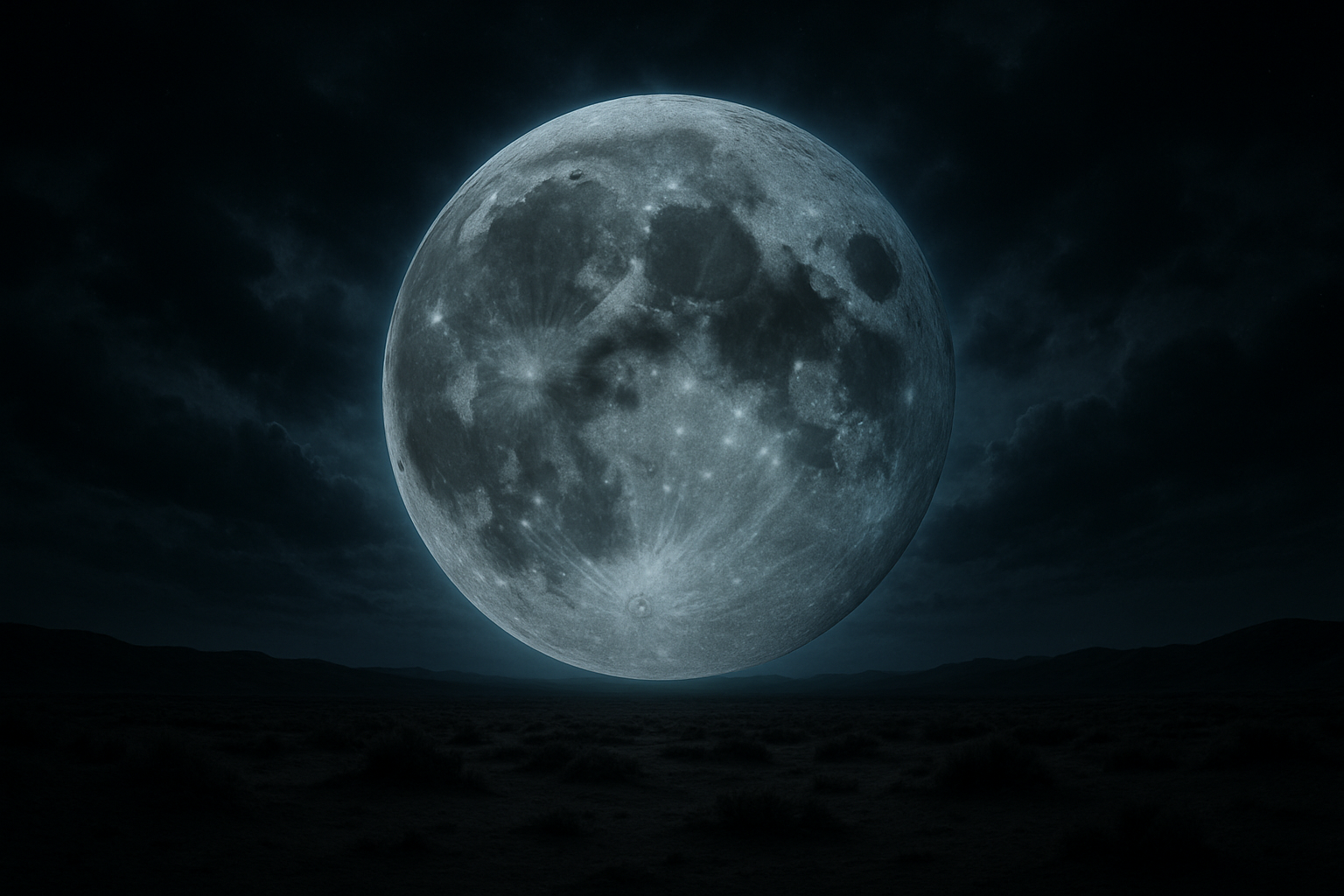
That is why every new cycle looks the same. A quote resurfaces. A video claims a crater is too perfect. A commentator insists Apollo data hinted at something NASA never wanted to say plainly. Skeptics answer. Scientists explain. The noise fades. Then the moon rises again, huge and white over a dark horizon, and the theory gets all its strength back for free.
In that sense, Hollow Moon belongs beside mysteries like the Somerton Man case. Very different facts. Very different stakes. But the same mechanism of endurance: a hard object of evidence surrounded by a much larger field of projection, doubt, and unresolved atmosphere.
Maybe that is the real secret of the Hollow Moon Theory. It does not need to prove the moon is artificial. It only needs to make people look up and feel, for a second, that the night has shifted. That what seemed ancient and settled may actually be staged. That the sky above us contains one huge familiar thing that has never fully explained itself.
And once that feeling settles in, the rest happens naturally.
FAQ
What is the Hollow Moon Theory?
The Hollow Moon Theory is the claim that Earth’s moon is not a normal natural satellite, but an artificial or partially hollow object. Believers usually point to Apollo-era moonquake data, strange scientific quotes, and the moon’s unusual characteristics to argue that something about it does not add up.
Why do people say the moon rang like a bell?
The phrase comes from Apollo-era seismic observations after impacts and moonquakes. In conspiracy retellings, it is treated like proof of a hollow interior. In mainstream science, it describes how vibrations traveled through the moon’s dry and rigid structure, not evidence that the moon is an empty shell.
Did scientists ever seriously suggest the moon could be artificial?
Yes, two Soviet writers famously speculated about that possibility in 1970. Their idea became a major pillar of the theory, but it was speculative and never accepted as mainstream lunar science.
Is there any real evidence that the moon is hollow?
No accepted scientific evidence shows that the moon is hollow in the way the theory claims. Modern lunar research supports natural explanations for its structure, orbit, and seismic behavior.
Why does the Hollow Moon Theory still get attention?
Because it turns the most familiar object in the night sky into a possible secret. It blends real science, misunderstood language, cosmic coincidence, and ancient emotional symbolism into a theory that is easy to repeat and hard to forget.
Continue exploring:
- The secret base legend where government secrecy mutates into something much stranger
- The Apollo theory that insists humanity’s most famous lunar moment was staged
- The hidden-world belief that imagines impossible space beneath our feet
- The crash story that turned one desert rumor into a permanent extraterrestrial debate
- The larger archive of cover-ups, hoaxes, and secret-history theories that feed this entire rabbit hole
- The beachside mystery where one body and one scrap of text kept history open
More Conspiracies & Theories stories:
Watch This Story on YouTube
Prefer to watch? See the full story on our YouTube channel.