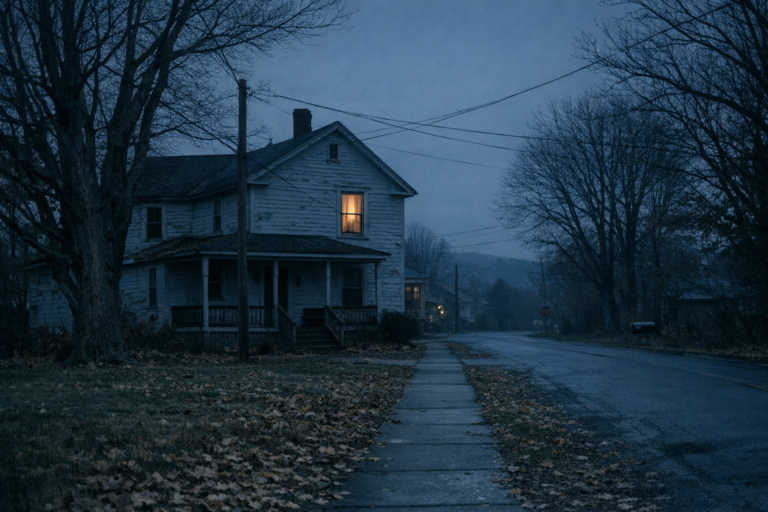
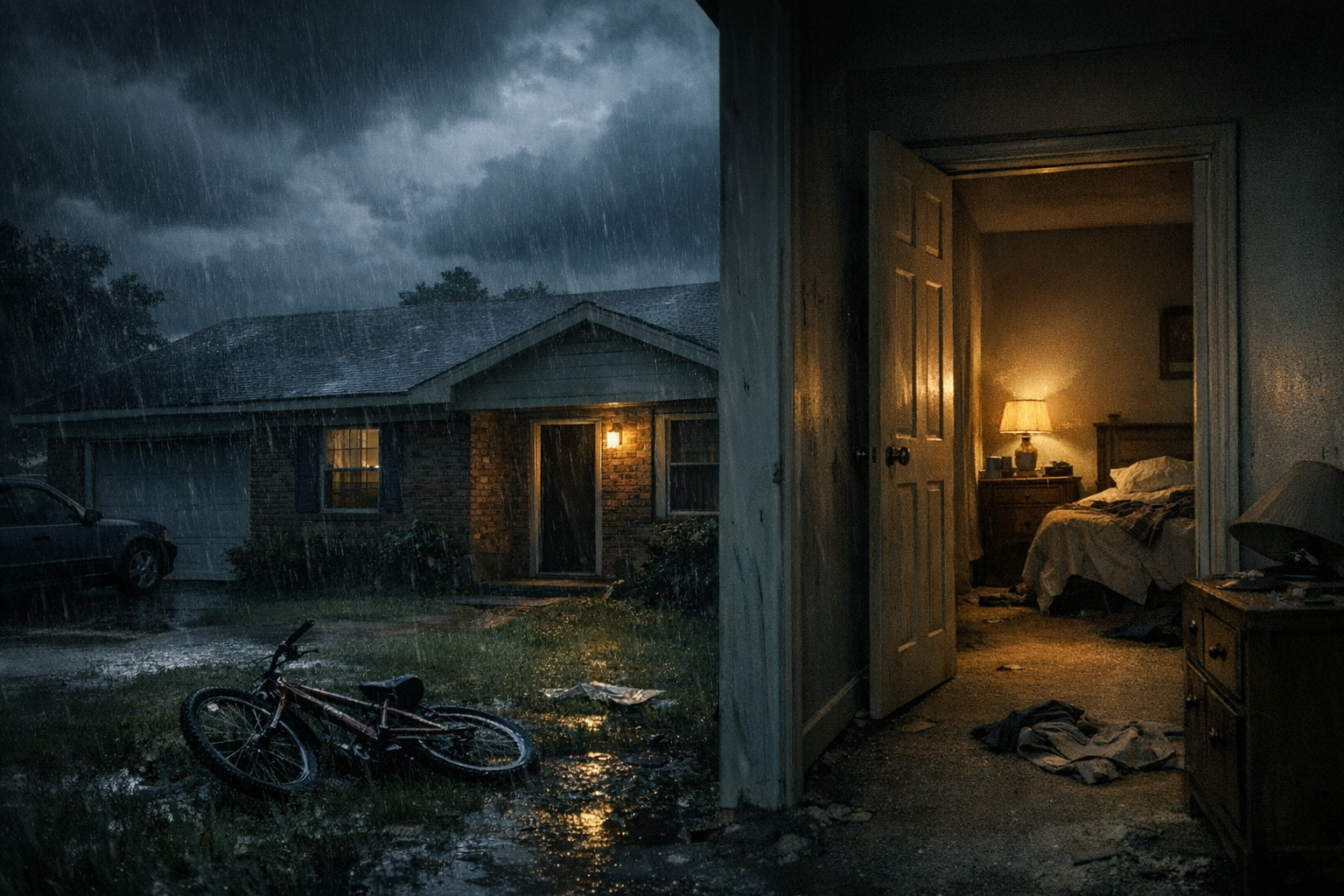
The rain had already started to turn the morning strange by the time Vickie Felton drove away from the house on Honey Locust Drive. Hurricane Andrew had not come ashore in Tupelo the way it had farther south, but its weather had reached Mississippi in that eerie, sideways way big storms do—wind worrying at the trees, dark clouds lowering over an ordinary neighborhood, the whole day feeling slightly off before it had even begun.
Inside the house, 13-year-old Leigh Occhi was supposed to be safe. She had plans later that day. She was waiting for her grandmother to pick her up for school open house. It was the first time her mother had left her home alone. A small step toward growing up. Nothing dramatic. Nothing dangerous. Just a girl in her nightshirt on a stormy morning, still inside the place that should have protected her most.
By 9:00 a.m., that same house looked less like a home than a scene someone had tried—and failed—to erase.
What happened to Leigh Occhi? The unsolved disappearance that still haunts Mississippi
Leigh Marine Occhi was a 13-year-old Tupelo girl who vanished on August 27, 1992, in what remains an unsolved disappearance and one of Mississippi’s most unsettling missing person cases. The case still matters because Leigh did not simply disappear into open ground or vanish after being last seen in public—she seems to have been taken from inside her own home, with blood evidence left behind and no clear answer ever found.
Cases like Leigh’s still sit at the center of the site’s broader missing children and teens archive, because they show how fast an ordinary morning can break into something permanent.
Leigh had been born in Hawaii in 1979 to parents serving in the military. By the summer of 1992, she was living in Tupelo, Mississippi, with her mother. She was 13, about to start eighth grade, and by every account still in that fragile stage between childhood and teenage independence. The details that morning were supposed to be simple: her mother would go to work, Leigh would stay home briefly, and her grandmother would pick her up later for an open house at school.
Then the weather changed. Hurricane Andrew had battered the Gulf Coast, and its outer bands brought heavy rain and turbulence northward. It was enough to make a parent uneasy. Not enough to suggest a child would vanish.
After leaving for work around 7:35 a.m., Vickie Felton reportedly tried calling home around 8:30 a.m. There was no answer. She tried again. Still nothing. At that point, the storm itself may have been enough to trigger worry. A 13-year-old home alone during bad weather might simply miss the phone. But the silence kept pressing on her, and she drove back.
What she said she found has kept this case alive for decades.
The garage door was open. The light was on. Another door was unlocked. Inside, there was no Leigh. Instead, there were signs that something violent had happened quickly and close-range. Investigators found fresh blood on the walls, on the carpet, and on the bathroom counter. There was a trail leading through the house toward the back door. Blood and hair were reportedly stuck to a door frame, suggesting a head injury. In Leigh’s bedroom, a bloodstained nightgown and bra were found. Her reading glasses, some clothing, shoes, and a sleeping bag were missing.
That combination is what makes the Leigh Occhi case feel so different from a standard missing-person file. This was not a person last seen walking down a road, boarding a bus, or stepping into a parking lot with no witnesses. This was a rupture inside the home itself. An environment that should have narrowed the possibilities somehow only made the case more disturbing.
Timeline of Events
- About 7:35 a.m., August 27, 1992: Leigh is last known to be at home on Honey Locust Drive in Tupelo after her mother leaves for work.
- Later that morning: Leigh is expected to be picked up by her grandmother for school open house.
- Around 8:30 a.m.: Her mother reportedly calls home and gets no answer.
- Shortly afterward: A second call also goes unanswered, increasing concern because of the stormy conditions.
- About 9:00 a.m.: Her mother returns home, finds the house in disarray with blood evidence inside, and calls police.
- Following days: Search teams, bloodhounds, and investigators comb the area, but weather conditions limit scent tracking and no trace of Leigh is found.
- September 1992: Leigh’s eyeglasses are mailed back to the residence from Booneville, Mississippi, in what authorities later treat as a likely distraction.
The storm matters here—not as an explanation, but as a pressure point. It may have masked sound. It may have emptied the street. It certainly complicated search work. Bloodhounds reportedly struggled because the weather had already started tearing away anything as fragile as a scent trail. If someone wanted to move fast and leave little behind, the conditions could hardly have been better.
The atmosphere is not decoration. The storm is built into the case itself. It changes the emotional texture, but it also changes the investigative reality.
And then there is the blood.
People often remember this case in shorthand as “the girl who vanished in a storm.” But the detail that gives it lasting power is not only the weather. It is the fact that Leigh seems to have been injured badly enough to bleed through multiple parts of the house—and yet there was still no body, no confirmed abductor, no reliable witness, and no neat ending investigators could lock into place.
What Doesn’t Add Up
- No forced entry: If someone came in from outside, Leigh may have known them, trusted them, or simply opened the door before anything felt wrong.
- Evidence of injury, but no victim recovered: The blood suggests violence, but not enough was publicly established to explain how someone removed Leigh without leaving a clearer trail outside.
- Signs of cleanup: Investigators believed someone may have tried to wipe part of the bathroom, which suggests time, composure, and familiarity with the scene.
- The mailed glasses: The envelope postmarked from Booneville looked less like proof of life than a staged attempt to redirect attention.
- The storm window: Bad weather made the neighborhood quieter and hurt early search efforts, but it also means the abduction would have had to happen in a very tight time frame.
If you lay those points out in order, the case starts to feel less random and more intimate. Not necessarily family-based, not necessarily solvable from the outside—but intimate. The lack of forced entry matters. The apparent attempt to clean matters. The chosen items missing from the room matter. Together, they do not prove exactly who took Leigh, but they do suggest this was not an impulsive grab by a stranger blundering through a storm.
That is why the case continues to attract attention alongside other stories involving evidence left behind, partial timelines, and homes that suddenly stop feeling safe. The horror here is not just that Leigh disappeared. It is that the house appears to have recorded part of what happened, but only part.
One of the most talked-about later developments came when Leigh’s glasses arrived by mail about a month after she vanished. They were addressed to her stepfather, whose surname was misspelled on the envelope, and the package came from Booneville, around 30 miles away. Investigators reportedly found little useful forensic value from it and came to suspect it was meant to throw them off. That suspicion makes sense. If this had been a real ransom signal or proof-of-life message, it was strangely empty. No demand. No explanation. Just a familiar object, returned like a taunt.
The glasses turned the case from frightening into almost theatrical, but in the worst possible way. Whoever mailed them—or wanted investigators to think they had been mailed by the abductor—understood that a tiny object could take over the entire public conversation. For years, people have stared at that detail and tried to decide whether it revealed intelligence, panic, cruelty, or simple misdirection.
Investigators interviewed multiple people over time, and suspicion has drifted in different directions. Leigh’s mother drew attention partly because she reportedly failed polygraph tests, though that by itself is far from proof in a case defined by trauma and stress. Other names have surfaced over the years as potential persons of interest, including a man connected through church who later committed violent crimes against another girl. None of it has produced a charge in Leigh’s disappearance.
That is another reason the case still resonates: there is just enough there to keep every theory alive, but not enough to let one stand without resistance. The scene looks staged and unstaged at the same time—too violent to be a harmless runaway scenario, too incomplete to deliver a straightforward abduction narrative, and too narrow in timing to stop people from revisiting the same morning again and again.
Key Evidence and Clues
- Fresh blood inside the house: Reportedly found on walls, carpet, and the bathroom counter, indicating recent violence.
- Blood trail toward the back door: Suggests movement through the home rather than a contained incident in one room.
- Blood and hair on the door frame: Often cited as evidence Leigh may have suffered a blow to the head.
- Missing personal items: Her glasses, shoes, some underclothes, and a sleeping bag were gone, raising questions about whether they were taken deliberately.
- Mailed eyeglasses from Booneville: One of the most bizarre post-disappearance developments, but also one authorities have long treated with caution.
- Weather interference: Hurricane conditions likely damaged the earliest chance of finding a scent trail or reliable outdoor evidence.
In many disappearances, the case becomes colder because there is almost nothing to work with. Here, the opposite problem may have happened. There was enough evidence to imply violence, but not enough to create a clean, prosecutable chain. Every clue opened a possibility and then stopped halfway.
That is why the Leigh Occhi disappearance still feels modern even though it happened in 1992. Readers today are used to surveillance cameras, phone records, and digital location trails. This case has none of that safety net. What remains is a storm, a short window of time, a house with blood inside it, and a missing girl whose story seems to end exactly where the answers should begin.
More than three decades later, the emotional center of the case has not changed. Leigh was 13. She was waiting to be picked up for a school event. She was in the one place where adults tend to believe children are safest. Then something happened quickly enough to erase her from the day while leaving behind a scene that still argues with itself.
Maybe that is the real reason people keep returning to this case. It forces a question that has never been settled: if Leigh Occhi was taken from inside that house on that stormy Mississippi morning, how could so much appear to happen in plain sight—and still leave so little that anyone could finish the story?
Until that answer arrives, if it ever does, her case stays where the most haunting cases always stay: not in the past, exactly, but in a suspended space where the evidence is still speaking and nobody has yet learned how to hear it clearly enough.