At first glance, it looked less like a crash than a photograph someone had staged to make your stomach tighten.
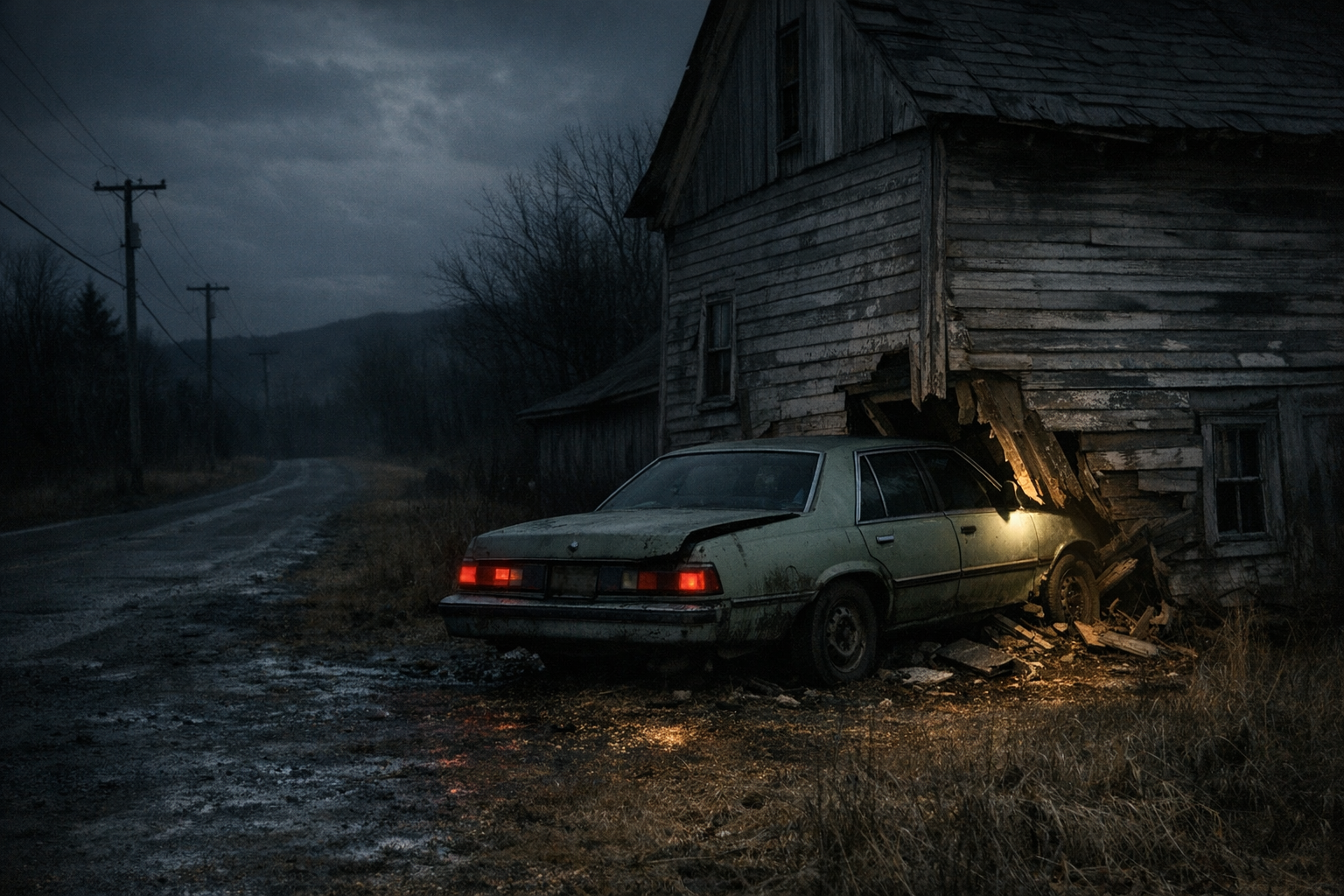
A pale green Oldsmobile sat half buried in the side of an abandoned house on a dark stretch of road in rural Vermont, its nose jammed into the broken boards, its rear end still hanging out into the night. No flashing lights. No crowd. No obvious trail leading away. Just a car left at a crooked angle, as if it had driven straight into the wall and then the person behind the wheel had simply stepped out of the world.
By sunrise, that frozen scene would become one of the most haunting images in modern missing-person history. Because the driver, 17-year-old Brianna Maitland, was gone.
What Happened to Brianna Maitland? The Unsolved Disappearance Behind Vermont’s Most Haunting Final Scene
Brianna Maitland’s unsolved disappearance remains one of the most unforgettable missing person cases in Vermont because it begins with a scene that looks impossible to explain: her car lodged in an abandoned farmhouse just hours after she left work. More than two decades later, the case still matters because that single image — the car, the building, and the silence around both — continues to raise the same question: what happened in the missing hours between Brianna’s final shift and the moment her vehicle was found?
That frozen final image is part of why cases like the found vehicle disappearances archive keep pulling readers back in: sometimes the vehicle stays behind like a message, but the person never does.
On the night Brianna vanished, there was nothing about the outside world that seemed large enough to swallow someone whole. She had worked her shift at the Black Lantern Inn in Montgomery, Vermont. It was late March 2004, cold and dark, the kind of northern New England night that turns back roads into tunnels. Brianna was young, restless, and trying to hold together a life that already had more strain in it than most teenagers knew how to carry.
Friends described her as independent, but independence can look different from a distance than it feels up close. By that point, Brianna had been moving through a rough patch. She had tensions in her personal life, instability around where she was staying, and signs that she had been pulled into a harder crowd than the people who cared about her wanted to admit. None of that means she was destined to vanish. But it does mean the hours before she disappeared were not floating in a vacuum. They belonged to a life already under pressure.
She had spent time living away from home and was trying to make adult decisions while still barely out of childhood. That detail matters because Brianna’s case is often remembered only for the image of the car. But the real mystery lives in the gap between the photograph and the person — in the decisions she was making, the people around her, and the possibility that whatever happened to her began before anyone realized they were watching the start of something irreversible.
After finishing her shift at the Black Lantern Inn on the evening of March 19, Brianna left alone. That is the last confirmed moment when her movements are relatively solid. From there, the timeline starts to loosen. She was believed to be driving her 1985 Oldsmobile 88. Sometime after leaving work, she vanished. Early the next morning, the car was discovered at the old Dutchburn House on Route 118 in Montgomery.
And that discovery did not look normal.
The car had backed or slid into the side of the abandoned building with enough force to puncture the wall. Yet there was no Brianna inside it. No clear sign of a major injury scene. No simple explanation that made the picture make sense in one glance. Personal items were reportedly left behind. The scene suggested interruption — not closure.
Timeline of Events
- March 19, 2004, evening: Brianna Maitland works her shift at the Black Lantern Inn in Montgomery, Vermont.
- Late that night: She leaves work alone in her Oldsmobile.
- After midnight / early March 20: Somewhere in the missing hours, something happens that separates Brianna from her car.
- March 20, 2004: Her vehicle is found backed into the abandoned Dutchburn House, creating the image that will define the case.
- Following days: Investigators begin looking at Brianna’s social circle, recent conflicts, and the possibility that foul play was involved.
That timeline is short on paper. In reality, it is a canyon. The farther people have looked into the case, the more obvious it becomes that the central problem is not the discovery itself. It is the missing stretch before the discovery — the minutes or hours in which Brianna was still somewhere in the world, and then suddenly wasn’t.
The abandoned house made the case famous, but it may also have distorted it. The image is so dramatic that it tempts people to think the answer must be inside the picture. Maybe there was a crash. Maybe she fled on foot. Maybe someone forced her from the vehicle right there. Maybe it was staged. But there is another possibility, and it is the one that keeps this case disturbing: the car scene may have been only the end of one part of the story, not the place where the real danger started.
Brianna’s disappearance is not just about a car in a wall. It is about the silence that followed a final scene so strange it distracted from everything just outside the frame.
Investigators and later coverage dug into the people around Brianna in the weeks before she vanished. There were reports that she had experienced trouble with others, including rumors of disputes tied to drug activity. Her family and supporters have long pushed back against lazy attempts to reduce her case to that detail alone, and they are right to. Drug rumors can become a shortcut people use when they do not have answers. But they cannot simply be ignored either, because if Brianna crossed paths with unstable or dangerous people, that could explain why the trail went cold so fast.
There were also signs that Brianna may have been trying to manage multiple stress points at once: work, relationships, housing instability, and the ordinary vulnerability of being a teenager moving through adult spaces at night. Cases like this often turn on a terrible collision between routine and risk. Someone leaves work. Someone takes a familiar road. Someone plans to sleep, go home, or meet up with a person they think they know. Then one bad encounter changes the whole shape of the story.
What Doesn’t Add Up
- The car scene feels wrong. It does not read cleanly as a straightforward crash, abandonment, or runaway setup.
- No confirmed exit path. If Brianna left the vehicle voluntarily, where did she go in the dark, and why?
- The timing gap is everything. The missing hours between leaving work and the vehicle’s discovery still have too many open possibilities.
- The social-circle questions never fully settled. Potentially important context around who Brianna was with, trusted, feared, or owed has remained frustratingly incomplete.
- The scene may have overshadowed the lead-up. The famous image pulls attention to the house, but the real answer may lie in events that happened before the car ever reached it.
That last point may be the most important. Many famous disappearances become trapped inside their own most iconic detail. In Maura Murray’s case, the roadside crash scene became a permanent focal point. In Steven Koecher’s disappearance, it was the surveillance footage of a man walking into a neighborhood and never reappearing. In Brandon Swanson’s case, it was the phone call that ended in darkness. Brianna’s version of that same trap is the Dutchburn House photo: unforgettable, yes — but possibly incomplete in the worst possible way.
If Brianna was harmed by someone she knew, or someone she had recently encountered, the abandoned-house scene may have been a discarded endpoint rather than the true beginning of the crime. If she was lured somewhere, threatened, or followed, the car could represent a hurried repositioning of events. If she met with foul play after leaving work but before reaching that road, then the house becomes less a location than a stage set left behind for everyone else to puzzle over.
That is part of why the case still gets attention every anniversary. Not just because it is sad, or because Brianna was young, or because the photo is eerie. It stays alive because the scene appears to promise an answer and then refuses to deliver one. Most people, when they first see that image, instinctively think the next step should be obvious. Instead, the road goes dead.
There have been theories over the years. Some point to foul play tied to local criminal activity. Some suspect that Brianna arranged to meet someone after work and never returned from that meeting. Others focus on the possibility that multiple people know more than they have ever admitted. As in many long-unsolved disappearances, rumor has often run faster than proof. But rumor usually grows in the spaces where witnesses stay quiet, accounts shift, and a community senses that the official picture is missing pieces.
Key Evidence and Clues
- The Black Lantern Inn exit: Brianna’s departure from work is the last relatively fixed point in the timeline.
- The Dutchburn House vehicle scene: Her Oldsmobile lodged in the abandoned building remains the single most important physical image in the case.
- Items left in or around the car: These suggested that Brianna did not simply pack up and start over.
- Possible conflict and pressure in her life: Reports about disputes and risky associations gave investigators reason to consider foul play.
- The absence of a clean narrative: No theory has ever neatly explained the car, Brianna’s disappearance, and the lack of a definitive trail all at once.
The hardest truth in cases like this is that a person can vanish even when the setting looks far too specific for mystery. People tend to think total disappearances happen in wilderness, on highways, or in oceans — places built for losing things. Brianna disappeared near roads, jobs, homes, and people. The image we remember is not wide-open emptiness. It is a car pinned against a building as if the world itself should have been forced to explain what came next.
But it didn’t.
And that is why the case continues to feel unfinished in a way that many missing-person cases do not. There is no clear emotional resolution available to the mind. If the car had been found miles into the woods, people would imagine exposure or disorientation. If Brianna had been seen getting into another car, people would focus on that handoff. If the vehicle had been cleanly abandoned, people would debate intent. Instead, the final scene seems to point in every direction at once.
More than twenty years later, Brianna Maitland’s disappearance still occupies a strange place in the public imagination because it feels like the middle of a sentence. A teenage girl leaves work. A car appears half inside a ruined house. The next line never comes.
That is the real power of the case — and the real sadness of it. The abandoned-house image is not just creepy. It is cruel. It tricks the mind into believing the answer must be close, just beyond the headlights, just off the shoulder of the road, just past the broken boards. But all these years later, the most important thing is still missing: Brianna herself.
Until that changes, the case will remain what it has always been — a story built around a final scene so vivid that people assume it should speak, and a silence so complete that it never does.