The Night the Sky Started Acting Wrong: A Witness-Led Timeline of the Signals, Movement, and Doubt That Followed
9 min readJanuary 27, 2026
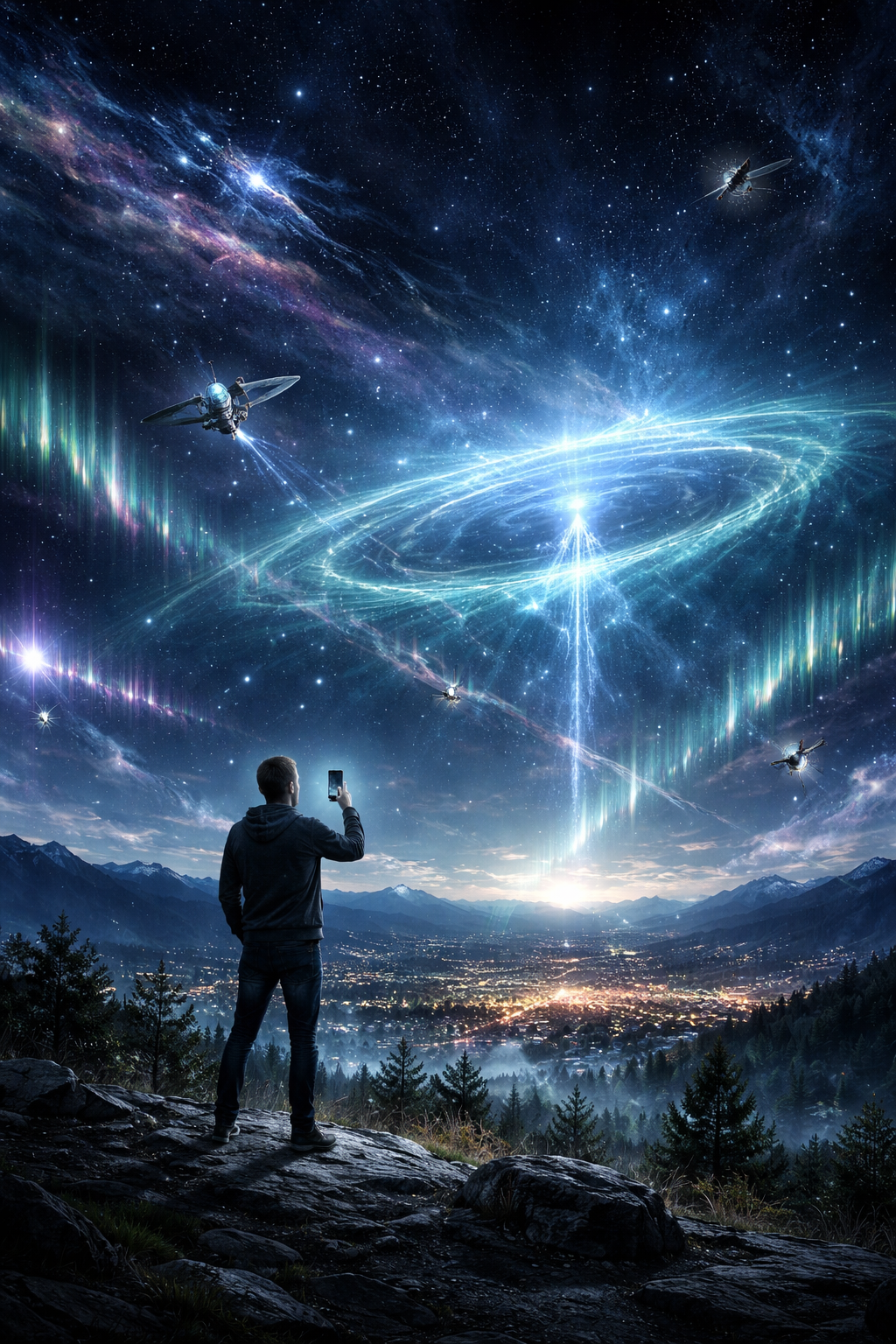
People kept describing the same moment in almost the same language. The light did not drift like a satellite. It did not streak like a meteor. It hung there, flickered once, then moved in a way that felt wrong before vanishing into an otherwise ordinary night sky.
The Night the Sky Started Acting Wrong looks at one of the strangest modern sky-anomaly stories: reports of lights that seemed to jump, blink, and react, followed by satellite glitches, argument, and a growing feeling that witnesses were not all misreading the same thing by accident. It still matters because the case sits in that unnerving space between observation and explanation, where every theory solves one part of the mystery and leaves another part untouched.
If you want the wider rabbit hole first, start with The Unsolved Mysteries Archive, because this story lives beside other signal and sky cases that make ordinary explanations feel just a little too small.
At first, the reports looked disposable. A strange light above one neighborhood. A short clip filmed through a windshield. A pilot mentioning a flash on the horizon that did not match weather or traffic. Each one, by itself, could be brushed away.
What made this case harder to ignore was the pattern. People in different places began describing lights that flickered, stopped, shifted direction, or appeared to fade out too cleanly. Amateur sky-watchers compared timestamps. Pilots talked quietly. Suddenly the story was not just about lights anymore. It was about whether the sky itself was behaving in a way people were not used to seeing.
The earliest accounts were easy to dismiss because they sounded almost too simple. Someone looked up and saw a point of light hesitate. Someone else swore a bright object jumped sideways before fading out. In another report, two lights seemed to move in sync for a few seconds and then separate so fast the observer assumed they had misunderstood what they were seeing.
Witnesses kept returning to the same detail: the motion did not feel natural. That does not make it supernatural, of course. Human beings are not built to judge distance and speed perfectly against a black sky. A light that seems close may be incredibly far away. A sudden turn can be an illusion created by clouds, depth, angle, or camera shake. Skeptics had good reasons to say so, and many did.
But those objections did not calm the discussion. They sharpened it. The more people tried to reduce the phenomenon to bad observation, the more another group insisted that the weirdest reports were being flattened into the same pile as obvious mistakes. That tension shaped the entire mystery. It was never just believers versus debunkers. It was people arguing over which details deserved to survive the first wave of dismissal.
The post that pushed the subject beyond casual curiosity came after several clips circulated close together. None of them were perfect, but together they created the same impression: light, pause, flicker, movement, disappearance.
Timeline of How the Sky-Anomaly Wave Grew
First stage: scattered witness reports describe lights that blink, pause, or shift direction in ways that feel unusual but still arguable.
Second stage: short videos begin circulating online, giving the discussion a visual reference point even though the footage remains frustratingly inconclusive.
Third stage: amateur trackers and forum users compare dates, times, and recurring descriptions, turning loose sightings into a recognizable pattern.
Fourth stage: attention expands beyond witnesses as people begin mentioning satellite hiccups, pilot observations, and strange gaps between what was seen and what could be confirmed.
Fifth stage: the mystery splits into camps: observational error, atmospheric distortion, experimental technology, or a still-unresolved phenomenon nobody can define cleanly.
That progression matters because it explains why the story lingered. Most sky mysteries flare up and die when there is no follow-through. This one kept mutating. Each new report did not prove the old ones, but it gave them company. In mysteries like this, company is powerful. People can ignore one strange night. They have a harder time ignoring a repeated feeling that the same strange night keeps happening in slightly different forms.
What Observers Said They Saw
The witness-centered version of this case is more compelling than the clean summary. People did not simply report “lights in the sky.” They described behavior. A point of light that seemed fixed, then jumped. An object that flickered out without the gradual fade expected from distance or cloud cover. Bright movement that looked almost deliberate, as if the object had corrected itself mid-path.
That last detail is where the mystery becomes sticky. When people say something in the sky looked wrong, they usually mean it violated rhythm. Planes move steadily. Meteors streak. Satellites glide. Drones wobble or hover. Even if someone misidentifies what they are seeing, they usually describe it using a familiar pattern. Here, witnesses kept describing interruptions to pattern itself. Stop. Shift. Blink. Gone.
Some accounts also included silence where people expected context. No sound of aircraft. No storm front. No obvious explanation arriving a few seconds later. A witness would see the motion, wait for the comforting reveal, and get nothing.
The reports also came from different kinds of observers: casual witnesses, forum regulars, stargazers, travelers, and people who sounded annoyed that they had seen anything unusual at all. That variety does not prove the phenomenon, but it does make the conversation harder to dismiss as one subculture talking itself into a shared fantasy.
What Doesn’t Add Up
The repeated motion language: many reports describe pause-and-jump behavior rather than steady travel, even when witnesses had no contact with one another.
The disappearance problem: several accounts involve objects fading or blinking out too abruptly for the observer to feel satisfied by ordinary distance or cloud cover.
The timing issue: discussion intensified when clusters of reports and clips appeared close together, giving the impression of a wave rather than random noise.
The confirmation gap: by the time investigators, skeptics, or online analysts looked closely, the strongest moments were already over, leaving impressions instead of decisive evidence.
That confirmation gap may be the most frustrating part of the entire story. The anomaly is vivid enough to be memorable but slippery enough to resist proof. In that way, it behaves like many of the best unsolved mysteries: not empty, not solved, just permanently one step outside the reach of certainty.
What Skeptics Argued
The skeptical case is stronger than believers sometimes admit. Atmospheric distortion can make ordinary objects appear to flicker, bend, or move strangely. Perspective can compress distance and create the illusion of sudden change. Consumer cameras are terrible witnesses. Autofocus hunts. Digital zoom exaggerates movement. Compression destroys context. A star near the horizon can look unstable. A satellite can seem to vanish as it enters Earth’s shadow. A drone can fool people who do not expect one to be there.
There is also the social explanation. Once a few dramatic clips spread online, people start looking up with expectation already loaded into the moment. If enough people are primed to ask whether the sky is acting strangely, then ordinary lights can begin generating extraordinary language.
Skeptics also point out that “pattern” is one of the easiest things for the human mind to overproduce. We connect similar descriptions, ignore weak mismatches, and start building a larger event out of fragments that may not belong together at all.
Still, skepticism does not close the file. It explains why many reports may be wrong. It does not fully explain why the same handful of specific behaviors kept surviving repeated retellings. That is the reason the mystery never really settles. The skeptical case is good. It just does not feel complete.
Theories That Keep Pulling People Back
One theory says the entire wave was a mess of ordinary objects seen under unusual conditions, amplified by the internet until it felt like a single event. That is the cleanest explanation and, for many people, still the most likely.
Another says at least some reports involved experimental technology. That could mean advanced drones, surveillance systems, or tests that produced unusual movement, lighting, or visibility effects. The appeal of that theory is obvious: it keeps the phenomenon real without requiring anything impossible. Its weakness is that it often explains too much with too little evidence.
A third theory, the one that keeps the story alive at 2 a.m., is that the witnesses really did catch something poorly understood at the edge of atmosphere, visibility, or instrumentation. Not aliens. Not necessarily anything dramatic. Just a phenomenon that does not fit neatly into the categories ordinary people reach for first. That theory survives because it matches the emotional shape of the reports. People were not just startled. They were left with the feeling that the sky had briefly stopped behaving like background.
Stories like Mysterious Signals From Space: The Sounds, the Sources, and Why They Still Feel Unfinished deepen that feeling, because they live in the same uncomfortable territory: real observation, incomplete interpretation, and just enough credible confusion to keep the question open.
That is also why the piece works best as a witness-led documentary mystery rather than a grand explanation. The unresolved part is the point. If the case had one neat answer, nobody would still be looking up and comparing notes.
Why This Case Still Gets Attention
It survives because it never collapses into one obvious category. It is not a single UFO story or one famous image. It is a cluster of observations that feel similar enough to matter and weak enough to argue over forever.
It also touches a very old human fear: that the familiar world can stay visually normal while behaving in ways we do not understand. If that mood is what pulled you in, Strange Sky Mysteries That Still Have No Explanation makes a natural companion read, because it widens the lens from one wave of reports to the larger archive of nights people could not explain even after the panic wore off.
That may be the truest ending available here. Not proof. Not closure. Just witness moments that refuse to flatten into coincidence as neatly as skeptics want, and refuse to harden into evidence as neatly as believers hope.
FAQ
What is The Night the Sky Started Acting Wrong about?
It is about a wave of witness reports describing strange lights that flickered, jumped, or vanished in ways people found hard to explain, along with the wider debate over whether those sightings were observational error, technology, atmospheric effects, or something less easily classified.
Were the strange sky lights ever officially explained?
No single official explanation settled the entire discussion. Skeptical explanations cover many reports well, but the broader pattern remains open enough that people still debate what the most credible sightings actually represent.
Why do people compare this case to mysterious signals and anomaly stories?
Because it lives in the same documentary territory: witnesses report something real enough to disturb them, but the available evidence never becomes clean enough to end the argument. That unresolved middle ground is what keeps readers coming back.
Is this considered a UFO case?
Some readers frame it that way, but the stronger interpretation is broader. It is a sky-anomaly mystery built around witness observations, inconsistent evidence, and the tension between ordinary explanations and a pattern that still feels unfinished.
If this mystery pulled you in, the author suggests these related real cases next: