
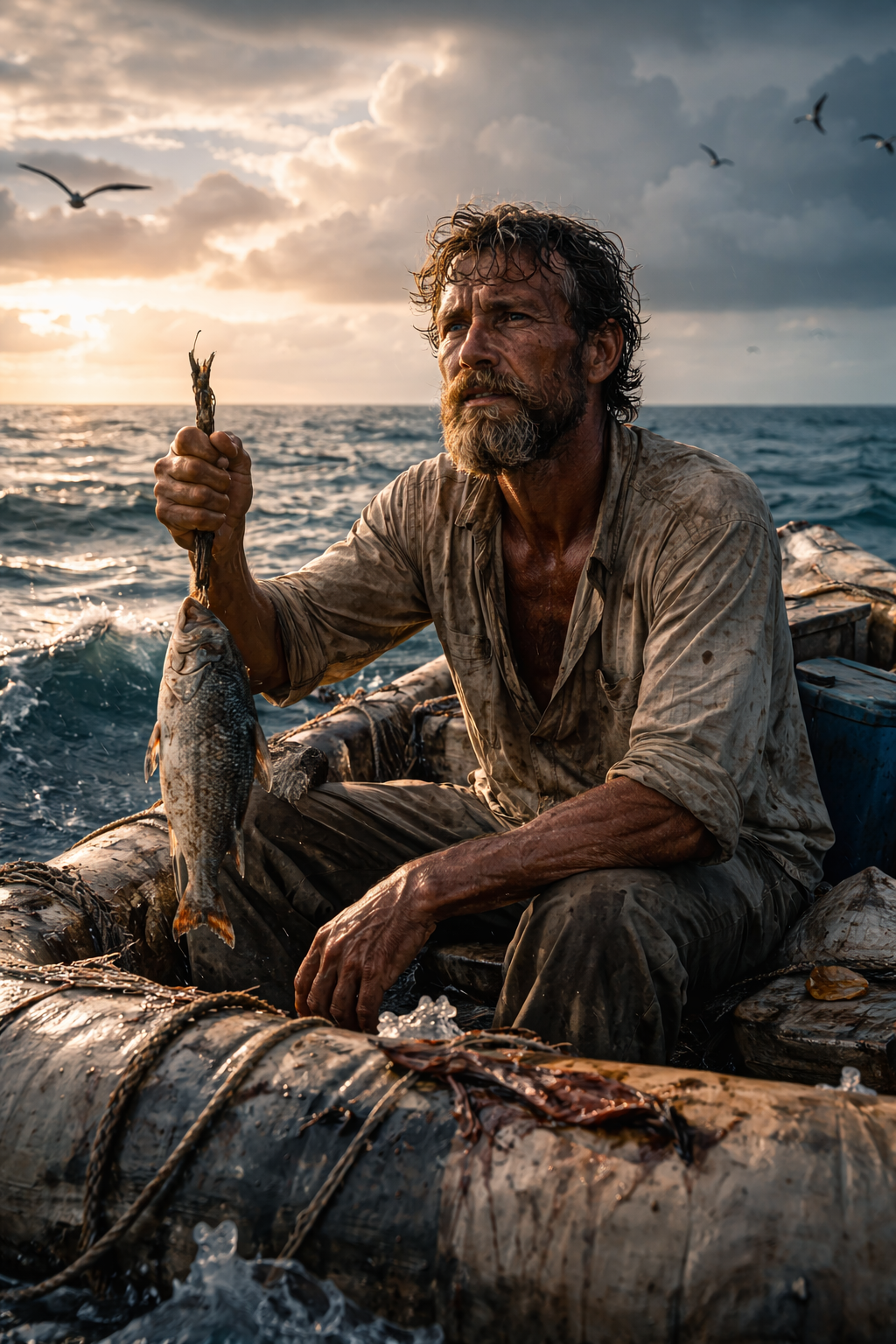
On November 17, 2012, Salvador Alvarenga and Ezequiel Córdoba left southern Mexico in a small fishing boat. They were setting out to catch fish and return to shore. The journey remembered as 438 Days at Sea would end with Alvarenga reaching the Marshall Islands in January 2014. Córdoba would never come home.
The ordeal was not just about hunger and weather, but about what happens when the world becomes water, silence, and the work of keeping yourself alive. The November departure date and January 30 landfall frame Jonathan Franklin’s later account. Early reports described a shorter, thirteen-month drift; the difference matters when assessing what was established afterward.
Alvarenga was an experienced fisherman working out of Mexico’s Pacific coast. He headed out in a fiberglass skiff with a younger deckhand, Ezequiel Córdoba. The plan was simple: run offshore, work the lines, come back. They carried fuel, bait, ice, and supplies meant for a short commercial trip.
In Alvarenga’s later account to Franklin, the storm turned their fishing trip into a struggle to keep the boat afloat. Waves hammered the boat. Water poured over the sides. Instead of working fish, the men spent their time bailing and trying to reach shore. The engine failed, followed by their communications. They were no longer navigating back toward Mexico. They were adrift in the open Pacific.
Timeline of Events
- November 17, 2012: The departure date used in Franklin’s later account. Contemporary follow-up reporting also placed the missing fishing trip in November, correcting early December accounts.
- Early in the trip: According to Alvarenga, a storm, engine failure and loss of communications leave the two fishermen adrift.
- During the drift: He describes catching marine animals and birds and collecting rainwater. He says Córdoba becomes weaker, refuses food and dies. The circumstances are his account, not an independently observed sequence.
- January 30, 2014: The landfall date in the later published account: Alvarenga reaches Ebon Atoll in the Marshall Islands.
- February 2014: Reporters trace the missing trip, officials investigate and oceanographers model a possible drift. These checks address different parts of the story; they do not reconstruct every day aboard.
A search did take place. CNN’s follow-up reporting found fishermen who remembered looking for Alvarenga and his companion, along with a local civil-protection document placing their disappearance in November 2012. There had been people trying to find them. The distance between that effort and the little boat kept growing.
So the situation changed from emergency to adaptation. Alvarenga described catching fish by hand, grabbing turtles when they came close enough and collecting rain in containers. Raw fish became food. He also reported drinking animal blood when fresh water ran low. These are descriptions of his ordeal, not a medical explanation of how long someone could survive that way. Survival at sea strips life down to a brutal arithmetic: what can be eaten, what can be saved, what cannot be wasted.
But the deeper horror was the waiting. Days without rescue turned into weeks. The boat became a floating cell. The sky repeated. The horizon repeated. Getting food aboard could solve the immediate problem of hunger without bringing either fisherman closer to home.
According to Alvarenga, Córdoba grew weaker and stopped eating. The account does not allow us to diagnose his companion’s condition or reduce his death to a failure of will. Alvarenga was the only surviving witness. His description of urging Córdoba to eat, and of eventually losing him, is the record we have of what happened between the two men.
In the later account, Alvarenga said he continued speaking to Córdoba’s body before placing it in the sea. That changed the story from a shared ordeal into solitude. The other person who had experienced the storm and the drift could no longer answer him. What remained was the same work—finding food, collecting water, staying afloat—with nobody beside him to share it.
What Doesn’t Add Up at First — and Why the Story Was Questioned
When Alvarenga reached land, the length of his reported journey drew immediate skepticism. The useful questions are about what the evidence establishes, rather than whether survival sounds extraordinary:
- Why do early reports say thirteen months? Initial coverage placed the departure in December 2012. Subsequent reporting traced a November disappearance; Franklin’s later book used November 17. The earliest reports and the later chronology should not be treated as identical.
- Did scientists verify a 438-day route? No. The University of Hawaiʻi simulation released virtual tracers on December 20, 2012, and followed roughly thirteen months of drift. Some reached the vicinity of Ebon. It supported the broad plausibility of Mexico-to-Marshall-Islands drift, not the exact later timeline or a tracked course of Alvarenga’s boat.
- What can be established about Córdoba? Alvarenga’s descriptions of his decline and death remain a survivor’s testimony. The missing-trip evidence does not independently confirm events aboard the boat, and uncertainty is not evidence of wrongdoing.
The distinction matters. A current model can test whether winds and water could carry a vessel across the Pacific; it cannot tell us what its occupants ate on a particular day. Witnesses on the Mexican coast could corroborate a missing boat without witnessing the months that followed. Those limits belong alongside the evidence supporting the broad journey.
CNN’s February 7 reporting also quoted a Mexican official describing doctors’ findings of severe dehydration and low vitamin and mineral levels. That is reporting about Alvarenga’s condition after rescue. It is not a clinical determination of the duration of his ordeal.
His account describes a terrible, repetitive system: fish, turtles, birds, rainwater and routine. The skiff was both prison and lifeline. Accounts of other ocean ordeals, including The Three Men the Ocean Forgot and Four Days in the Water: The USS Indianapolis, also turn on the struggle to endure while help remains beyond reach.
How He Stayed Alive When the Ordeal Became Psychological
Alvarenga did not describe unwavering confidence. In a February 2014 CNN interview, he said he had considered killing himself when food and water ran out. In the same interview, he spoke about believing he would survive and about the importance of his faith. Both were part of his account: the resolve to live and moments when that resolve faltered.
The later narrative describes imagined scenes during his isolation and his attempts to follow the passing months through the moon’s cycles. Alongside those ways of occupying his mind were tasks that could not be postponed. Food had to be caught. Rain had to be collected when it came. Staying alive meant returning to those tasks even when they offered no answer to the larger question of when the drift would end.
In January 2014, the boat finally reached the vicinity of Ebon Atoll. According to his account, Alvarenga swam the remaining distance to shore. He had crossed the Pacific, but the end of the journey was not a search aircraft finding him far out at sea. It was the chance to leave the boat and reach land.
By the time CNN interviewed him in the Marshall Islands, he was visibly weak and complaining of headaches. Across the ocean, his parents in El Salvador were hearing that their son was alive. His mother described hope wearing thin during his absence; his father was looking forward to seeing him again.
Even after land, the story did not become neat. Alvarenga could return to his family. Córdoba could not. That difference stays with the account beyond the extraordinary number in its title: two fishermen had left together, and only one could tell what happened between the departure and the shore.
FAQ
How did Salvador Alvarenga survive 438 days at sea?
He described catching fish, turtles and birds and collecting rainwater. The boat kept him afloat during the drift. These details come principally from his own account, recorded in early interviews and Franklin’s later narrative.
Was the 438 Days at Sea story verified?
Follow-up reporting supported the missing fishing trip, and ocean-current modeling supported the broad drift’s plausibility. Neither independently verifies every detail of life aboard. The model used a December start, distinct from the November departure in the later chronology.
What happened to Ezequiel Córdoba?
According to Alvarenga’s account, Córdoba died during the ordeal after becoming weaker and refusing food. Alvarenga was the only surviving witness to his death, so those details cannot be independently confirmed.
Why did this survival story become so famous?
The reported duration and Pacific crossing drew worldwide attention, followed by efforts to corroborate the missing trip and assess whether the drift was possible.
Why does this case still stay with people?
Its scale is extraordinary, but its human cost is close and specific: two men sharing a small boat, one losing his companion, and a return home that could not undo that loss.
Sources & References
The following resources were consulted to verify and update this article.
- University of Hawaiʻi at Mānoa / International Pacific Research Center — Castaway fisherman’s drift matches currents and winds
February 13, 2014: the researchers’ simulation uses a December 20, 2012 start and roughly thirteen months of drift, rather than the later November chronology. - My Modern Met, with Jonathan Franklin — Interview: Jonathan Franklin’s Extraordinary Survival Tale of a Castaway Lost at Sea for 438 Days
An interview with the investigative author and authorized book extract based on interviews with Alvarenga and people involved. - ABC News — How Castaway Says He Survived 13 Months at Sea
Early reporting citing Marshall Islands officials and the U.S. ambassador, including initial skepticism. - CNN Wire via WTVR — Mystery surrounds castaway’s 13 months at sea claim
February 7, 2014 reporting on the November missing-trip documentation, fishermen’s recollections and an official’s description of doctors’ findings. - CNN — Connect the World, February 4, 2014
Rafael Romo’s interview with Alvarenga and interviews with his parents; includes the early, subsequently revised departure chronology. - Pan Macmillan — 438 Days, Jonathan Franklin
Publisher synopsis giving the later November 17, 2012 departure and January 30, 2014 landfall dates.
Related Stories
- The Thai Cave Rescue — a trapped group and the effort to bring everyone out.
Explore this topic: Lost at Sea Survival Stories · The Survival Stories Archive · All Survival Stories
Watch This Story on YouTube
Prefer to watch? See the full story on our YouTube channel.