Listen to Hiromitsu Shinkawa’s Survival Story
On his second day at sea, Hiromitsu Shinkawa found a comic book and a marker floating against the roof of his house. He tore out a page, wrote down his wife’s name and date of birth, and put the paper inside an empty drink bottle. The water had separated the couple the afternoon before. If he died before anyone found him, he wanted someone to know to look for her.
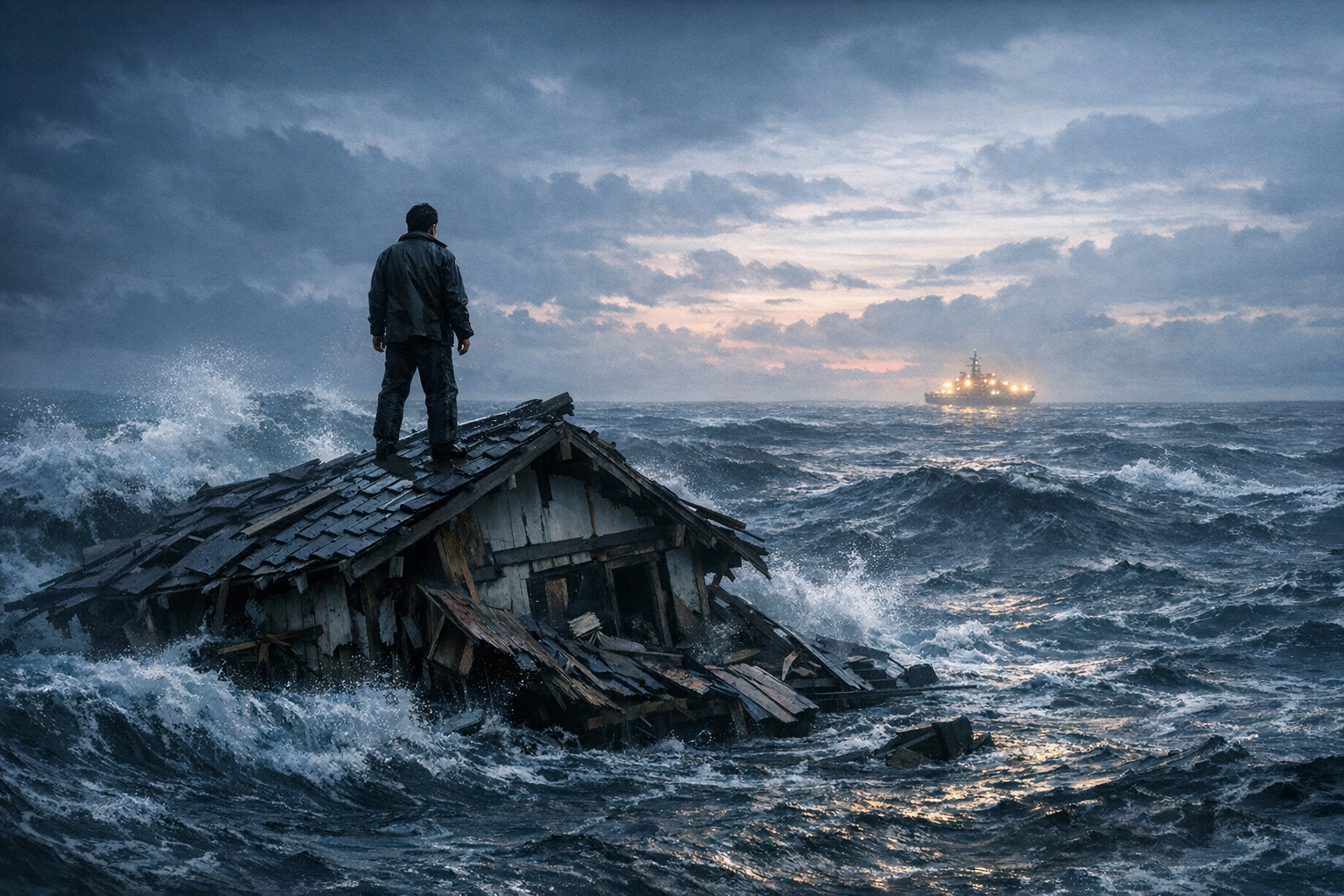
Shinkawa told that part of the story to the Yomiuri Shimbun three months after the tsunami. The first pictures that travelled around the world showed a man on a piece of roof off the Fukushima coast, waving to a Japanese naval vessel. By the time those pictures were taken, he had already tried to reach other passing ships and aircraft. A crew had to recognize a signal among the wreckage for the small boat that finally reached him to be launched.
A return home in Minamisoma
At 2:46 on the afternoon of March 11, 2011, a magnitude 9.0 earthquake struck off northeastern Japan. Three minutes later the Japan Meteorological Agency issued its first tsunami warnings and advisories. It increased them twice in the next hour. Along the Fukushima coast, a gauge at Soma would record water at least 9.3 metres above its normal level. The height at that gauge gives a sense of what reached the coast. The water reached different places at different times.
Shinkawa was sixty and worked for a forestry cooperative. In his June interview he remembered hurrying home from work after the quake. At the house, about a kilometre inland, there was seed rice the agricultural cooperative had just distributed. He put it away in the barn. Looking out from the upstairs balcony, he saw muddy water approaching. His wife called up to him to evacuate. He felt the impact, and they lost each other.
What floated alongside the roof
Shinkawa saw the roof of his house afloat and climbed onto it. He looked for his wife among the debris. He could see so much wreckage on the surface that, he later recalled, it resembled land. He could see no sign of her.
Each time something drifted close to the roof, he had an opportunity to take it or had to withstand the collision. A helmet came within reach. He put it on to protect his head as the wreckage struck. He gathered a floating futon and a blanket against the cold. He also had two bottles of a nutritional drink. In his account to the people who took him aboard, he described trying to ration what he drank.
One of the bottles still had a use when it was empty. The note he wrote on the comic-book page included his own name and the date as well as the information about his wife. He told the Yomiuri that he wanted to leave a record that he had been alive. The record we have of that note comes from the man who wrote it.
Timeline of Events
- Friday, March 11, 2:46 p.m. Japan time. The earthquake strikes. The first tsunami warnings and advisories follow at 2:49 p.m.
- Friday afternoon. Water reaches the Shinkawas’ home in Minamisoma. Shinkawa finds a way onto the floating roof after he and his wife are separated.
- Saturday, March 12. According to his later interview, a comic book and marker drift up to the roof. He writes a message and puts it inside a bottle.
- Sunday, March 13. A Japanese Maritime Self-Defense Force destroyer spots him about 15 kilometres offshore and sends a small boat. A shipboard helicopter later takes him to a hospital.
- June and July 2011. Shinkawa describes the evacuation and his time on the roof, and a relative speaks about his wife’s continuing disappearance.
The lookout beside the bridge
Shinkawa could see aircraft and boats. He told his rescuers that several had passed without seeing him. From his end there was something to wave, a red cloth that the Associated Press described in its account of the rescue. From a distance, a sailor first had to see that someone in the debris was moving.
On Sunday a lookout aboard the destroyer Chokai was using binoculars beside the bridge. The lookout saw a person waving and alerted the crew. The ship sounded its whistle, turned on its searchlights and closed the distance. The sequence comes from the Yomiuri’s account of the Japanese defense ministry’s Joint Staff briefing.
A loudspeaker let the crew reach Shinkawa before they could bring him aboard. They told him they were coming. Then the destroyer lowered a small boat to get alongside the roof. The ship had found him roughly nine miles from shore. That figure measures his position when the crew saw him. No one had tracked the roof from his home out to sea.
A drink after the rescue
On the day of the rescue, CNN relayed a Japanese news agency’s account of a rescuer giving Shinkawa a drink. He swallowed and began to cry. When he spoke to a reporter later, Shinkawa said he remembered the rush of gratitude he felt as he took the water.
Aboard the destroyer he ate rice porridge. A helicopter carried him to a hospital in Soma. The first reports described him as conscious and in good condition. Hospital workers subsequently told the Yomiuri that he had scratches on his face and arms and could walk. After treatment he went to a relative’s house.
What his family could say afterward
In June, Shinkawa was talking to people about leaving immediately after an earthquake. He wished he had left the seed rice where it lay and told his wife they should go straight to the evacuation shelter. It was his own account of that afternoon, given after he had had three months to think about the time it took to put something away.
In July a member of the Minamisoma fire brigade spoke at a national conference about the search on land. Crews had drained a pond to reach submerged vehicles and had worked with police along the shore. As part of his presentation, the speaker showed a newspaper story about the man found on his roof. He knew the family. The woman swept away with Shinkawa was his cousin, he told the conference, and she was still missing.
FAQ
Who was the Japan tsunami drifter rescued on a roof?
Hiromitsu Shinkawa was a sixty-year-old resident of Minamisoma in Fukushima Prefecture. He recognized part of his own house floating in the floodwater and climbed onto it.
How long was Hiromitsu Shinkawa adrift?
He was swept away on Friday afternoon and rescued on Sunday. The Yomiuri’s later interview put the interval at about 43 hours.
How far offshore was the Japan tsunami drifter found?
The defense ministry placed the rescue about 15 kilometres offshore, a little over nine miles. News accounts that say roughly ten miles are rounding the same distance.
How did the crew get him off the roof?
The destroyer Chokai sent a small boat to pick him up. He travelled by helicopter on the next leg of his journey, from the ship to a hospital.
Was Shinkawa’s wife rescued with him?
He was alone on the roof when the crew reached him. At the fire brigade conference in July 2011, her cousin said she remained missing.
Research Sources
The following resources were consulted to verify and update this article.
- ABC News — Tsunami survivor found 15km out to sea
Contemporary reporting of Shinkawa’s return home, offshore rescue by a destroyer and hospital transfer. - CNN — March 13, 2011 news coverage
Contemporary coverage of his two days on a roof fragment, red flag and separation from his wife. - Japan Meteorological Agency — Information on the 2011 Great East Japan Earthquake
Official earthquake timing, tsunami warnings and observed coastal wave heights. - Associated Press, account of the rooftop rescue
Defense Ministry spokesman Yoshiyuki Kotake describes the offshore position and red signal. - The Yomiuri Shimbun, March 2011 rescue report
The lookout’s sighting, small-boat recovery and medical transfer, drawn from the Joint Staff briefing and subsequent reporting. - The Yomiuri Shimbun, June 11 interview with Shinkawa (archived Japanese edition)
Shinkawa recalls the seed rice, the note on the roof and the lesson he wanted to pass on. - Japan Firefighters Association, Minamisoma conference report (PDF, p. 49)
A local brigade member identifies Shinkawa’s wife as his cousin and describes the family’s situation in July 2011.
Related stories
Explore this topic
- Disaster survival stories
- Lost-at-sea accounts
- Survival stories by setting
- Browse all survival stories
Watch Hiromitsu Shinkawa’s Tsunami Survival Story on YouTube
Watch the full story here, or open it on YouTube.