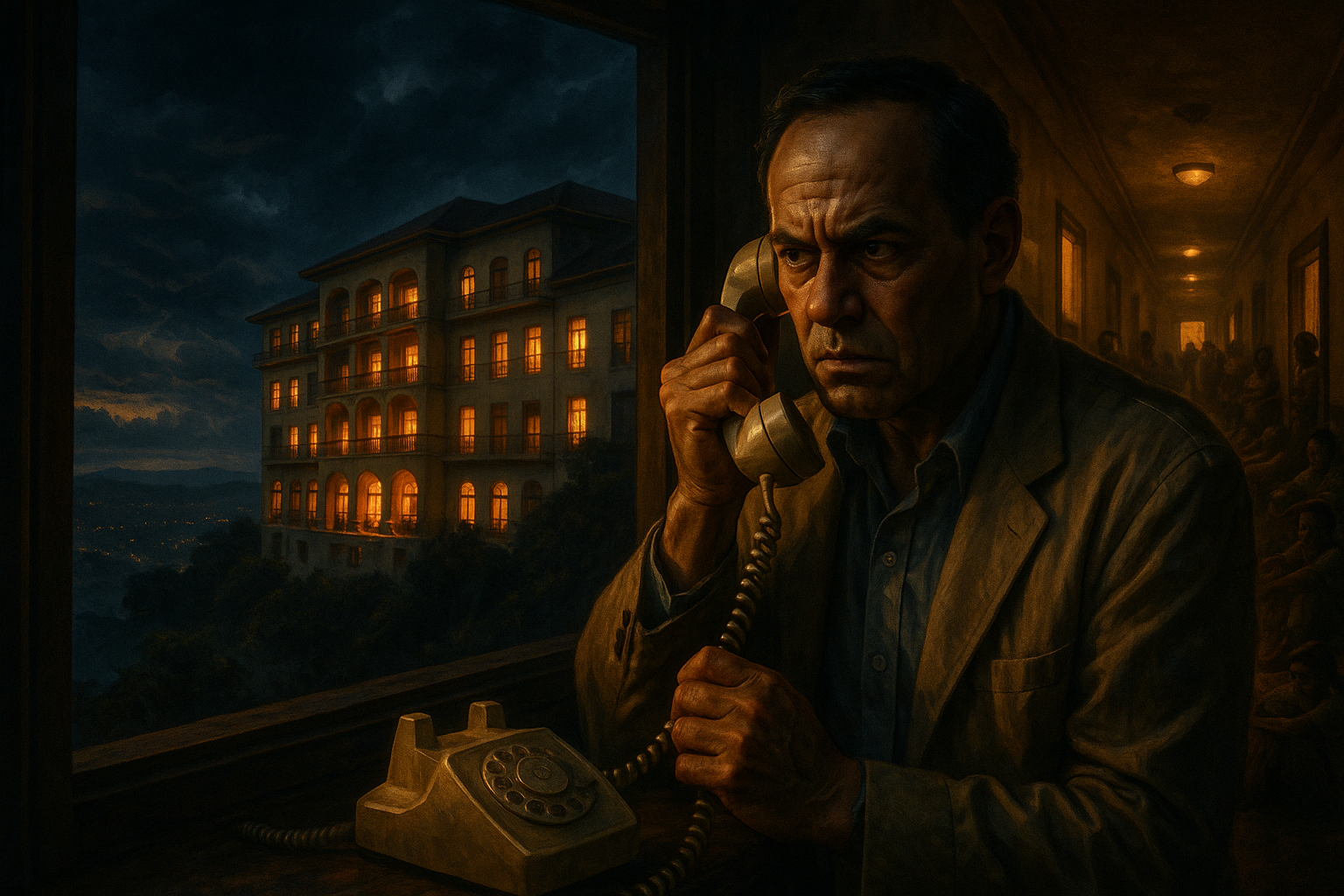
The phone rang into a city that had already decided who was supposed to die.
Outside the Hotel des Mille Collines in Kigali, roadblocks were rising, armed men were spreading through neighborhoods, and families were starting to understand that the old rules had vanished overnight. Inside, people crowded into hallways and rooms built for tourists, not for terror. Some had bags. Some had children. Some had nothing at all except the hope that a hotel door might hold a little longer than a front gate at home.
At the center of it stood Paul Rusesabagina, a hotel manager with no weapon bigger than a telephone, a list of names, and a voice that could stay calm while everything around him came apart.
Paul Rusesabagina’s survival story at the Hotel des Mille Collines matters because it unfolded during the 1994 Rwanda genocide, when more than a thousand frightened civilians tried to stay alive inside one building while the country collapsed around them. What keeps this story alive is not just the scale of the danger, but the suffocating question of how long negotiation, improvisation, and nerve can hold back organized killing.
Stories like this sit beside other impossible acts of endurance, from Reshma Begum’s long wait beneath the rubble to other disasters where survival came down to a few more minutes bought against impossible odds.
The Night Kigali Changed
On April 6, 1994, the plane carrying Rwandan president Juvénal Habyarimana was shot down as it approached Kigali. The explosion did not create the hatred that followed, but it became the spark for a plan that had been waiting. Within hours, roadblocks appeared. Militias moved with purpose. Political moderates were targeted. Tutsi families were hunted. Radio voices helped turn fear into instruction.
For ordinary people in Kigali, the change was immediate and physical. Streets that had been used for errands and work became places where being recognized could get you killed. A wrong name, a wrong identity card, a wrong checkpoint at the wrong hour could end everything. The city did not descend into chaos in the loose sense of the word. It hardened into a system.
That was part of what made the hotel so strange. It still had polished floors. It still had a front desk. It still looked, from the outside, like a place built for routine. But routine had become a performance. The people arriving there were not guests anymore. They were people testing a desperate theory: maybe a known hotel with foreign connections would be harder to wipe out in public than a private home.
They came quickly. Families arrived carrying children, medicines, documents, and sometimes the stunned silence of people who had seen neighbors dragged away hours earlier. Others arrived with almost nothing. A bag dropped in the road. A car abandoned. A home left unlocked because locking it no longer mattered.
By the time the sheltering population swelled, the hotel was no longer a business in any normal sense. It had become a waiting room at the edge of mass murder.
How the Siege Took Shape
Paul Rusesabagina had spent years learning how to manage demands, smooth tempers, and make powerful people feel respected. In ordinary life that meant hospitality. In Kigali in 1994, it meant survival work measured in hours and names.
He was not commanding soldiers. He was dealing with officers, militia figures, officials, and armed men whose moods could shift faster than policy. He called anyone who might answer. He reminded them who knew the hotel. He leaned on reputation, vanity, hierarchy, and the fear of international attention. Sometimes he appears in later accounts almost like a negotiator trapped inside a nightmare version of his own profession, trying to keep death outside by making it inconvenient, embarrassing, or temporarily unwise to bring it in.
The pressure never stayed gone. People inside the hotel knew the walls were not magic. Armed men came close. Threats were made. Names were demanded. Rumors spread that an attack could happen within minutes. Every time a confrontation was delayed, it felt less like a victory than a reprieve.
That is what gives the story its shape. It was not one dramatic rescue scene. It was a siege made of repeated near-failures, each one barely held together.
Timeline of Events
- April 6, 1994: President Habyarimana’s plane is shot down near Kigali, triggering immediate political crisis and violence.
- Within hours: Roadblocks appear, killings begin, and Tutsi civilians along with moderate Hutu become targets.
- Early days of the genocide: People begin fleeing to hotels and compounds they believe might offer some protection, including the Hotel des Mille Collines.
- As the crisis deepens: The number of people sheltering inside the hotel rises into the hundreds and then beyond a thousand by many accounts.
- Throughout the siege: Paul Rusesabagina and others inside the hotel rely on calls, contacts, negotiation, rationing, and visible order to hold off repeated threats.
- April to July 1994: The genocide continues across Rwanda for roughly 100 days, with an estimated 800,000 people killed, mostly Tutsi along with moderate Hutu and others.
- July 1994: As the Rwandan Patriotic Front takes Kigali, the immediate threat around the hotel recedes and those inside emerge alive into a shattered country.
Inside the Hotel, Survival Became a Routine
What happened inside the Mille Collines was not cinematic in the clean, heroic sense people often prefer after history has cooled. It was cramped, anxious, dirty, and repetitive. Water became uncertain. Food had to be stretched. Bathrooms backed up. Parents tried to keep children quiet not because quiet was virtuous, but because noise could draw attention and panic spreads fast in a crowded building.
Adults watched gates and hallways. People slept in clothes, ready to move even though there was nowhere safe to move to. Every engine outside could mean a delivery, an official, or a death squad. Every voice rising in the distance could be argument or execution. Time itself changed in those conditions. A single night could feel like a month. A sunrise could feel like winning something, even if all it really meant was that the killing had been postponed until later.
Rusesabagina’s role was not the only reason people survived there, and the history around his exact actions is debated in places, but the basic shape of the hotel’s endurance is clear: someone had to keep making calls, keep projecting control, keep giving frightened people a structure to stand inside. In a genocidal environment, that structure mattered. Disorder could invite collapse from within just as much as assault from outside.
The hotel also survived because of what it represented. Foreigners had been there. Diplomats knew it. That made it visible. Visibility is not the same thing as safety, but in Kigali that spring, visibility could buy time. Time was the currency everything else depended on.
And time kept being purchased in ugly little increments: one conversation, one intimidation avoided, one commander persuaded to wait, one more day of rations, one more night without the gate being forced open.
What Doesn’t Leave You
The physical survival of the people inside the hotel is only one layer of the story. The harder layer is the scale of what was happening outside. During the genocide, churches became massacre sites. Schools became killing grounds. Entire families disappeared in spans of hours. The people inside the Mille Collines were not watching a distant catastrophe through television. They were listening to it through walls and radio reports while wondering if they would be next.
That is why this story still feels suffocating decades later. The hotel was not an island of peace. It was an island of suspended fate. Even when the doors held, everyone inside knew that the wider country was being torn apart. Survival came tied to helplessness, grief, and the knowledge that thousands of others had found no such shelter at all.
If this kind of ordeal pulls you in, the site’s Survival Stories Archive shows the same brutal pattern in different forms: ordinary settings turning, without warning, into long fights against death.
Key Questions That Still Surround the Story
- How many people were protected there? Most widely repeated accounts place the number at more than a thousand civilians sheltered at the hotel during the worst period.
- Was survival there guaranteed once people got inside? No. The threat remained constant, and safety depended on repeated delays, negotiations, and the hotel’s unusual visibility.
- Why is Paul Rusesabagina’s role sometimes debated? Because stories tied to atrocity, memory, politics, testimony, and later public fame often become contested in details even when the larger survival event is clear.
- What remains beyond debate? In a city where organized killing was underway, the hotel functioned as one of the best-known shelters, and many people inside lived who believed they were about to die.
The End of the 100 Days
As the Rwandan Patriotic Front advanced and ultimately took Kigali in July 1994, the immediate threat around the hotel began to break. But an end to imminent death did not mean a return to normal life. Survivors emerged into a country altered beyond recognition. Streets remained, buildings remained, but families had been erased and trust had been broken at the level of neighbor, classmate, coworker, parishioner.
That aftermath matters because it keeps the story from becoming a neat fable. The Hotel des Mille Collines did not defeat the genocide. It did not undo what happened across Rwanda. What it did was hold a door closed long enough for many people on the wrong side of history’s machinery to stay alive.
In survival stories, readers often want a single moment where everything turns. This one resists that. Its turning point was cumulative. Enough calls answered. Enough threats delayed. Enough armed men deciding not to cross one threshold just yet. It is closer in spirit to the drawn-out dread of the Estonia ferry disaster survivor story or the trapped silence inside Harrison Okene’s sunken-ship ordeal than to a sudden escape. The fear stayed present almost the entire time.
That is also why the story continues to grip people. It asks what survival looks like when courage is not loud, when rescue does not arrive cleanly, and when keeping people alive depends on bureaucracy, persuasion, and exhausted discipline as much as bravery.
FAQ
What happened to Paul Rusesabagina during the Rwanda genocide?
Paul Rusesabagina was the manager of the Hotel des Mille Collines in Kigali and became closely associated with the effort to keep civilians alive there during the 1994 Rwanda genocide. He used calls, contacts, negotiation, and visible order inside the hotel while violence unfolded outside.
How many people were sheltered at the Hotel des Mille Collines?
Accounts commonly state that more than a thousand people were sheltered there during the worst period of the genocide, though exact figures can vary depending on the source and moment being described.
Why is the Hotel Rwanda story still discussed today?
It remains discussed because it sits at the intersection of genocide, survival, moral pressure, international failure, and the complicated question of how much one building and a handful of decisions can matter when a country is being torn apart.
Was the Hotel des Mille Collines actually safe?
Not in any absolute sense. It was safer than many places outside, but people inside lived under repeated threat and had no guarantee the hotel would continue to hold.
🔎 If this story stayed with you, the author suggests these real cases next:
- She survived beneath concrete long after rescuers thought the silence had won
- The doctor trapped under ice until survival should have been impossible
- The man who kept knocking from inside a ship everyone thought was a tomb
- Nine days in the Sahara after a race turned into a vanishing
Explore more Survival Stories here: