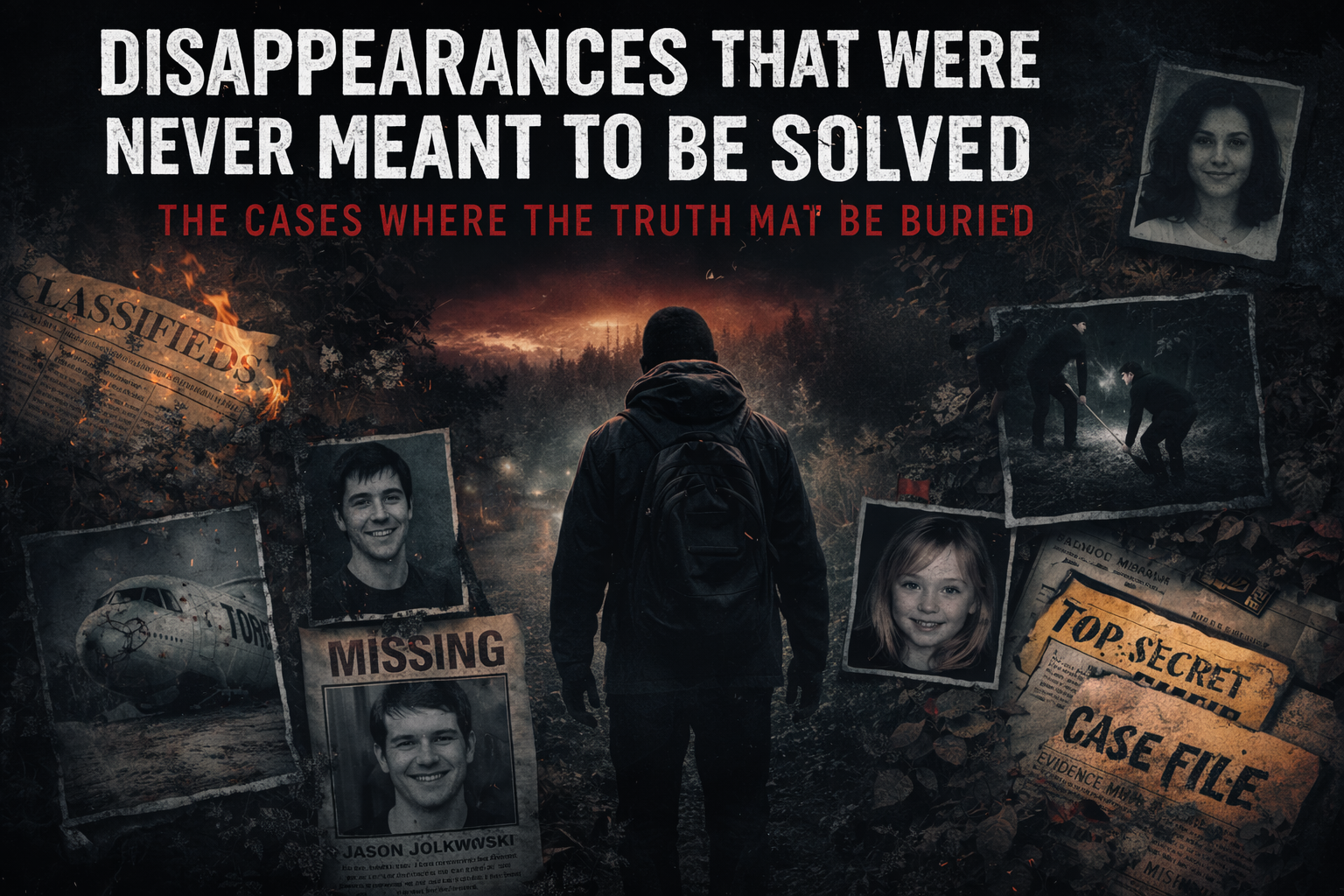
There are disappearances that stay open because the trail goes cold. And then there are disappearances that feel colder than that — cases where the silence seems to arrive too fast, where the evidence breaks in the wrong places, and where the final version of events never quite feels like the whole file.
In stories like these, the missing person is only the first vanishing. After that, a witness changes shape, a timeline develops a hole, a camera catches almost enough, a search turns up less than it should, or a crucial setting swallows the truth so completely that people start wondering whether the case was ever going to close in any ordinary way.
That is what makes these disappearances so hard to leave alone.
Jason Jolkowski’s disappearance is one of the clearest examples: a short walk in daylight, no obvious struggle, no known trail out, and still no answer. It belongs to a category of cases that do not just go unsolved — they seem to resist being solved.
Disappearances that feel built to stay cold
This page gathers some of the most haunting disappearances where obstruction, missing context, dead-end geography, or broken evidence made the truth feel permanently out of reach. If you are drawn to unsolved disappearances where the timeline, the witness story, or the setting itself keeps blocking resolution, these are the cases that readers return to again and again.
Some of these stories hinge on a city in chaos. Some hinge on one blocked frame of surveillance footage. Others hinge on the simple fact that once a person steps into open water, darkness, wilderness, or a gap of just a few minutes, an entire life can vanish behind that gap.
When the last verified moment becomes a locked room
Some cases become legendary because the final confirmed moment feels almost insultingly small. A short walk. A brief stop. A quick return to a room. A short drive after an ordinary errand. The tighter that last window becomes, the less room there should be for a person to disappear. And yet that is exactly what happens.
Sneha Philip vanished on the eve of one of the most chaotic mornings in modern history. Her story has never sat comfortably inside a single explanation, because September 11 did not just destroy buildings. It destroyed certainty. If she died in the attacks, the destruction itself may have erased the final proof. If she did not, then the timing may have hidden a completely different chain of events behind the largest disaster imaginable. That is what makes Sneha Philip’s disappearance so unnerving: almost every route to the truth passes through confusion, missing visibility, and a day that overwhelmed normal investigation.
Jason Jolkowski disappeared in the kind of space most people never fear — the familiar stretch between home and a nearby meeting point. No long highway. No dangerous wilderness. No known enemy waiting in the dark. Just a few minutes in a residential area, and then nothing. The reason his case still haunts people is that the window is so narrow it should have made the mystery easier. Instead, it made the absence feel cleaner, sharper, and somehow worse.
Madeleine McCann vanished from a holiday resort under circumstances so public, so examined, and so argued over that the case almost exists in layers now: the event itself, the investigation, the media storm, the theories, the backlash to the theories, and the years of suspicion spread across different people and different countries. In the Madeleine McCann case, the locked room is not literal. It is investigative. So many eyes turned toward it that clarity should have improved. Instead, the glare sometimes made the outline harder to see.
Cases where the evidence exists — but not in a way that closes anything
Some disappearances survive because investigators have too little. Others survive because they have just enough evidence to keep the case alive without ever letting it resolve. That may be the cruelest kind of mystery: not a blank file, but a file filled with fragments that refuse to line up.
Jennifer Kesse is the perfect example. Her abandoned car was found. Surveillance footage showed a person parking it. And yet the most important visual clue in the case became infamous for the exact reason it should have helped: in frame after frame, the person of interest was obscured at the worst possible moment. It was a case with video, but not an answer. That is why Jennifer Kesse’s disappearance still feels less like a solved image and more like a taunt. The evidence exists. It just stops short of certainty.
Brandon Swanson left behind a different kind of fragment — a live, unfolding moment. He was on the phone with his parents, describing where he thought he was, trying to navigate his way back, until the call suddenly broke with the word that has echoed through the case ever since. In Brandon Swanson’s disappearance, the evidence is not visual but auditory, and that almost makes it more intimate. People do not just study the case. They feel as if they were almost in the dark with him, almost one step behind him, almost close enough to prevent what came next.
Maura Murray left behind one of the most debated post-crash disappearances in modern true mystery culture. A car sits where it should not. A brief interaction happens. Minutes pass. Then the person at the center of it all is simply no longer there. Maura Murray’s case has lasted because the evidence never permits one clean theory to dominate. Accident, planned disappearance, opportunistic harm, misdirection — the road stays open in too many directions at once.
That same pressure runs through the site’s broader archive of disappearance cases where one stubborn detail broke the official timeline. These are the stories that do not collapse because nothing was found. They stay open because what was found keeps misbehaving.
Timeline fractures that keep pulling readers back
One reason these cases become binge-reading material is that they unfold like documentary episodes built around a fracture point. There is always a moment when the ordinary sequence of events stops behaving normally. That break can happen in a parking lot, on a road, inside a resort, at sea, or in the final minutes before someone should have arrived home. Once it appears, readers start trying to walk through it again and again.
Flight MH370 is the largest and most terrifying version of that pattern. A commercial aircraft disappears, an enormous international search begins, and the world is left with data, fragments, signals, arguments, and a void too large to emotionally process. In the disappearance of Flight MH370, the fracture point is not just one person stepping out of sight. It is an entire plane slipping beyond ordinary explanation. The scale of the mystery should make it easier to believe the answer is somewhere in the data. But scale can work the other way too. It can hide the truth inside noise.
Amy Lynn Bradley vanished from a cruise ship, which gives her case a claustrophobic edge that never really loosens. A ship feels contained until a disappearance proves how many blind corners and impossible questions can exist inside a floating world. Did she go overboard? Did someone move her through a closed system full of witnesses who never realized what they saw? Were later reports meaningful or misleading? Amy Lynn Bradley’s disappearance remains powerful because the setting feels finite, while the explanations feel endless.
Readers who keep following this pattern tend to drift toward archives built around the final sequence itself, which is exactly why pages like these disappearance timelines reconstructed minute by minute hold so much tension. They turn mystery into motion. They force the question every great unresolved case creates: at what exact moment did the story stop obeying normal life?
What these disappearances have in common
- A constricted final window: the last known stretch is short enough that the disappearance should be explainable.
- Evidence that points without resolving: a car, a call, a video clip, a travel route, or a sighting survives, but not in a way that settles the case.
- A setting that helps the mystery: chaos, open water, wilderness, a public resort, or a roadside gap all create different kinds of investigative blindness.
- A theory problem: more than one explanation remains plausible enough to survive, which keeps the file permanently unstable.
- An emotional afterimage: each case leaves behind one unforgettable image — the blocked face on camera, the empty road, the open ocean, the silent call, the vast search area, the missing child in a holiday room.
The pattern investigators keep running into
Investigators can solve extraordinary cases when the chain holds. Witnesses hold. Time stamps hold. Search areas hold. The story does not need to be simple; it just needs to stay connected. These disappearances break that chain in specific ways.
Sometimes the problem is contamination by chaos, as with a case tied to an event so massive it reshaped the evidence landscape. Sometimes the problem is that the last sighting is too ordinary to trigger alarm soon enough. Sometimes the problem is that a camera captures the right person at exactly the wrong angle. Sometimes geography wins, whether it is ocean, roadside darkness, or a landscape large enough to turn minutes into miles of uncertainty.
That is why readers who finish one of these cases often move naturally into disappearances defined by the last witness, ride, call, or companion or into cases where the vehicle stayed behind but the person did not. Those pages do not just collect similar stories. They reveal the recurring pressure points where real investigations begin to fail.
Why these stories never really let go
People return to these disappearances because they attack a basic assumption about the world: that if something big enough happens, reality will leave a readable mark behind. But sometimes it does not. Sometimes the mark is incomplete. Sometimes it is contradictory. Sometimes it is lost in a crowd, erased by weather, blurred by technology, or swallowed by a setting that gives nothing back.
And once a case reaches that state, it becomes more than an open investigation. It becomes a permanent argument between evidence and absence. Every later article, documentary, forum thread, witness memory, and new theory is really an attempt to cross the same broken bridge.
If that is the kind of mystery that keeps you reading long after midnight, the strongest next stop is The Unsolved Disappearances Archive, where the patterns widen and the contradictions get even harder to ignore.
FAQ
Why do some disappearances feel like they were never meant to be solved?
Usually because the case develops a structural barrier early on. That can mean chaos at the scene, conflicting witness accounts, a missing timeline segment, weak physical evidence, or geography that destroys the trail before investigators can fully lock it down.
Which disappearance cases are most often described as impossible to solve?
Readers often point to cases like Sneha Philip, Jennifer Kesse, Jason Jolkowski, Brandon Swanson, Maura Murray, Amy Lynn Bradley, Madeleine McCann, and Flight MH370 because each one contains a final gap that has never been cleanly bridged.
Do these cases stay unsolved because there is no evidence?
Not always. Some of the most haunting disappearances have evidence, but it is incomplete, contradictory, or frustratingly indirect. A partial clue can keep a case alive for years without bringing it any closer to closure.
Why do disappearance timelines matter so much?
The timeline is where the mystery usually breaks. Once investigators know the last verified movements, they can see where normal life stopped and uncertainty began. In these cases, that break is exactly what never gets fully repaired.
Why do people binge-read disappearance archives like this one?
Because the cases echo each other in unsettling ways. One story leads naturally to another: a final phone call, an abandoned vehicle, a blocked surveillance image, a witness who saw too little, or a place that seems to have swallowed the truth whole.
🔎 If this mystery pulled you in, the author suggests these related real cases next:
- Start with the wider disappearance archive where the timelines refuse to close
- Follow the cases where one piece of evidence changed the entire theory
- Enter the abandoned-car disappearances where the person vanished but the vehicle stayed
- Read the final-witness cases where one last conversation never stopped haunting the file
- Go deeper into the minute-by-minute timelines that still break in the same place
Explore more Disappearances stories here: