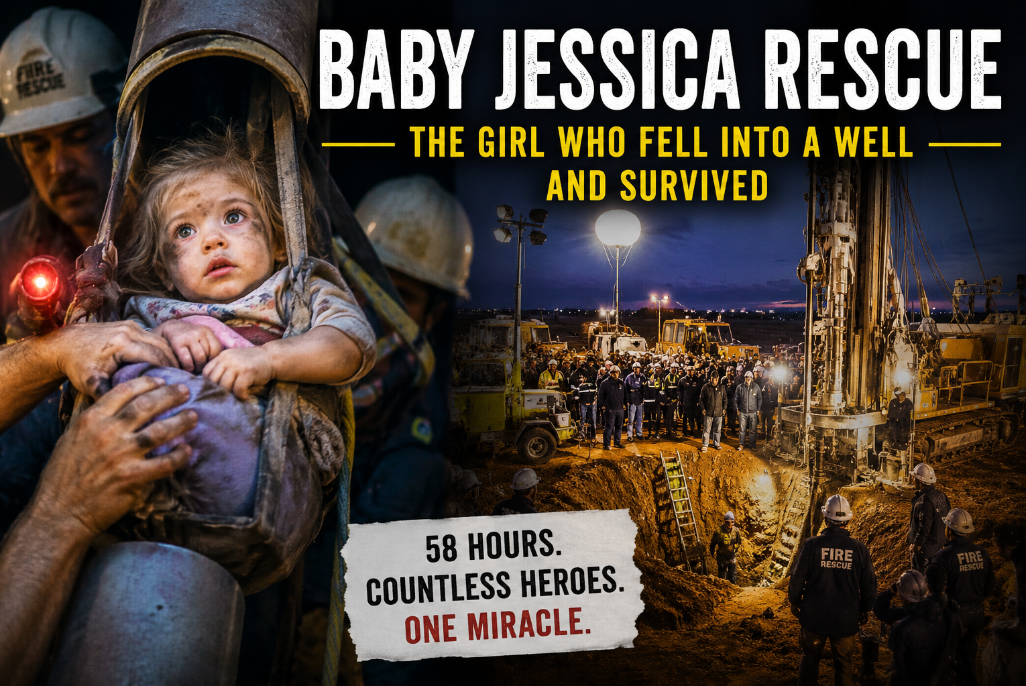
A narrow opening in a Midland backyard became the center of a rescue watched far beyond Texas. Jessica McClure was alive below the surface, and the challenge was to reach her.
The retained video presents an earlier narration. The written account uses the dated research below.
The Baby Jessica rescue began on October 14, 1987, when 18-month-old Jessica McClure fell into an abandoned well in Midland, Texas. What followed was a 58-hour rescue that turned a small backyard emergency into one of the most watched survival stories in American history.
It belongs beside the most impossible trapped-alive rescues because everything about it seemed designed to defeat the people trying to save her. If this kind of story grips you, the wider archive of buried-alive survival stories where rescuers heard signs of life shows just how often hope begins with something small: a sound, a movement, a faint answer from the dark.
The Fall No One Could Reach
Jessica was playing outside at her aunt’s home when she slipped into a narrow well pipe. It was not a wide opening where a firefighter could climb down. It was a tight vertical shaft, the kind of forgotten hazard that seems harmless until one impossible second changes everything.
She became trapped about 22 feet below the surface. The narrow shaft prevented a rescuer from simply climbing down beside her. Reaching a child so close beneath the yard required a different route.
That was the first horror of the Baby Jessica rescue. She was not lost somewhere far away. She was directly under them. Every decision had to happen above a child who was alive, frightened, injured, and unreachable.
Why the Rescue Was So Dangerous
The well was too narrow for a straightforward descent. Rescuers instead drilled a nearby shaft and made a connecting passage toward Jessica. Hard ground made the work slow.
So the plan became more complicated: dig a second shaft nearby, then tunnel sideways toward her. That sounds simple until you picture it in real time. Crews drilled through hard ground to make the parallel shaft and a connecting passage. The work was measured in inches, and every inch mattered.
Firefighters, oil-field workers, engineers, miners, paramedics, doctors, and volunteers became part of one improvised machine. The task required people with different skills to work together. It was a problem being solved in public, under lights, while the clock kept moving.
The Backyard Became a National Vigil
As local crews worked, television cameras arrived. Then more came. The story spread because it had the simplest possible stakes: a little girl was underground, and nobody knew whether the next hour would save her or break everyone watching.
Across the country, people followed updates from living rooms, offices, diners, and hospital waiting rooms. The rescue site became a strange mix of machinery and prayer. There were drills, cables, microphones, medical teams, and reporters. There were also people standing nearby with nothing to offer except silence, hope, and the need to be present while strangers fought for a child’s life.
The intensity came from the waiting. A disaster that lasts seconds is terrifying, but a rescue that stretches across days becomes something else. It forces everyone to live inside uncertainty. Every report that Jessica was still responding gave people another reason to hope. Every delay made the well feel deeper.
The 58 Hours Underground
For Jessica, the world had shrunk to darkness, pressure, pain, and voices from above. For rescuers, the world narrowed to calculations: how far to drill, where to cut, how to keep oxygen moving, how to get medical help ready, and how to reach her without making the final moments more dangerous.
The work did not stop when the cameras needed a new angle or when exhaustion set in. Crews drilled the parallel shaft, fought through hard ground, and began the horizontal tunnel that would become the only route to her. The connecting tunnel was another stage of the effort.
That is why the story still lands decades later. It was not just that Jessica survived. It was that survival depended on a whole community refusing to accept the obvious answer: that the pipe was too narrow, the earth too stubborn, the child too far beyond reach.
Timeline of the Baby Jessica Rescue
- October 14, 1987: Jessica McClure fell into the abandoned well pipe in Midland, Texas, while playing outside.
- Early response: Emergency crews realized she could not be safely pulled straight up through the narrow opening.
- Rescue plan formed: Workers began drilling a parallel shaft so rescuers could reach her from the side.
- National attention grew: News coverage turned the rescue into a live national vigil as crews worked through the day and night.
- The connecting tunnel: Rescuers made a horizontal passage between the new shaft and Jessica’s well.
- October 16, 1987: After about 58 hours, Jessica was brought out alive.
What Made the Rescue So Difficult
The Baby Jessica rescue was not hard because crews lacked will. It was hard because every practical option came with danger.
- The well was extremely narrow. A rescuer could not simply descend and bring her up.
- The depth increased the risk. More than 20 feet of earth separated Jessica from the people trying to save her.
- The ground resisted drilling. Crews had to make a route through hard material beside the original well.
- Medical pressure was constant. Jessica needed oxygen, warmth, and rapid care once she was reached.
- The connecting passage mattered. Drilling the parallel shaft was not enough; rescuers also had to reach the original well.
That combination made the rescue feel almost impossible. It also explains why the outcome became so powerful. The victory was not one dramatic move. It was hundreds of careful choices made while nobody could guarantee they would be enough.
The Moment She Came Out Alive
When rescuers finally reached Jessica, the rescue shifted from engineering problem to human moment. The tunnel, the drilling, the sleepless calculations, and the television coverage all narrowed down to one fragile transfer from darkness into waiting arms.
When she emerged alive, the relief was enormous because the country had spent nearly three days preparing itself for any ending. People who had never met Jessica cried because the story had reduced everything to a truth anyone could understand: a child had been trapped, and strangers had refused to stop reaching for her.
She still had a long recovery ahead. Survival did not erase the injuries or the trauma of what happened underground. But the fact that she lived turned the rescue into a rare public memory where fear, skill, exhaustion, and hope all met at the same point.
Why This Rescue Still Gets Remembered
Some survival stories fade because they are tied to one news cycle. The Baby Jessica rescue lasted because it felt like a national campfire story told in real time. People watched technology, instinct, and community effort combine around one small life.
It also changed the emotional language of televised rescue coverage. Viewers were not watching a finished documentary. They were waiting without knowing the ending. That uncertainty made every update feel personal.
Modern rescue stories still echo it. When crews dig through rubble after earthquakes, listen for tapping under debris, or tunnel toward trapped survivors, the same terrible equation returns: how do you move fast enough to save someone without moving so fast that the rescue itself becomes the danger?
That same tension runs through stories like the archive story The Knock Under the Ruins and another story about listening for survivors beneath rubble. The details change. The feeling does not. Somewhere below the surface, someone is still there, and the people above have to decide they are not leaving.
What Happened Afterward
Jessica McClure survived, recovered, and grew up outside the frozen image many people still carry from 1987. That matters. Famous survival stories can trap people in the moment the public first met them, but Jessica’s life continued beyond the well, beyond the cameras, and beyond the nickname “Baby Jessica.”
The rescue also left a lasting mark on the rescuers and the community. Some became known for their role in the operation. Others returned to ordinary life after doing something extraordinary under impossible pressure. The well itself became less important than what happened around it: neighbors, specialists, and strangers forming a rescue system because a child needed them to.
That is the quiet power of the story. It is not only about a fall. It is about the decision to keep working when the problem looks too narrow, too deep, and too late.
FAQ
What happened to Baby Jessica?
Baby Jessica, whose name is Jessica McClure, fell into an abandoned well in Midland, Texas, in October 1987. She was trapped more than 20 feet underground until rescuers reached her through a parallel shaft and tunnel.
Did Baby Jessica survive?
Yes. Jessica McClure survived the well rescue after about 58 hours underground. She needed medical treatment afterward, but the rescue succeeded and became one of America’s most remembered survival stories.
How long was Baby Jessica trapped in the well?
She was trapped for about 58 hours. The long timeline is part of why the case became so unforgettable: the country watched as crews worked day and night to reach her safely.
How did rescuers reach Baby Jessica?
Rescuers drilled a shaft beside the well and then dug horizontally toward her. They could not simply pull her up through the original pipe because it was too narrow and dangerous.
Why does the Baby Jessica rescue still matter?
It remains powerful because it showed a community solving an almost impossible rescue in real time. The story still represents patience, technical skill, and the refusal to give up on someone trapped in the dark.
Research Sources
The following resources were consulted to verify and update this article.
- HISTORY: Baby Jessica rescued from a well
Dates, rescue method and the medical recovery after the ordeal. - ABC News: Baby Jessica, twenty years later
Later reporting on the drilling effort and Jessica’s recollections. - ABC News: Fame lingers for Baby Jessica
Interview-based reporting on the rescue’s public attention and later life.