
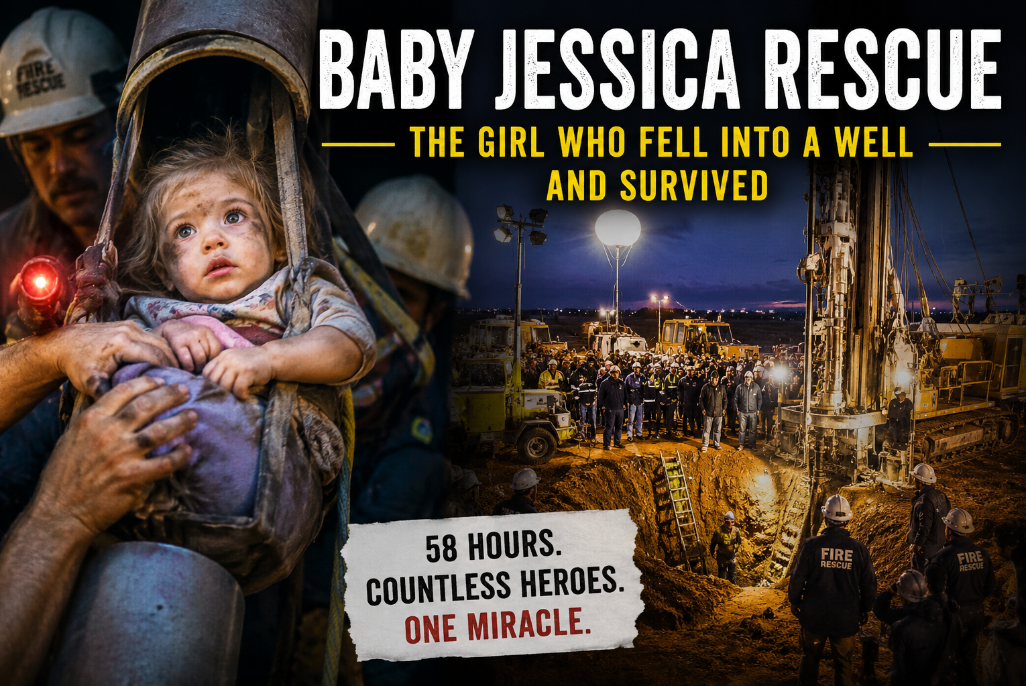
On an ordinary afternoon in West Texas, an 18-month-old girl disappeared from sight in a matter of seconds.
One moment she was playing outside while adults talked nearby. The next, she had slipped into a narrow well pipe barely wider than a dinner plate. She fell more than 20 feet underground, becoming trapped in complete darkness where almost nobody believed a rescue would be possible.
For the next 58 hours, firefighters, engineers, oil drillers, miners, doctors, and volunteers refused to give up. Millions of people stopped what they were doing to watch the rescue unfold live on television.
Against nearly impossible odds, the little girl survived.
Her name was Jessica McClure.
Today, most people simply remember her as Baby Jessica.
Who was Baby Jessica?
Baby Jessica was 18-month-old Jessica McClure, who fell 22 feet into an abandoned well in Midland, Texas, on October 14, 1987. After a dramatic rescue lasting about 58 hours, emergency crews successfully pulled her to safety. The rescue became one of the most watched live news events in American history and changed how rescuers prepare for similar emergencies.
The Afternoon That Changed Everything
October 14, 1987, started like many other days.
Jessica McClure lived with her family in Midland, Texas, where her mother worked at a local daycare. The daycare sat beside a small yard where children often played while adults talked nearby.
That afternoon, Jessica wandered toward an old water well.
The well had once been drilled years earlier but was no longer being used. Most of it had been covered, but one narrow pipe remained open. It measured only about eight inches across.
That was barely enough room for a toddler.
Nobody noticed the danger until it was too late.
Jessica stepped onto the opening.
In an instant, she disappeared.
There was no time for anyone to grab her.
She plunged more than 20 feet down the narrow shaft before becoming wedged tightly underground.
At first, the adults couldn’t even understand what had happened.
Then they heard crying.
The sound was coming from deep inside the earth.
Someone immediately called 911.
A Rescue Unlike Anything They Had Seen
Firefighters arrived within minutes.
Their first thought was simple.
Lower someone into the well.
That idea disappeared almost immediately.
The pipe was far too narrow.
Even the smallest rescue worker could not fit.
They tried lowering ropes.
Too narrow.
They considered special hooks.
No room.
They thought about pulling Jessica straight up.
But nobody could safely reach her.
The little girl was trapped beyond human reach.
Rescuers lowered microphones into the pipe to listen.
Sometimes they heard crying.
Sometimes singing.
Sometimes nothing at all.
Every silence made everyone above ground wonder whether she was still alive.
Racing Against Time
Doctors quickly realized Jessica faced several serious dangers.
She had fallen hard enough to suffer broken bones.
She was trapped upside down for long periods.
She had almost no room to move.
The underground temperature stayed cool, but dehydration, shock, and lack of circulation could quickly become life-threatening.
Nobody knew how badly she had been injured.
Nobody could even see her clearly.
Yet every minute mattered.
Emergency crews began discussing a completely different approach.
Instead of going down the well…
…they would dig beside it.
It sounded simple.
It wasn’t.
Digging Through Solid Rock
West Texas soil isn’t soft.
Just beneath the surface lay hard rock that ordinary digging equipment could barely penetrate.
Construction crews brought heavy drilling machines.
Oil companies offered equipment.
Mining experts arrived.
Engineers studied maps.
Everyone searched for the safest plan.
The rescue team decided to drill a second shaft running parallel to the well.
Once that shaft reached Jessica’s depth, workers would dig sideways through the rock until they reached the trapped toddler.
It was an enormous gamble.
The drilling could take many hours.
Too much vibration could shift the original well.
Too little progress could cost precious time.
Still, it was the best chance they had.
Soon the quiet daycare yard had transformed into one of the busiest rescue scenes America had ever seen.
Bulldozers.
Drilling rigs.
Generators.
Floodlights.
Ambulances.
Police officers.
Doctors.
Volunteers.
Everyone had one goal.
Bring Jessica home.
The Whole Country Started Watching
As news spread, television crews arrived from across Texas.
Then from across the country.
Within hours, satellite trucks lined the streets.
National television networks interrupted regular programming.
Millions of Americans watched live updates throughout the day.
Schools rolled televisions into classrooms.
Offices kept the news running.
Restaurants left their TVs on.
People prayed together in churches.
Others gathered around radios hoping for good news.
The rescue had become far more than a local emergency.
It had become America’s rescue mission.
Nobody wanted to hear the story end in tragedy.
Hope Underground
One encouraging sign kept everyone going.
Jessica continued making sounds.
Workers sometimes heard her crying.
At other times she softly sang children’s songs to herself.
Those tiny sounds echoed through the narrow pipe and reminded rescuers that she was still fighting.
Every cry renewed their determination.
Whenever the sounds stopped, anxiety spread across the rescue site.
Doctors explained that periods of silence did not necessarily mean the worst.
She could simply be exhausted.
Still, every quiet moment felt unbearably long.
Above ground, rescuers pushed themselves harder.
Nobody wanted to lose a race against time.
Drilling Against the Clock
By the second day, exhaustion had become the rescue team’s biggest enemy.
The drilling machines had been running almost nonstop, but progress was painfully slow.
The rock beneath Midland was much harder than anyone had expected.
Drill bits wore out.
Equipment overheated.
Crews had to stop repeatedly to replace damaged parts before continuing.
Every delay felt unbearable.
Above ground, Jessica’s family waited only a few yards away.
They could do nothing except hope.
Emergency workers tried not to think about how long the little girl had already been trapped. Instead, they focused on the next few feet of rock that still stood between Jessica and the rescue shaft.
The Tunnel No Machine Could Dig
Eventually, the rescue shaft reached approximately the same depth as Jessica.
Now came the hardest part.
No drilling machine could safely finish the job.
The final stretch had to be dug by hand.
Rescuers climbed into the newly drilled shaft carrying only basic tools.
Working in an area barely large enough for one person, they began carefully chipping sideways through solid rock.
Every strike had to be controlled.
Too much force might collapse part of the well.
Too little force meant losing precious time.
Dust filled the cramped space.
The temperature rose.
Workers had almost no room to stand.
Teams rotated in and out as fatigue set in.
Each rescuer spent only a limited time underground before another took over.
Nobody complained.
Everyone wanted another chance to help save the little girl.
They Finally Saw Her
Late on the second night, rescuers made their first breakthrough.
A small opening appeared between the rescue tunnel and the original well.
For the first time since Jessica had fallen, someone could actually see her.
The sight was heartbreaking.
Jessica was tightly wedged inside the narrow casing.
One leg was bent awkwardly beneath her.
Her forehead was bruised.
Her hair was matted with dirt.
She barely had room to move.
Yet she was still alive.
Rescuers quietly called up to the surface.
“We’ve got eyes on her.”
The words brought a wave of relief.
After nearly two and a half days, they finally knew exactly where she was.
Now they just had to get her out.
A Rescue Measured in Inches
Seeing Jessica did not make the rescue easy.
It made it more delicate.
There was almost no space between her body and the wall of the well.
Rescuers carefully chipped away pieces of rock around the pipe.
Every inch created just a little more room.
One wrong movement could injure Jessica or trap her even more tightly.
The team worked slowly.
Sometimes only a few inches of progress came after an hour of effort.
Doctors remained above ground, ready to guide the rescuers if Jessica showed signs of distress.
Microphones carried voices between the tunnel and the command post.
The entire operation depended on patience.
Nobody wanted speed anymore.
They wanted precision.
The Man Who Reached Her
Among the rescuers working underground was Midland firefighter Robert O’Donnell.
Like everyone else, he understood that the rescue had become incredibly dangerous.
The tunnel was cramped.
Loose rock surrounded them.
There was always the possibility of another collapse.
Still, he climbed into the narrow opening.
Working beside the well, O’Donnell carefully reached toward Jessica.
She was stuck more firmly than anyone had hoped.
He gently tried to free one arm.
Then a shoulder.
Then her clothing.
Every movement had to be done by feel because there was almost no room to maneuver.
The rescue took minutes that felt like hours.
Finally, Jessica shifted.
Just enough.
O’Donnell wrapped an arm around the toddler.
Then, inch by inch, he eased her free from the well that had held her captive for nearly 58 hours.
Cheers Erupted Across the Rescue Site
At 8:55 p.m. on October 16, rescuers lifted Jessica into the open air.
For a brief second, there was silence.
Then the entire rescue scene exploded with applause.
Firefighters hugged each other.
Police officers cheered.
Volunteers cried openly.
Some rescuers simply sat down, overwhelmed by emotion.
Jessica was immediately rushed to waiting paramedics.
Although dirty, bruised, and badly injured, she was alive.
Against every expectation, the impossible had happened.
The little girl who had disappeared into an eight-inch-wide well had come home.
A Long Road to Recovery
Jessica was flown to a hospital where doctors quickly discovered the extent of her injuries.
She had suffered severe damage to her right foot.
Her forehead was badly cut.
The lack of circulation during the long rescue had injured parts of one leg.
Over the following days, surgeons performed several operations to repair the damage.
In time, Jessica also lost one toe because the tissue could not be saved.
For most people, surviving the fall alone would have been remarkable.
Recovering from it seemed almost unbelievable.
Yet Jessica continued to improve.
Week after week, she grew stronger.
Eventually, she was able to return home with her family.
The little girl millions had prayed for was finally back where she belonged.
America Celebrated Together
The rescue came at a time when live television was bringing major events directly into people’s homes like never before.
Millions had watched every update.
Many felt as though they knew Jessica personally.
When the rescue succeeded, celebrations broke out across the country.
Newspapers devoted front pages to the story.
Television networks replayed the dramatic rescue for days.
Letters, toys, cards, and donations poured in from around the world.
For a few days, Americans who disagreed on almost everything else found themselves united by one small child and the people who refused to stop digging.
It became one of those rare moments that people remembered exactly where they were when they heard the good news.
Life After the Rescue
For Jessica McClure and her family, life was never quite the same again.
For months after the rescue, the little girl continued receiving medical care and physical therapy. Despite her injuries, she recovered remarkably well. As she grew older, she was able to walk, run, and live a largely normal life.
Unlike many children who become famous overnight, Jessica’s parents tried to give her as ordinary a childhood as possible.
That wasn’t always easy.
People recognized her name everywhere.
Reporters remained interested in her life for years.
Still, her family worked hard to keep her out of the spotlight whenever they could.
As an adult, Jessica has occasionally spoken about the rescue but has generally chosen a private life in Midland, Texas—the same community that fought so hard to save her.
The Rescuers Never Forgot
While Jessica recovered physically, many rescuers carried emotional memories of those 58 hours for the rest of their lives.
For firefighters, police officers, engineers, and volunteers, it had been one of the most intense operations they would ever experience.
Some described it as the proudest moment of their careers.
Others admitted the pressure stayed with them long after the television cameras left.
Among the most recognized rescuers was firefighter Robert O’Donnell, whose role in reaching Jessica made him a national hero.
Like many first responders, however, the emotional toll of emergency work continued long after the headlines faded.
His story later became a reminder that rescuers sometimes carry invisible wounds, even after successful missions.
The Baby Jessica rescue was remembered not only because a little girl survived, but because hundreds of ordinary people refused to give up.
How the Rescue Changed Emergency Response
The operation highlighted challenges that many emergency agencies had never faced before.
Rescuers learned valuable lessons about:
- Coordinating large multi-agency rescue efforts.
- Using engineers and technical specialists early in complex incidents.
- Managing live media coverage without disrupting emergency operations.
- Planning confined-space rescues with specialized equipment.
- Providing medical support throughout lengthy rescue missions.
In the years that followed, many departments expanded training for confined-space rescues and improved communication between emergency responders, engineers, and technical experts.
While no two rescues are ever identical, many professionals point to Baby Jessica’s rescue as one of the events that helped shape modern rescue planning.
Why America Couldn’t Stop Watching
The rescue happened at exactly the right—and wrong—moment in television history.
By 1987, satellite technology allowed networks to broadcast live from almost anywhere.
Instead of reading about the rescue the next morning, millions of people experienced it as it happened.
Every update felt personal.
Every delay created new tension.
Every encouraging sign gave viewers hope.
There was no script.
No one knew how the story would end.
It wasn’t just a news event.
It became a shared national experience.
For nearly three days, Americans laughed, cried, prayed, and waited together.
Few rescue stories before—or since—have captured that level of attention.
Timeline of the Baby Jessica Rescue
October 14, 1987 – Around 9:30 a.m.
Jessica McClure falls approximately 22 feet into an abandoned eight-inch-wide well in Midland, Texas.
Minutes later
Firefighters, police officers, and paramedics arrive. Early rescue attempts fail because the well is too narrow.
October 14–15
Engineers develop a plan to drill a parallel shaft and tunnel sideways toward Jessica.
Throughout October 15
Heavy drilling equipment works around the clock through solid rock while millions watch live television coverage.
October 16
Rescuers complete the rescue shaft and begin digging the final tunnel by hand.
October 16 – 8:55 p.m.
After approximately 58 hours underground, Jessica McClure is safely pulled from the well.
Following days
Jessica undergoes multiple surgeries and begins a long recovery.
Why the Story Still Matters
Many dramatic rescues eventually fade from memory.
This one never did.
Perhaps it was because the victim was so young.
Perhaps it was because the odds seemed impossible.
Or perhaps it was because the rescue showed what could happen when hundreds of strangers worked toward a single goal without giving up.
Nobody involved knew whether the operation would succeed.
Equipment failed.
Plans changed.
Hours turned into days.
Still, every person at the scene kept working.
The story remains one of the clearest examples of determination, teamwork, and hope overcoming overwhelming circumstances.
Nearly four decades later, people still remember one simple phrase that appeared across newspapers and television screens around the world:
Baby Jessica is alive.
Frequently Asked Questions
How old was Baby Jessica when she fell into the well?
Jessica McClure was 18 months old when she fell into the abandoned well on October 14, 1987.
How deep did Baby Jessica fall?
She fell about 22 feet (6.7 meters) before becoming trapped inside the narrow well casing.
How long was Baby Jessica trapped?
Jessica remained underground for approximately 58 hours before rescuers pulled her to safety.
Where did the rescue happen?
The rescue took place in Midland, Texas, at a daycare where Jessica had been playing.
Did Baby Jessica survive?
Yes. Despite serious injuries and multiple surgeries, Jessica survived and recovered.
What injuries did she suffer?
She suffered cuts, fractures, and severe damage to one foot due to the fall and the prolonged time trapped underground. Doctors later amputated one toe because the tissue could not be saved.
Is Jessica McClure still alive today?
Yes. Jessica McClure has lived a largely private life in Midland, Texas, away from the public spotlight.
Final Thoughts
The Baby Jessica rescue is remembered not because disaster struck, but because hope won.
An accident that lasted only a few seconds became one of the greatest rescue efforts in modern American history. Firefighters, engineers, doctors, oil workers, volunteers, and ordinary neighbors worked together with one shared purpose: to save a little girl they had never met.
For nearly 58 hours, they refused to accept that the task was impossible.
Their determination saved Jessica’s life—and gave the world a story that continues to inspire generations.
Sometimes the most unforgettable stories are not about how someone fell.
They’re about how countless people came together to lift them back up.
Baby Jessica Rescue Video