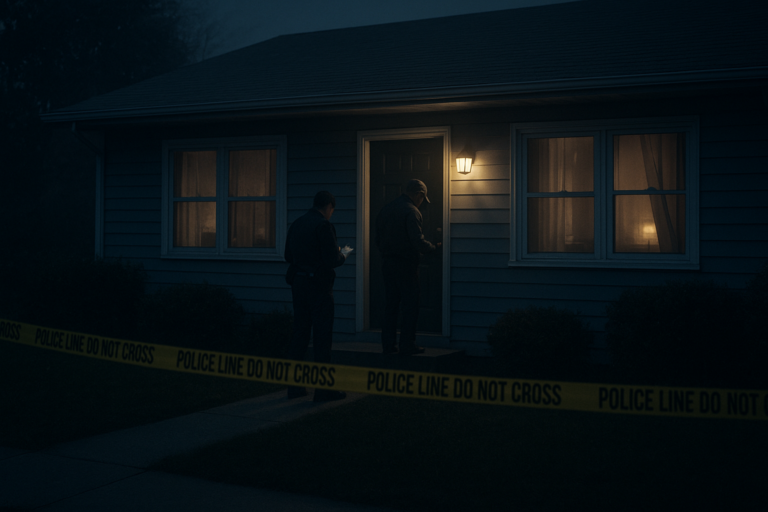
For decades, the crimes known as the East Area Rapist and Original Night Stalker cases had evidence but no defendant. DNA eventually connected attacks in different parts of California. It did not immediately supply a name. The breakthrough came when investigators used genetic relationships to build a path from an unknown profile to Joseph James DeAngelo.
Editorial note: The written article below has been fact-checked and updated. The retained audio or video may reflect an earlier version.
A Case Spread Across California
The offender acquired several names as investigators worked crimes in different places: the Visalia Ransacker, East Area Rapist, Original Night Stalker and, later, Golden State Killer. DeAngelo’s eventual admissions encompassed crimes committed while he was a police officer and crimes committed after he was fired from the Auburn Police Department in 1979.
The history was not a simple progression from nonfatal attacks to murder in Southern California. His admitted murders included Claude Snelling in 1975 and Katie and Brian Maggiore in 1978, before the later Southern California killings. That chronology matters when describing the geographical spread of the investigation.
Years could change the available tools without changing the source of the evidence. A preserved biological sample remained a connection to the offender even when investigators could not yet identify him. By 2001, DNA had connected the northern rape series with the southern murders. A connection between cases, however, was still short of a connection to a named person.
Why Genetic Genealogy Changed the Search
Conventional DNA comparison can test a known person’s sample against crime-scene evidence or search a database. Investigative genetic genealogy adds another route: identifying genetic relatives and reconstructing family relationships to develop leads. It does not mean that every relative is a suspect, or that a family-tree match is itself proof of guilt.
In this investigation, researchers narrowed possible identities using family relationships, age, location and other characteristics. After focusing on DeAngelo, investigators obtained discarded DNA and compared it with the crime evidence. The genealogical lead required that separate confirmation.
The distinction is the heart of the breakthrough. A family tree could suggest where to look. Investigators still needed evidence connecting the individual to the crimes. The case was not solved by one magical database result or a literal single strand of DNA.
Timeline of the Hunt
- 1975: Claude Snelling is killed, a murder DeAngelo later admits.
- 1976 onward: The East Area Rapist series terrorizes the Sacramento area.
- 2001: DNA links the northern and southern crime series.
- April 2018: Genetic genealogy and subsequent DNA confirmation lead to DeAngelo’s arrest.
- June 29, 2020: He pleads guilty to thirteen murders and thirteen kidnappings to commit robbery.
- August 21, 2020: He is sentenced to multiple life terms without parole.
The Admissions and the Sentence
The plea also required DeAngelo to admit numerous uncharged offenses. Some crimes could no longer be prosecuted because of limitation periods; their inclusion gave survivors an opportunity to hear responsibility acknowledged in court. The charged kidnapping offenses were kidnappings to commit robbery, not thirteen additional murder charges.
The sentencing record distinguishes the number of convictions from the arrangement of prison terms: eleven consecutive life-without-parole terms for the thirteen murders, an additional consecutive life term for the kidnappings, and eight years for weapon enhancements. A shorter description—multiple life terms without parole—is accurate. Counting every conviction as a separate consecutive life term would not be.
Survivors and relatives addressed the court before sentencing. Their statements made clear that the case had never been only an identification puzzle. Its solution established who was responsible; it could not restore the lives taken or undo the harm to those who survived.
That is why the Golden State Killer investigation remains consequential. It shows the value of preserving evidence and revisiting a stalled inquiry with new methods. It also shows why a technological breakthrough must be followed through to individual confirmation and a legal outcome.
FAQ
Who was the Golden State Killer?
Joseph James DeAngelo, who pleaded guilty in 2020 to thirteen murders and thirteen kidnappings to commit robbery.
Did a genealogy match alone prove his guilt?
No. Family-tree research developed the lead; investigators subsequently obtained his DNA for confirmation.
What sentence did he receive?
Multiple life terms without the possibility of parole, imposed in August 2020.
Research Sources
The following resources were consulted to verify and update this article.
- Tulare County DA: joint plea announcement — Exact guilty-plea counts, admitted early murders, policing history and additional offenses.
- ABC News: case chronology — Genetic genealogy, discarded-DNA confirmation, later proceedings and survivor statements.
- Tulare County DA: joint sentencing announcement — Completed August 21, 2020 sentence and distinction between convictions and consecutive terms.
- FBI Law Enforcement Bulletin, June 2002: Serial Rapist/Killer — Contemporaneous law-enforcement notice explicitly dates the northern/southern DNA linkage to 2001 (printed page 25).
- Guerrini and colleagues, PLOS Biology (2018) — Peer-reviewed explanation of genetic-relative matching, family-tree reconstruction and subsequent direct DNA confirmation in this investigation.
🔎 Related Investigation:
If this case pulled you deeper into the mystery, continue into:
🔎 If this story stayed with you, the author suggests these real cases next:Explore more Solved Cases stories here: View all Solved Cases stories →
- Other murders where family-tree DNA dragged the truth out of the dark
- The cold cases that waited decades for genetic genealogy to finally speak
- The Iowa Christmas murder that stayed frozen in time until a family tree broke it open
- The double murder investigated through genetic genealogy
- The serial killer who thought he was still in control until a floppy disk betrayed him
Watch This Story on YouTube
Prefer to watch? See the full story on our YouTube channel.