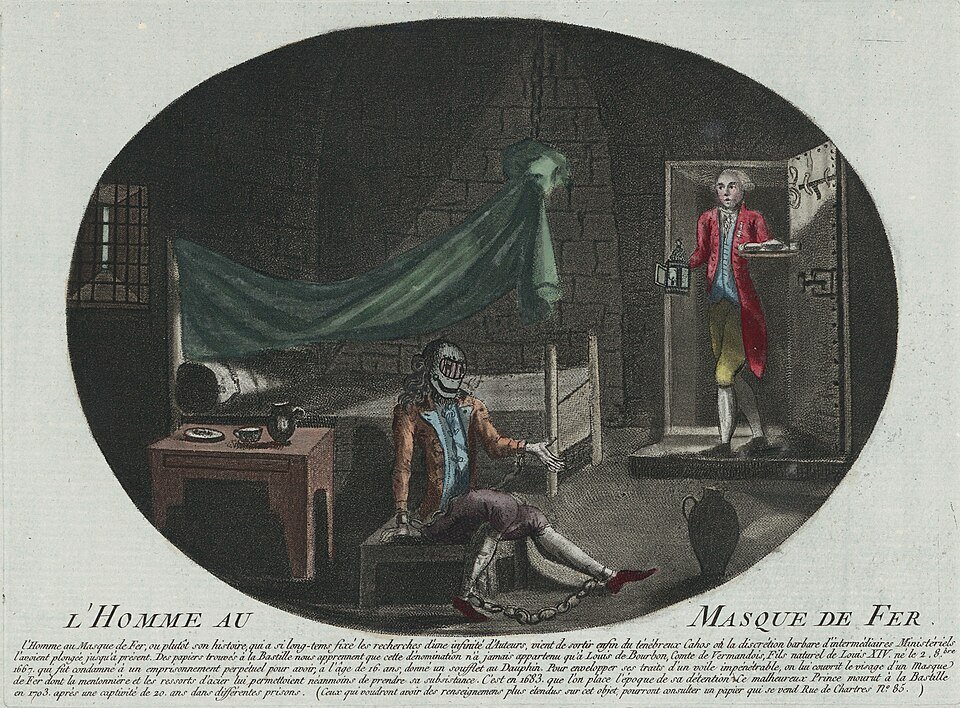
An anonymous 1789 print depicting the Man in the Iron Mask. Historical artwork, not an authenticated likeness; the print’s proposed identification is unproven. Image credit: Anonymous artist / Library of Congress, ppmsca.07185. Public domain.
A masked prisoner spent decades in custody under Saint-Mars. His confinement is documented, but the reasons for it remain disputed. He died in the Bastille in 1703.
The Man in the Iron Mask remains one of history’s most famous unsolved identity mysteries because the imprisonment was real, the secrecy was documented, and yet the one fact people wanted most was never settled: who was the prisoner Louis XIV kept hidden for more than three decades? The case still matters because it sits in that uneasy space between archive and legend, where just enough evidence survives to make the silence feel deliberate.
That feeling is part of what links this case to other identity-driven historical mysteries like the Somerton Man, another case in which identification and the surviving evidence must be considered separately.
A Prisoner Delivered Under Orders No One Was Supposed to Forget
In 1669, Louis XIV’s minister, the Marquis de Louvois, sent instructions to Bénigne Dauvergne de Saint-Mars, the governor of the prison at Pignerol. A prisoner would be arriving under the name Eustache Dauger. Saint-Mars was told to prepare a cell with unusual precautions. He was to see the man personally. He was to limit contact. And if the prisoner spoke about anything except his immediate needs, he was to be killed.
That is where the real chill of this story begins. Not with the later novels. Not with the iron mask in popular culture. With paperwork. With a government letter calm enough to sound routine and severe enough to tell you this was not an ordinary inmate. Even in a kingdom built on rank, secrecy, and gossip, this prisoner required an extra layer of silence.
The name Eustache Dauger appears in the correspondence. Establishing his earlier life and the reason for the exceptional precautions is a separate problem from reading the name in a document.
Timeline of the Captivity
- 1669: A prisoner identified in state correspondence as Eustache Dauger is arrested and sent to Pignerol under strict secrecy orders.
- 1669–1681: He remains under the supervision of Saint-Mars at Pignerol, where his existence is treated as unusually sensitive.
- 1681: Saint-Mars is transferred to Exilles, and the prisoner goes with him.
- 1687: The prisoner is moved again when Saint-Mars takes charge on Île Sainte-Marguerite.
- 1698: Saint-Mars becomes governor of the Bastille and brings the same prisoner to Paris.
- 1703: The prisoner dies in the Bastille and is buried under the name “Marchioly” or a similar variation.
The succession of prisons ties the case to Saint-Mars’s career. It also provides a way to test proposed identities against the chronology.
The Mask and the Later Legend
The phrase “iron mask” is so famous that it feels inseparable from the story, but the historical record is murkier than the legend. Many historians believe the prisoner more likely wore a black velvet mask in key moments, especially during transfers, and that the image of literal iron hardened over time as rumor and retelling took over.
The covering does not by itself establish royal ancestry or explain why the prisoner was detained.
What Doesn’t Add Up About the Identity Theories
Over the centuries, the Man in the Iron Mask has been identified as almost everyone powerful, inconvenient, or symbolically irresistible enough to fit the myth. But most theories collapse when they hit the same hard wall: the surviving timeline.
- The twin brother of Louis XIV: Dumas made the twin-brother story famous in fiction. But historians have found no solid evidence that the king had a secret twin hidden from the world.
- Nicolas Fouquet: He was certainly a high-profile prisoner under Saint-Mars, but the dates do not work cleanly. Fouquet’s imprisonment is separately documented, and he is known to have died before the Bastille ending tied to the masked prisoner.
- Ercole Antonio Mattioli: Mattioli was a historical candidate. Later archival research has challenged that identification; the burial-name resemblance is not sufficient proof.
- Eustache Dauger: Dauger appears in the original state correspondence and is a leading identification. His occupation and the reason for his confinement remain debated.
The names in a theory must fit the records, rather than the dramatic expectations created by the legend.
Why Historians Keep Coming Back to Eustache Dauger
Historian Paul Sonnino identifies the prisoner as Dauger and argues that he had served in the household of Mazarin’s treasurer. That reconstruction is Sonnino’s explanation of the records. The museum presents the broader identity question as unresolved.
Why This Story Still Pulls People Back In
The Man in the Iron Mask still gets attention because the mystery taps into several fears at once: the fear of being erased by power, the fear that official records can hide as much as they reveal, and the fear that history sometimes preserves the shell of a story while destroying the name inside it.
There is also something uniquely haunting about how long the imprisonment lasted. A sudden disappearance is terrifying in one way. A decades-long disappearance in plain custody is different. It means the man remained alive inside the system while his identity was slowly reduced to rumor. He was not lost in the wilderness or at sea. He was held by a government that knew exactly where he was and refused to say who he was.
That is what makes the case feel close to stories like the Lost Colony of Roanoke, the Green Children of Woolpit, the Pollock Twins, and Dyatlov Pass. Each has generated its own mixture of records, interpretations and later storytelling.
Strip away the powdered wigs and fortress walls, and the core question remains painfully modern: what happens when a state decides secrecy matters more than a person?
FAQ
Who was the Man in the Iron Mask?
Dauger is the leading archival identification in the research discussed here. His earlier life and the reason for imprisonment remain debated; Mattioli and a royal twin belong to the history of competing theories.
Was the mask really made of iron?
Probably not in the way popular culture imagines it. Many historians believe the prisoner was more likely forced to wear a black velvet mask during transfers, and that the iron version grew larger through rumor and retelling.
Why was the Man in the Iron Mask imprisoned?
The reason remains uncertain. Secrecy orders establish restrictions on the prisoner’s communication, rather than proving any particular scandal or crime.
Is the Man in the Iron Mask mystery solved?
Not fully. Some historians think the most plausible answer is already in the records, but the evidence still leaves enough gaps that the mystery remains open in the public imagination.
Why does this case still get so much attention?
Because it combines real state secrecy, a missing identity, and a legend that grew directly out of documented history. It feels less like a rumor invented from nothing and more like a silence someone worked very hard to protect.
Research Sources
The following resources were consulted to verify and update this article.
- City of Cannes, Musée du Masque de fer et du Fort Royal — The Man in the Iron Mask: museum displays
The captivity, transfers and uncertain mask material. - Sarah Madry; Cahiers du dix-septième — The Valet: Louvois’s Invited Guest (2016)
Reproduces the 1669 instructions and examines archival identity evidence. - UC Santa Barbara; Jim Logan interviews Paul Sonnino — Mystery Unmasked (2016)
A historian’s case for Dauger and the limits of identifying his background.
Related stories
- The Somerton Man and the evidence for Carl Webb
- What John White found at Roanoke
- The Green Children of Woolpit in medieval chronicles
- The Pollock twins and their family’s account
Explore this topic
Video update note: This retained video predates the research update and may contain earlier wording. The article and Research Sources provide the updated account.
Watch This Story on YouTube
Prefer to watch? See the full story on our YouTube channel.