On the morning of January 15, 2009, New York was the color of steel.
The sky was low, the river looked black, and the wind slid through jacket seams like a blade. People hurried across sidewalks with their heads down, coffee cups in one hand and phones in the other, moving through an ordinary Thursday that felt no different from any other. At LaGuardia Airport, the loudspeaker clicked and hummed, boarding calls came and went, and Flight 1549 to Charlotte prepared to leave Gate C15.
Inside that plane were 150 passengers, three flight attendants, and two pilots. Some were business travelers already answering emails before takeoff. Some were heading home. A few were first-time flyers still watching every movement out the window, treating each step of departure as something slightly magical. The crew had done this routine thousands of times. Push back. Taxi. Takeoff. Climb. Turn south. Settle into cruise.
At 3:24 p.m., Airbus A320 N106US began its roll down the runway. The engines roared, the city blurred, and the aircraft lifted into cold winter air. For about ninety seconds, everything was exactly what it should have been. Then, at around 2,800 feet, the world in front of the cockpit turned into a violent storm of feathers.
A flock of Canada geese, large and heavy, exploded across the windshield and into both engines. The sound was not a bang. Survivors later described it as a series of deep thuds, like giant rocks hitting metal at highway speed. Then came the smell, a hot, sickening odor of burned birds and fuel. In the cabin, conversations stopped mid-sentence. The lights flickered. The engine noise, that steady mechanical promise that everything was working, fell away into something hollow.
Captain Chesley Sullenberger and First Officer Jeffrey Skiles had almost no time to think. Skiles started emergency procedures immediately, flipping through restart steps with practiced speed. Sullenberger flew the aircraft, scanning gauges that were telling a terrible story: both engines had lost thrust. They were now a glider over one of the most crowded cities in the world.
Air traffic control offered Runway 13 back at LaGuardia. Then Teterboro in New Jersey. The options came in quick bursts over radio, each one sounding possible for a second until math, altitude, and distance stripped away hope. The plane was descending too fast. There was no margin for a failed turn, no room for one mistake. Sullenberger made the decision that would define the flight in one short call: they were going to the Hudson.
In the cabin, flight attendants moved with a kind of controlled urgency that looked calm from a distance and felt terrifying up close. “Brace! Brace! Heads down! Stay down!” they shouted, over and over, as people tried to understand what they were hearing. A forced landing in a river wasn’t something most passengers had ever imagined as a real event. It belonged in movies, not in the narrow seat row where your laptop bag was still under your feet.
One passenger looked out and saw buildings sliding by too low, too close. Another said the silence was the worst part, because without the engines you could hear people breathing, hear someone crying two rows back, hear a tray table rattle against its latch. Time bent. The descent lasted only minutes, but for people inside it felt suspended, stretched into a slow-motion corridor where every second carried the weight of a final second.
At 3:31 p.m., the plane struck the Hudson River.
The impact was brutal but controlled, a flat, hard slam that tore through the fuselage and sent a wall of water racing against the body of the aircraft. Overhead bins burst open. People were thrown forward even in brace position. Then the plane kept moving, skimming and slowing, carving white spray across dark water. It didn’t break apart. It stayed afloat.
That fact alone, in those first moments, was the difference between disaster and possibility.
Within seconds, freezing river water began entering the cabin. Passengers fumbled with seatbelts numbed by shock. Some tried to grab bags and were screamed at to leave everything. Others couldn’t stand in the slanting aisle and crawled. The water in January was near freezing, cold enough to steal breath and muscle control in minutes. People stumbled onto the wings where wind cut straight through thin business clothes.
The rear of the cabin was taking on water faster, and passengers there faced a terrifying bottleneck as they pushed toward exits. One woman had to be pulled free by strangers after being pinned in the crowd. A man who could not swim made it out anyway, dragged by others who refused to leave him. This was not a perfect evacuation. It was chaotic, messy, frightening, and full of small acts of courage no camera could fully capture.
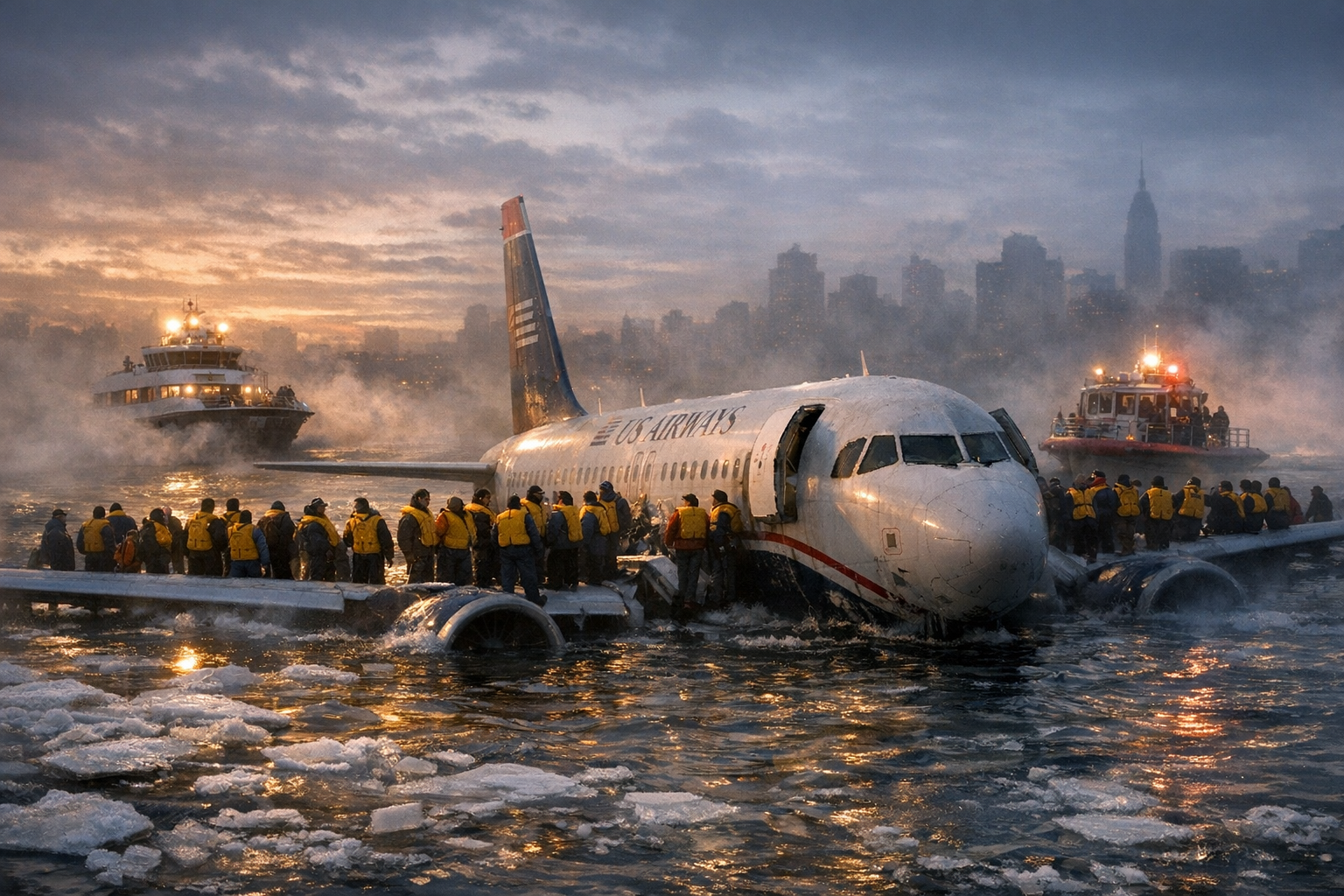
On the left wing, people stood shoulder to shoulder, shoes submerged, clinging to one another as the aircraft settled lower. On the right wing, the angle was steeper, and several slid toward the water before being hauled back. Flight attendants moved through the cabin one last time, checking rows, shouting for anyone still inside. Captain Sullenberger did his own final walk-through, looking into the flooding interior to make sure nobody remained.
Outside, New York reacted fast.
Ferry captains on the Hudson saw the plane come down and turned toward it immediately, throttles up, cutting wakes through icy water. Commuter boats, tour boats, tugboats, and emergency crews converged from all directions. On shore, people stopped in disbelief, staring as an airliner sat in the river with people standing on its wings like tiny dark figures against the winter haze.
The first ferries reached the plane within minutes, but rescue was still dangerous. Large boats had to maneuver close enough for people to jump or be pulled aboard without crushing them against hulls. Crew members threw ladders and life rings, grabbed wrists, coats, backpacks, anything they could hold. Passengers, shivering uncontrollably, were lifted over rails and laid on deck. Some were too cold to speak. Some cried. Some just stared ahead, unable to process that they were alive.
By the time all 155 people were accounted for, the temperature had done damage. Many were treated for hypothermia, cuts, and bruises. But there was no mass-casualty count, no list of the dead scrolling across the bottom of a screen. Against impossible odds, everyone had survived.
Investigators later reconstructed every second. The National Transportation Safety Board confirmed what the crew had faced: a dual engine failure at low altitude, one of the most difficult emergencies in commercial aviation. Simulations showed that returning to LaGuardia might have been physically possible only under unrealistically perfect conditions with no human delay. Real pilots in real time needed seconds to recognize the emergency, communicate, and act. Those seconds were the difference. The river, risky as it was, became the only runway left.
In the days that followed, the story took on a nickname the world still remembers: the Miracle on the Hudson. The word miracle made sense emotionally, because survival felt almost supernatural. But inside that miracle were layers of preparation and professionalism. Skiles had the discipline to run checklists under extreme pressure. Sullenberger had decades of flying experience, including glider training, that sharpened his judgment in powerless flight. The cabin crew did exactly what training demanded while people screamed around them. Ferry workers became first responders without waiting for orders.
And then there were the passengers, ordinary people who became part of an extraordinary chain. They helped strangers. They held onto one another on freezing metal. They listened when every instinct told them to panic. In disasters, survival often depends on collective behavior as much as individual skill, and Flight 1549 showed that in plain, human terms.
Even now, years later, survivor accounts still carry the same emotional shape. First came disbelief. Then fear so total it narrowed the world to immediate action: brace, breathe, move, help. Then came the shaking aftermath, the deep body tremor that arrives when adrenaline drains away and reality finally catches up. People returned home that night to apartments, families, and routines that had seemed guaranteed that morning and suddenly looked fragile.
Some kept in touch, bonded by minutes they could never fully explain to anyone who wasn’t there. Others avoided talking about it for years. A few said they developed a new relationship with time itself, less willing to waste it, more aware that ordinary days are not owed to anyone.
The aircraft was eventually lifted from the river by cranes, scarred and waterlogged, its final position no longer on the Hudson but in history. Photos of the floating jet became iconic, but the image only tells part of the story. What it cannot show is the cockpit decision made under crushing uncertainty, the shouted commands in narrow aisles, the frozen fingers reaching from boat decks, or the quiet moment later when survivors sat wrapped in blankets and realized the story had ended differently than expected.
If you look closely at that day, the most haunting part is not just how close everyone came to dying. It is how thin the line was between catastrophe and rescue, and how many people, in separate places, crossed that line together in exactly the right way.
A winter sky. A river like black glass. A jet with no engines and nowhere to go.
Three minutes after takeoff, it should have become one of the worst crashes in American aviation.
Instead, it became a survival story told in the language of seconds, training, chance, and stubborn human will.
And somewhere in the noise of headlines and history, there remains one simple truth that still feels almost impossible: one hundred and fifty-five souls stepped onto that plane, and one hundred and fifty-five came back.