For long stretches of the last known night of Bryce Laspisa’s life, nothing looked dramatic from the outside. His SUV was not mangled in a ditch yet. No search helicopters were in the air. No one was standing on a lakeside road staring at an empty vehicle and trying to understand how a person could vanish so completely. There was only a nineteen-year-old somewhere on the long spine of California, a phone that kept ringing, and parents who could feel that something had gone wrong before they had any proof they were already in the middle of a missing-person case.
The Bryce Laspisa disappearance still holds people because it did not begin with a clean break. It began with delay, distance, and a drive home that stretched into something psychologically strange. What should have been an ordinary trip from Northern California to Laguna Niguel ended near Castaic Lake on August 30, 2013, when Bryce’s wrecked Toyota Highlander was found without him inside.
That lingering sense of a person slipping away in slow motion is part of why Bryce’s case keeps getting compared with other vehicle mysteries where the car is found but the explanation never arrives. If that angle pulls you deeper, this archive of found-vehicle disappearances traces the same kind of silence left behind on roadsides, embankments, and empty parking areas.
Before Bryce vanished, he was a Sierra College student who had recently gone through a breakup and whose behavior, according to later reporting, had started to worry people around him. Friends said his mood had changed, and there were reports that he had given away personal belongings. None of that, on its own, explains what happened next. But it changes the atmosphere of the story. It means the mystery did not begin at the crash.
On August 28, 2013, Bryce left the Chico area and started south toward his parents’ home in Orange County. The drive was long, but not extraordinary. Thousands of students make versions of it all the time: a highway run home, a late-night arrival, maybe a tired voice on the phone saying they are a few hours out. What turned Bryce’s trip into one of the most unsettling disappearance timelines in the country is how badly time stopped behaving. He kept moving, but not in a way that made emotional sense. Hours passed. His progress barely seemed to match the clock. And the people trying to reach him kept hearing some variation of the same answer: he was fine.
Timeline of the Final Drive
- August 28: Bryce leaves Northern California and begins the drive south after a turbulent stretch in his personal life.
- August 29: Concern grows as he remains in the Buttonwillow area far longer than expected. He reportedly runs out of gas and receives roadside assistance.
- Later that day: Even after getting help, he stays near the same location for hours. His mother asks for another welfare check. A deputy also makes contact and reportedly finds no obvious sign of impairment or immediate danger.
- 2:08 a.m., August 30: Bryce calls his mother and says he is too tired to keep driving and plans to rest before continuing home.
- Early morning, August 30: His 2003 Toyota Highlander is found crashed near Castaic Lake, but Bryce is gone.
That timeline is not just unusual. It is unnerving because it creates the feeling that multiple chances existed to stop the story before it reached its most frightening point. Bryce was not instantly unreachable. He was still answering calls. He was still being physically seen by other people. He was still, in theory, on his way home. Yet the whole drive has the quality of a person drifting inside some private storm while everyone around him keeps trying to interpret the situation using the language of ordinary travel problems.
Buttonwillow sits in the flat, exposed geography of the Central Valley, the kind of place where highway stops, truck traffic, and long empty stretches blur together. It is not inherently mysterious. But in Bryce’s story, it became the setting for one of the most baffling pauses in any disappearance case. He had help available. He had contact with family. He had a working vehicle after receiving gas. He was not hidden. And still he seemed stuck there for hour after hour, as if the act of driving home had become emotionally impossible even while he kept saying he intended to do exactly that.
This is where the case becomes more than a missing-person report. A parent on the phone hears a familiar voice and clings to it. A roadside worker sees a young man who may seem strange or exhausted but is still upright and talking. A deputy checks in and does not find a visible emergency large enough to force the story in another direction. People were close enough to Bryce to feel hope, but not close enough to understand what he was actually experiencing.
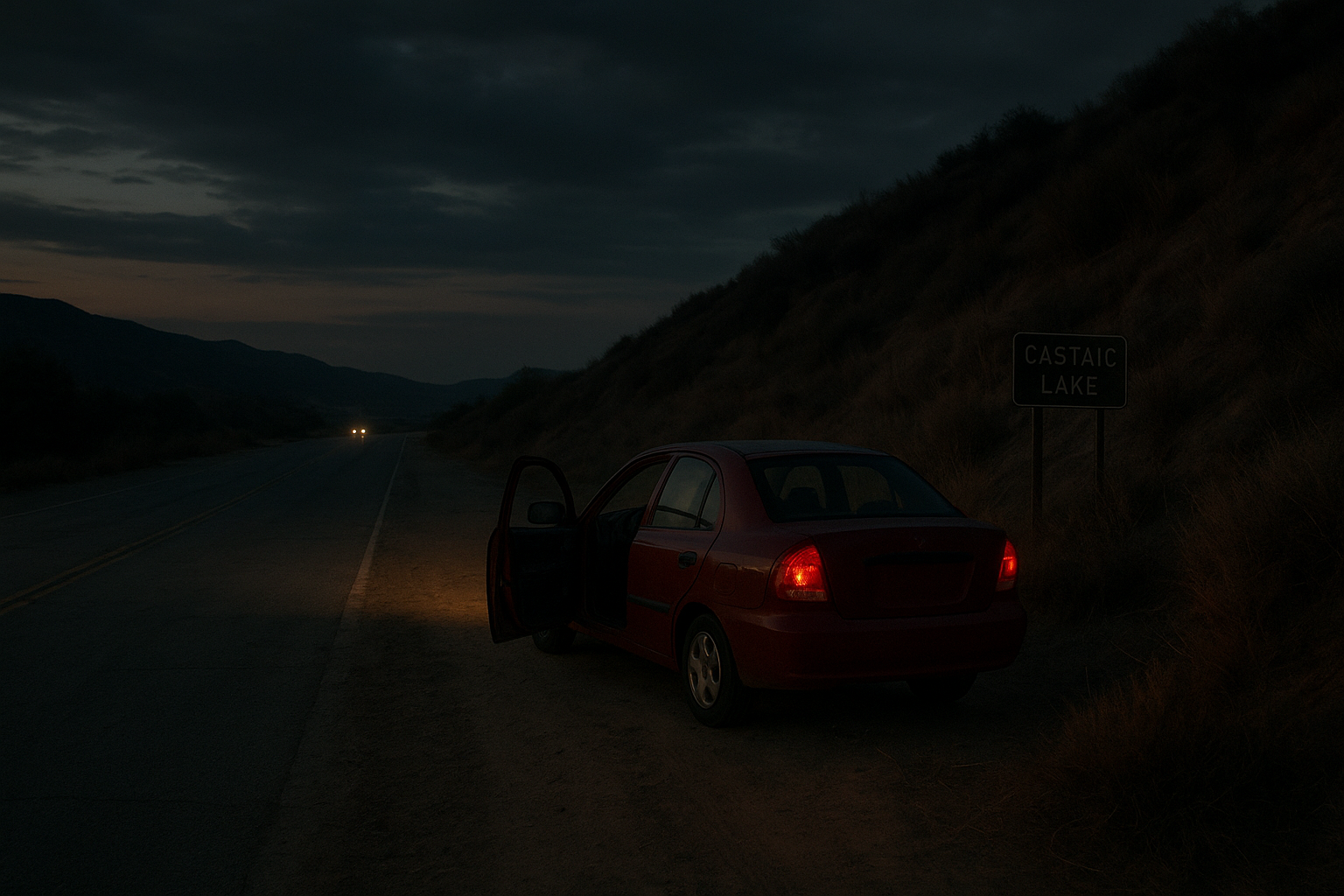
Then, sometime after Bryce said he would rest, the story lurched forward. His parents heard a knock at the door and briefly believed their son had finally made it home. Instead, they learned that his SUV had been discovered near Castaic Lake. The vehicle had gone off the road and down an embankment, but Bryce was not in it.
Inside the SUV were the details that make the case feel so wrong: his phone, wallet, and laptop were still there. Blood was found, but not enough to clearly suggest a fatal injury at the scene. Investigators reportedly believed he got out through the rear of the vehicle after the crash. Searchers combed the surrounding area, but the hills, brush, roads, and lake edges around Castaic can hide a person faster than they appear to.
What Doesn’t Add Up
- The length of the drive: A trip that should have ended hours earlier turned into a drawn-out, almost stalled progression that still feels hard to explain.
- The Buttonwillow delay: Bryce remained in roughly the same area long after getting help, even though his stated goal was to get home.
- The repeated reassurance: He kept telling people he was fine, even as his behavior made that harder and harder to believe.
- The empty crash site: The SUV was found, but not the driver, despite a major search effort.
- The belongings left behind: Phone, wallet, and laptop remaining in the vehicle make every theory feel incomplete.
Those contradictions are why the dominant theories all seem to solve one piece of the puzzle while failing another. One possibility is that Bryce was in the middle of a mental health crisis or severe emotional breakdown. That idea fits the strange pauses, the unsettling conversations, and the way the drive lost its normal logic. It could also explain why, after the crash, he might have wandered away disoriented and been swallowed by the terrain. But even that theory leaves open the brutal question that has kept the case alive for so long: after all the searches, why has no clear physical answer surfaced?
Another theory centers on substance use or exhaustion amplifying whatever emotional state he was already in. Public discussion of the case often returns to reports involving stimulant use, alcohol, sleep deprivation, and erratic behavior. That framework can explain the psychologically jagged feel of the timeline. But it still does not tell us what happened after the wreck. Temporary impairment might help explain the road to Castaic. It does not automatically explain the years of silence that followed.
Then there is the theory that Bryce deliberately disappeared. People who believe this point to the belongings he gave away before the drive, the emotional strain in his life, and the possibility that the crash created a dramatic boundary between one identity and another. But that theory also runs into problems. Deliberate disappearances usually require some kind of preparation, some retained access to money, communication, or a next step. Leaving behind a phone, wallet, and laptop makes an intentional vanishing look less like a plan and more like a break in reality.
Foul play remains part of the public conversation because it always enters the gap when evidence grows thin. If Bryce encountered someone after the crash, that could explain why he was never found nearby. Yet there has never been public proof strong enough to make that theory feel solid.
Why This Case Still Gets Attention
Some disappearances are remembered for one shocking final image. Bryce Laspisa’s case is remembered for the long, uneasy stretch before that image: the hours that should not have taken so long, the repeated claims that he was fine, and the feeling that a young man was slipping away while still technically within reach. That is also why Bryce’s story connects so naturally to other disappearances where the final timeline still refuses to close.
More than a decade later, Bryce Laspisa remains missing. His family still lives with the worst kind of uncertainty: no confirmed death, no confirmed survival, and no definitive clue that closes the distance between that final drive and the wreck near Castaic Lake. It feels less like a single disappearance than a drawn-out fade — strange calls, lost hours, a crash, then silence.
FAQ
What happened to Bryce Laspisa?
Bryce Laspisa disappeared in the early hours of August 30, 2013, after an unusually long and troubling drive through California. His Toyota Highlander was found crashed near Castaic Lake, but Bryce was not inside and has never been found.
Where was Bryce Laspisa’s car found?
His vehicle was discovered near Castaic Lake in Los Angeles County, California, after it went down an embankment in the early morning hours. The SUV was there, but Bryce himself was gone.
What makes the Bryce Laspisa timeline so strange?
The biggest mystery is how long the drive took and how little progress Bryce seemed to make for hours, especially around Buttonwillow. He remained in contact with family and was even checked on by others, yet the trip kept slipping further out of normal logic.
Is the Bryce Laspisa case still unsolved?
Yes. Despite large search efforts, public attention, and years of tips and reported sightings, there has been no confirmed answer explaining what happened to Bryce after the crash.
What are the main theories in Bryce Laspisa’s disappearance?
The main theories usually focus on a mental health crisis, impairment or exhaustion, an intentional disappearance, or foul play after the crash. The reason the case remains so debated is that each theory explains part of the story without explaining all of it.
🔎 If this story stayed with you, the author suggests these real cases next:
- Cases where the vehicle was left behind and the person never came back for it
- Disappearances reconstructed minute by minute when the final hours still do not settle
- Disappearances where one last sighting changed how everything was understood
- The young geologist whose Jeep turned up in the Arizona desert without him
- The college driver who vanished after a dark roadside crash
Explore more Disappearances stories here: