Before the name became legend, it was just fear.
Fear of a wet street after midnight. Fear of footsteps behind you in a district where nobody had enough money, nobody trusted the dark, and nobody could afford to stop moving for long. In the autumn of 1888, Whitechapel did not feel like the setting of a mystery people would debate for generations. It felt like a place where survival lasted one night at a time, and where one killer learned exactly how much chaos a city could hide.
The Jack the Ripper case remains one of the most infamous unsolved murders in history because the Whitechapel murders combined brutal violence, public panic, and a complete lack of certainty about the man responsible. More than a century later, the case still matters not only for the horror of the crimes, but for how quickly rumor, press frenzy, and limited forensic tools turned a real investigation into an enduring shadow.
If the most unsettling part of this story is how an ordinary man could disappear inside a city already on edge, the Serial Killer Archive is the clearest doorway into other cases where predators stayed hidden far longer than they should have.
Whitechapel before the legend
Victorian London liked to imagine itself as the center of an empire, but Whitechapel exposed the lie beneath that confidence. The East End was overcrowded, poor, and hard. Lodging houses were packed. Work was unstable. Drink was everywhere. So were illness, exhaustion, and the quiet desperation of people who could fall from barely managing to completely stranded in a single day.
That matters because Jack the Ripper did not descend on a calm world. He moved through a neighborhood already trained to live with danger. Women on the margins, especially those forced into precarious street life, were exposed to men, violence, and sudden disappearance in ways respectable society preferred not to think about. Whitechapel gave the killer cover long before anyone called him anything at all.
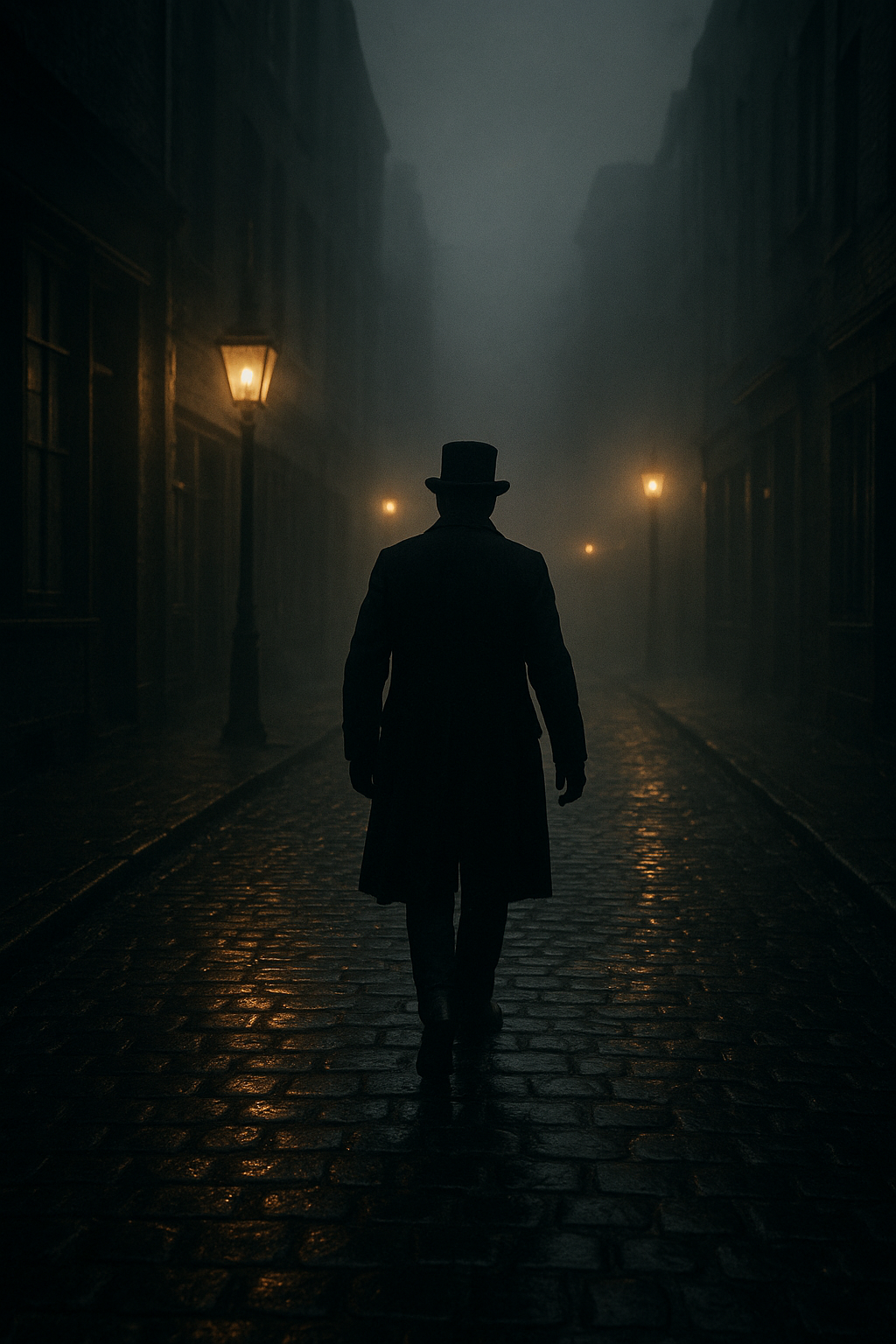
By the time panic fully set in, the district was already a place of narrow lanes, weak gaslight, and crowds dense enough to swallow a stranger. The killer did not need supernatural powers to vanish. He needed darkness, nerve, and a city where people could hear something terrible only a few yards away and still have no idea who had done it.
When the murders began to form a pattern
The first of the so-called canonical victims was Mary Ann Nichols, known as Polly. On August 31, 1888, she was found in Buck’s Row with her throat cut and her body mutilated. The crime was shocking, but London had seen violence before. What police could not know yet was whether they were looking at an isolated atrocity or the beginning of something much worse.
Just over a week later, on September 8, Annie Chapman was found in the yard behind 29 Hanbury Street. Her injuries were even more severe. The scene suggested not only ferocity, but confidence. Whoever had done this had operated in a cramped residential space, close to sleeping neighbors, and still escaped before anyone stopped him.
Then came September 30, the date that fixed the case in public imagination. Elizabeth Stride was discovered in Dutfield’s Yard with her throat cut. Because her body lacked the same mutilations seen in other killings, many investigators and later writers believed the killer may have been interrupted. Less than an hour later, Catherine Eddowes was found in Mitre Square, murdered and mutilated in a way that made the possibility even more chilling. If the same man committed both crimes, he had been disrupted once, moved across the city while alarms were rising, and killed again anyway.
The final canonical victim, Mary Jane Kelly, was found on November 9 inside her room at Miller’s Court. Her murder was the most horrific of all. Indoors, with privacy and time, the killer left behind a scene so devastating that it permanently deepened the mythology around the case. By then, Whitechapel was no longer only afraid. It was consumed.
Timeline of the Whitechapel murders
- August 31, 1888: Mary Ann Nichols is found murdered in Buck’s Row.
- September 8, 1888: Annie Chapman is killed at Hanbury Street.
- September 30, 1888: Elizabeth Stride is found in Dutfield’s Yard, followed less than an hour later by the murder of Catherine Eddowes in Mitre Square.
- November 9, 1888: Mary Jane Kelly is murdered in her room at Miller’s Court.
- Autumn 1888 onward: Police face intense pressure, witness reports conflict, and letters claiming to be from the killer help fix the name “Jack the Ripper” in the public mind.
How panic turned a killer into a permanent figure
Cases become legends when fear outruns evidence. That happened fast in Whitechapel. Newspapers seized on every detail they could print and every rumor they could stretch. Witness reports multiplied. So did theories. The killer was said to be a doctor, a butcher, a sailor, a foreigner, a gentleman, a madman. With every new speculation, the real man seemed to recede further into the fog.
Letters sent to police and newspapers made the effect even worse. One of them carried the signature that would survive the century: Jack the Ripper. Historians still debate whether the real killer wrote any of the famous letters, but by that point the question had almost become secondary. The name gave the public a villain they could imagine. It also gave the press a brand powerful enough to eclipse the fragile, uncertain reality of the investigation itself.
That is one reason the case remains so magnetic. Jack the Ripper is not only an unsolved murder story. It is one of the earliest modern examples of a criminal becoming larger than the file. If later cases like the Zodiac Killer were shaped by taunting messages and public obsession, Whitechapel shows the prototype: a murderer whose identity dissolved while his legend sharpened.
What doesn’t add up in the case
- The witness problem: Whitechapel was crowded, but crowded does not mean clear. Too many people saw fragments, and those fragments rarely aligned in a useful way.
- The skill debate: For generations, people have argued over whether the injuries suggested medical knowledge. That question has never produced real consensus.
- The suspect flood: The list of proposed suspects became so large that it often created more heat than light.
- The letters: They helped shape the legend, but they also buried the case under layers of possible hoaxing and attention-seeking.
- The limits of 1888 policing: Detectives were trying to solve a case with far fewer forensic tools, inconsistent record-keeping, and enormous public pressure.
Why the evidence kept slipping away
Modern readers often approach the Jack the Ripper case expecting one hidden clue that should have solved everything. But the deeper truth is more frustrating. The investigation was working inside the limits of its time. There was no DNA profiling, no modern surveillance, no integrated databases, and no reliable way to separate dozens of emotional claims from the few details that mattered. Investigators were not only chasing a killer. They were chasing the conditions of a city that kept swallowing certainty.
That is why the case belongs beside other famous unresolved investigations like The Black Dahlia Murder, where notoriety made the story bigger, but not necessarily clearer. Public fascination can preserve a case, but it can also distort it. In Whitechapel, that distortion started almost immediately.
Even the victim count became a battleground. The canonical five are the names most often attached to the Ripper story, but debates over linked or unlinked murders have never truly stopped. That uncertainty keeps the case alive, yet it also makes the historical ground unstable. Each new theory promises to cut through the haze. None has ended the argument.
The women behind the mythology
One of the bleakest features of the Jack the Ripper story is how often the women disappear behind the nickname. The murders became famous so quickly that the victims were at risk of being turned into scenery for someone else’s legend. But the case lands differently when you slow down and remember what Whitechapel actually was: a district full of women trying to survive one more night under conditions most of polite society only acknowledged after blood forced the issue.
Mary Ann Nichols, Annie Chapman, Elizabeth Stride, Catherine Eddowes, and Mary Jane Kelly were not symbols when they were alive. They were poor, vulnerable human beings moving through a brutal environment that left them exposed to men with bad intentions and left them little protection when danger arrived. The Ripper myth survives because the identity question was never answered. The emotional weight survives because the human cost was real from the first morning onward.
That is also why readers who fall into this case often keep moving through the broader archive of murders that were amplified by panic, class anxiety, and media spectacle. Some end up in clearly modern stories such as the Toolbox Killers case, where horror was preserved in evidence almost too unbearable to describe. Others stay in the unsolved lane, circling cases that remain open because proof never caught up to fear.
Why Jack the Ripper still gets attention
Some mysteries stay alive because new evidence keeps arriving. Jack the Ripper survives for the opposite reason. The silence at the center of the case never broke. There is no final confession everyone accepts, no courtroom ending, no official answer strong enough to end the argument. Instead there is a city, a season, five murdered women, and a suspect list that keeps mutating with every generation.
There is also the setting. Whitechapel in 1888 feels cinematic in a way few historical crimes do: gaslight, alleys, police whistles, packed lodging houses, newspaper sellers shouting headlines into the morning. It is easy to see why the case still pulls people in. But the strongest reason it lasts is simpler. It represents the terrifying possibility that a killer can become famous without ever being truly known.
If that unresolved feeling is what keeps you reading, broader collections like Unsolved True Crime Cases That Still Have No Answers show how often the same pattern returns: limited evidence, too many theories, and one missing certainty that keeps the whole case half-open forever.
FAQ
What happened to Jack the Ripper’s victims?
The murders most commonly linked to Jack the Ripper are the deaths of Mary Ann Nichols, Annie Chapman, Elizabeth Stride, Catherine Eddowes, and Mary Jane Kelly in Whitechapel in 1888. All were killed during a period of intense fear and public attention in London’s East End.
Was Jack the Ripper ever identified?
No. Many suspects have been proposed over the years, but no theory has produced a final answer accepted by historians, investigators, and the public at the same time. That unresolved identity is a major reason the case still endures.
Why is Jack the Ripper still unsolved?
The case was investigated with the limited forensic tools of 1888, under enormous public pressure, with conflicting witness statements and a flood of rumor. Over time, missing certainty hardened into permanent doubt.
Who were the canonical five victims?
The canonical five are Mary Ann Nichols, Annie Chapman, Elizabeth Stride, Catherine Eddowes, and Mary Jane Kelly. They are the victims most widely grouped together in the standard historical version of the Jack the Ripper case.
Why does the Jack the Ripper case still get attention?
It combines brutal murders, a vivid historical setting, a famous nickname, and no definitive solution. The case also sits at the crossroads of media sensationalism, class anxiety, and the early making of a criminal legend.
Continue exploring:
- Enter the serial killer archive that shows how ordinary men learned to hide in plain sight
- Step into Hollywood’s most haunting unsolved murder
- Follow the letter-writing killer who turned silence into terror
- Read the case where one recording still horrifies investigators
More True Crime stories:
Watch This Story on YouTube
Prefer to watch? See the full story on our YouTube channel.