The Lauren Spierer disappearance is one of the most well-known unsolved disappearance cases in the United States, centered around a college student who vanished after a night out in Bloomington, Indiana. This timeline breakdown explores her final known movements, the key evidence, and what investigators believe may have happened.
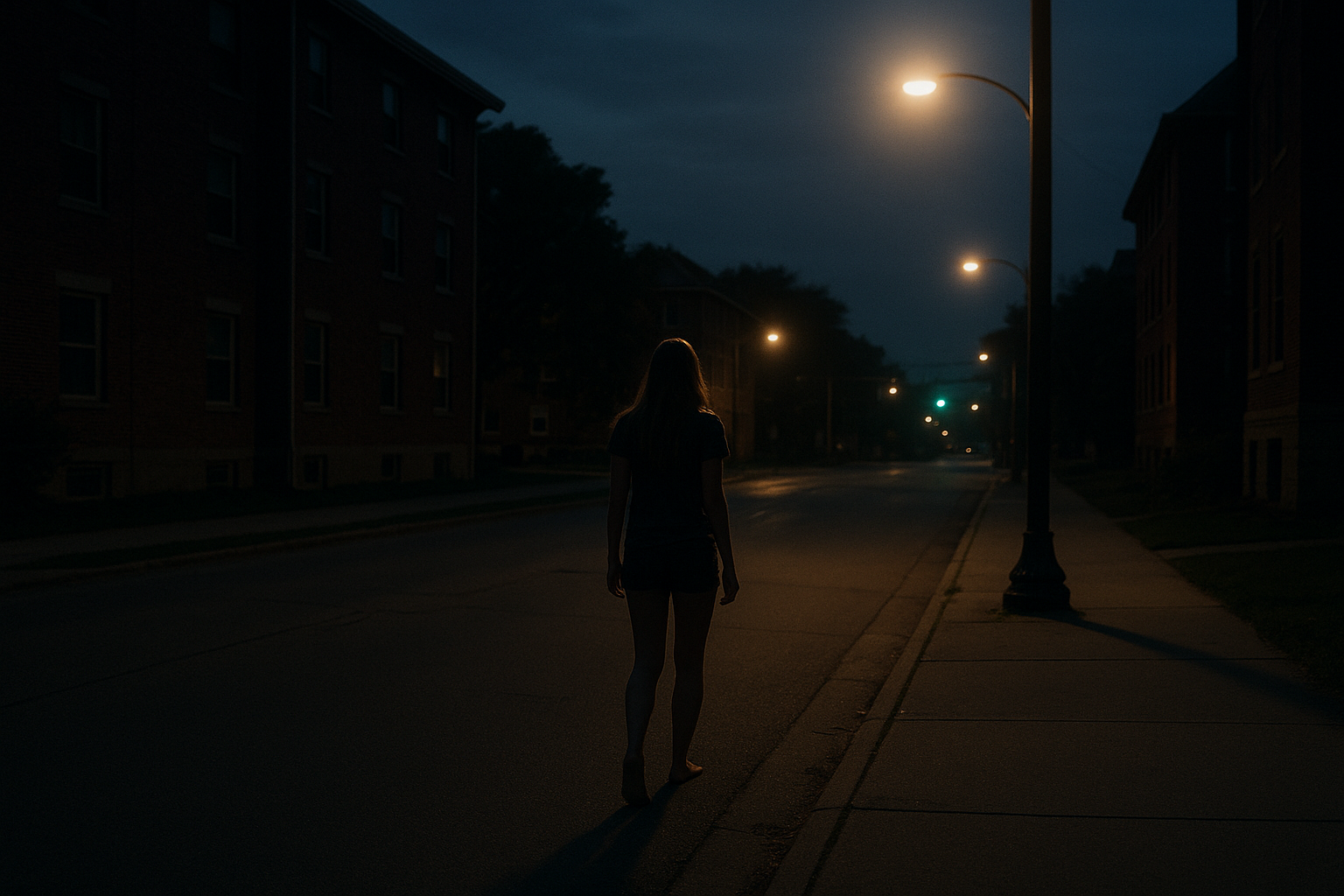
By the time the sun was getting ready to come up over Bloomington, the streets near Indiana University had gone from loud to hollow. Music had faded behind apartment walls. The last groups were drifting home. The bars were closing. And somewhere in that thin, strange hour when a college town seems half asleep and half feral, Lauren Spierer was walking barefoot through the dark.
She was twenty years old. She was tiny, clearly intoxicated, missing her phone, missing her shoes, and only a few blocks from the apartment where she should have been safe.
Then she vanished.
The Lauren Spierer disappearance is one of the most discussed unsolved disappearances of the last two decades, a haunting missing person case centered on a college student who disappeared after a night out in Bloomington, Indiana. More than a decade later, the mystery of Lauren Spierer still turns on a narrow timeline, missing hours, and the uncomfortable possibility that somebody close to the last known movements knows far more than they ever said.
To understand why this case still grips people, you have to picture how ordinary the setting looked from the outside. Bloomington was not some isolated back road or deep wilderness. This was a lively college town. Lauren lived at Smallwood Plaza, a student apartment building right in the middle of everything. Her world that night was measured in short walks: bar to apartment, apartment to friend, friend to another corner. Nothing about the map screamed danger. If anything, it looked like the kind of place where somebody could disappear for only a few minutes before turning up again.
But that is exactly what makes the case so unnerving. Lauren did not vanish crossing a desert or driving alone through the mountains. She disappeared in a tight, well-populated area filled with students, cameras, apartments, and people who were awake. Cases like that tend to linger, the same way stories like those collected in this roundup of unsolved disappearances that still have no answers linger, because they make modern life feel a lot less solid than we want it to feel.
Lauren Spierer was an Indiana University student from Scarsdale, New York. Friends described her as social, energetic, and well known in her circle. On the night she disappeared, she had been out drinking with friends in downtown Bloomington. What investigators later pieced together was not a giant, dramatic chase across the city. It was a shrinking corridor of movement. Her last known hours collapsed into a handful of blocks and a few key people.
Just after midnight on June 3, 2011, Lauren left her apartment and moved through the night the way thousands of students do in college towns every weekend. She ended up at Kilroy’s Sports Bar, a place packed with noise, alcohol, and the kind of bad decisions that often feel harmless until the next morning. Surveillance footage placed her entering the bar. Later, more footage showed her leaving it. By then she was heavily intoxicated.
That matters, not because it makes her responsible for what happened, but because it shapes every terrifying decision point that followed. An intoxicated person cannot properly judge risk. She may trust the wrong person. She may insist she is fine when she is not. She may wander instead of asking for help. And if something bad happens, the chaos of that condition gives everyone around her room to claim confusion later.
After leaving the bar, Lauren was seen with Corey Rossman. She had reportedly left behind her phone and shoes. Think about that for a second. A college student on foot in the middle of the night, without the two things most people use to stay oriented and connected. No phone to call for help. No shoes to steady herself. No clean line back to safety. Already, the case had started to tilt away from normal.
She made it back toward Smallwood Plaza, where a passerby noticed how impaired she looked and asked if she was okay. That moment has always felt chilling. It suggests that even to someone who barely knew her, Lauren stood out as vulnerable. She was seen, visibly struggling, and yet still somehow kept moving deeper into a night that was becoming more dangerous by the minute.
From there, the timeline gets tighter and stranger. Lauren and Rossman were seen heading toward Rossman’s apartment, which was only a short distance away. Somewhere along that path, Lauren’s keys and purse were later found in an alley. That detail has never sat comfortably. People do lose things when they are drunk, yes. But a purse and keys left along the route also create the feeling of a person coming apart in pieces, leaving behind little signs that she was no longer in control of the night.
At Rossman’s apartment, another roommate, Michael Beth, later said Rossman was so intoxicated he had to be put to bed. Beth said he wanted Lauren to stay there rather than wander off alone. According to his account, Lauren wanted to return to her own apartment. If true, that decision fits the logic of intoxication perfectly: close enough to home to think the risk is manageable, impaired enough not to realize how quickly a short walk can turn into disaster.
Instead of making it home, Lauren wound up at the nearby apartment of Jay Rosenbaum. There, according to his account, she made calls from his phone to two friends because she no longer had her own. Neither answered. That detail is small, but it is one of the saddest in the entire case. Imagine being disoriented, without your phone, without your belongings, bruised, barefoot, and trying to reach people who do not pick up because they have no reason to think history is pressing its thumb down on that moment.
Rosenbaum later said he last saw Lauren around 4:30 in the morning, walking south near the intersection of 11th Street and College Avenue. Barefoot. White top. Black leggings. Alone. After that, there is no confirmed sighting that truly closes the gap. No camera footage of her reaching home. No verified image of her getting into a car. No proof she crossed paths with a stranger. Just a stop at the edge of the timeline and a drop into empty space.
Timeline of Events
- 12:30 a.m. Lauren leaves her apartment area and begins moving through Bloomington with friends.
- 1:46 a.m. Surveillance captures her entering Kilroy’s Sports Bar.
- 2:27 a.m. She leaves Kilroy’s with Corey Rossman, having left behind her phone and shoes.
- 2:30 a.m. She is seen near Smallwood Plaza, visibly intoxicated.
- 2:48–2:51 a.m. Cameras capture her moving through an alley; later, her purse and keys are found along that route.
- Shortly after 3:00 a.m. She is at Corey Rossman’s apartment; accounts say Rossman is incapacitated and Lauren does not stay there.
- Around 3:30 a.m. She is at Jay Rosenbaum’s apartment and uses his phone to call friends.
- About 4:30 a.m. Rosenbaum says Lauren leaves on foot. This is the last reported sighting.
What Doesn’t Add Up
- Lauren disappeared within a very small, highly populated area without a confirmed final sighting.
- Multiple people saw her condition that night, yet no clear account explains her final movements.
- No surveillance footage shows her reaching home or encountering a stranger.
- Key hours in the timeline remain dependent on personal accounts rather than verified evidence.
The timeline matters because it is not broad. It is claustrophobic. In roughly three hours, Lauren moved through a small zone, intersected with several known people, and then vanished before daylight. That makes random chance feel less satisfying as an explanation. The smaller the corridor, the harder it is to accept that nobody saw the critical moment.
And that is where the mystery starts tightening around the people who were last with her. Not necessarily because investigators proved what happened, but because this is one of those missing person cases where the final known timeline is crowded, yet the answer is absent. That gap is what keeps people circling the story year after year. Someone was around her. Someone saw her condition. Someone knew she was in trouble long before the public understood she might never come home.
Police worked the case aggressively. Surveillance footage was collected. Friends were interviewed. Search efforts expanded. Investigators received thousands of tips over the years. The FBI offered a reward. At one point, police even searched a landfill, a detail so bleak it is hard to read without feeling sick. Because a landfill search tells you what investigators feared early on: that this may not have been a simple wandering-off case, and that whatever happened may have been hidden fast.
That suspicion never turned into a public resolution. No body was found. No murder charge tied the disappearance to a specific person. No single theory ever locked into place hard enough to survive scrutiny. Instead, the case split into possibilities, each one terrible in its own way.
One possibility is that Lauren, deeply impaired and alone, encountered a stranger in those final minutes. On paper, that seems plausible. A young woman by herself at dawn is vulnerable, and stranger abductions do happen. But many people find that explanation incomplete because of the tight geography. This was not an unseen highway shoulder. This was a busy student area. If a stranger took her, it happened with extraordinary speed and almost perfect luck.
Another possibility is that Lauren made it into a private space with people who panicked after something went wrong. That theory has hovered over the case for years because it explains the silence differently. Not as ignorance, but as self-protection. Maybe there was an accident. Maybe there was violence. Maybe there was a delayed emergency and the wrong decision got made in a terrible moment. The problem is that suspicion is not proof. Police can pressure, question, and test stories, but without evidence, the case remains locked.
Then there is the darkest possibility of all: that multiple people know fragments of the truth, but no one person has ever cracked. Cases like this do not always stay unsolved because the mystery is too complex. Sometimes they stay unsolved because every witness sees just enough to be afraid, guilty, or uncertain, and that fractured silence becomes stronger than the investigation itself.
Lauren’s family has lived inside that silence since 2011. Her parents have pushed for answers year after year, refusing to let the case sink into the background noise of old headlines. And that persistence is part of why the story still matters. The case is not just a puzzle for strangers on the internet. It is an open wound for people who went to sleep expecting Lauren to come home and instead entered a nightmare that never fully ended.
There is something especially haunting about the fact that Lauren was so close to safety. If she had made it back to Smallwood Plaza and closed the door behind her, this story would likely not exist. That is what makes the case feel cinematic in the worst way. Not because it is sensational, but because the whole thing seems balanced on tiny decisions and tiny intervals: one more answered phone call, one friend insisting harder, one camera angle covering the missing gap, one honest account instead of a partial one. Any one of those might have changed everything.
Over the years, the disappearance has generated endless attention, documentaries, theories, and armchair reconstruction. Some of that attention has been helpful. Some of it has probably only deepened the fog. That happens in famous unsolved cases. Every repeated retelling creates the illusion that the answer must be sitting somewhere obvious, waiting to be picked up. But obvious is not the same thing as provable. Plenty of people may have instincts about what happened to Lauren Spierer. Very few of those instincts can survive the burden of evidence.
And still, the case refuses to let go of people. Maybe because Lauren is easy to picture. Maybe because college-town freedom is so familiar to millions of families. Maybe because the details are so brutally ordinary: a bar, a walk, a borrowed phone, a few blocks, then nothing. It is the kind of story that makes parents sick, students uneasy, and everyone else suddenly aware of how thin the line is between a messy night out and permanent disappearance.
That is why the mystery of Lauren Spierer has endured. It is not just that she vanished. It is that she vanished in public, in stages, in front of pieces of a system that should have caught her fall. Witnesses saw her. Cameras saw her. Friends interacted with her. Investigators built a framework around her final hours. And yet the essential fact remains missing: the moment the case changed from a bad night into a possible death.
Until that moment is explained, Lauren remains suspended in one of the cruelest categories there is. Not found. Not brought home. Not fully understood. Just held in that terrible space between what can be proven and what so many people suspect.
Maybe the answer lives in a memory somebody has been trying to outrun since 2011. Maybe it sits inside a lie that has been repeated so many times it now feels safer than the truth. Or maybe the final clue is still hidden in something investigators already touched but could not interpret at the time. Whatever the explanation, the passage of years has not made the disappearance less disturbing. It has made it worse. Every year Lauren stays missing is another year the timeline hardens, witnesses age, and the simplest human promise of all goes unfulfilled.
A young woman went out for the night and never came back.
And somewhere between the bar, the alley, the borrowed phone, and the last walk south through Bloomington, the world closed over her without making a sound.
🔎 If this story stayed with you, the author suggests these real cases next:
- The student who entered a crowded bar and somehow vanished without ever being seen leaving
- The snowy roadside mystery that turned one crashed car into years of questions
- The short walk that should have taken minutes but ended in total silence
Explore more Disappearances stories here: