Kristin Smart, a 19-year-old Cal Poly student, disappeared after an off-campus party in May 1996. Fellow students helped her toward the dorms. The last part of that walk became central to a murder prosecution that took decades to reach trial.
By sunrise, Kristin Smart was gone.
Kristin Smart’s disappearance and murder case became one of the most haunting missing person cases in California because it began with something painfully ordinary: a college student trying to get back to her dorm after a party. Even after a murder conviction years later, the case still matters because her body has never been recovered, and the long silence around her final walk exposed just how easily a crucial window can close.
For readers who have followed other campus vanishings like the Lauren Spierer disappearance, Kristin’s case hits a familiar nerve — a short distance, a late hour, a last known path that should have been simple, and a timeline that somehow opened into decades of uncertainty.
Kristin Denise Smart was finishing her first year at California Polytechnic State University in San Luis Obispo in May 1996. She was 19 years old, tall enough that people often remembered her instantly, and on Memorial Day weekend she went to an off-campus party near campus. She did not know many people there. That detail matters, because from the outside, the night had all the ingredients of something forgettable — student noise, alcohol, people drifting in and out, nobody imagining they were standing inside the opening scene of one of California’s most infamous disappearances.
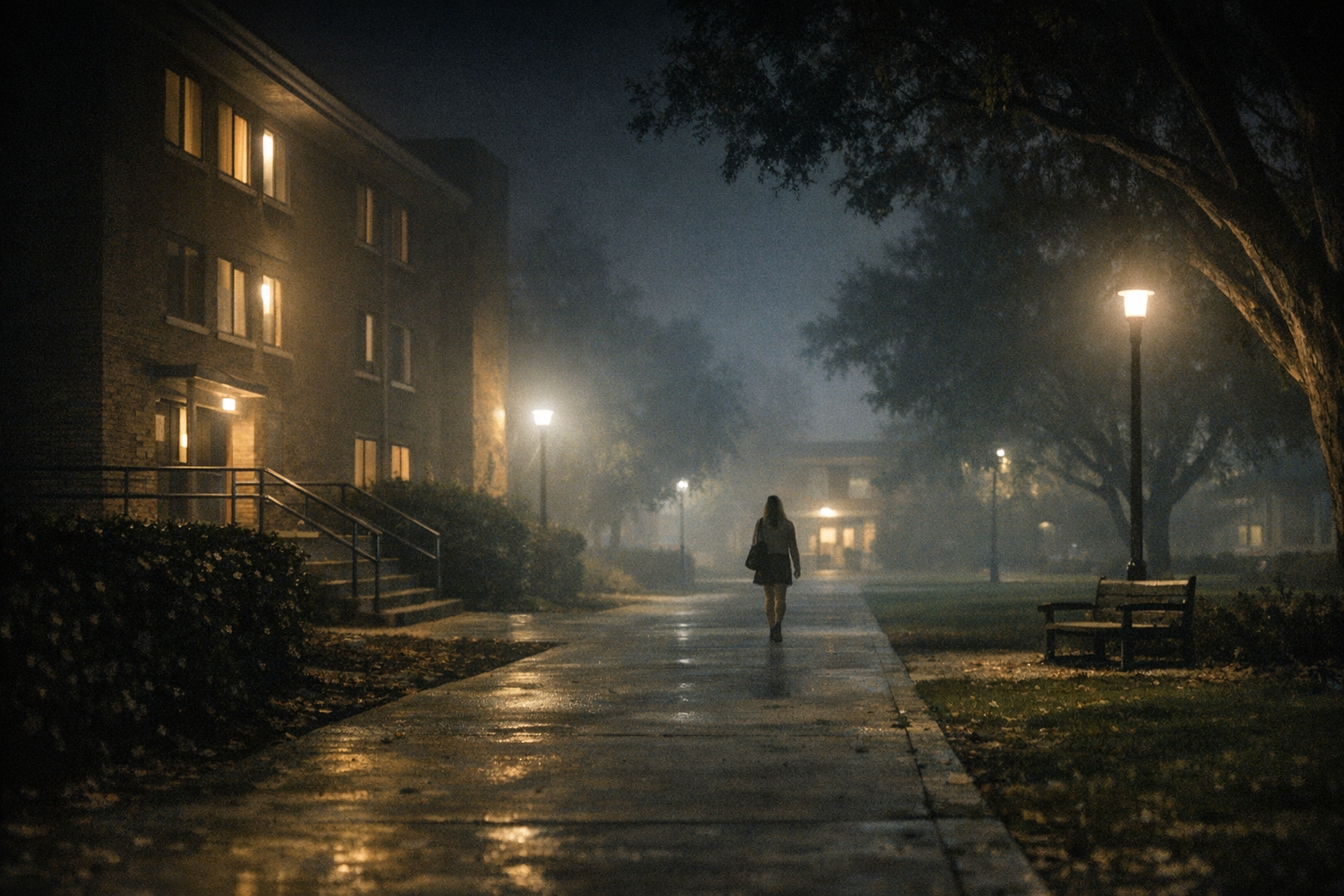
As the night wore on, Kristin became heavily intoxicated. Sometime around 2 a.m. on May 25, two fellow students, Cheryl Anderson and Tim Davis, found her on a lawn near the party. She was struggling. They helped her up and started walking her back toward the dorms. Along the way, another student joined them: Paul Flores.
The walk home became the critical sequence in the case. The appellate court’s account describes Smart needing physical support as the students returned toward their dormitories.
Tim Davis left the group when they reached his dormitory. Cheryl Anderson kept walking with Kristin and Flores until they reached the point where their routes separated. Flores reportedly told Anderson he would get Kristin back safely because his dorm was closest. That moment has echoed for years because it sits at the center of the case like a door quietly closing.
According to Flores, he walked Kristin only part of the way and then watched her continue alone toward Muir Hall, her dorm. If that version were true, Kristin should have made it back within minutes. But she did not show up in her room. She did not call home. She did not surface the next day with some harmless explanation. Instead, the trail seemed to stop in the short space between the place where others left her and the place she never reached.
Timeline of Events
- Evening of May 24, 1996: Kristin attends an off-campus party near Cal Poly during Memorial Day weekend.
- About 2:00 a.m., May 25: She is found incapacitated on a lawn and is helped away from the party by other students.
- Shortly after: Tim Davis leaves at his dormitory; Cheryl Anderson later leaves after making Flores promise to take Kristin safely to her room.
- Last known stretch: Flores later says he watched Kristin continue toward her dorm on her own.
- Following days: Kristin is not immediately treated like a high-risk missing student case, and precious time slips away.
- 2002: She is declared legally dead.
- 2021: Paul Flores and his father Ruben Flores are arrested after renewed investigative work.
- 2022: Paul Flores is convicted of Kristin Smart’s murder; Ruben Flores is acquitted of being an accessory after the fact.
- 2023: Paul Flores is sentenced to 25 years to life in prison.
- January 2026: California’s Supreme Court denies his petition for review.
- May 2026: A further search at Susan Flores’s property ends without finding Kristin’s remains.
What made the case so unbearable was not only that Kristin vanished. It was that the first response to her disappearance now looks painfully inadequate. In the early days, campus police reportedly treated the situation with far less urgency than it deserved. There was no immediate lockdown of the timeline, no instant recognition that a young woman had disappeared in a narrow window after being seen vulnerable and unable to care for herself.
That delay mattered. In disappearance cases, the first hours are oxygen. They are when memories are freshest, paths are still warm, and mistakes can still be corrected. In Kristin Smart’s case, those hours drained away while her family was left trying to make people understand that this was not normal behavior for her. She had not simply gone off for the weekend. She had not quietly chosen to disappear. Something had interrupted the rest of her life before it could even begin.
Suspicion focused on Paul Flores over many years. A murder conviction finally followed in 2022, after renewed investigative work and additional witnesses.
Years passed. Search teams went out. Tips came in. Rumors multiplied. Kristin’s family kept pushing. Billboards stayed up. The case never really left California’s memory, but it also never moved the way a grieving family needs a case to move. It hung there — unresolved, publicly known, privately devastating.
And then the story took on a second life. It became not just a disappearance, but a case study in what happens when a long-buried pattern finally starts to crack. Renewed public attention, including deep independent coverage and years of pressure, dragged old details back into the light. Investigators returned to physical evidence. Search warrants followed. Ground-penetrating radar and cadaver-dog work added weight to a possibility people had feared for decades: that Kristin had not simply been lost, and that her remains may have been moved.
🔎 Related Investigation:
🔎 Related Investigation:
If this case pulled you deeper into the mystery, continue into:
🔎 Related Investigation:
If this case pulled you deeper into the mystery, continue into:
What Doesn’t Add Up
- The distance was tiny. Kristin was not crossing a city or starting a road trip. She was on the last leg of a walk to her dorm.
- She was visibly vulnerable. Multiple people saw that she needed help, which makes the idea of an uneventful solo arrival hard to accept.
- The timeline narrowed suspicion instead of widening it. Very few people were positioned inside that exact final window.
- The case carried a long atmosphere of silence. For years, the story felt less like a mystery without a suspect and more like a truth that remained socially unspoken.
- Her remains have never been found. Even after conviction, the missing-body reality keeps the case emotionally unfinished.
Prosecutors argued that Kristin’s body had been buried beneath Ruben Flores’s deck and later moved. The appellate opinion discusses disturbed soil and tests consistent with human blood and decomposition; that evidence did not identify recovered remains as Kristin’s. Ruben was acquitted of the accessory charge.
That is why the eventual breakthrough mattered so much. When Paul Flores was arrested in 2021 and later convicted in 2022, the case finally crossed a line that many families in long-running disappearances never get to cross at all. The justice system said, in effect, that Kristin Smart had been murdered. It did not restore her. It did not answer every question. But it punctured the old fog.
Even so, the conviction did not erase the most haunting part of the story. Kristin is still missing.
That absence changes the emotional logic of everything. In many solved-years-later cases, the final chapter comes when a body is found, a confession is made, or a physical location gives the family somewhere to place the grief. Here, there is still an open wound at the center. The legal answer arrived before the human one. Her family got a verdict, but not a grave. That is part of why Kristin’s story naturally belongs beside cases in Disappearances Solved Years Later: the breakthrough mattered, but it did not close the ache.
The case also reshaped campus safety policy in California. That part can get buried beneath the courtroom headlines, but it should not. Kristin Smart’s disappearance helped drive the Kristin Smart Campus Safety Act of 1998, which required designated campuses to make written agreements with local law enforcement assigning responsibility for specified violent-crime investigations. In other words, the silence after her walk home became part of a larger warning. Future disappearances should not be allowed to drift in bureaucratic limbo while the most important hours vanish too.
There is something especially brutal about how ordinary the opening scene was. No abandoned car in the desert. No cryptic phone call from a highway shoulder. No surveillance clip showing a person entering the final frame. Just a college night, a short route back to a dorm, and a vulnerable student being left with the wrong person at the wrong time. That simplicity is what makes the case so hard to forget. The setting was familiar enough to lower everyone’s guard.
And then there is the social silence. Not silence in the literal sense — people talked, rumors spread, suspicions formed — but the kind of silence that comes when a community lives beside a likely truth without forcing it fully into the open. Kristin Smart’s story has long carried that feeling. For years, it seemed like the answer was not floating somewhere far away. It was sitting nearby, half-buried under time, fear, denial, and the slow grind of a case that could not quite break free.
That is why the final walk home remains the emotional anchor of the entire case. It was not just the last path Kristin took. It was the last moment when intervention still looked easy. If one more person had stayed. If one more question had been asked. If the first response had been sharper. If the early warning signs had been treated as emergency instead of ambiguity. This case is full of the kind of “if” that keeps families awake for decades.
Why This Case Still Gets Attention
- It began on a college campus, which makes the fear instantly relatable to students, parents, and anyone who remembers how fragile those late-night routines can be.
- It became a solved-years-later story without full recovery, so it still carries both the tension of a true-crime breakthrough and the pain of an unfinished disappearance.
- The case exposed institutional failure, especially in the early response to a vulnerable missing student.
- It never stopped feeling local and national at the same time. For San Luis Obispo, it was deeply personal. For the wider public, it became a symbol of delayed justice.
Today, when people ask what happened to Kristin Smart, they are usually asking two questions at once. The first is the literal one: what happened during those final minutes after she was left in Paul Flores’s company? The second is broader and harder: how did it take so long for the case to break in a way the public could plainly see?
The answer to the first question is constrained by what was lost with time, concealment, and the fact that Kristin’s remains have never been recovered. The answer to the second is more visible. Cases like this stay alive because families refuse to stop, because public memory can outlast official inertia, and because buried patterns sometimes do rise — slowly, painfully, and never in a way that feels like enough.
Kristin Smart should have made it back to her dorm in a matter of minutes. Instead, that short walk became a 26-year divide between suspicion and conviction. And that is what still makes the case hit so hard. Not just that she vanished, but that the space between last seen and a murder conviction was allowed to stretch across an entire generation.
For her family, the story is not really about headlines, podcasts, or even the courtroom ending people remember most. It is about a daughter who left a party and never got to finish the simplest trip in the world. Everything that followed — the searches, the whispers, the legal fight, the excavation, the verdict — came after that single break in the ordinary.
And maybe that is why Kristin Smart’s case still lingers so heavily. Because the walk home should have been the safest part.
🔎 Related Investigation:
Research Sources
The following resources were consulted to verify and update this article.
- California Court of Appeal — People v. Flores, October 24, 2025
Reviews the trial evidence and affirms Flores’s conviction. - San Luis Obispo County District Attorney — Paul Flores’s petition for review denied by California Supreme Court
Documents the January 2026 denial of review and prior sentencing. - San Luis Obispo County District Attorney — Paul Flores convicted of Kristin Smart’s murder
Records the October 2022 jury verdict and Ruben Flores’s acquittal. - California Legislative Analyst’s Office — Kristin Smart Campus Safety Act of 1998
Explains the law’s name and campus/local policing agreements. - Associated Press — Kristin Smart’s remains not found in search of California home, authorities say
Reports the conclusion of the May 2026 search without recovery.
🔎 If this story stayed with you, the author suggests these real cases next:
- The college night that became Lauren Spierer’s final known timeline
- The missing child case that changed how America looked at disappearances
- The disappearance cases that only broke open years later
Explore more Disappearances stories here: